When she was migrated to VOIP, she explained to the Openreach engineer
that she wanted to be able to use both phones so she could make and
answer calls either using one of the DECT handsets or using the corded phone.
But she has noticed several times that when she is on the phone (eg to
me) using the DECT, the landline rings with another call - which she can answer while keeping the call open to me on the DECT phone.
Could it be that the router has two analogue BT sockets, with the DECT
in one and the corded in the other
with software doing a divert-on-busy
from the DECT phone to the corded phone?
I was expecting one BT socket
on the router to go to a two-way splitter so both DECT and analogue are identical and don't ring or allow outgoing calls independently of each other.
Her main concern is that she may be being charged twice for two VOIP landlines (with the same number) if they feed different phones.
Curiouser and curiouser. As far as I am aware POTS has been turned offCould it be that the router has two analogue BT sockets, with the DECT
in one and the corded in the other
More likely the router has a built-in DECT base that the handset speak
to, and the corded phone is in the POTS port.
On 20/10/2026 20:46, Andy Burns wrote:
Curiouser and curiouser. As far as I am aware POTS has been turned off on the old copper pair. But... the photo she's sent me shows just one "Phone" socket with a BT socket, as well as all the RJ45 for 4x LAN Ethernet andCould it be that the router has two analogue BT sockets, with the DECT
in one and the corded in the other
More likely the router has a built-in DECT base that the handset speak
to, and the corded phone is in the POTS port.
for WAN connection to the fibre modem. And the DECT phone is the same one she's had all along, not a special one which speaks VOIP.
I will be intrigued to see how it's all connected when we next visit her - maybe at Christmas. Teamviewer is great for remote control of a PC and an Android phone, but it's no substitute for being able to follow a rats' next of cables and see where they go and what is plugged into what. Somewhere
she should have a UPS, provided as backup because she's classed as "vulnerable" on account of her age, but goodness knows where it is and what is plugged into it.
Does the analogue output of a router's VOIP interface (the "Phone" socket
on the router) have a ringer-equivalence number? Can it drive more than one phone via a splitter (eg DECT and corded phone in parallel)?
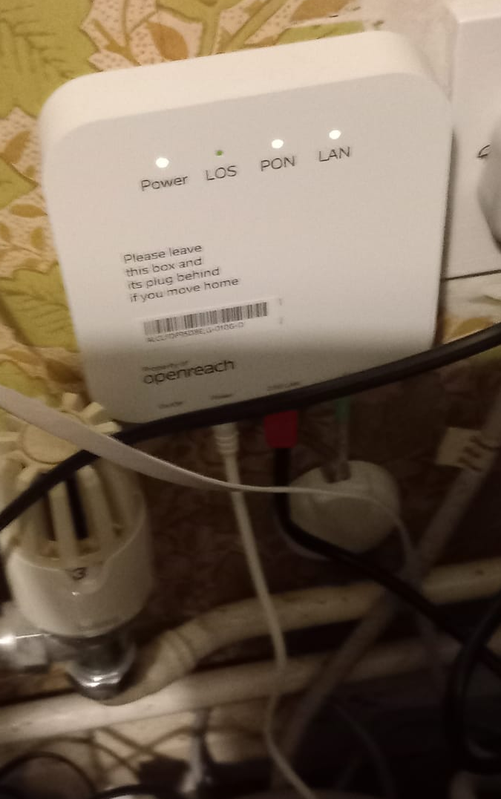
Do you ever get a VOIP output on the fibre modem (fibre termination unit), bypassing the router? Because her photo of the FTU has *three* cables going into it: power, Cat 5 probably to the router, and a third cable with a
small white inline box. Could that box have one of the two phones plugged into it?
https://i.postimg.cc/VsDJ6gp7/Image1.png
White is power
Red plug on black cable is WAN to router (WAN socket on router has same red plug/black cable)
Third lead to small white box - could that be a WAN-to-analogue VOIP interface? Shame the black cable obscures the writing on the FTU for that socket, though everything has camera-shake...
On 20/10/2026 20:46, Andy Burns wrote:
Curiouser and curiouser. As far as I am aware POTS has been turned offCould it be that the router has two analogue BT sockets, with the
DECT in one and the corded in the other
More likely the router has a built-in DECT base that the handset speak
to, and the corded phone is in the POTS port.
on the old copper pair. But... the photo she's sent me shows just one "Phone" socket with a BT socket, as well as all the RJ45 for 4x LAN
Ethernet and for WAN connection to the fibre modem. And the DECT phone
is the same one she's had all along, not a special one which speaks VOIP.
I will be intrigued to see how it's all connected when we next visit her
- maybe at Christmas. Teamviewer is great for remote control of a PC and
an Android phone, but it's no substitute for being able to follow a
rats' next of cables and see where they go and what is plugged into
what.
classed as "vulnerable" on account of her age, but goodness knows whereThey just provide a battery. Perhaps that is why they linked the DECT to
it is and what is plugged into it.
Does the analogue output of a router's VOIP interface (the "Phone"
socket on the router) have a ringer-equivalence number? Can it drive
more than one phone via a splitter (eg DECT and corded phone in parallel)?
Do you ever get a VOIP output on the fibre modem (fibre termination
unit), bypassing the router? Because her photo of the FTU has *three*
cables going into it: power, Cat 5 probably to the router, and a third
cable with a small white inline box. Could that box have one of the two phones plugged into it?
https://i.postimg.cc/VsDJ6gp7/Image1.png
White is power
Red plug on black cable is WAN to router (WAN socket on router has same
red plug/black cable)
Third lead to small white box - could that be a WAN-to-analogue VOIP interface? Shame the black cable obscures the writing on the FTU for
that socket, though everything has camera-shake...
On 20/10/2026 21:35, NY wrote:
On 20/10/2026 20:46, Andy Burns wrote:
Curiouser and curiouser. As far as I am aware POTS has been turnedCould it be that the router has two analogue BT sockets, with the
DECT in one and the corded in the other
More likely the router has a built-in DECT base that the handset
speak to, and the corded phone is in the POTS port.
off on the old copper pair. But... the photo she's sent me shows just
one "Phone" socket with a BT socket, as well as all the RJ45 for 4x
LAN Ethernet and for WAN connection to the fibre modem. And the DECT
phone is the same one she's had all along, not a special one which
speaks VOIP.
The DECT does not need to be special. The EE hub will act as a DECT
base station and talk to any GAP compatible DECT handset.
I will be intrigued to see how it's all connected when we next visit
her - maybe at Christmas. Teamviewer is great for remote control of a
PC and an Android phone, but it's no substitute for being able to
follow a rats' next of cables and see where they go and what is
plugged into what.
If the BT line is disconnected they may have left the DECT base
station plugged into it but not in use.
Somewhere she should have a UPS, provided as backup because she's
classed as "vulnerable" on account of her age, but goodness knowsThey just provide a battery. Perhaps that is why they linked the DECT
where it is and what is plugged into it.
to the EE router. You then don't need to put battery backup on the
original DECT base.
Does the analogue output of a router's VOIP interface (the "Phone"
socket on the router) have a ringer-equivalence number? Can it drive
more than one phone via a splitter (eg DECT and corded phone in
parallel)?
RENs are pretty irrelevant on modern phone systems. Most modern phones
have a fractional REN so even if the box can in theory only drive 1
REN in practice it will drive multiple phones. If you have multiple
phones you can get a back-to-back patch cable to patch the router into
the house wiring.
Do you ever get a VOIP output on the fibre modem (fibre termination
unit), bypassing the router? Because her photo of the FTU has *three*
cables going into it: power, Cat 5 probably to the router, and a
third cable with a small white inline box. Could that box have one of
the two phones plugged into it?
The white cable is the Fibre. BT started with ONTs (not FTU) that had
phone sockets, but OFCOM said it was anticompetitive so they now all
use the router.
https://i.postimg.cc/VsDJ6gp7/Image1.png
White is power
Red plug on black cable is WAN to router (WAN socket on router has
same red plug/black cable)
Third lead to small white box - could that be a WAN-to-analogue VOIP
interface? Shame the black cable obscures the writing on the FTU for
that socket, though everything has camera-shake...
That is the Fibre.
info on ONTs here
https://www.ispreview.co.uk/index.php/2022/09/pictured-openreachs-future-2-5gbps-ont-for-fttp-broadband.html
(you may have to re-join URL)
Like I said above the EE router is a DECT base station.
Dave
The DECT does not need to be special. The EE hub will act as a DECT base station and talk to any GAP compatible DECT handset.
The white cable is the Fibre. BT started with ONTs (not FTU) that had
phone sockets, but OFCOM said it was anticompetitive so they now all use
the router.
info on ONTs here[]
https://www.ispreview.co.uk/index.php/2022/09/pictured-openreachs-future-2-5gbps-ont-for-fttp-broadband.html
(you may have to re-join URL)
Do you ever get a VOIP output on the fibre modem
| Sysop: | Amessyroom |
|---|---|
| Location: | Fayetteville, NC |
| Users: | 76 |
| Nodes: | 6 (0 / 6) |
| Uptime: | 58:09:47 |
| Calls: | 1,265 |
| Calls today: | 1 |
| Files: | 1,362 |
| D/L today: |
4 files (9,632K bytes) |
| Messages: | 285,955 |