On 02/04/2026 01:14, J. P. Gilliver wrote:
In that "digital signals" always, for most of about the last
fortysomething years, means "digital signals with error correction";
this is so often assumed as to be understood, but the omission of the
fact confuses newcomers to the subject (who are left wondering_why_ are
digital signals better - and/or more reliable - until this point is
explained. Which it often isn't).
Error correction allows you to get closer to the Shannon Hartley limit
for Gaussian noise, and can also cope with short dropouts, but I think
the key original benefit was that it could be regenerated almost
perfectly, whereas analogue would always accumulate noise and distortion.
On 05/04/2026 00:08, Richmond wrote:Mostly true, though I bet those doing the tests were mostly male, and
David Woolley <david@ex.djwhome.demon.invalid> writes:
On 02/04/2026 10:13, Richmond wrote:
So really the question is, with the right SIP/VOIP telephone equipment, >>>> and a VOIP to VOIP connection, can I achieve this full frequency?
There is no point in having the low frequencies; they don't contribute
to voice intelligibility
There is no point if all you want is to understand the speech, but it
does change the sound and make it more real and immediate, and I
appreciate that, I think it is worth doing, especially as we now have
band width coming out of our ears with fibre.
Low frequencies take up no bandwidth at all, really.
So many people talking through their backsides here.
Telephones have always been able to carry low frequencies but the old
carbon mics couldn't generate them and nor could the primitive earpieces reproduce them.
A long tome ago simple tests revealed that provided you could send 300Hz-3kHz adequately, speech was intelligible and clear.
People who have actually pursued audio engineering fir a living knowStill nice to have though, and as someone else has said they cost
that above 3kHz is just the hisses and clicks of the sound, and the fundamentals of voice do not go below 200Hz, That range is reserved for
bass (guitars) and drums, organs and the odd large woodwind.
Cassette recorders were very hard to get above 5kHz and many people
still think they were 'hifi'
I don't think many audiophiles in the era when cassettes were at their
height would consider them hifi, though 10 or even 15 kHz was
obtainable;
(FM radio didn't go much above 15 kHz, especially after stereo
came in and you had to have a cutoff
- most recoding engineers so called are total shit
Having finally got my studio monitors back working I am now in the sad position that when I went to hear a real live orchestra, I realised my
ears now have intermodulation distortion. :0-(
As others have said, you lose top with age anyway - I was startled to discover mine now rolls off below 8 kHz (I'm in my 60s), as I wasn't
aware of any loss (and I've never been into either loud discos, night
clubs etc., nor noisy work environments). I guess I've retained good sensitivity, just not frequency range.
- Vinyl is shit
On 05/04/2026 21:08, The Natural Philosopher wrote:
- Vinyl is shit
I marginally prefer vinyl sound to CD sound (*), where I have something
on both media for comparison, but this a *far* outweighed by the fact
that CDs have a lot more dynamic range because most LPs suffer very
badly from background noise (constant "sandpaper" noise, random dust
crackle and regular 33 times/second clicks from scratches etc) even
after very little playing. And many records have horrendous distortion
on some types of music: I was trying to copy some old LPs of Christmas carols for my father=in-law and the combination of church organ and choristers' voice was deeply unpleasant. That's probably due to dirt embedded in the grooves.
Given a choice between LP and cassette, I'd go for cassette every time because its background noise and its artefacts are less objectionable
than those for vinyl, even though the frequency response, dynamic range
and background hiss may be worse than for vinyl.
CDs are great for listening in a quiet environment (speakers/headphones
in a quiet living room) but don't fare as well in a noisy car where compression is needed so you aren't deafened on the loud parts while you
can still hear the quiet parts over the engine/road noise. But that's
not exclusively a shortcoming of CDs, because even FM radio can be more difficult to listen to than AM radio which I imagine is more compressed.
(*) Though I would never say that vinyl sound is more faithful: it is
its shortcomings that I prefer. CD players could benefit from a
switchable filter that introduces the shortcomings of the RIAA emphasis/de-emphasis process that vinyl involves.
On 05/04/2026 17:21, J. P. Gilliver wrote:
As others have said, you lose top with age anyway - I was startled to
discover mine now rolls off below 8 kHz (I'm in my 60s), as I wasn't
aware of any loss (and I've never been into either loud discos, night
clubs etc., nor noisy work environments). I guess I've retained good
sensitivity, just not frequency range.
You're lucky to get as high as 8 kHz. I'm 63 and when I last had my
hearing tested at around 60, it was fairly flat up to about 5 kHz and
fell after that - though the diagram I was given didn't label the Y axis
so I've no idea where the -3 dB point was - or even whether it was logarithmic or linear.
My hearing has started doing weird things - it seems to emphasis a
narrow band towards the upper end which makes reproduced sound (speakers
or headphones or earbuds) have a very scratchy sound on some speech, but
not on music. Live sound (someone speaking next to me) is fine. I've set
VLC player on my laptop (where I watch a lot of TV) to have a notch
around 3 kHz to avoid that.
On 05/04/2026 21:08, The Natural Philosopher wrote:
- Vinyl is shit
...many records have horrendous distortion
on some types of music: I was trying to copy some old LPs of Christmas
carols for my father=in-law and the combination of church organ and choristers' voice was deeply unpleasant. That's probably due to dirt embedded in the grooves.
(*) Though I would never say that vinyl sound is more faithful: it is
its shortcomings that I prefer. CD players could benefit from a
switchable filter that introduces the shortcomings of the RIAA emphasis/de-emphasis process that vinyl involves.
LPs suffer very badly from [...] regular 33 times/second clicks
NY wrote:
LPs suffer very badly from [...] regular 33 times/second clicks
Maybe you shouldn't play them at 1980 rpm!
If you have speech to text at one end, and text to speech at the other,
does it improve sound quality?
NY wrote:
LPs suffer very badly from [...] regular 33 times/second clicks
Maybe you shouldn't play them at 1980 rpm!
On 06/04/2026 10:59, Andy Burns wrote:
NY wrote:
LPs suffer very badly from [...] regular 33 times/second clicks
Maybe you shouldn't play them at 1980 rpm!
Ha-bloody-ha. I did of course mean 33 times/minute ;-)
Reminds me of fast tape duplication machines which play a master at many times normal speed (with corresponding pitch shift, needing much better head/amplifier design) and record the copies at that same high speed.
I wonder what VERA (BBC's attempt at making a video tape recorder)
looked like in action - the tape ran at "5.08 metres per second (16.7
ft/s)"
(https://en.wikipedia.org/wiki/Vision_Electronic_Recording_Apparatus)
which is 11 mph. I'm sure I've heard a speed of about 60 mph mentioned,
but that must be wrong...
On 06/04/2026 20:22, NY wrote:
I wonder what VERA (BBC's attempt at making a video tape recorder)
looked like in action - the tape ran at "5.08 metres per second (16.7
ft/s)"
(https://en.wikipedia.org/wiki/Vision_Electronic_Recording_Apparatus)
which is 11 mph. I'm sure I've heard a speed of about 60 mph mentioned,
but that must be wrong...
Short clip starting at bout 26 seconds in.
Scary....
https://www.facebook.com/watch/?v=363128574296809
On 06/04/2026 21:17, John Williamson wrote:
On 06/04/2026 20:22, NY wrote:
I wonder what VERA (BBC's attempt at making a video tape recorder)
looked like in action - the tape ran at "5.08 metres per second (16.7
ft/s)"
(https://en.wikipedia.org/wiki/Vision_Electronic_Recording_Apparatus)
which is 11 mph. I'm sure I've heard a speed of about 60 mph mentioned,
but that must be wrong...
Short clip starting at bout 26 seconds in.
Scary....
https://www.facebook.com/watch/?v=363128574296809
Ah, I'd forgotten that the famous Richard Dimbleby demo on Panorama
included shots of VERA in action. It's difficult to get a feeling for
how fast those reels are spinning. The friction between the tape and the head must warm things up nicely ;-)
Mind you, Quad spins the head at an incredible 15,000 rpm which is a
serious head-to-tape speed (1,500 ips or 38 metres/sec), though am I
right that the head does not quite touch the surface of the tape?
I don't know what speed the old steel strip recorder ran at; I do know
it had to be in a room by itself for safety reasons, because if the tape >snapped there was a sharp end scything around at a fair speed ... and of >course splicing was a welding job!
On 06/04/2026 20:22, NY wrote:
On 06/04/2026 10:59, Andy Burns wrote:
NY wrote:
LPs suffer very badly from [...] regular 33 times/second clicks
Maybe you shouldn't play them at 1980 rpm!
Ha-bloody-ha. I did of course mean 33 times/minute ;-)
Reminds me of fast tape duplication machines which play a master at
many times normal speed (with corresponding pitch shift, needing much
better head/amplifier design) and record the copies at that same high
speed.
I wonder what VERA (BBC's attempt at making a video tape recorder)
looked like in action - the tape ran at "5.08 metres per second (16.7
ft/s)"
(https://en.wikipedia.org/wiki/Vision_Electronic_Recording_Apparatus)
which is 11 mph. I'm sure I've heard a speed of about 60 mph mentioned,
but that must be wrong...
Short clip starting at bout 26 seconds in.
Scary....
https://www.facebook.com/watch/?v=363128574296809
J. P. Gilliver wrote:
I don't know what speed the old steel strip recorder ran at; I do know
it had to be in a room by itself for safety reasons, because if the tape
snapped there was a sharp end scything around at a fair speed ... and of
course splicing was a welding job!
In the late 60s, I was on a visit to the BBC regional radio
studio in Leeds, and the guy showing us round remembered using
metal tape recorders. He described them as having enormous reels,
and ran at high speed, with lots of zig-zag tension rollers to
cope with the inertia.
They once had a tape break on the take-up side, during a
broadcast. They had to spend the rest of the programme running
down the corridor trying to keep up with the tape as it continued
to spew forth.
Chris
On Mon, 06 Apr 2026 21:17:44 +0100, John Williamson wrote:[]
We were still using the trolleys - supported Tektronix 545 series andShort clip starting at bout 26 seconds in.
Scary....
https://www.facebook.com/watch/?v=363128574296809
Bloody old Cossor scope, used one of those in 1958
On 2026/4/7 9:22:43, jon wrote:
On Mon, 06 Apr 2026 21:17:44 +0100, John Williamson wrote:[]
Short clip starting at bout 26 seconds in.
Scary....
https://www.facebook.com/watch/?v=363128574296809
Bloody old Cossor scope, used one of those in 1958
We were still using the trolleys - supported Tektronix 545 series and
similar - in the '80s. (I think we had an old transistor curve tracer of
that family, which worked and was used infrequently enough that it
wasn't seen necessary to replace it. And one old two-beam 'scope with genuinely two timebases - not diddled between channels as was the later fashion, I think it had a two-neck tube; most disconcerting to observe
two traces sweeping at different speeds!)
I worked (as an apprentice) in the Marconi Instruments internal repair
and maintenance department back in the 1960s. A Tektronix 545 was a
very modern rarity there! :-) Our 'bread and butter' 'scopes were MI
TF1330 and TF1331 with the occasional TF2200 to make things more
exciting. I think there were still a few of the old Cossor 'scopes
around too.
On 2026/4/7 12:30:23, Chris Green wrote:
[]
I worked (as an apprentice) in the Marconi Instruments internal repair
and maintenance department back in the 1960s. A Tektronix 545 was a
very modern rarity there! :-) Our 'bread and butter' 'scopes were MI TF1330 and TF1331 with the occasional TF2200 to make things more
exciting. I think there were still a few of the old Cossor 'scopes
around too.
(I _was_ the test equipment department at Marconi Research Centre for
the brief period between it being given an excellent rating by an
external auditor and it being outsourced. [Beware: being highly-rated
does not protect you!])
IIRR, the 545 series was the first with plugins. Yes, plugins with
valves in!
(I _was_ the test equipment department at Marconi Research Centre for
the brief period between it being given an excellent rating by an
external auditor and it being outsourced. [Beware: being highly-rated
does not protect you!])
IIRR, the 545 series was the first with plugins. Yes, plugins with
valves in!
J. P. Gilliver <G6JPG@255soft.uk> wrote:
On 2026/4/7 9:22:43, jon wrote:
On Mon, 06 Apr 2026 21:17:44 +0100, John Williamson wrote:[]
Short clip starting at bout 26 seconds in.
Scary....
https://www.facebook.com/watch/?v=363128574296809
Bloody old Cossor scope, used one of those in 1958
We were still using the trolleys - supported Tektronix 545 series and similar - in the '80s. (I think we had an old transistor curve tracer of that family, which worked and was used infrequently enough that it
wasn't seen necessary to replace it. And one old two-beam 'scope with genuinely two timebases - not diddled between channels as was the later fashion, I think it had a two-neck tube; most disconcerting to observe
two traces sweeping at different speeds!)
I worked (as an apprentice) in the Marconi Instruments internal repair
and maintenance department back in the 1960s. A Tektronix 545 was a
very modern rarity there! :-) Our 'bread and butter' 'scopes were MI
TF1330 and TF1331 with the occasional TF2200 to make things more
exciting. I think there were still a few of the old Cossor 'scopes
around too.
On 2026/4/6 23:0:27, NY wrote:
On 06/04/2026 21:17, John Williamson wrote:
On 06/04/2026 20:22, NY wrote:
I wonder what VERA (BBC's attempt at making a video tape recorder)
looked like in action - the tape ran at "5.08 metres per second (16.7
ft/s)"
None of your metric ... it was 200 IPS. :-) [Yes, that _is_ 5.08 m/s.)
Quite why a round 200 rather than a binary multiple of the standard
speeds, which would have given 240, I don't know: probably it was sufficiently different that it made sense to use a new speed (and that
gave you slightly longer recording time - I think it might have been
half an hour a reel).
I remember reading somewhere that VERA used much of the mechanics - and
the reels - from the old steel-strip sound recorder the Beeb had. (But
with conventional plastic recording tape, as shown by Dimbleby, not
steel strip.)
I don't know what speed the old steel strip recorder ran at; I do know
it had to be in a room by itself for safety reasons, because if the tape snapped there was a sharp end scything around at a fair speed ... and of course splicing was a welding job!
Was [VERA] only system A ("405 line")?
I do remember seeing - on some magazine-type prog., like "Nationwide" or similar, so no technical details were given - of someone who'd used an ordinary domestic reel-to-reel transport (screwed to the top of his TV
set IIRR); last time I mentioned this here people mentioned one or two commercial products that basically did the same thing, but this was definitely a home enthusiast (just 7" reels, IIRR).
Mind you, Quad spins the head at an incredible 15,000 rpm which is a
serious head-to-tape speed (1,500 ips or 38 metres/sec), though am I
right that the head does not quite touch the surface of the tape?
Indeed; if it does, it is likely to kill the heads. Same with helical recorders - certainly the Philips reel-to-reel one I had, and I think
the home formats: a very thin film of air designed into the system.
That's why splicing (actually joining the tape) was so rarely done with
any format videotape - too much danger of the splice hitting the heads.
You can work out the head-to-tape speed of quad, roughly: if you know
how many passes per field (and you can see that from old quad material
that was recorded, or transferred, with slightly worn/maladjusted kit so there are fairly static spots in the video), multiplied by the field
rate and by two inches. (Slightly more than two as the tape was moving
so you get a slightly diagonal track, though the angle was a lot less
than with helical wraps.)
On 07/04/2026 02:48, J. P. Gilliver wrote:
On 2026/4/6 23:0:27, NY wrote:
On 06/04/2026 21:17, John Williamson wrote:
On 06/04/2026 20:22, NY wrote:
I wonder what VERA (BBC's attempt at making a video tape recorder)
looked like in action - the tape ran at "5.08 metres per second (16.7 >>>>> ft/s)"
None of your metric ... it was 200 IPS. :-) [Yes, that _is_ 5.08 m/s.)
Quite why a round 200 rather than a binary multiple of the standard
speeds, which would have given 240, I don't know: probably it was
sufficiently different that it made sense to use a new speed (and that
gave you slightly longer recording time - I think it might have been
half an hour a reel).
Numerical values of standards always intrigue me. Why 24 rather than 25 frames per second for sound film (and 16 or 18 for silent film, rather
than 15)? Persistence of vision gives the minimum frame rate that will "work" but why not divide a second into either a power of two or else
round to the nearest 5 fps? Why make floppy disks 5 1/4" and 3 1/2"
rather than 5", 6" or 3"? Why make a standard terminal have a width of
80 rather than 100 characters? Why did records run at 33 1/3, 45 and 78
rpm, rather than round numbers like 30 or 35, 50 and 80 rpm?
Are we being unreasonable in expecting that where there is a free
choice, people would choose a nice round number?
I realise the some "weird" numbers have a very logical reason - the PAL
and NTSC sub-carrier frequencies are chosen (n+1)/2 time line frequency,
to minimise cross-colour, plus fiddle factors to reduce the appearance
of dot patterning.
And likewise, you'd expect VERA to use an extension of the
well-established 1 7/8, 3 1/4, 7 1/5, 15, 30, ... sequence of tape speeds.
I remember reading somewhere that VERA used much of the mechanics - and
the reels - from the old steel-strip sound recorder the Beeb had. (But
with conventional plastic recording tape, as shown by Dimbleby, not
steel strip.)
I don't know what speed the old steel strip recorder ran at; I do know
it had to be in a room by itself for safety reasons, because if the tape
snapped there was a sharp end scything around at a fair speed ... and of
course splicing was a welding job!
I always wondered how WWII wireless reporters managed to record to steel tape or wire, given the danger of sharp ends flailing round if the
machine was hit by a stray bullet/shell.
Was [VERA] only system A ("405 line")?
I think VERA had been superseded by the Ampex Quad system while it was
still at the prototype stage, long before 625. I suppose in theory
someone could have tried recording a 625-line signal to it if the
machinery had still been serviceable once 625 had been developed. If
VERA only used frame sync pulses it could have synced to 625 line as
easily as 405, but the horizontal resolution would have been dire given
that its low bandwidth. I've not found a value for the bandwidth, but
200 ips for VERA is a lot lower than 1500 head-to-tape for Quad, so bandwidth would be proportionally lower than the 6 MHz that is usually
the upper limit of 625/25.
I do remember seeing - on some magazine-type prog., like "Nationwide" or
similar, so no technical details were given - of someone who'd used an
ordinary domestic reel-to-reel transport (screwed to the top of his TV
set IIRR); last time I mentioned this here people mentioned one or two
commercial products that basically did the same thing, but this was
definitely a home enthusiast (just 7" reels, IIRR).
That rings a bell. Sometime in the 1970s, IIRC. I came across a
local-news interview with the designer, on Youtube a few years ago.
There was also a children's toy camera and recorder that used a very low
res and low frame rate camera to record to audio cassette (probably
running at normal 1 7/8" ips).
There was also a children's toy camera and recorder that used a very
low res and low frame rate camera to record to audio cassette
(probably running at normal 1 7/8" ips).
PXL2000 I think?
Sadly managed the double of being pricy and poor quality results...
On 07/04/2026 02:48, J. P. Gilliver wrote:Me too!
On 2026/4/6 23:0:27, NY wrote:
On 06/04/2026 21:17, John Williamson wrote:
On 06/04/2026 20:22, NY wrote:
I wonder what VERA (BBC's attempt at making a video tape recorder)
looked like in action - the tape ran at "5.08 metres per second (16.7 >>>>> ft/s)"
None of your metric ... it was 200 IPS. :-) [Yes, that _is_ 5.08 m/s.)>> Quite why a round 200 rather than a binary multiple of the standard
speeds, which would have given 240, I don't know: probably it was
sufficiently different that it made sense to use a new speed (and that>> gave you slightly longer recording time - I think it might have been
half an hour a reel).
Numerical values of standards always intrigue me. Why 24 rather than 25
frames per second for sound film (and 16 or 18 for silent film, rather > than 15)? Persistence of vision gives the minimum frame rate that will It did work out at exactly 5 seconds (80 frames) a foot for standard 8,though I think the 16 FPS standard predated that format - maybe
"work" but why not divide a second into either a power of two or elsePersistence of vision and flicker reduction are the reasons for the
round to the nearest 5 fps? Why make floppy disks 5 1/4" and 3 1/2"word-processor used them, as did the Oric Atmos and one or two other
rather than 5", 6" or 3"? Why make a standard terminal have a width of Good questions! Actually, 3" floppies did exist - the Amstrad
80 rather than 100 characters? Why did records run at 33 1/3, 45 and 78I think the 80 may have developed from typewriters, but that begs the
rpm, rather than round numbers like 30 or 35, 50 and 80 rpm?
Are we being unreasonable in expecting that where there is a freeI wouldn't consider it at all unreasonable! I guess in most cases some
choice, people would choose a nice round number?
I realise the some "weird" numbers have a very logical reason - the PAL
and NTSC sub-carrier frequencies are chosen (n+1)/2 time line frequency,
to minimise cross-colour, plus fiddle factors to reduce the appearance > of dot patterning.
And likewise, you'd expect VERA to use an extension of the
well-established 1 7/8, 3 1/4, 7 1/5, 15, 30, ... sequence of tape speeds.
I remember reading somewhere that VERA used much of the mechanics - and
the reels - from the old steel-strip sound recorder the Beeb had. (But>> with conventional plastic recording tape, as shown by Dimbleby, not
steel strip.)
I don't know what speed the old steel strip recorder ran at; I do know>> it had to be in a room by itself for safety reasons, because if the tape
snapped there was a sharp end scything around at a fair speed ... and of
course splicing was a welding job!
I always wondered how WWII wireless reporters managed to record to steel tape or wire, given the danger of sharp ends flailing round if the
machine was hit by a stray bullet/shell.
Did it use AM, FM, or direct recording of the video waveform? (IWas [VERA] only system A ("405 line")?
I think VERA had been superseded by the Ampex Quad system while it was > still at the prototype stage, long before 625. I suppose in theory
someone could have tried recording a 625-line signal to it if the
machinery had still been serviceable once 625 had been developed. If
VERA only used frame sync pulses it could have synced to 625 line as
easily as 405, but the horizontal resolution would have been dire given
that its low bandwidth. I've not found a value for the bandwidth, but
200 ips for VERA is a lot lower than 1500 head-to-tape for Quad, so bandwidth would be proportionally lower than the 6 MHz that is usually > the upper limit of 625/25.
If you find the link again, please share! (I have a feeling it may haveI do remember seeing - on some magazine-type prog., like "Nationwide" or
similar, so no technical details were given - of someone who'd used an>> ordinary domestic reel-to-reel transport (screwed to the top of his TV>> set IIRR); last time I mentioned this here people mentioned one or two>> commercial products that basically did the same thing, but this was
definitely a home enthusiast (just 7" reels, IIRR).
That rings a bell. Sometime in the 1970s, IIRC. I came across a
local-news interview with the designer, on Youtube a few years ago.
There was also a children's toy camera and recorder that used a very lowSee later post.
res and low frame rate camera to record to audio cassette (probably
running at normal 1 7/8" ips).
simplified to special grooves on the drum between the heads on the
Mind you, Quad spins the head at an incredible 15,000 rpm which is a
serious head-to-tape speed (1,500 ips or 38 metres/sec), though am I
right that the head does not quite touch the surface of the tape?
Indeed; if it does, it is likely to kill the heads. Same with helical
recorders - certainly the Philips reel-to-reel one I had, and I think
the home formats: a very thin film of air designed into the system.
That's why splicing (actually joining the tape) was so rarely done with
any format videotape - too much danger of the splice hitting the heads. Though others have replied that it _did_; I thought it didn't, with a complicated system of pneumatics being involved (which had been
The thought of splicing Quad tape to make edits (one of its strengthsI thought the broadcasting industry developed a special - disc-based, I
for quickly assembling compilation tapes for sports events) strikes
terror in my heart. The only reason it was possible is that the splice > had to be at an exact location between one frame sync pulse and the next
which was *guaranteed* to be between one head pass and the next.
Apparently editing was done by spraying magnetic "developing fluid" on > the tape to make the frame sync pulses on the control track visible, and
then the cutting, butting and splicing was done under a microscope. But
in the hands of a skilled operator, a lot quicker than making up an edit decision list and dubbing selected parts from one helical-scan tape to > another. Quad continued for highlights of sports and live events (royal
weddings etc) a long time after it had become obsolete for every thing else.
It still amazes me that we went from Quad which needed compressed air
and vacuum pump, and needed a lot of tweaking of tape tension, head penetration etc, to Philips N1500 and then VHS which needed nothing more than occasional adjustment of tracking - and that was in about 15 years.
How you managed to switch between one head's output and another several times per field, without noticeable glitches in normal circumstances, isDidn't they use FM (for the octaves reason mentioned above), so
a testament to consistent build quality of heads, given that I presume > the signal level is dependent on magnetic field strength (ie amplitude > modulated rather than frequency modulated) so heads have to be very
closely matched in gain (or else there needs to be switchable gain
between one head and another to compensate).
Am I right that *all* helical formats, even 1" professional ones,
recorded a whole field per head-pass, rather than needing several head > passes per field?
I'm sure I've heard of some video recorders (not sure whether Quad or helical) which could record single frames and so could be used for stop-frame animation. Stopping and starting the tape (or backspacing it correctly) for each frame sounds like a servo-mechanism nightmare ;-) Normally VT needed a few seconds pre-roll to get the tape and heads in > perfect sync, and then the tape ran at consistent constant speed.
I remember a holiday job, in the mid 80s, when I was at universityNot related, but I've recently played with one of the domestic-level
involved me playing loads of U-Matic tapes of scenes that are probably > covered by the Official Secrets Act, and dubbing them to a standard BBC
slo-mo unit. This was then played back frame by frame, allowing long
enough for each frame to be digitised and stored on computer. I think it took about a second to digitise each frame (so 25x slowed that real
time!), during which time the computer-controlled slo-mo made some very unhealthy noises ;-)
On 07/04/2026 20:42, James Heaton wrote:
There was also a children's toy camera and recorder that used a very
low res and low frame rate camera to record to audio cassette
(probably running at normal 1 7/8" ips).
PXL2000 I think?
Sadly managed the double of being pricy and poor quality results...
That's the one. https://en.wikipedia.org/wiki/PXL2000 says that it was 120rCe|urCe90 pixels at 15 fps, and (I was wrong about this bit) ran the audio tape at 9x normal speed.
It had a modulator for North American VHF TV (so I presume it produced
an NTSC 525-line 30 fps output) which rather scuppered its use in 625/25 Europe...
On 05/04/2026 21:08, The Natural Philosopher wrote:
- most recoding engineers so called are total shit
The recording engineers are responding to the demands of their
clients.
Having finally got my studio monitors back working I am now in the
sad position that when I went to hear a real live orchestra, I
realised my ears now have intermodulation distortion. :0-(
Getting old is no fun.
John Williamson wrote:
On 05/04/2026 21:08, The Natural Philosopher wrote:
- most recoding engineers so called are total shitThe recording engineers are responding to the demands of their
clients.
Having finally got my studio monitors back working I am now in theGetting old is no fun.
sad position that when I went to hear a real live orchestra, I
realised my ears now have intermodulation distortion. :0-(
The alternative is worse!
Why did records run at 33 1/3, 45 and 78
rpm, rather than round numbers like 30 or 35, 50 and 80 rpm?
I always wondered how WWII wireless reporters managed to record to steel
tape or wire, given the danger of sharp ends flailing round if the
machine was hit by a stray bullet/shell.
John Williamson wrote:
On 05/04/2026 21:08, The Natural Philosopher wrote:
- most recoding engineers so called are total shitThe recording engineers are responding to the demands of their
clients.
Having finally got my studio monitors back working I am now in theGetting old is no fun.
sad position that when I went to hear a real live orchestra, I
realised my ears now have intermodulation distortion. :0-(
The alternative is worse!
Not related, but I've recently played with one of the domestic-level
machines for digitising old cine film (sold under various names -
Winait, Wolverine, and a couple of German names; I think Winait is
actually the [Chinese of course] maker of the machines). That runs at 2 frames per second, so 1/8 real time (or 1/9 for Super 8). I'd been
expecting to run into the criticisms discussion of these machines raises
- unnecessary compression in the firmware, and other such; in practice, sadly, my films have deteriorated - mainly colour balance - to the
extent that those are the least of my worries. (These machines aren't telecine - they just have a camera set up to take pictures of the
frames, hence the slow speed.) Given the film degradation, the results
have been quite acceptable.
On 08/04/2026 09:06, Ashley Booth wrote:
John Williamson wrote:Going by what's happening to my Mum at the moment, she is wondering
On 05/04/2026 21:08, The Natural Philosopher wrote:
- most recoding engineers so called are total shitThe recording engineers are responding to the demands of their
clients.
Having finally got my studio monitors back working I am now in theGetting old is no fun.
sad position that when I went to hear a real live orchestra, I
realised my ears now have intermodulation distortion. :0-(
The alternative is worse!
about that.:-(
On 08/04/2026 00:45, J. P. Gilliver wrote:
Not related, but I've recently played with one of the domestic-level
My dad had all his Standard and Super 8 films telecined by a commercial company. The results were not too bad, though they showed just how bad 8
mm film was in terms of picture resolution/sharpness. One interesting
thing I noticed: although Standard 8 has a smaller frame and therefore
needs more optical magnification to fit a standard 720x576 video frame,
the pictures appeared sharper. I think it was because the grain was so
large that it had a sharpening effect - for some weird psychological
reason, adding noise to a slightly blurred picture can make it appear sharper.
The most challenging film to sort out was one where he mounted his Super
8 camera on some baulks of wood laid in the dashboard and back of the
front passenger seat and drove round town with me clicking the manual shutter every second (roughly). Obviously everything is speeded up by a factor of about 25x. It is a wonderful record of what Wakefield (where
we lived) was like at the time: driving along roads in the city centre
which were pedestrianised and terraced a year later, or along roads
which were later closed at one end.
What made it a challenge to get a good video copy was that when it was telecined, there was a sequence of two video frames which corresponded
to two consecutive film frames, followed by one video frame which was a composite of two film frames overlapping - rinse and repeat. I had to convert the MPG film to a large number of still BMP pictures, delete
every third one (the composites) and the join the remaining pictures
back into an MPEG file. That gave me the option of repeating every video frame n times to slow down the motion a bit, at the expense of making
the motion very jerky.
I filmed a modern-day equivalent in 2019(*), following the route as accurately as possible, with gaps where I couldn't drive along roads
that no longer existed.
https://www.youtube.com/watch?v=f3eZB2QNvtM (1973) https://www.youtube.com/watch?v=-T4OkqOdL8o (2019)
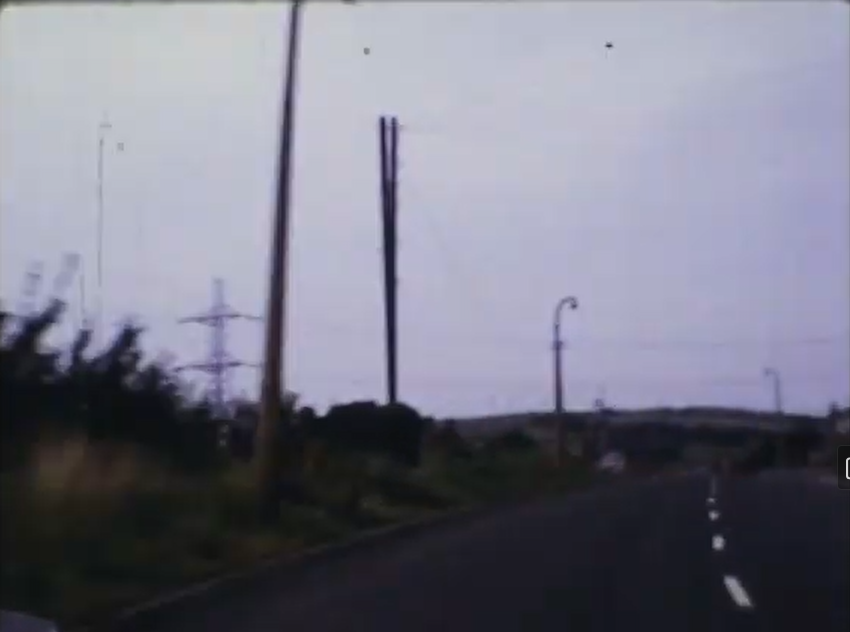
back there as part of a trip around the city. I was always intrigued by
this double-headed telegraph pole
https://i.postimg.cc/g0ZFBYt4/Image1.png at 3:41 in the old film.
(*) A small GoPro fastened to the screen by a sucker (like a dashcam) is
a lot less intrusive than a Super 8 camera mounted on baulks of 2x4"
timber ;-)
On 2026/4/7 12:30:23, Chris Green wrote:[Beware: being highly-rated
[]
does not protect you!])
Getting old is no fun.
| Sysop: | Amessyroom |
|---|---|
| Location: | Fayetteville, NC |
| Users: | 74 |
| Nodes: | 6 (0 / 6) |
| Uptime: | 01:09:47 |
| Calls: | 1,102 |
| Calls today: | 2 |
| Files: | 1,339 |
| Messages: | 276,785 |