https://www.amazon.com/Peavey-00050130-9-Volt-Battery-Each/dp/B000HL0L3S
John Larkin
Highland Tech Glen Canyon Design Center
Lunatic Fringe Electronics
https://www.amazon.com/Peavey-00050130-9-Volt-Battery-Each/dp/B000HL0L3S
On Thu, 25 Jun 2026 17:28:47 -0700, john larkin <jl@glen--canyon.com>
wrote:
https://www.amazon.com/Peavey-00050130-9-Volt-Battery-Each/dp/B000HL0L3S
$13/ea seems rather expensive. Peavy sells them direct for $8/ea: <https://peavey.com/product/9-volt-batteries/>
For the true audiophile, no price is high enough.
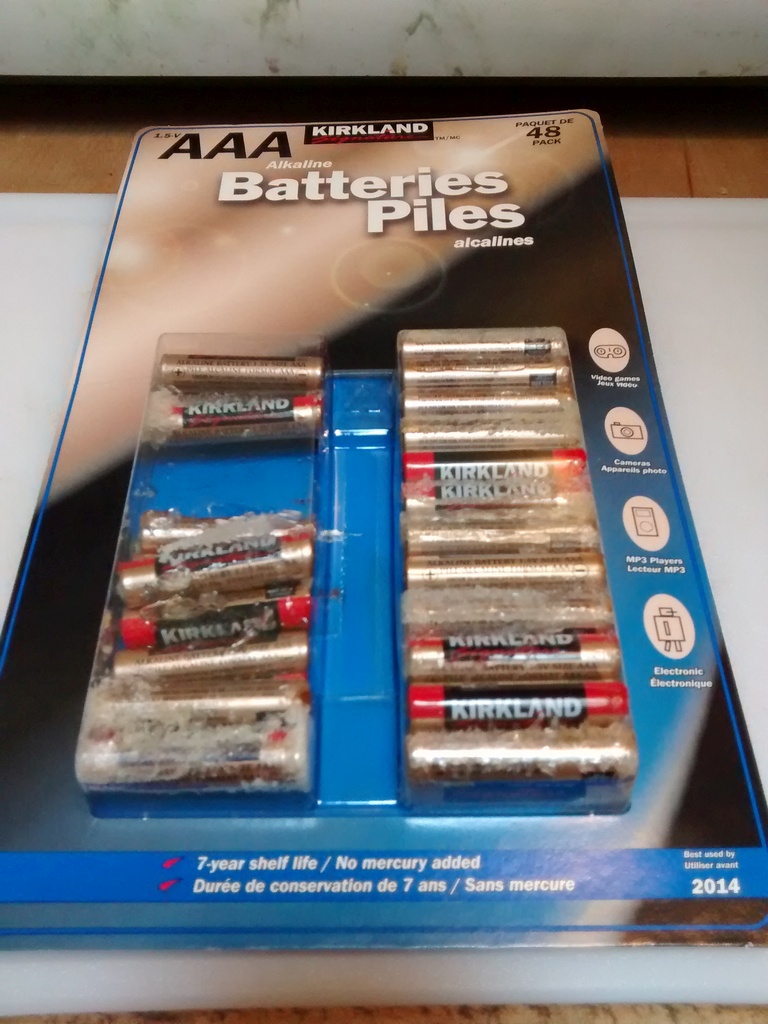
Personally, I don't like alkaline batteries. <http://802.11junk.com/jeffl/crud/Kirkland-AAA-leak.jpg>
Instead, I use 9v Li-Ion rechargeable 9V batteries for $8 or $9/ea.
For example:
<https://www.ebay.com/itm/275206338185>
The main advantage is that Li-Ion is rechargeable, doesn't leak and
has a low self-discharge rate. I've been using Li-Ion 9V batteries in
my various DVM's, LRC meters, and gadgets for about 6 years. All are
still running on my original replacement Li-Ion batteries. After not
being used for literally years, most of these devices are ready to use without having to replace the battery or clean up the mess from
leaking alkaline batteries. Unfortunately, Li-Ion does nothing for
gadgets that draw parasitic current when turned off.
On 26/06/2026 12:16 pm, Jeff Liebermann wrote:
On Thu, 25 Jun 2026 17:28:47 -0700, john larkin <jl@glen--canyon.com>
wrote:
https://www.amazon.com/Peavey-00050130-9-Volt-Battery-Each/dp/B000HL0L3S
$13/ea seems rather expensive.-a Peavy sells them direct for $8/ea:
<https://peavey.com/product/9-volt-batteries/>
For the true audiophile, no price is high enough.
Personally, I don't like alkaline batteries.
<http://802.11junk.com/jeffl/crud/Kirkland-AAA-leak.jpg>
Instead, I use 9v Li-Ion rechargeable 9V batteries for $8 or $9/ea.
For example:
<https://www.ebay.com/itm/275206338185>
The main advantage is that Li-Ion is rechargeable, doesn't leak and
has a low self-discharge rate.-a I've been using Li-Ion 9V batteries in
my various DVM's, LRC meters, and gadgets for about 6 years.-a All are
still running on my original replacement Li-Ion batteries.-a After not
being used for literally years, most of these devices are ready to use
without having to replace the battery or clean up the mess from
leaking alkaline batteries.-a Unfortunately, Li-Ion does nothing for
gadgets that draw parasitic current when turned off.
I use 9V Lithium iron phosphate primary cells in smoke alarms when I can
get them - they are the same size as 9V alkaline batteries, but last a
lot longer - about 10 years - and cost more when you can get them.
Bill Sloman, Sydney
Jeff Liebermann <jeffl@cruzio.com>wrote:
On Thu, 25 Jun 2026 17:28:47 -0700, john larkin <jl@glen--canyon.com>wrote:
https://www.amazon.com/Peavey-00050130-9-Volt-Battery-Each/dp/B000HL0L3S
$13/ea seems rather expensive. Peavy sells them direct for $8/ea: ><https://peavey.com/product/9-volt-batteries/>
For the true audiophile, no price is high enough.
Personally, I don't like alkaline batteries. ><http://802.11junk.com/jeffl/crud/Kirkland-AAA-leak.jpg>
Instead, I use 9v Li-Ion rechargeable 9V batteries for $8 or $9/ea.
For example:
<https://www.ebay.com/itm/275206338185>
The main advantage is that Li-Ion is rechargeable, doesn't leak and
has a low self-discharge rate. I've been using Li-Ion 9V batteries in
my various DVM's, LRC meters, and gadgets for about 6 years. All are
still running on my original replacement Li-Ion batteries. After not
being used for literally years, most of these devices are ready to use >without having to replace the battery or clean up the mess from
leaking alkaline batteries. Unfortunately, Li-Ion does nothing for
gadgets that draw parasitic current when turned off.
https://www.amazon.com/Peavey-00050130-9-Volt-Battery-Each/dp/B000HL0L3S
Jeff Liebermann <jeffl@cruzio.com>wrote:
On Thu, 25 Jun 2026 17:28:47 -0700, john larkin <jl@glen--canyon.com>wrote:
https://www.amazon.com/Peavey-00050130-9-Volt-Battery-Each/dp/B000HL0L3S
$13/ea seems rather expensive. Peavy sells them direct for $8/ea:
<https://peavey.com/product/9-volt-batteries/>
For the true audiophile, no price is high enough.
Personally, I don't like alkaline batteries.
<http://802.11junk.com/jeffl/crud/Kirkland-AAA-leak.jpg>
Instead, I use 9v Li-Ion rechargeable 9V batteries for $8 or $9/ea.
For example:
<https://www.ebay.com/itm/275206338185>
Does it go on fire if you short one?
The main advantage is that Li-Ion is rechargeable, doesn't leak and
has a low self-discharge rate. I've been using Li-Ion 9V batteries in
my various DVM's, LRC meters, and gadgets for about 6 years. All are
still running on my original replacement Li-Ion batteries. After not
being used for literally years, most of these devices are ready to use
without having to replace the battery or clean up the mess from
leaking alkaline batteries. Unfortunately, Li-Ion does nothing for
gadgets that draw parasitic current when turned off.
I just use 9V Alkaline batteries in my multimeter
Does not leak, used every day, for more than a year now:
https://www.ah.nl/producten/product/wi136835/ah-9v-alkaline-batterijen
about 2 US dollies
I do use li-ion in many other things though, high power ones in my drones..
https://panteltje.nl/pub/charging_chinese_lipo_with_rc_plane_charger_IMG_5473.JP
And use a lot of 'Eneloop AA and AAA rechargable batteries.
those have close to zero self discharge too.
https://panteltje.nl/pub/gamma_spectrometer_supply_side_MG_6578.JPG
In li-ion in my cameras too:
https://panteltje.nl/pub/microvision_mars_attacks_IMG_0137.JPG
Gerhard Hoffmann <dk4xp@arcor.de>wrote:
Am 26.06.26 um 02:28 schrieb john larkin:
https://www.amazon.com/Peavey-00050130-9-Volt-Battery-Each/dp/B000HL0L3S
Not available here. :-)
There is an article from NIST on battery noise. (1133.pdf,
pubs are a moving target url @ NIST.) They may not endorse
products, so I repeated it with batteries I could actually
buy.
< >http://www.hoffmann-hochfrequenz.de/downloads/NoiseMeasurementsOnChemicalBatteries.pdf
John R Walliker <jrwalliker@gmail.com>wrote:
On 26/06/2026 07:36, Jan Panteltje wrote:
Jeff Liebermann <jeffl@cruzio.com>wrote:
On Thu, 25 Jun 2026 17:28:47 -0700, john larkin <jl@glen--canyon.com>wrote:
https://www.amazon.com/Peavey-00050130-9-Volt-Battery-Each/dp/B000HL0L3S >>>$13/ea seems rather expensive. Peavy sells them direct for $8/ea:
<https://peavey.com/product/9-volt-batteries/>
For the true audiophile, no price is high enough.
Personally, I don't like alkaline batteries.
<http://802.11junk.com/jeffl/crud/Kirkland-AAA-leak.jpg>
Instead, I use 9v Li-Ion rechargeable 9V batteries for $8 or $9/ea.
For example:
<https://www.ebay.com/itm/275206338185>
Does it go on fire if you short one?
The lithium iron disulphide primary batteries from Energizer
have internal over-current and over-temperature protection.
There is an internal ptc protection device. The details for the
original cylindrical cell are in the Energizer patent.
John
Gerhard Hoffmann <dk4xp@arcor.de>wrote:
Am 26.06.26 um 02:28 schrieb john larkin:
https://www.amazon.com/Peavey-00050130-9-Volt-Battery-Each/dp/B000HL0L3S
Not available here. :-)
There is an article from NIST on battery noise. (1133.pdf,
pubs are a moving target url @ NIST.) They may not endorse
products, so I repeated it with batteries I could actually
buy.
<
http://www.hoffmann-hochfrequenz.de/downloads/NoiseMeasurementsOnChemicalBatteries.pdf
Interesting, I take it the 'unloaded peaks' that are about the same frequency for all batteries are a local noise source?
On 26/06/2026 05:53, Bill Sloman wrote:
On 26/06/2026 12:16 pm, Jeff Liebermann wrote:
On Thu, 25 Jun 2026 17:28:47 -0700, john larkin <jl@glen--canyon.com>
wrote:
https://www.amazon.com/Peavey-00050130-9-Volt-Battery-Each/dp/B000HL0L3S >>>$13/ea seems rather expensive.-a Peavy sells them direct for $8/ea:
<https://peavey.com/product/9-volt-batteries/>
For the true audiophile, no price is high enough.
Personally, I don't like alkaline batteries.
<http://802.11junk.com/jeffl/crud/Kirkland-AAA-leak.jpg>
Instead, I use 9v Li-Ion rechargeable 9V batteries for $8 or $9/ea.
For example:
<https://www.ebay.com/itm/275206338185>
The main advantage is that Li-Ion is rechargeable, doesn't leak and
has a low self-discharge rate.-a I've been using Li-Ion 9V batteries in
my various DVM's, LRC meters, and gadgets for about 6 years.-a All are
still running on my original replacement Li-Ion batteries.-a After not
being used for literally years, most of these devices are ready to use
without having to replace the battery or clean up the mess from
leaking alkaline batteries.-a Unfortunately, Li-Ion does nothing for
gadgets that draw parasitic current when turned off.
I use 9V Lithium iron phosphate primary cells in smoke alarms when I
can get them - they are the same size as 9V alkaline batteries, but
last a lot longer - about 10 years - and cost more when you can get them.
Don't you mean lithium iron disulphide?
On 26/06/2026 4:19 pm, John R Walliker wrote:
On 26/06/2026 05:53, Bill Sloman wrote:
On 26/06/2026 12:16 pm, Jeff Liebermann wrote:
On Thu, 25 Jun 2026 17:28:47 -0700, john larkin <jl@glen--canyon.com>
wrote:
https://www.amazon.com/Peavey-00050130-9-Volt-Battery-Each/dp/
B000HL0L3S
$13/ea seems rather expensive.-a Peavy sells them direct for $8/ea:
<https://peavey.com/product/9-volt-batteries/>
For the true audiophile, no price is high enough.
Personally, I don't like alkaline batteries.
<http://802.11junk.com/jeffl/crud/Kirkland-AAA-leak.jpg>
Instead, I use 9v Li-Ion rechargeable 9V batteries for $8 or $9/ea.
For example:
<https://www.ebay.com/itm/275206338185>
The main advantage is that Li-Ion is rechargeable, doesn't leak and
has a low self-discharge rate.-a I've been using Li-Ion 9V batteries in >>>> my various DVM's, LRC meters, and gadgets for about 6 years.-a All are >>>> still running on my original replacement Li-Ion batteries.-a After not >>>> being used for literally years, most of these devices are ready to use >>>> without having to replace the battery or clean up the mess from
leaking alkaline batteries.-a Unfortunately, Li-Ion does nothing for
gadgets that draw parasitic current when turned off.
I use 9V Lithium iron phosphate primary cells in smoke alarms when I
can get them - they are the same size as 9V alkaline batteries, but
last a lot longer - about 10 years - and cost more when you can get
them.
Don't you mean lithium iron disulphide?
https://en.wikipedia.org/wiki/Lithium_metal_battery
does list it as an option, but I have got a Ph.D. in chemistry, and if
that had been what I meant, that is what I would have written.
https://www.amazon.com/Peavey-00050130-9-Volt-Battery-Each/dp/B000HL0L3S
On 26/06/2026 12:16 pm, Jeff Liebermann wrote:
On Thu, 25 Jun 2026 17:28:47 -0700, john larkin <jl@glen--canyon.com>
wrote:
https://www.amazon.com/Peavey-00050130-9-Volt-Battery-Each/dp/B000HL0L3S
$13/ea seems rather expensive. Peavy sells them direct for $8/ea:
<https://peavey.com/product/9-volt-batteries/>
For the true audiophile, no price is high enough.
Personally, I don't like alkaline batteries.
<http://802.11junk.com/jeffl/crud/Kirkland-AAA-leak.jpg>
Instead, I use 9v Li-Ion rechargeable 9V batteries for $8 or $9/ea.
For example:
<https://www.ebay.com/itm/275206338185>
The main advantage is that Li-Ion is rechargeable, doesn't leak and
has a low self-discharge rate. I've been using Li-Ion 9V batteries in
my various DVM's, LRC meters, and gadgets for about 6 years. All are
still running on my original replacement Li-Ion batteries. After not
being used for literally years, most of these devices are ready to use
without having to replace the battery or clean up the mess from
leaking alkaline batteries. Unfortunately, Li-Ion does nothing for
gadgets that draw parasitic current when turned off.
I use 9V Lithium iron phosphate primary cells in smoke alarms when I can
get them - they are the same size as 9V alkaline batteries, but last a
lot longer - about 10 years - and cost more when you can get them.
Bill Sloman, Sydney
https://www.amazon.com/Peavey-00050130-9-Volt-Battery-Each/dp/B000HL0L3SJohn LarkinHighland Tech Glen Canyon Design CenterLunatic Fringe Electronics
On Fri, 26 Jun 2026 14:53:38 +1000, Bill Sloman <bill.sloman@ieee.org>
wrote:
On 26/06/2026 12:16 pm, Jeff Liebermann wrote:
On Thu, 25 Jun 2026 17:28:47 -0700, john larkin <jl@glen--canyon.com>
wrote:
https://www.amazon.com/Peavey-00050130-9-Volt-Battery-Each/dp/B000HL0L3S >>>$13/ea seems rather expensive. Peavy sells them direct for $8/ea:
<https://peavey.com/product/9-volt-batteries/>
For the true audiophile, no price is high enough.
Personally, I don't like alkaline batteries.
<http://802.11junk.com/jeffl/crud/Kirkland-AAA-leak.jpg>
Instead, I use 9v Li-Ion rechargeable 9V batteries for $8 or $9/ea.
For example:
<https://www.ebay.com/itm/275206338185>
The main advantage is that Li-Ion is rechargeable, doesn't leak and
has a low self-discharge rate. I've been using Li-Ion 9V batteries in
my various DVM's, LRC meters, and gadgets for about 6 years. All are
still running on my original replacement Li-Ion batteries. After not
being used for literally years, most of these devices are ready to use
without having to replace the battery or clean up the mess from
leaking alkaline batteries. Unfortunately, Li-Ion does nothing for
gadgets that draw parasitic current when turned off.
I use 9V Lithium iron phosphate primary cells in smoke alarms when I can
get them - they are the same size as 9V alkaline batteries, but last a
lot longer - about 10 years - and cost more when you can get them.
Bill Sloman, Sydney
Thanks. As far as I know, smoke alarm batteries are non-rechargeable (primary cell) lithium batteries and not LiFePO4, which are
rechargeable: <https://www.google.com/search?q=lithium%209v%20smoke%20alarm%20battery&udm=2>
I need to search for info on what cathode chemistry is used in
"lithium" smoke alarm batteries. Any clues?
On 26/06/2026 11:48, Bill Sloman wrote:
On 26/06/2026 4:19 pm, John R Walliker wrote:
On 26/06/2026 05:53, Bill Sloman wrote:
On 26/06/2026 12:16 pm, Jeff Liebermann wrote:
On Thu, 25 Jun 2026 17:28:47 -0700, john larkin <jl@glen--canyon.com> >>>>> wrote:
https://www.amazon.com/Peavey-00050130-9-Volt-Battery-Each/dp/
B000HL0L3S
$13/ea seems rather expensive.-a Peavy sells them direct for $8/ea:
<https://peavey.com/product/9-volt-batteries/>
For the true audiophile, no price is high enough.
Personally, I don't like alkaline batteries.
<http://802.11junk.com/jeffl/crud/Kirkland-AAA-leak.jpg>
Instead, I use 9v Li-Ion rechargeable 9V batteries for $8 or $9/ea.
For example:
<https://www.ebay.com/itm/275206338185>
The main advantage is that Li-Ion is rechargeable, doesn't leak and
has a low self-discharge rate.-a I've been using Li-Ion 9V batteries in >>>>> my various DVM's, LRC meters, and gadgets for about 6 years.-a All are >>>>> still running on my original replacement Li-Ion batteries.-a After not >>>>> being used for literally years, most of these devices are ready to use >>>>> without having to replace the battery or clean up the mess from
leaking alkaline batteries.-a Unfortunately, Li-Ion does nothing for >>>>> gadgets that draw parasitic current when turned off.
I use 9V Lithium iron phosphate primary cells in smoke alarms when I
can get them - they are the same size as 9V alkaline batteries, but
last a lot longer - about 10 years - and cost more when you can get
them.
Don't you mean lithium iron disulphide?
https://en.wikipedia.org/wiki/Lithium_metal_battery
does list it as an option, but I have got a Ph.D. in chemistry, and if
that had been what I meant, that is what I would have written.
I wasn't aware that 9V primary lithium iron phosphate batteries were available in the same size package as alkaline ones.-a Do you have a
link please?
| Sysop: | Amessyroom |
|---|---|
| Location: | Fayetteville, NC |
| Users: | 70 |
| Nodes: | 6 (0 / 6) |
| Uptime: | 37:37:19 |
| Calls: | 948 |
| Calls today: | 2 |
| Files: | 1,325 |
| Messages: | 280,462 |