• Multiple output DC-DC converter

    From UFO@techforce@nospam.gmx.com to sci.electronics.design on Sat Jun 20 16:43:46 2026
    From Newsgroup: sci.electronics.design

    Trying to bring an old Ford car Stereo back to life and the DC-DC
    converter module is shot, electrolyte damaged the traces from leaky caps
    and one smd diode is disintegrated...no schematic to go by.

    I do know it puts this output:

    +/- 5.0 VDC
    +/- 8.0 VDC
    +/- 13.5 VDC
    + 30.0 VDC

    Is there something on the market as a kit etc, that can fit this spec?


    --- Synchronet 3.22a-Linux NewsLink 1.2
  • From Edward Rawde@invalid@invalid.invalid to sci.electronics.design on Sat Jun 20 20:28:08 2026
    From Newsgroup: sci.electronics.design

    "UFO" <techforce@nospam.gmx.com> wrote in message news:1116u27$bh10$1@dont-email.me...
    Trying to bring an old Ford car Stereo back to life and the DC-DC
    converter module is shot, electrolyte damaged the traces from leaky caps
    and one smd diode is disintegrated...no schematic to go by.

    I do know it puts this output:

    +/- 5.0 VDC
    +/- 8.0 VDC
    +/- 13.5 VDC
    + 30.0 VDC

    Is there something on the market as a kit etc, that can fit this spec?

    Probably not without more information.
    Some questions which come to mind are:
    Does this car stereo have a model or other identification number on it?
    Does the converter module have its own part number or any identification numbers and if so what?
    What are the power requirements for the four rails mentioned above?
    Some pictures might help but no guarantee.


    --- Synchronet 3.22a-Linux NewsLink 1.2
  • From Don Y@blockedofcourse@foo.invalid to sci.electronics.design on Sat Jun 20 17:39:01 2026
    From Newsgroup: sci.electronics.design

    On 6/20/2026 1:43 PM, UFO wrote:
    Trying to bring an old Ford car Stereo back to life and the DC-DC
    converter module is shot, electrolyte damaged the traces from leaky caps
    and one smd diode is disintegrated...no schematic to go by.

    I do know it puts this output:

    +/- 5.0-a VDC
    +/- 8.0-a VDC
    +/- 13.5 VDC
    + 30.0-a VDC

    Is there something on the market as a kit etc,-a that can fit this spec?
    A visit to local junkyards might be more productive.
    Either looking for a complete replacement for the "stereo"
    or one from which you can pilfer the components.
    --- Synchronet 3.22a-Linux NewsLink 1.2
  • From Jeff Liebermann@jeffl@cruzio.com to sci.electronics.design on Sat Jun 20 19:44:06 2026
    From Newsgroup: sci.electronics.design

    On Sat, 20 Jun 2026 16:43:46 -0400, "UFO" <techforce@nospam.gmx.com>
    wrote:

    Trying to bring an old Ford car Stereo back to life and the DC-DC
    converter module is shot, electrolyte damaged the traces from leaky caps
    and one smd diode is disintegrated...no schematic to go by.

    I do know it puts this output:

    +/- 5.0 VDC
    +/- 8.0 VDC
    +/- 13.5 VDC
    + 30.0 VDC

    Is there something on the market as a kit etc, that can fit this spec?

    Tubes, valves or transistors? Vibrator power supply? +30VDC is not a
    common voltage found in transistorized car radios. Same with DC to DC converters, unless it's designed to handle both negative and positive automotive ground systems.

    Look around inside (and on the chassis) for a date. If you can't find
    or disclose the radio model number, perhaps having the date of
    manufacture will help narrow the search. This might also help: <https://www.caranddriver.com/features/a15128476/the-history-of-car-radios/> The first stereo car radio was introduced in the early 1960's.
    --
    Jeff Liebermann jeffl@cruzio.com
    PO Box 272 http://www.LearnByDestroying.com
    Ben Lomond CA 95005-0272 AE6KS 831-336-2558

    --- Synchronet 3.22a-Linux NewsLink 1.2
  • From someone@2a59d59e3809f827ce709d3815e3950eef4a6a93af5557a93a7fdfba71460843@example.com to sci.electronics.design on Sun Jun 21 06:00:01 2026
    From Newsgroup: sci.electronics.design

    Putting this to Google AI gets this:

    The specific component you are looking for is the internal multi-rail power supply circuit (or voltage regulator IC) typically found inside Ford premium radio head units, such as the Ford Audio Control Module (ACM) from the Sony or Shaker premium sound systems.Where These Specific Voltages Are UsedIn a standard automotive environment, a vehicle's battery only supplies a single, nominal 12 VDC to 14.5 VDC rail. To power complex internal electronics, the car stereo utilizes an onboard step-up/step-down multi-channel power supply management IC (PMIC) to split and convert that single input into these exact sub-rails:-# 5.0 VDC: Powers the digital logic, the main microcontroller unit (MCU), the USB ports, and the CAN-bus communication chips.-# 8.0 VDC: Dedicated strictly to clean audio processing, including the AM/FM tuner circuitry, pre-amplifier stages, and Digital Signal Processing (DSP) operational amplifiers (op-amps).-# 13.5 VDC: Replicates stable battery-level voltage to power the internal CD/DVD changer motors, display backlighting, and cooling fans.30.0 VDC: Generated by an internal DC-to-DC boost converter specifically to drive Vacuum Fluorescent Displays (VFD) or high-voltage liquid crystal display (LCD) bias gates.Common Integrated Circuits (ICs) to CheckIf you are repairing or testing a Ford stereo PCB board, look for the following multi-output automotive power supply ICs (often manufactured by STMicroelectronics or NXP) located near the main power input connector block:L9779 / L9780 Series: Automotive multi-voltage regulators commonly deployed in Ford infotainment platforms.ST75185 / TDA-series regulators: Multi-channel voltage regulators that manage 5V, 8V, and boosted display lines on a single chip.If you are trying to bench-test this Ford stereo outside of the car, note that you do not need a power supply that outputs all of these voltages. You only need to feed a standard 12VrCo13.8V DC (at least 5 to 10 Amps) power supply into the stereo's main harness pins (BATT+ and ACC/Ignition), and the radio's internal circuitry will generate the 5V, 8V, 13.5V, and 30V rails on its own.To help you find the exact schematic or chip placement, could you share the model number or part number (usually starting with letters like AA8T, BL3T, or HC3T) printed on the radio's metal sticker?

    End Quote

    If you identify the particular multi-rail regulator chip or chips, the manu will have an app note or datasheet typical from which inferring the schematic is a trivial exercise.
    --
    For full context, visit https://www.electrondepot.com/electrodesign/multiple-output-dc-dc-converter-4405051-.htm

    --- Synchronet 3.22a-Linux NewsLink 1.2
  • From UFO@techforce@nospam.gmx.com to sci.electronics.design on Mon Jun 22 09:12:20 2026
    From Newsgroup: sci.electronics.design


    I made a photo album showing the Stereo and model
    with pics of the converter pcb.

    https://www.mediafire.com/folder/q95p225198ne9/FOLF-18C815-BA


    --- Synchronet 3.22a-Linux NewsLink 1.2
  • From Edward Rawde@invalid@invalid.invalid to sci.electronics.design on Mon Jun 22 09:45:17 2026
    From Newsgroup: sci.electronics.design

    "UFO" <techforce@nospam.gmx.com> wrote in message news:111bcbo$1hnrp$1@dont-email.me...

    I made a photo album showing the Stereo and model
    with pics of the converter pcb.

    https://www.mediafire.com/folder/q95p225198ne9/FOLF-18C815-BA


    https://www.google.com/search?q=MB3775&udm=2

    Shouldn't be too hard to repair that board.

    https://static5.arrow.com/pdfs/2015/6/28/2/9/39/445/span_/manual/14e427204_3.jpg

    https://www.mikrocontroller.net/attachment/576803/MB3775.pdf

    Your board may be different but where did the voltage rail information you posted come from?


    --- Synchronet 3.22a-Linux NewsLink 1.2
  • From UFO@techforce@nospam.gmx.com to sci.electronics.design on Mon Jun 22 10:00:10 2026
    From Newsgroup: sci.electronics.design


    A retired Ford tech that worked at their service center back in the day
    and repaired hundreds of these.

    He says leaked electrolyte eats the foil traces and sometimes the fine wire
    of the
    inductors.

    He has a SM, but says this module is not shown in the schematics, as its proprietary.


    Your board may be different but where did the voltage rail information you posted come from?

    --- Synchronet 3.22a-Linux NewsLink 1.2
  • From Edward Rawde@invalid@invalid.invalid to sci.electronics.design on Mon Jun 22 10:29:26 2026
    From Newsgroup: sci.electronics.design

    "UFO" <techforce@nospam.gmx.com> wrote in message news:111bf5e$1ik5u$1@dont-email.me...

    A retired Ford tech that worked at their service center back in the day
    and repaired hundreds of these.

    He says leaked electrolyte eats the foil traces and sometimes the fine wire of the
    inductors.

    Replace all electrolytics and check condition of inductors.
    Use the information you now have to check PCB trace integrity
    and the condition of any suspect semiconductors.

    Ask the retired worker for the exact schematic or use the information here: https://www.google.com/search?q=MB3775+schematic&udm=2 https://i1.wp.com/powersupply33.com/wp-content/uploads/2012/07/Sega-Game-Gear-Power-supply.jpg

    If available use bench power supplies to determine the power requirements for each rail.

    If necessary, search for another unit you can take parts from.

    https://www.google.com/search?q=%22FOLF-18C815%22&udm=2

    If funds are unlimited get a replacement board produced which may or may
    not use MB3775


    He has a SM, but says this module is not shown in the schematics, as its proprietary.


    Your board may be different but where did the voltage rail information you posted come from?


    --- Synchronet 3.22a-Linux NewsLink 1.2
  • From Edward Rawde@invalid@invalid.invalid to sci.electronics.design on Mon Jun 22 10:55:24 2026
    From Newsgroup: sci.electronics.design

    "UFO" <techforce@nospam.gmx.com> wrote in message news:111bf5e$1ik5u$1@dont-email.me...

    A retired Ford tech that worked at their service center back in the day
    and repaired hundreds of these.

    He says leaked electrolyte eats the foil traces and sometimes the fine wire of the
    inductors.

    He has a SM, but says this module is not shown in the schematics, as its proprietary.

    I'd probably obtain one of these because it may have useful parts and may be hackable to
    match exactly what you need even if it's the wrong physical shape/size.

    https://www.aliexpress.com/item/1005006997666077.html


    Your board may be different but where did the voltage rail information you posted come from?


    --- Synchronet 3.22a-Linux NewsLink 1.2
  • From ehsjr@ehsjr@verizon.net to sci.electronics.design on Mon Jun 22 14:51:44 2026
    From Newsgroup: sci.electronics.design

    On 6/22/2026 9:12 AM, UFO wrote:

    I made a photo album showing the Stereo and model
    with pics of the converter pcb.

    https://www.mediafire.com/folder/q95p225198ne9/FOLF-18C815-BA


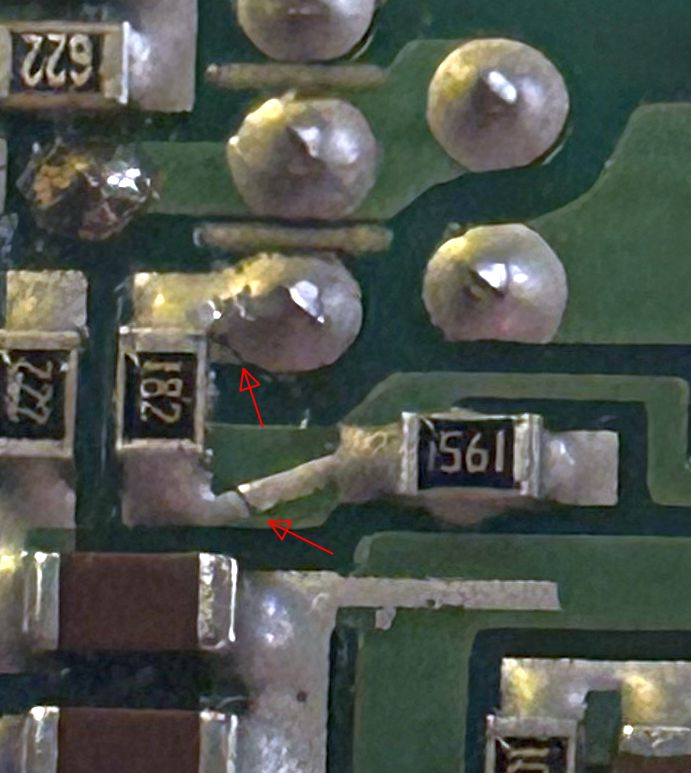
    On your photo img3551 I see a crack in the trace between two resistors
    with values 182 and 561 Location upper left corner of photo.
    There's an unmarked cap on the left followed by resistors whose values
    are, from left to right, 243, 202, 222 and 182. The *apparently*
    defective trace connects from the 182 to the 561.

    It could be just a piece of dust - I can't tell from the photo - but
    its worth examining.
    Ed
    --- Synchronet 3.22a-Linux NewsLink 1.2
  • From Jeff Liebermann@jeffl@cruzio.com to sci.electronics.design on Mon Jun 22 12:47:24 2026
    From Newsgroup: sci.electronics.design

    On Mon, 22 Jun 2026 14:51:44 -0400, ehsjr <ehsjr@verizon.net> wrote:

    On 6/22/2026 9:12 AM, UFO wrote:

    I made a photo album showing the Stereo and model
    with pics of the converter pcb.

    https://www.mediafire.com/folder/q95p225198ne9/FOLF-18C815-BA


    On your photo img3551 I see a crack in the trace between two resistors
    with values 182 and 561 Location upper left corner of photo.
    There's an unmarked cap on the left followed by resistors whose values
    are, from left to right, 243, 202, 222 and 182. The *apparently*
    defective trace connects from the 182 to the 561.

    It could be just a piece of dust - I can't tell from the photo - but
    its worth examining.
    Ed

    You have good eyes. I enlarged the photo and played with the
    contrast. Now, I see two cracks: <https://www.learnbydestroying.com/jeffl/crud/IMG_3551-1.jpg>
    However, the green solder mask extends past the ends of the cracks.
    There doesn't seem to be a corresponding break in the area of the
    solder mask that is not part of the solder trace. The only way to be
    sure is to resolder the trace (or reinforce the trace with a fine bare
    wire).
    --
    Jeff Liebermann jeffl@cruzio.com
    PO Box 272 http://www.LearnByDestroying.com
    Ben Lomond CA 95005-0272 AE6KS 831-336-2558

    --- Synchronet 3.22a-Linux NewsLink 1.2
  • From UFO@techforce@nospam.gmx.com to sci.electronics.design on Tue Jun 23 12:05:05 2026
    From Newsgroup: sci.electronics.design

    Will have my tech take a look.

    Meanwhile, the blown "diode" may be marked N19, and could be like the others
    on the board, hard to say. N19 comes up in AI as a smd transistor, theres another
    one blown on the mainboard, so he has a bunch of them new on hand in case.

    On the datasheet theres a diode near a pair of transistors, not sure if
    thats the location
    of the one thats blown, but apparently the buck boost coils use whats
    probably
    a GP type diode for that purpose? High speed switch maybe?

    --- Synchronet 3.22a-Linux NewsLink 1.2
  • From Jeff Liebermann@jeffl@cruzio.com to sci.electronics.design on Tue Jun 23 10:04:43 2026
    From Newsgroup: sci.electronics.design

    On Mon, 22 Jun 2026 09:12:20 -0400, "UFO" <techforce@nospam.gmx.com>
    wrote:


    I made a photo album showing the Stereo and model
    with pics of the converter pcb.

    https://www.mediafire.com/folder/q95p225198ne9/FOLF-18C815-BA


    Found using Google Image Search: <https://www.facebook.com/groups/themarkviiclub/posts/10159984852788530/> <https://www.ebay.com/p/2211682564?iid=298268684961> <https://www.jarimaki.fi/radio/cd-soitin-kaytetty-ford-1991/20592/> <https://www.reddit.com/r/CarAV/comments/1jh1lsc/why_are_these_single_din_ford_cd_players_so_hard/>
    --
    Jeff Liebermann jeffl@cruzio.com
    PO Box 272 http://www.LearnByDestroying.com
    Ben Lomond CA 95005-0272 AE6KS 831-336-2558

    --- Synchronet 3.22a-Linux NewsLink 1.2
  • From UFO@techforce@nospam.gmx.com to sci.electronics.design on Tue Jun 23 15:29:00 2026
    From Newsgroup: sci.electronics.design


    Not sure now if those were the correct outputs, there dont seem to be
    many pins to have that many.

    Found out original Sony Part Number was: 1-466-025-14

    Some sites list it but no stock.

    Apparently Sony used this sort of design in an lot of gear, to drive
    displays
    in Camcorders and such....

    Probably not without more information.
    Some questions which come to mind are:
    Does this car stereo have a model or other identification number on it?
    Does the converter module have its own part number or any identification numbers and if so what?
    What are the power requirements for the four rails mentioned above?
    Some pictures might help but no guarantee.

    --- Synchronet 3.22a-Linux NewsLink 1.2