• Oldovan tools associated with Paranthropus

    From erik simpson@eastside.erik@gmail.com to sci.anthropology.paleo on Fri May 2 08:28:34 2025
    From Newsgroup: sci.anthropology.paleo

    Expanded geographic distribution and dietary strategies of the earliest Oldowan hominins and Paranthropus. (Open access)

    Abstract
    The oldest Oldowan tool sites, from around 2.6 million years ago, have previously been confined to EthiopiarCOs Afar Triangle. We describe sites
    at Nyayanga, Kenya, dated to 3.032 to 2.581 million years ago and expand
    this distribution by over 1300 kilometers. Furthermore, we found two hippopotamid butchery sites associated with mosaic vegetation and a C4 grazerrCodominated fauna. Tool flaking proficiency was comparable with
    that of younger Oldowan assemblages, but pounding activities were more
    common. Tool use-wear and bone damage indicate plant and animal tissue processing. Paranthropus sp. teeth, the first from southwestern Kenya, possessed carbon isotopic values indicative of a diet rich in C4 foods.
    We argue that the earliest Oldowan was more widespread than previously
    known, used to process diverse foods including megafauna, and associated
    with Paranthropus from its onset.
    --- Synchronet 3.21d-Linux NewsLink 1.2
  • From Pandora@pandora@knoware.nl to sci.anthropology.paleo on Fri May 2 18:40:25 2025
    From Newsgroup: sci.anthropology.paleo

    Op 02-05-2025 om 17:28 schreef erik simpson:

    Expanded geographic distribution and dietary strategies of the earliest Oldowan hominins and Paranthropus.-a (Open access)

    Abstract
    The oldest Oldowan tool sites, from around 2.6 million years ago, have previously been confined to EthiopiarCOs Afar Triangle. We describe sites
    at Nyayanga, Kenya, dated to 3.032 to 2.581 million years ago and expand this distribution by over 1300 kilometers. Furthermore, we found two hippopotamid butchery sites associated with mosaic vegetation and a C4 grazerrCodominated fauna. Tool flaking proficiency was comparable with
    that of younger Oldowan assemblages, but pounding activities were more common. Tool use-wear and bone damage indicate plant and animal tissue processing. Paranthropus sp. teeth, the first from southwestern Kenya, possessed carbon isotopic values indicative of a diet rich in C4 foods.
    We argue that the earliest Oldowan was more widespread than previously known, used to process diverse foods including megafauna, and associated with Paranthropus from its onset.

    https://www.science.org/doi/10.1126/science.abo7452

    "Extraoral cutting and pounding with stone tools could have provided
    access to carcasses and within bone nutrients, and made plant and animal tissue easier to chew and digest, potentially allowing Paranthropus to
    expand its diet."

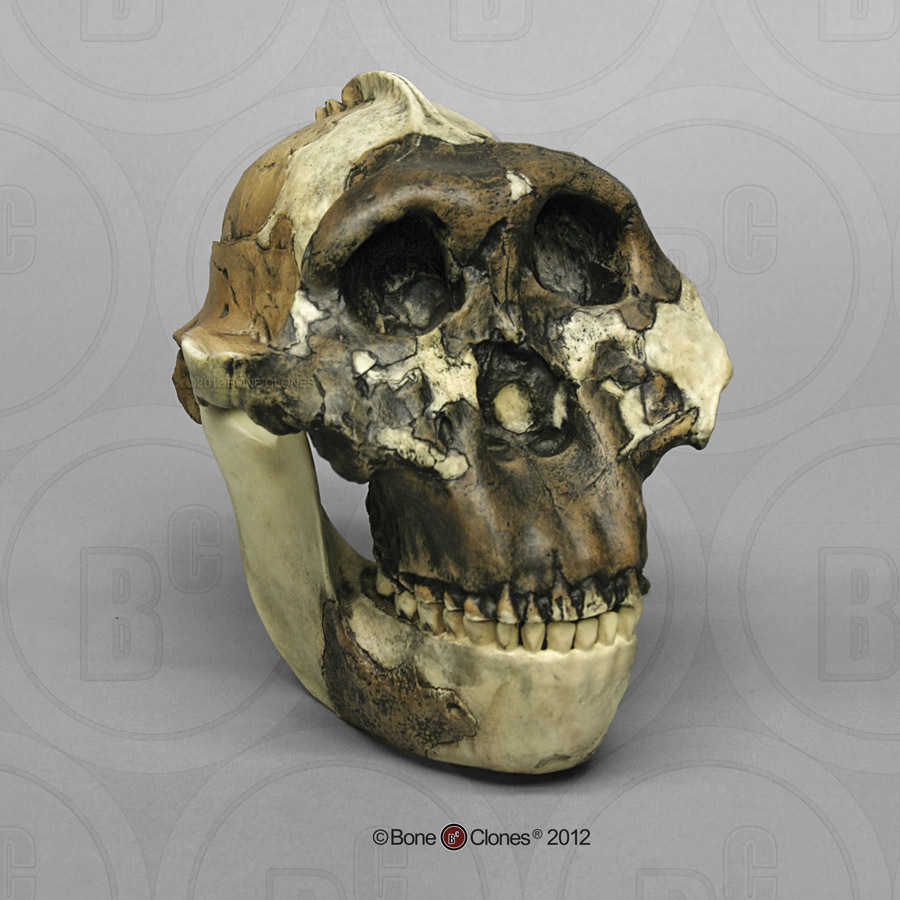
    Then why the massive jaws and teeth and cranial superstructures for
    muscle attachment (cranial cresting) in this taxon?

    See: https://boneclones.com/images/store-product/product-1575-main-original-1415043811.jpg
    --- Synchronet 3.21d-Linux NewsLink 1.2
  • From JTEM@jtem01@gmail.com to sci.anthropology.paleo on Fri May 2 16:38:04 2025
    From Newsgroup: sci.anthropology.paleo

    On 5/2/25 11:28 AM, erik simpson wrote:
    Expanded geographic distribution and dietary strategies of the earliest Oldowan hominins and Paranthropus.-a (Open access)

    Abstract
    The oldest Oldowan tool sites, from around 2.6 million years ago, have previously been confined to EthiopiarCOs Afar Triangle. We describe sites
    at Nyayanga, Kenya, dated to 3.032 to 2.581 million years ago and expand this distribution by over 1300 kilometers. Furthermore, we found two hippopotamid butchery sites associated with mosaic vegetation and a C4 grazerrCodominated fauna. Tool flaking proficiency was comparable with
    that of younger Oldowan assemblages, but pounding activities were more common. Tool use-wear and bone damage indicate plant and animal tissue processing. Paranthropus sp. teeth, the first from southwestern Kenya, possessed carbon isotopic values indicative of a diet rich in C4 foods.
    We argue that the earliest Oldowan was more widespread than previously known, used to process diverse foods including megafauna, and associated with Paranthropus from its onset.

    Quite frankly, it's just WokeTardia.

    They're "Finding" that Paranthropus, if it's really a distinct species (genus?), ate a lot of plants, thus it butchered animals.

    From your cite:

    "Thus, the emergence of C4 specialist diets coincided with the
    appearance of at least one major aspect of robust masticatory
    morphology (large post-canine teeth) relatively early in the
    evolution of Paranthropus [as opposed to (19)]."

    Kind of makes sense, right? Gorillas are more "Robust" than humans,
    herbivores tend to be larger, more "robust" than carnivores...

    Also from your cite:

    Similar C4 grazerrCodominated ecosystems are documented at the Ethiopian
    sites of Ledi-Geraru (~2.8 Ma) (17) and Mille-Logya (~2.8 to ~2.4 Ma)
    (18), indicating that early representatives of both Paranthropus and
    Homo were found in substantially open ecosystems.

    wow golly gee willickers, Batman, the dates overlap! LOTS!

    Paleoanthropology is the furthest thing from a real science. It's a
    social program, and it's used to promote the "We're all exactly the
    same" message which form some reason never once explained can only be
    true if modern humans originated in Africa.
    --
    https://jtem.tumblr.com/tagged/The%20Book%20of%20JTEM/page/5
    --- Synchronet 3.21d-Linux NewsLink 1.2
  • From JTEM@jtem01@gmail.com to sci.anthropology.paleo on Fri May 2 16:39:23 2025
    From Newsgroup: sci.anthropology.paleo

    On 5/2/25 12:40 PM, Pandora wrote:

    https://www.science.org/doi/10.1126/science.abo7452

    "Extraoral cutting and pounding with stone tools could have provided
    access to carcasses and within bone nutrients, and made plant and animal tissue easier to chew and digest, potentially allowing Paranthropus to expand its diet."

    Then why the massive jaws and teeth and cranial superstructures for
    muscle attachment (cranial cresting) in this taxon?

    Well color me surprised!

    You're about to change your position, because you're agreeing with me!
    --
    https://jtem.tumblr.com/tagged/The%20Book%20of%20JTEM/page/5
    --- Synchronet 3.21d-Linux NewsLink 1.2
  • From Primum Sapienti@invalide@invalid.invalid to sci.anthropology.paleo on Sun May 4 22:42:35 2025
    From Newsgroup: sci.anthropology.paleo

    Pandora wrote:
    Op 02-05-2025 om 17:28 schreef erik simpson:

    Expanded geographic distribution and dietary strategies of the
    earliest Oldowan hominins and Paranthropus.-a (Open access)

    Abstract
    The oldest Oldowan tool sites, from around 2.6 million years ago, have
    previously been confined to EthiopiarCOs Afar Triangle. We describe
    sites at Nyayanga, Kenya, dated to 3.032 to 2.581 million years ago
    and expand this distribution by over 1300 kilometers. Furthermore, we
    found two hippopotamid butchery sites associated with mosaic
    vegetation and a C4 grazerrCodominated fauna. Tool flaking proficiency
    was comparable with that of younger Oldowan assemblages, but pounding
    activities were more common. Tool use-wear and bone damage indicate
    plant and animal tissue processing. Paranthropus sp. teeth, the first
    from southwestern Kenya, possessed carbon isotopic values indicative
    of a diet rich in C4 foods. We argue that the earliest Oldowan was
    more widespread than previously known, used to process diverse foods
    including megafauna, and associated with Paranthropus from its onset.

    https://www.science.org/doi/10.1126/science.abo7452

    "Extraoral cutting and pounding with stone tools could have provided
    access to carcasses and within bone nutrients, and made plant and animal tissue easier to chew and digest, potentially allowing Paranthropus to expand its diet."

    Then why the massive jaws and teeth and cranial superstructures for
    muscle attachment (cranial cresting) in this taxon?


    "Paranthropus sp. teeth, the first from
    southwestern Kenya, possessed carbon isotopic
    values indicative of a diet rich in C4 foods."

    A diet in transition? Not the best source but it'll do

    https://www.newhistorian.com/2015/10/11/important-questions-answered-about-evolution-of-hominin-diet/

    "The crucial consequence of this difference is that
    C4 plants are much more suited to growing in a hot,
    dry climate..."

    "By expanding their diet to include C4 plants,
    hominins may have been able to increase the variety
    of environments in which they could survive, or
    increase their chances of survival in more
    changeable environments. "


    See: https://boneclones.com/images/store-product/product-1575-main-original-1415043811.jpg


    --- Synchronet 3.21d-Linux NewsLink 1.2
  • From JTEM@jtem01@gmail.com to sci.anthropology.paleo on Mon May 5 01:00:19 2025
    From Newsgroup: sci.anthropology.paleo

    On 5/5/25 12:42 AM, Primum Sapienti wrote:

    "The crucial consequence of this difference is that
    C4 plants are much more suited to growing in a hot,
    dry climate..."

    "By expanding their diet to include C4 plants,
    hominins may have been able to increase the variety
    of environments in which they could survive, or
    increase their chances of survival in more
    changeable environments. "

    The problem is the a-priori assumptions that you're
    ignoring. It's shoehorning their interpretation of the
    evidence into their conclusion. Homo finds overlap
    these so why not just assume the tools are Homo? It
    would, as I have suggested in a different context, be
    that they were the prey of Homo. And, of course, this
    "Paranthropus" may be the proof of what others have
    suggested, which is that Chimps evolved from
    australopiths and Paranthropus is transitional...

    Hell, they could be a lab experiment by aliens gone
    bad! The point is that the evidence is interpreted,
    and what we are reading is an interpretation and not
    facts.
    --
    https://jtem.tumblr.com/tagged/The%20Book%20of%20JTEM/page/5
    --- Synchronet 3.21d-Linux NewsLink 1.2