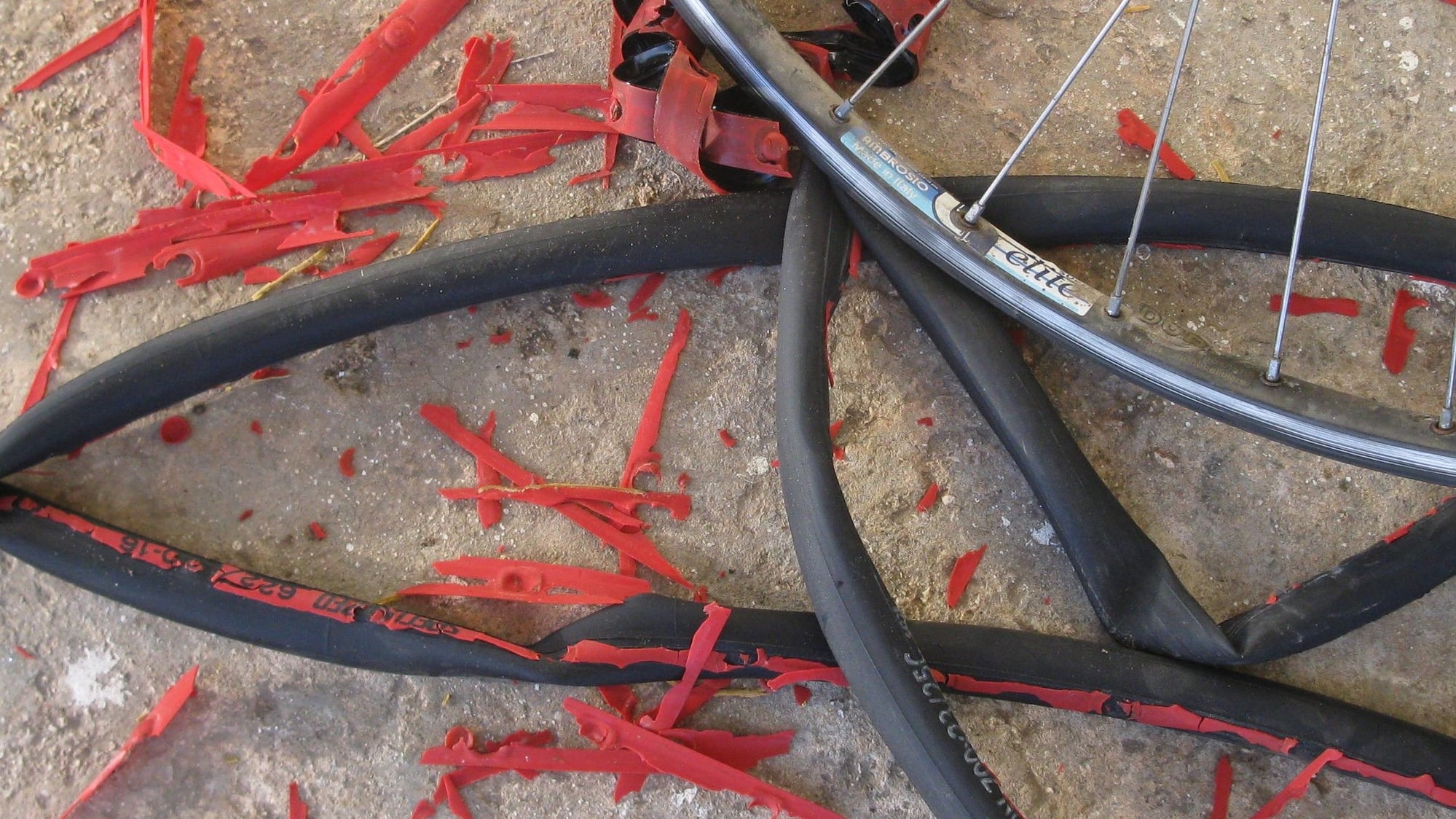
Finished my ride today 43 miler was little chilly actually
at 59 degrees starting out. Not too fast thought I was going
harder but cold weather see to pull down the average.
Coming in today 1/2 block from home concrete street with
some pot holes. I felt one hit pretty hard but that happens
right. Sure enough I look down and the right front 20 inch
tire on the catrike went flat. My guess is a pitch flat but
on a trike pretty easy to just roll another 1/2 block home.
I was due you don't go forever I have 4750 miles on the
Catrike so a flat first time and 1000 feet from home I can
live with. I have a feeling though changing inner tubes is
not easy on these Trikes out on the road.
Finished my ride today 43 miler was little chilly actually
at 59 degrees starting out. Not too fast thought I was going
harder but cold weather see to pull down the average.
Coming in today 1/2 block from home concrete street with
some pot holes. I felt one hit pretty hard but that happens
right. Sure enough I look down and the right front 20 inch
tire on the catrike went flat. My guess is a pitch flat but
on a trike pretty easy to just roll another 1/2 block home.
I was due you don't go forever I have 4750 miles on the
Catrike so a flat first time and 1000 feet from home I can
live with. I have a feeling though changing inner tubes is
not easy on these Trikes out on the road.
On 9/11/2026 12:57 PM, Mark J cleary wrote:
Finished my ride today 43 miler was little chilly actually
at 59 degrees starting out. Not too fast thought I was
going harder but cold weather see to pull down the average.
Coming in today 1/2 block from home concrete street with
some pot holes. I felt one hit pretty hard but that
happens right. Sure enough I look down and the right front
20 inch tire on the catrike went flat. My guess is a pitch
flat but on a trike pretty easy to just roll another 1/2
block home.
I was due you don't go forever I have 4750 miles on the
Catrike so a flat first time and 1000 feet from home I can
live with. I have a feeling though changing inner tubes is
not easy on these Trikes out on the road.
p.s.
Zoom ahead to 17:00 minutes
https://vimeo.com/804023315?fl=pl&fe=cm
On 9/11/2026 12:57 PM, Mark J cleary wrote:
Finished my ride today 43 miler was little chilly actually at 59
degrees starting out. Not too fast thought I was going harder but cold
weather see to pull down the average.
Coming in today 1/2 block from home concrete street with some pot
holes. I felt one hit pretty hard but that happens right. Sure enough
I look down and the right front 20 inch tire on the catrike went flat.
My guess is a pitch flat but on a trike pretty easy to just roll
another 1/2 block home.
I was due you don't go forever I have 4750 miles on the Catrike so a
flat first time and 1000 feet from home I can live with. I have a
feeling though changing inner tubes is not easy on these Trikes out on
the road.
p.s.
Zoom ahead to 17:00 minutes
https://vimeo.com/804023315?fl=pl&fe=cm
Finished my ride today 43 miler was little chilly actually at 59 degrees starting out. Not too fast thought I was going harder but cold weather see-ato-apull-adown-athe-aaverage.
Coming in today 1/2 block from home concrete street with some pot holes.
I felt one hit pretty hard but that happens right. Sure enough I look
down and the right front 20 inch tire on the catrike went flat. My guess
is a pitch flat but on a trike pretty easy to just roll another 1/2 block-ahome.
I was due you don't go forever I have 4750 miles on the Catrike so a
flat first time and 1000 feet from home I can live with. I have a
feeling though changing inner tubes is not easy on these Trikes out on the-aroad.
On 9/11/2026 1:21 PM, AMuzi wrote:
On 9/11/2026 12:57 PM, Mark J cleary wrote:Yes, I knew that would be the way to go most of the time
Finished my ride today 43 miler was little chilly
actually at 59 degrees starting out. Not too fast thought
I was going harder but cold weather see to pull down the
average.
Coming in today 1/2 block from home concrete street with
some pot holes. I felt one hit pretty hard but that
happens right. Sure enough I look down and the right
front 20 inch tire on the catrike went flat. My guess is
a pitch flat but on a trike pretty easy to just roll
another 1/2 block home.
I was due you don't go forever I have 4750 miles on the
Catrike so a flat first time and 1000 feet from home I
can live with. I have a feeling though changing inner
tubes is not easy on these Trikes out on the road.
p.s.
Zoom ahead to 17:00 minutes
https://vimeo.com/804023315?fl=pl&fe=cm
Andrew. Just changed the tube and never bothered with the
wheel or tire coming off. One thing I did though was a good
finger inspection on the tire outside and inside. I have had
flats where I did not get the piece of whatever out of the
tire. This had on hole right about 2 inches from the value
stem so not a snake bite as such? Can a rim bottom out and
only have one place that it goes through. It is almost a
perfect round hole and on the inside of tube not outside
road contact.
It it did not take long at all but these Schwalb 406 Durango
1.1 call for 85-115 PSI. I don't run them that high maybe
around 80 average as I air them around 90 and they go for
about a week or so before needing and air. To me it seems
that is a high pressure. The rear is a Schwalb One 23 and it
does take more I run it around 90 psi but I have run them as
low as 75.
Finally I took the flat tube and patched it I am old school.
Patch the tube if it seams reasonable to do so. I know
riders who just toss. Now I need to buy two replacement
front tires. They are certainly good for what I think will
be many miles but with 4750 on them I need replacements on
deck. The rear I have some trusty Conti GP5000s on hand the
best tire ever> Is wish they made and equivalent 20 inch
tire. Might have to AI that question.
On 9/11/2026 12:57 PM, Mark J cleary wrote:
Finished my ride today 43 miler was little chilly actually
at 59 degrees starting out. Not too fast thought I was going
harder but cold weather see to pull down the average.
Coming in today 1/2 block from home concrete street with
some pot holes. I felt one hit pretty hard but that happens
right. Sure enough I look down and the right front 20 inch
tire on the catrike went flat. My guess is a pitch flat but
on a trike pretty easy to just roll another 1/2 block home.
I was due you don't go forever I have 4750 miles on the
Catrike so a flat first time and 1000 feet from home I can
live with. I have a feeling though changing inner tubes is
not easy on these Trikes out on the road.
You'll discover one feature of tricycles in that stub-axle
wheels can change rubber without removing the wheel from the
vehicle. Bonus!
On 9/11/2026 1:58 PM, Mark J cleary wrote:
On 9/11/2026 1:21 PM, AMuzi wrote:
On 9/11/2026 12:57 PM, Mark J cleary wrote:
I was due you don't go forever I have 4750 miles on the
Catrike so a flat first time and 1000 feet from home I
can live with. I have a feeling though changing inner
tubes is not easy on these Trikes out on the road.
https://vimeo.com/804023315?fl=pl&fe=cmYes, I knew that would be the way to go most of the time
Andrew. Just changed the tube and never bothered with the
wheel or tire coming off. One thing I did though was a good
finger inspection on the tire outside and inside. I have had
flats where I did not get the piece of whatever out of the
tire. This had on hole right about 2 inches from the value
stem so not a snake bite as such? Can a rim bottom out and
only have one place that it goes through. It is almost a
perfect round hole and on the inside of tube not outside road
contact.
Inside flat is a rim or rim liner problem.
Low pressure pinch flat (aka 'snake bite') is on the sides
(usually two slits). Increase and maintain recommended
pressure. Inspect tire casing* to ensure fabric is not torn.
Punctures are on the outside (tire side) and great care should
be taken to find* and remove the object, which can be very
small (wire, remnant of a thorn or in urban areas a syringe
needle).
For your flat, rim is either solid section or hollow.
Solid section rims' nipples stick up inside rim, which needs a
rubber, not broken or chafed, rim liner. Rubber rim liner has
to be wide enough to fill the well, but not so wide as to
obstruct or occlude rim bead seat.
Hollow section rims have a hole to allow access to the nipple.
Rim liners are nylon cloth which can withstand tire pressures
over those holes. Rubber or plastic rim liners will cut through
under pressure on a hollow section rim, leaving distinctly
round or crescent cuts* or marks on the inside face of the
tube.
*Good practice is to mark tire, rim and valve on one side
before dismounting tire, so the injury may be traced back to
its source. Especially for punctures, you're looking for a
very small thing embedded somewhere in a lot of area of fabric.
Knowing where to look makes that more likely successful.
On Fri, 11 Sep 2026 15:20:57 -0500,
AMuzi <am@yellowjersey.org> wrote:
On 9/11/2026 1:58 PM, Mark J cleary wrote:
On 9/11/2026 1:21 PM, AMuzi wrote:
On 9/11/2026 12:57 PM, Mark J cleary wrote:
I was due you don't go forever I have 4750 miles on the
Catrike so a flat first time and 1000 feet from home I
can live with. I have a feeling though changing inner
tubes is not easy on these Trikes out on the road.
https://vimeo.com/804023315?fl=pl&fe=cmYes, I knew that would be the way to go most of the time
Andrew. Just changed the tube and never bothered with the
wheel or tire coming off. One thing I did though was a good
finger inspection on the tire outside and inside. I have had
flats where I did not get the piece of whatever out of the
tire. This had on hole right about 2 inches from the value
stem so not a snake bite as such? Can a rim bottom out and
only have one place that it goes through. It is almost a
perfect round hole and on the inside of tube not outside road
contact.
Inside flat is a rim or rim liner problem.
Low pressure pinch flat (aka 'snake bite') is on the sides
(usually two slits). Increase and maintain recommended
pressure. Inspect tire casing* to ensure fabric is not torn.
Punctures are on the outside (tire side) and great care should
be taken to find* and remove the object, which can be very
small (wire, remnant of a thorn or in urban areas a syringe
needle).
I had a pinch flat a few weeks ago that I patched on the road.
The tire pumped to pressure reasonably effectively, but shortly
after starting out it went flat again. Turned out I had a small
puncture that lost enough pressure to aggravate the risk of pinch
flatting.
For your flat, rim is either solid section or hollow.
Solid section rims' nipples stick up inside rim, which needs a
rubber, not broken or chafed, rim liner. Rubber rim liner has
to be wide enough to fill the well, but not so wide as to
obstruct or occlude rim bead seat.
Hollow section rims have a hole to allow access to the nipple.
Rim liners are nylon cloth which can withstand tire pressures
over those holes. Rubber or plastic rim liners will cut through
under pressure on a hollow section rim, leaving distinctly
round or crescent cuts* or marks on the inside face of the
tube.
Great info, as usual.
Any thoughts on fabric strips (e.g., Velox)? I've had them form
creases on my Ritchey (hollow section) rims, and have had flats
that were in the same spot and caused (I think) by fretting
abrasion.
*Good practice is to mark tire, rim and valve on one side
before dismounting tire, so the injury may be traced back to
its source. Especially for punctures, you're looking for a
very small thing embedded somewhere in a lot of area of fabric.
Knowing where to look makes that more likely successful.
I don't mark anything, but always keep the tube in the same
orientation as the rim and tire after I pull it put and inflate
it. Once I find the leak, I use that to zero in on where to
inspect the tire (and rim, if needed). Pretty much the approach
you suggest, Andrew.
On 9/11/2026 1:58 PM, Mark J cleary wrote:
On 9/11/2026 1:21 PM, AMuzi wrote:
On 9/11/2026 12:57 PM, Mark J cleary wrote:Yes, I knew that would be the way to go most of the time
Finished my ride today 43 miler was little chilly
actually at 59 degrees starting out. Not too fast thought
I was going harder but cold weather see to pull down the
average.
Coming in today 1/2 block from home concrete street with
some pot holes. I felt one hit pretty hard but that
happens right. Sure enough I look down and the right
front 20 inch tire on the catrike went flat. My guess is
a pitch flat but on a trike pretty easy to just roll
another 1/2 block home.
I was due you don't go forever I have 4750 miles on the
Catrike so a flat first time and 1000 feet from home I
can live with. I have a feeling though changing inner
tubes is not easy on these Trikes out on the road.
p.s.
Zoom ahead to 17:00 minutes
https://vimeo.com/804023315?fl=pl&fe=cm
Andrew. Just changed the tube and never bothered with the
wheel or tire coming off. One thing I did though was a good
finger inspection on the tire outside and inside. I have had
flats where I did not get the piece of whatever out of the
tire. This had on hole right about 2 inches from the value
stem so not a snake bite as such? Can a rim bottom out and
only have one place that it goes through. It is almost a
perfect round hole and on the inside of tube not outside
road contact.
It it did not take long at all but these Schwalb 406 Durango
1.1 call for 85-115 PSI. I don't run them that high maybe
around 80 average as I air them around 90 and they go for
about a week or so before needing and air. To me it seems
that is a high pressure. The rear is a Schwalb One 23 and it
does take more I run it around 90 psi but I have run them as
low as 75.
Finally I took the flat tube and patched it I am old school.
Patch the tube if it seams reasonable to do so. I know
riders who just toss. Now I need to buy two replacement
front tires. They are certainly good for what I think will
be many miles but with 4750 on them I need replacements on
deck. The rear I have some trusty Conti GP5000s on hand the
best tire ever> Is wish they made and equivalent 20 inch
tire. Might have to AI that question.
Inside flat is a rim or rim liner problem.
Low pressure pinch flat (aka 'snake bite') is on the sides
(usually two slits). Increase and maintain recommended
pressure. Inspect tire casing* to ensure fabric is not torn.
Punctures are on the outside (tire side) and great care
should be taken to find* and remove the object, which can be
very small (wire, remnant of a thorn or in urban areas a
syringe needle).
For your flat, rim is either solid section or hollow.
Solid section rims' nipples stick up inside rim, which needs
a rubber, not broken or chafed, rim liner. Rubber rim liner
has to be wide enough to fill the well, but not so wide as
to obstruct or occlude rim bead seat.
Hollow section rims have a hole to allow access to the
nipple. Rim liners are nylon cloth which can withstand tire
pressures over those holes. Rubber or plastic rim liners
will cut through under pressure on a hollow section rim,
leaving distinctly round or crescent cuts* or marks on the
inside face of the tube.
*Good practice is to mark tire, rim and valve on one side
before dismounting tire, so the injury may be traced back to
its source. Especially for punctures, you're looking for a
very small thing embedded somewhere in a lot of area of
fabric. Knowing where to look makes that more likely successful.
On Fri, 11 Sep 2026 15:20:57 -0500, AMuzi <am@yellowjersey.org> wrote:
On 9/11/2026 1:58 PM, Mark J cleary wrote:
On 9/11/2026 1:21 PM, AMuzi wrote:
On 9/11/2026 12:57 PM, Mark J cleary wrote:Yes, I knew that would be the way to go most of the time
Finished my ride today 43 miler was little chilly
actually at 59 degrees starting out. Not too fast thought
I was going harder but cold weather see to pull down the
average.
Coming in today 1/2 block from home concrete street with
some pot holes. I felt one hit pretty hard but that
happens right. Sure enough I look down and the right
front 20 inch tire on the catrike went flat. My guess is
a pitch flat but on a trike pretty easy to just roll
another 1/2 block home.
I was due you don't go forever I have 4750 miles on the
Catrike so a flat first time and 1000 feet from home I
can live with. I have a feeling though changing inner
tubes is not easy on these Trikes out on the road.
p.s.
Zoom ahead to 17:00 minutes
https://vimeo.com/804023315?fl=pl&fe=cm
Andrew. Just changed the tube and never bothered with the
wheel or tire coming off. One thing I did though was a good
finger inspection on the tire outside and inside. I have had
flats where I did not get the piece of whatever out of the
tire. This had on hole right about 2 inches from the value
stem so not a snake bite as such? Can a rim bottom out and
only have one place that it goes through. It is almost a
perfect round hole and on the inside of tube not outside
road contact.
It it did not take long at all but these Schwalb 406 Durango
1.1 call for 85-115 PSI. I don't run them that high maybe
around 80 average as I air them around 90 and they go for
about a week or so before needing and air. To me it seems
that is a high pressure. The rear is a Schwalb One 23 and it
does take more I run it around 90 psi but I have run them as
low as 75.
Finally I took the flat tube and patched it I am old school.
Patch the tube if it seams reasonable to do so. I know
riders who just toss. Now I need to buy two replacement
front tires. They are certainly good for what I think will
be many miles but with 4750 on them I need replacements on
deck. The rear I have some trusty Conti GP5000s on hand the
best tire ever> Is wish they made and equivalent 20 inch
tire. Might have to AI that question.
Inside flat is a rim or rim liner problem.
Low pressure pinch flat (aka 'snake bite') is on the sides
(usually two slits). Increase and maintain recommended
pressure. Inspect tire casing* to ensure fabric is not torn.
Punctures are on the outside (tire side) and great care
should be taken to find* and remove the object, which can be
very small (wire, remnant of a thorn or in urban areas a
syringe needle).
For your flat, rim is either solid section or hollow.
Solid section rims' nipples stick up inside rim, which needs
a rubber, not broken or chafed, rim liner. Rubber rim liner
has to be wide enough to fill the well, but not so wide as
to obstruct or occlude rim bead seat.
Hollow section rims have a hole to allow access to the
nipple. Rim liners are nylon cloth which can withstand tire
pressures over those holes. Rubber or plastic rim liners
will cut through under pressure on a hollow section rim,
leaving distinctly round or crescent cuts* or marks on the
inside face of the tube.
*Good practice is to mark tire, rim and valve on one side
before dismounting tire, so the injury may be traced back to
its source. Especially for punctures, you're looking for a
very small thing embedded somewhere in a lot of area of
fabric. Knowing where to look makes that more likely successful.
Wow.. I put PVC rim tape on my new rear wheel. No problem yet, but I
guess I better change it to nylon.
My two new front tires came with blue rim tape already installed by
Catrike. I don't know what they are made of, but if Mr. Cleary had a
circular hole in his Catrike installed tire, mine are likely the same.
I think I'll take the time to change them out too. I'm putting all
three old wheels back on before I leave for Ohio later this week. I
left the old tires on the wheels, so all I have to do is transfer the cassette and make sure the brake disks line up.
--
C'est bon
Soloman
On 9/11/2026 5:12 PM, Ted Heise wrote:
On Fri, 11 Sep 2026 15:20:57 -0500,
AMuzi <am@yellowjersey.org> wrote:
Inside flat is a rim or rim liner problem.
Solid section rims' nipples stick up inside rim, which
needs a rubber, not broken or chafed, rim liner. Rubber rim
liner has to be wide enough to fill the well, but not so
wide as to obstruct or occlude rim bead seat.
Hollow section rims have a hole to allow access to the
nipple. Rim liners are nylon cloth which can withstand tire
pressures over those holes. Rubber or plastic rim liners
will cut through under pressure on a hollow section rim,
leaving distinctly round or crescent cuts* or marks on the
inside face of the tube.
Great info, as usual.
Any thoughts on fabric strips (e.g., Velox)? I've had them
form creases on my Ritchey (hollow section) rims, and have had
flats that were in the same spot and caused (I think) by
fretting abrasion.
Velox used to be our preferred rim liner. But it's annoyingly
thick where clearance is critical (as on so many modern rims).
Besides, it's not stretchy so it needs adhesive which, as you
found is prone to migration. We prefer Torelli or Ritchey or
FSA or similar thin nylon cloth liners now.
A pet peeve here is with a local shop who uses Velox on solid
section rims where it promptly cuts through on any sharp nipple
On 9/11/2026 1:21 PM, AMuzi wrote:
On 9/11/2026 12:57 PM, Mark J cleary wrote:Yes, I knew that would be the way to go most of the time Andrew. Just changed the tube and never bothered with the wheel or tire coming off.
Finished my ride today 43 miler was little chilly actually at 59
degrees starting out. Not too fast thought I was going harder but cold
weather see to pull down the average.
Coming in today 1/2 block from home concrete street with some pot
holes. I felt one hit pretty hard but that happens right. Sure enough
I look down and the right front 20 inch tire on the catrike went flat.
My guess is a pitch flat but on a trike pretty easy to just roll
another 1/2 block home.
I was due you don't go forever I have 4750 miles on the Catrike so a
flat first time and 1000 feet from home I can live with. I have a
feeling though changing inner tubes is not easy on these Trikes out on
the road.
p.s.
Zoom ahead to 17:00 minutes
https://vimeo.com/804023315?fl=pl&fe=cm
One thing I did though was a good finger inspection on the tire outside
and inside. I have had flats where I did not get the piece of whatever
out of the tire. This had on hole right about 2 inches from the value
stem so not a snake bite as such? Can a rim bottom out and only have one place that it goes through. It is almost a perfect round hole and on the inside of tube not outside road contact.
It it did not take long at all but these Schwalb 406 Durango 1.1 call
for 85-115 PSI. I don't run them that high maybe around 80 average as I
air them around 90 and they go for about a week or so before needing and air. To me it seems that is a high pressure. The rear is a Schwalb One
23 and it does take more I run it around 90 psi but I have run them as
low as 75.
Finally I took the flat tube and patched it I am old school. Patch the
tube if it seams reasonable to do so. I know riders who just toss. Now I need to buy two replacement front tires. They are certainly good for
what I think will be many miles but with 4750 on them I need
replacements on deck. The rear I have some trusty Conti GP5000s on hand
the best tire ever> Is wish they made and equivalent 20 inch tire. Might have to AI that question.
Mark J cleary <mcleary08@comcast.net> wrote:
On 9/11/2026 1:21 PM, AMuzi wrote:As Andrew has noted snake bites are two and on the side, and personally you >do tend to (though not always) feel the rim bottom out.
On 9/11/2026 12:57 PM, Mark J cleary wrote:Yes, I knew that would be the way to go most of the time Andrew. Just
Finished my ride today 43 miler was little chilly actually at 59
degrees starting out. Not too fast thought I was going harder but cold >>>> weather see to pull down the average.
Coming in today 1/2 block from home concrete street with some pot
holes. I felt one hit pretty hard but that happens right. Sure enough >>>> I look down and the right front 20 inch tire on the catrike went flat. >>>> My guess is a pitch flat but on a trike pretty easy to just roll
another 1/2 block home.
I was due you don't go forever I have 4750 miles on the Catrike so a
flat first time and 1000 feet from home I can live with. I have a
feeling though changing inner tubes is not easy on these Trikes out on >>>> the road.
p.s.
Zoom ahead to 17:00 minutes
https://vimeo.com/804023315?fl=pl&fe=cm
changed the tube and never bothered with the wheel or tire coming off.
One thing I did though was a good finger inspection on the tire outside
and inside. I have had flats where I did not get the piece of whatever
out of the tire. This had on hole right about 2 inches from the value
stem so not a snake bite as such? Can a rim bottom out and only have one
place that it goes through. It is almost a perfect round hole and on the
inside of tube not outside road contact.
It it did not take long at all but these Schwalb 406 Durango 1.1 callThe One is the replacement for the Durango in SchwableAs line up, I have
for 85-115 PSI. I don't run them that high maybe around 80 average as I
air them around 90 and they go for about a week or so before needing and
air. To me it seems that is a high pressure. The rear is a Schwalb One
23 and it does take more I run it around 90 psi but I have run them as
low as 75.
the One plus on my roadie, mates used to run the Durango plus, for
commuting.
There will be less volume in the 20in front tyres due to the smaller >diameter, but obviously is two of them. Probably could experiment with >pressures, the CatTrike do look to be fairly front heavy as most trikes are >with the Crankset and riders legs ahead of the front wheel, could I guess >roll the tyre, some MTBAs who run really low pressures tubeless manage to >oburpo the tyres. With a tube thatAs not a factor and frankly unlikely to
be loading the sidewall though banked corner aka a berms.
Finally I took the flat tube and patched it I am old school. Patch the
tube if it seams reasonable to do so. I know riders who just toss. Now I
need to buy two replacement front tires. They are certainly good for
what I think will be many miles but with 4750 on them I need
replacements on deck. The rear I have some trusty Conti GP5000s on hand
the best tire ever> Is wish they made and equivalent 20 inch tire. Might
have to AI that question.
Conti like others only do their high end stuff in 700c with few exceptions, >20in get more utilitarian or training type of tyres, which makes sense as
the 20in bikes I see about are cargo bikes with the occasional larger
wheeled folding bikes, with 16in wheels being more common with the Brompton >and others.
But in all cases the market for high end performance 20in tyres seems to be >small, with Moulton bikes of which I see examples maybe once a year the
only performance bikes using 20in wheels?
Recumbents be they bike or trike are relatively small market, and within
that not all will want high end road tyres ie lot seem to be fitted with >Marathons and similar more touring types.
Roger Merriman
On 12 Sep 2026 20:44:35 GMT, Roger Merriman <roger@sarlet.com> wrote:
Mark J cleary <mcleary08@comcast.net> wrote:
On 9/11/2026 1:21 PM, AMuzi wrote:As Andrew has noted snake bites are two and on the side, and personally you >> do tend to (though not always) feel the rim bottom out.
On 9/11/2026 12:57 PM, Mark J cleary wrote:Yes, I knew that would be the way to go most of the time Andrew. Just
Finished my ride today 43 miler was little chilly actually at 59
degrees starting out. Not too fast thought I was going harder but cold >>>>> weather see to pull down the average.
Coming in today 1/2 block from home concrete street with some pot
holes. I felt one hit pretty hard but that happens right. Sure enough >>>>> I look down and the right front 20 inch tire on the catrike went flat. >>>>> My guess is a pitch flat but on a trike pretty easy to just roll
another 1/2 block home.
I was due you don't go forever I have 4750 miles on the Catrike so a >>>>> flat first time and 1000 feet from home I can live with. I have a
feeling though changing inner tubes is not easy on these Trikes out on >>>>> the road.
p.s.
Zoom ahead to 17:00 minutes
https://vimeo.com/804023315?fl=pl&fe=cm
changed the tube and never bothered with the wheel or tire coming off.
One thing I did though was a good finger inspection on the tire outside >>> and inside. I have had flats where I did not get the piece of whatever
out of the tire. This had on hole right about 2 inches from the value
stem so not a snake bite as such? Can a rim bottom out and only have one >>> place that it goes through. It is almost a perfect round hole and on the >>> inside of tube not outside road contact.
It it did not take long at all but these Schwalb 406 Durango 1.1 callThe One is the replacement for the Durango in Schwable-As line up, I have
for 85-115 PSI. I don't run them that high maybe around 80 average as I >>> air them around 90 and they go for about a week or so before needing and >>> air. To me it seems that is a high pressure. The rear is a Schwalb One
23 and it does take more I run it around 90 psi but I have run them as
low as 75.
the One plus on my roadie, mates used to run the Durango plus, for
commuting.
There will be less volume in the 20in front tyres due to the smaller
diameter, but obviously is two of them. Probably could experiment with
pressures, the CatTrike do look to be fairly front heavy as most trikes are >> with the Crankset and riders legs ahead of the front wheel, could I guess
roll the tyre, some MTB-As who run really low pressures tubeless manage to >> -oburp-o the tyres. With a tube that-As not a factor and frankly unlikely to >> be loading the sidewall though banked corner aka a berms.
Finally I took the flat tube and patched it I am old school. Patch the
tube if it seams reasonable to do so. I know riders who just toss. Now I >>> need to buy two replacement front tires. They are certainly good for
what I think will be many miles but with 4750 on them I need
replacements on deck. The rear I have some trusty Conti GP5000s on hand >>> the best tire ever> Is wish they made and equivalent 20 inch tire. Might >>> have to AI that question.
Conti like others only do their high end stuff in 700c with few exceptions, >> 20in get more utilitarian or training type of tyres, which makes sense as
the 20in bikes I see about are cargo bikes with the occasional larger
wheeled folding bikes, with 16in wheels being more common with the Brompton >> and others.
But in all cases the market for high end performance 20in tyres seems to be >> small, with Moulton bikes of which I see examples maybe once a year the
only performance bikes using 20in wheels?
Recumbents be they bike or trike are relatively small market, and within
that not all will want high end road tyres ie lot seem to be fitted with
Marathons and similar more touring types.
Roger Merriman
I went through a full set of Schwalbe Durano tires many years ago. I
didn't see them as any faster than the Schwalbe green guards, and not
nearly as durable. I've tried and rejected several other Schwalbe
"race guard" tires, Racers, Kojoks, etc. My tire experimentation days
are over. I use Marathon Greens all around.
--
C'est bon
Soloman
| Sysop: | Amessyroom |
|---|---|
| Location: | Fayetteville, NC |
| Users: | 74 |
| Nodes: | 6 (0 / 6) |
| Uptime: | 02:22:25 |
| Calls: | 1,194 |
| Files: | 1,353 |
| D/L today: |
2 files (1,590K bytes) |
| Messages: | 291,157 |