Why can't you ever find any of these zealots you talk about?
Oh but he can. They're *everywhere*! I'm one, you're one, everyone is!
Capacity is not irrelevant. Capacity by itself is a poor stand-in for
battery life, and treating it as the only measure is ignorant.
Correct.
The most important spec for a battery, you call "a brain dead definition". >> *What kind of person does that?*
Someone who can think.
It's like arguing that the most important spec for a car is the size of the petrol tank. No one cares about that. They care about mpg and range, especially for EVs.
Q: What are the most important top 3 specifications for any battery?
A: ?
Chris wrote:
The most important spec for a battery, you call "a brain dead definition".
*What kind of person does that?*
Someone who can think.
It's like arguing that the most important spec for a car is the size of the >> petrol tank. No one cares about that. They care about mpg and range,
especially for EVs.
Chris,
If we said a car was degraded to the point of trade in after 1000 fill cycles, and if most cars get about the same miles per gallon, then the size of the gas tank would be one of the most important related specifications.
Q: What are the most important top 3 specifications for any battery?
A: ?
1) How safe is it (don't want an exploding battery),
2) How long it keeps my device up & running during the day,
3) After how much time do I have to replace it (see 2).
Chris wrote:
Why can't you ever find any of these zealots you talk about?
Oh but he can. They're *everywhere*! I'm one, you're one, everyone
is!
Since there are people reading this who are NOT religious zealots,
when you make an absurd excuse for Apple's crappy capacity by saying
one of the most important specifications for a battery is, in your
words "brain dead", that is an indication that you'll defend Apple to
the death, no matter what, using the first absurd inanely idiotic
excuse that pops into your head.
Snit does it (aka Brock McNuggets). Alan Baker does it. nospam did it.
Lewis did it. Jolly Roger does it. JF Mezei did it. Your Name does it.
Additionally, some of those Chinese brands don't exactly use the best quality metal on the batteries they sell you. That's part of why the
Apple or ASUS ones wear out a lot more slowly than the ones by brands
like MSI. However, even with good quality batteries, x86-64 drains way
more than an ARM processor does. From my research, Apple silicon devices
use between 3w and 15w under load whereas PCs rarely use less than 9w
and usually closer to 25w an hour.
John Bokma wrote:
Q: What are the most important top 3 specifications for any battery?
A: ?
1) How safe is it (don't want an exploding battery),
2) How long it keeps my device up & running during the day,
3) After how much time do I have to replace it (see 2).
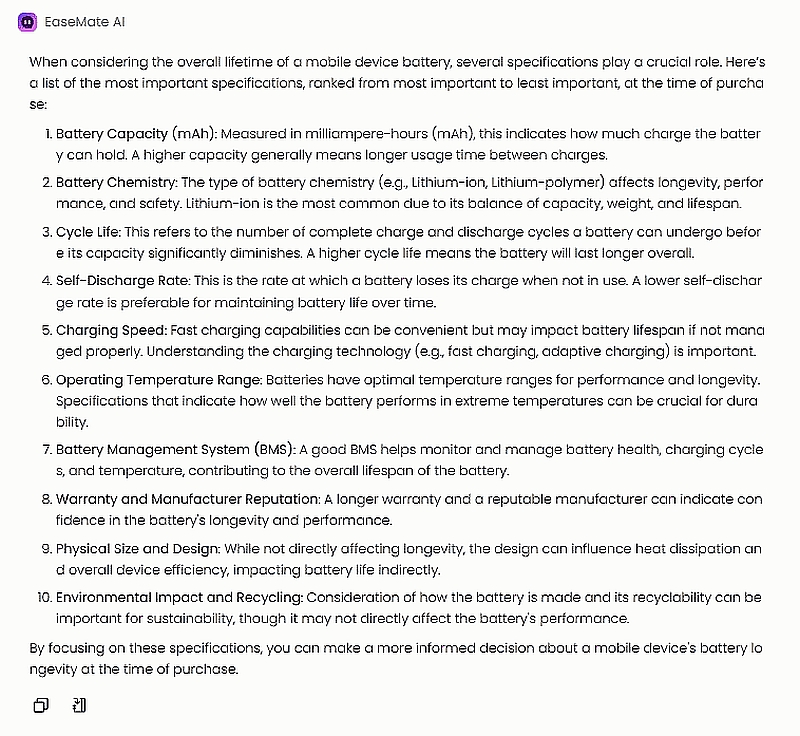
1. Battery Capacity (mAh): Measured in milliampere-hours (mAh), this indicates how much charge the battery can hold. A higher capacity generally means longer usage time between charges.
3. Cycle Life: This refers to the number of complete charge and discharge cycles a battery can undergo before its capacity significantly diminishes.
A higher cycle life means the battery will last longer overall.
John Bokma wrote:Lying by omission...
Q: What are the most important top 3 specifications for any battery?
A: ?
1) How safe is it (don't want an exploding battery),
2) How long it keeps my device up & running during the day,
3) After how much time do I have to replace it (see 2).
For the Windows newsgroup, I'm testing all the free no-registration LLMs, where I am scheduled to test easemate today, so this is the first query:
<https://www.easemate.ai/webapp/chat?from=ai-chat>
Pops this query into that LLM and tell us what you get as the output?
"When mobile device battery overall lifetime (in years) matters most,
what are the most important specifications FOR THE BATTERY, in order
of most important to least important, at purchase time of the device?"
On 2026-10-20 10:26, Maria Sophia wrote:
John Bokma wrote:Lying by omission...
-a-a Q: What are the most important top 3 specifications for any battery? >>>> -a-a A: ?
1) How safe is it (don't want an exploding battery),
2) How long it keeps my device up & running during the day,
3) After how much time do I have to replace it (see 2).
For the Windows newsgroup, I'm testing all the free no-registration LLMs,
where I am scheduled to test easemate today, so this is the first query:
-a <https://www.easemate.ai/webapp/chat?from=ai-chat>
Pops this query into that LLM and tell us what you get as the output?
-a "When mobile device battery overall lifetime (in years) matters most,
-a-a what are the most important specifications FOR THE BATTERY, in order
-a-a of most important to least important, at purchase time of the device?"
...and thinking you're too clever for anyone to notice?
Here's a clue for you, Arlen:
You're not that clever.
On 20/10/2026 19:46, Alan wrote:
On 2026-10-20 10:26, Maria Sophia wrote:
John Bokma wrote:Lying by omission...
-a-a Q: What are the most important top 3 specifications for any
battery?
-a-a A: ?
1) How safe is it (don't want an exploding battery),
2) How long it keeps my device up & running during the day,
3) After how much time do I have to replace it (see 2).
For the Windows newsgroup, I'm testing all the free no-registration
LLMs,
where I am scheduled to test easemate today, so this is the first query: >>> -a <https://www.easemate.ai/webapp/chat?from=ai-chat>
Pops this query into that LLM and tell us what you get as the output?
-a "When mobile device battery overall lifetime (in years) matters most, >>> -a-a what are the most important specifications FOR THE BATTERY, in order >>> -a-a of most important to least important, at purchase time of the
device?"
...and thinking you're too clever for anyone to notice?
Here's a clue for you, Arlen:
You're not that clever.
Yup, asking the same question to Github Copilot (gpt-6-luna):
"
When mobile device battery overall lifetime (in years) matters most,
-a-a what are the most important specifications FOR THE BATTERY, in order
-a-a of most important to least important, at purchase time of the device?
6. Capacity (mAh) rCo A larger battery may require fewer full-equivalent cycles for the same daily use, but capacity by itself does *not* tell
you how many years the battery will last.
Bottom line: prioritize a credible cycle-life rating, then battery replacement support and evidence of good temperature and charging management. Treat fast-charging wattage and mAh as poor indicators of battery longevity on their own.
"
Especially notice the *not* by 6. (Emphasis Copilot, not me).
John Bokma wrote:
Q: What are the most important top 3 specifications for any battery?
A: ?
1) How safe is it (don't want an exploding battery),
2) How long it keeps my device up & running during the day,
3) After how much time do I have to replace it (see 2).
For the Windows newsgroup, I'm testing all the free no-registration LLMs,
On 20/10/2026 19:46, Alan wrote:<snip 6 lines>
On 2026-10-20 10:26, Maria Sophia wrote:
John Bokma wrote:
Lying by omission...
For the Windows newsgroup, I'm testing all the free no-registration
LLMs, where I am scheduled to test easemate today, so this is the
first query: <https://www.easemate.ai/webapp/chat?from=ai-chat>
Pops this query into that LLM and tell us what you get as the
output?
"When mobile device battery overall lifetime (in years) matters
most, what are the most important specifications FOR THE BATTERY, in
order of most important to least important, at purchase time of the
device?"
...and thinking you're too clever for anyone to notice?
Here's a clue for you, Arlen:
You're not that clever.
Yup, asking the same question to Github Copilot (gpt-6-luna):
"
When mobile device battery overall lifetime (in years) matters most,
what are the most important specifications FOR THE BATTERY, in order
of most important to least important, at purchase time of the device?
Thought for 10s
Thought for 2s
For battery lifetime in years, prioritize these at purchaserConot just
how long one charge lasts:
1. Published cycle life to a stated capacity-retention level rCo Look
for a figure such as "at least 1,000 full-equivalent cycles to 80%
capacity," and check the test conditions. A cycle-life number without
a retention target or test details is hard to compare. 2. Battery
replacement options rCo Check whether the battery can be replaced,
whether parts and service are available, and the likely cost. A
replaceable battery can extend the device's useful life more reliably
than a small difference in battery chemistry. 3. Temperature
management rCo Heat accelerates battery aging. Reviews that report
sustained charging or heavy-use temperatures can be more useful than a processor or charging-speed spec alone. 4. Charging controls rCo Prefer
a device that lets you set a charge limit (for example, 80%) or has
effective adaptive charging. Spending less time hot and fully charged generally helps a lithium-ion battery last longer. 5. Chemistry, if
clearly disclosed rCo Chemistry affects cycle life, but phone makers
often provide little detail. Don't assume "lithium-polymer" or a
particular marketing label guarantees longer life. 6. Capacity (mAh) rCo
A larger battery may require fewer full-equivalent cycles for the same
daily use, but capacity by itself does *not* tell you how many years
the battery will last.
Bottom line: prioritize a credible cycle-life rating, then battery replacement support and evidence of good temperature and charging
management. Treat fast-charging wattage and mAh as poor indicators of
battery longevity on their own. "
Especially notice the *not* by 6. (Emphasis Copilot, not me).
1. Battery Capacity (mAh): Measured in milliampere-hours (mAh), this
indicates how much charge the battery can hold. A higher capacity generally >> means longer usage time between charges.
Generally. It depends a lot on the hardware *and* software it runs.
Hence, why I stated "How long it keeps my device up & running during the day" and not "A large capacity".
3. Cycle Life: This refers to the number of complete charge and discharge
cycles a battery can undergo before its capacity significantly diminishes. >> A higher cycle life means the battery will last longer overall.
This is my 3)
[ rest snipped ]
I do miss 1).
Just focusing on capacity is not smart, IMO.
On Oct 20, 2026 at 10:52 AM, John Bokma wrote in 11b89p7$387jb$1@dont-email.me:
Bottom line: prioritize a credible cycle-life rating, then battery
replacement support and evidence of good temperature and charging
management. Treat fast-charging wattage and mAh as poor indicators of
battery longevity on their own. "
Especially notice the *not* by 6. (Emphasis Copilot, not me).
He gets ideas in his head and they will not go away with evidence.
total lifetime is what
I'm always talking about, where Apple's iPhone batteries simply die sooner.
that it's still the most important starting point for overall life."raw capacity affects how long a charge lasts per day, but says
On Oct 20, 2026 at 10:52 AM, John Bokma wrote in 11b89p7$387jb$1@dont-email.me:
On 20/10/2026 19:46, Alan wrote:<snip 6 lines>
On 2026-10-20 10:26, Maria Sophia wrote:
John Bokma wrote:
Lying by omission...
For the Windows newsgroup, I'm testing all the free no-registration
LLMs, where I am scheduled to test easemate today, so this is the
first query: <https://www.easemate.ai/webapp/chat?from=ai-chat>
Pops this query into that LLM and tell us what you get as the
output?
"When mobile device battery overall lifetime (in years) matters
most, what are the most important specifications FOR THE BATTERY, in
order of most important to least important, at purchase time of the
device?"
...and thinking you're too clever for anyone to notice?
Here's a clue for you, Arlen:
You're not that clever.
Yup, asking the same question to Github Copilot (gpt-6-luna):
"
When mobile device battery overall lifetime (in years) matters most,
what are the most important specifications FOR THE BATTERY, in order
of most important to least important, at purchase time of the device?
Thought for 10s
Thought for 2s
For battery lifetime in years, prioritize these at purchaserConot just
how long one charge lasts:
1. Published cycle life to a stated capacity-retention level rCo Look
for a figure such as "at least 1,000 full-equivalent cycles to 80%
capacity," and check the test conditions. A cycle-life number without
a retention target or test details is hard to compare. 2. Battery
replacement options rCo Check whether the battery can be replaced,
whether parts and service are available, and the likely cost. A
replaceable battery can extend the device's useful life more reliably
than a small difference in battery chemistry. 3. Temperature
management rCo Heat accelerates battery aging. Reviews that report
sustained charging or heavy-use temperatures can be more useful than a
processor or charging-speed spec alone. 4. Charging controls rCo Prefer
a device that lets you set a charge limit (for example, 80%) or has
effective adaptive charging. Spending less time hot and fully charged
generally helps a lithium-ion battery last longer. 5. Chemistry, if
clearly disclosed rCo Chemistry affects cycle life, but phone makers
often provide little detail. Don't assume "lithium-polymer" or a
particular marketing label guarantees longer life. 6. Capacity (mAh) rCo
A larger battery may require fewer full-equivalent cycles for the same
daily use, but capacity by itself does *not* tell you how many years
the battery will last.
Bottom line: prioritize a credible cycle-life rating, then battery
replacement support and evidence of good temperature and charging
management. Treat fast-charging wattage and mAh as poor indicators of
battery longevity on their own. "
Especially notice the *not* by 6. (Emphasis Copilot, not me).
He gets ideas in his head and they will not go away with evidence.
6. Capacity (mAh) iX A larger battery may require fewer full-equivalent cycles for the same daily use, but capacity by itself does *not* tell
you how many years the battery will last.
Maria Sophia <mariasophia@comprehension.com> wrote:
total lifetime is what
I'm always talking about, where Apple's iPhone batteries simply die sooner. >>
An assertion you've *never* been able to substantiate beyond vague hand waving.
Got anything concrete, this time?
Brock McNuggets <brock.mcnuggets@gmail.com> wrote:<snip 20 lines>
On Oct 20, 2026 at 10:52 AM, John Bokma wrote in
11b89p7$387jb$1@dont-email.me:
On 20/10/2026 19:46, Alan wrote:<snip 6 lines>
On 2026-10-20 10:26, Maria Sophia wrote:
John Bokma wrote:
Yup, asking the same question to Github Copilot (gpt-6-luna):
"
When mobile device battery overall lifetime (in years) matters most,
what are the most important specifications FOR THE BATTERY, in order
of most important to least important, at purchase time of the
device? Thought for 10s
Thought for 2s
For battery lifetime in years, prioritize these at purchaserConot just
how long one charge lasts:
1. Published cycle life to a stated capacity-retention level rCo Look
for a figure such as "at least 1,000 full-equivalent cycles to 80%
capacity," and check the test conditions. A cycle-life number
without a retention target or test details is hard to compare. 2.
Battery replacement options rCo Check whether the battery can be
replaced, whether parts and service are available, and the likely
cost. A replaceable battery can extend the device's useful life more
reliably than a small difference in battery chemistry. 3.
Temperature management rCo Heat accelerates battery aging. Reviews
that report sustained charging or heavy-use temperatures can be more
useful than a processor or charging-speed spec alone. 4. Charging
controls rCo Prefer a device that lets you set a charge limit (for
example, 80%) or has effective adaptive charging. Spending less time
hot and fully charged generally helps a lithium-ion battery last
longer. 5. Chemistry, if clearly disclosed rCo Chemistry affects cycle
life, but phone makers often provide little detail. Don't assume
"lithium-polymer" or a particular marketing label guarantees longer
life. 6. Capacity (mAh) rCo A larger battery may require fewer
full-equivalent cycles for the same daily use, but capacity by
itself does *not* tell you how many years the battery will last.
Bottom line: prioritize a credible cycle-life rating, then battery
replacement support and evidence of good temperature and charging
management. Treat fast-charging wattage and mAh as poor indicators
of battery longevity on their own. "
Especially notice the *not* by 6. (Emphasis Copilot, not me).
He gets ideas in his head and they will not go away with evidence.
LOL. "Ideas" in his "head". You are assuming facts not in evidence.
On 20/10/2026 20:36, Brock McNuggets wrote:
On Oct 20, 2026 at 10:52 AM, John Bokma wrote in
11b89p7$387jb$1@dont-email.me:
[snip]
Bottom line: prioritize a credible cycle-life rating, then battery
replacement support and evidence of good temperature and charging
management. Treat fast-charging wattage and mAh as poor indicators
of battery longevity on their own. "
Especially notice the *not* by 6. (Emphasis Copilot, not me).
He gets ideas in his head and they will not go away with evidence.
I like the "Treat fast-charging wattage and mAh as poor indicators of
battery longevity on their own.".
I asked Claude.ai the same question:
"
When mobile device battery overall lifetime (in years) matters most,
what are the most important specifications FOR THE BATTERY, in order
of most important to least important, at purchase time of the device?
When you're optimizing specifically for how many years a battery will
remain usable (not just how long it lasts per charge), the specs that
matter most rCo and the order in which they matter rCo look different from what most buying guides emphasize. Here's the ranking:
1. Charge cycle rating (rated cycle life)
This is the single most predictive spec. Manufacturers (or third-party teardown sites) often state something like "rated for 800 cycles to
80% capacity." A battery rated for 1000+ cycles will outlast one rated
for 500, all else equal. This number directly reflects the chemistry
and cell engineering quality, so it's the most direct proxy for
longevity.
2. Battery chemistry type
LFP (LiFePOrea) rCo significantly longer cycle life (often 2000rCo3000+ cycles) and much better tolerance of full charges/heat, at the cost of
lower energy density (bulkier for the same capacity). Rare in phones,
common in some e-readers, power banks, and increasingly some
budget/rugged devices. Standard Li-ion (NMC/NCA/LCO blends) rCo what's
in nearly all phones and laptops; typically 300rCo800 rated cycles
depending on quality. Li-poly rCo essentially a packaging variant of
Li-ion, not a separate chemistry; doesn't meaningfully change
longevity on its own.
Chemistry sets the ceiling that the cycle rating above is drawn from,
so in practice these two specs are closely linked rCo but chemistry is
worth checking separately since it's sometimes disclosed when cycle
count isn't.
3. Charging/discharge voltage range and depth-of-discharge tolerance Batteries that are chemically designed or firmware-limited to charge
to a lower peak voltage (e.g., capped at 4.0V instead of the typical 4.2rCo4.45V per cell) degrade far slower, at the cost of lower usable capacity. Some devices expose this as a "battery health" / "optimized charging" / "80% charge limit" feature rCo if a device offers
hardware-level charge-limiting as a built-in option, that's a
meaningful longevity-relevant spec, not just software fluff.
4. Nominal capacity (mAh) relative to device power draw A larger
battery for the same workload cycles less often per day rCo fewer cycles consumed per year of real-world use extends calendar lifespan, even
with identical cycle-life chemistry. This matters less than #1rCo3
because it only shifts when you hit the cycle count, not how many
cycles the cell can take.
5. Fast-charging wattage supported (inversely important rCo lower is
often better for longevity) Higher-wattage fast charging generates
more heat and current stress per cycle, accelerating degradation
slightly faster than slow charging, all else equal. This is a
secondary factor rCo manufacturers increasingly compensate with better thermal management and charge curves, so it matters less than it used
to, but very high wattages (100W+) on poorly managed systems can
meaningfully shorten lifespan.
6. Battery capacity density/form factor claims (Wh/L, Wh/kg) These
relate to thinness and weight, not longevity rCo denser batteries are sometimes (not always) pushed to tighter tolerances that slightly
reduce cycle life, but this is a minor, inconsistent effect compared
to the specs above. Worth knowing about, but not something to weight
heavily in a purchase decision.
Why "mAh capacity" alone (which most buyers fixate on) ranks lower
here: raw capacity affects how long a charge lasts per day, but says
nothing about how many years of daily charging the cell can sustain
before degrading rCo which is a separate, chemistry/engineering-driven property.
Practical note: cycle-count ratings and charge-voltage specs are
rarely printed on spec sheets or marketing pages rCo they're usually
found in teardown reports (iFixit), manufacturer
sustainability/repairability disclosures, or battery health
documentation (especially for Apple devices, which publish this). If a
listed spec sheet only gives you mAh and nothing else, that alone
tells you very little about multi-year longevity. "
Again, in the practical note we read: *If a listed spec sheet only
gives you mAh and nothing else, that alone tells you very little about multi-year longevity.*
And of course, this gem: *Why "mAh capacity" alone (which most buyers
fixate on) ranks lower here: raw capacity affects how long a charge
lasts per day, but says nothing about how many years of daily charging
the cell can sustain before degrading rCo which is a separate, chemistry/engineering-driven property.*
(Emphasis mine, in both cases)
For the Windows newsgroup, I'm testing all the free no-registration LLMs,
The one I used [1] concluded: "Treat fast-charging wattage and mAh as
poor indicators of battery longevity on their own". That's what
everybody, except you, have been saying.
[1] Github's Copilot CLI with gpt-luna-6, see also my other post.
In this case, Chris claimed that the initial capacity was a 'brain dead' specification, where I doubt you can find a single LLM that will NOT put
the initial capacity on the list when you ask the question about lifetime.
Remember, we've had this discussion about the crappy batteries Apple puts
in iPhones for something like a decade, so it's only the starting point.
[capacity]> But my point to Chris, who said it was a "brain dead" specification, is
that it's still the most important starting point for overall life."raw capacity affects how long a charge lasts per day, but says
*nothing* about how many years of daily charging the cell can sustain
before degrading iX which is a separate, chemistry/engineering-driven property."
John Bokma wrote:
[capacity]> But my point to Chris, who said it was a "brain dead"
specification, is
that it's still the most important starting point for overall life."raw capacity affects how long a charge lasts per day, but says
*nothing* about how many years of daily charging the cell can sustain
before degrading -iX which is a separate, chemistry/engineering-driven
property."
For a moment, I thought you weren't an Apple religious zealot nutcase.
But this shows that you resorted to bullshit to defend Apple's
decisions.
Seriously. Don't waste our time with idiotically absurd inanely
childish defenses of Apple's decision to put crappy batteries in the
iPhone.
Show me a screenshot of what you exactly asked and what it exactly
said. Make sure you asked about mobile devices. Not flashlight
batteries.
Because nobody with any knowledge of batteries would claim that the
initial capacity isn't one of the most important specifications for
overall life in a mobile device.
Nobody.
Specifically, we're not talking about car batteries. We're not talking
about batteries used in toys. We're talking about mobile device
batteries.
What Apple religious zealot nutcases do to defend every Apple decision
is they come up with the first absurdly inane excuse they can think
of.
Why not ask the LLM why Apple puts crappy batteries in the iPhone,
John?
In this case, Chris claimed that the initial capacity was a 'brain dead'
specification, where I doubt you can find a single LLM that will NOT put
the initial capacity on the list when you ask the question about lifetime.
Each, so far, has given a warning that it's more or less meaningless to
look at capacity by itself.
Remember, we've had this discussion about the crappy batteries Apple puts
in iPhones for something like a decade, so it's only the starting point.
According to Claude:
"
the "Apple batteries die sooner" impression, if you've heard it, isn't
well supported by current rated cycle-life specs or degradation data iX Apple's newer-model ratings are actually competitive-to-better than many Android counterparts in the same price tier. What is true is that
Apple's battery health reporting is more visible and standardized, which paradoxically can make iPhone battery decline feel more noticeable/discussed, simply because people can actually see the number dropping.
"
So, newer-model ratings are actually competitive-to-better. I don't care that 6 years ago they used less good parts. Ten years ago batteries
exploded in Samsung devices... And the replacements, too...
John Bokma wrote:
For the Windows newsgroup, I'm testing all the free no-registration LLMs, >>The one I used [1] concluded: "Treat fast-charging wattage and mAh as
poor indicators of battery longevity on their own". That's what
everybody, except you, have been saying.
[1] Github's Copilot CLI with gpt-luna-6, see also my other post.
I never disagree with anyone who makes a logically sensible statement.
Yet, I'll vehemently disagree with idiotic statements like that one, John.
I repeat, I have higher degrees in electrical engineering
and I would never
have said that the only specification that matters for long life is a
single capacity metric, but, I would say it's certainly an important
metric.
Got anything concrete, this time?
I just asked Claude:
Show me a screenshot of what you exactly asked and what it exactly said.
Make sure you asked about mobile devices. Not flashlight batteries.
Let's mathematically compare overall life between these two flagships:1. 2. 3. 4. 5. 6.
Apple iPhone 17 Pro Max
Samsung Galaxy S26 Ultra
John Bokma wrote:
Q: What are the most important top 3 specifications for any battery?
A: ?
1) How safe is it (don't want an exploding battery),
2) How long it keeps my device up & running during the day,
3) After how much time do I have to replace it (see 2).
For the Windows newsgroup, I'm testing all the free no-registration LLMs, where I am scheduled to test easemate today, so this is the first query:
<https://www.easemate.ai/webapp/chat?from=ai-chat>
Pops this query into that LLM and tell us what you get as the output?
On 20/10/2026 21:10, Chris wrote:Shortly, Arlen/Maria will conclude that Claude is an "Apple religious
Maria Sophia <mariasophia@comprehension.com> wrote:
-a total lifetime is what
I'm always talking about, where Apple's iPhone batteries simply die
sooner.
An assertion you've *never* been able to substantiate beyond vague hand
waving.
Got anything concrete, this time?
I just asked Claude:
"
Do apple batteries die sooner?
Searched the web
Short answer: not really rCo not systematically.
Maria Sophia <mariasophia@comprehension.com> wrote:
John Bokma wrote:
Q: What are the most important top 3 specifications for any battery?
A: ?
1) How safe is it (don't want an exploding battery),
2) How long it keeps my device up & running during the day,
3) After how much time do I have to replace it (see 2).
For the Windows newsgroup, I'm testing all the free no-registration LLMs,
where I am scheduled to test easemate today, so this is the first query:
<https://www.easemate.ai/webapp/chat?from=ai-chat>
Pops this query into that LLM and tell us what you get as the output?
Lol. Asking an LLM is the refuge of those who can't support their own arguments.
On 20/10/2026 21:02, Maria Sophia wrote:
[capacity]> But my point to Chris, who said it was a "brain dead" specification, is
that it's still the most important starting point for overall life."raw capacity affects how long a charge lasts per day, but says
*nothing* about how many years of daily charging the cell can sustain
before degrading rCo which is a separate, chemistry/engineering-driven property."
According to Claude, emphasis mine.
According to Claude, emphasis mine.
I don't need technical data because I have my own experience: the nearly five-year-old iPhone I own lasts me all day, not one Android I've ever
owned has been able to do the same. Similarly, my MacBook Air can easily last a day or two for my kind of work, not one PC I've ever owned has
been able to do the same, and neither has any Android device or Linux installation. I know that they are now making PCs with battery life that competes with what Macs offer, but if you are going to buy devices with
a long-lasting battery, why the heck would you want it to run Windows?
On 20/10/2026 19:06, Maria Sophia wrote:
Q: What are the most important top 3 specifications for any battery?
A: ?
1) How safe is it (don't want an exploding battery),
2) How long it keeps my device up & running during the day,
3) After how much time do I have to replace it (see 2).
I never disagree with anyone who makes a logically sensible statement.
Yet, I'll vehemently disagree with idiotic statements like that one, John.
Yes, I got that. Yet it's true: relying only on capacity is silly.
I repeat, I have higher degrees in electrical engineering
Higher than whom?
and I would never
have said that the only specification that matters for long life is a
single capacity metric, but, I would say it's certainly an important
metric.
It's way less important than you make it sound.
For the Windows newsgroup, I'm testing all the free no-registration LLMs,
where I am scheduled to test easemate today, so this is the first query:
<https://www.easemate.ai/webapp/chat?from=ai-chat>
Pops this query into that LLM and tell us what you get as the output?
Lol. Asking an LLM is the refuge of those who can't support their own arguments.
Source: <https://www.gsmarena.com/battery-test-v2.php3>
CrudeSausage wrote:
According to Claude, emphasis mine.
I don't need technical data because I have my own experience: the nearly
five-year-old iPhone I own lasts me all day, not one Android I've ever
owned has been able to do the same. Similarly, my MacBook Air can easily
last a day or two for my kind of work, not one PC I've ever owned has
been able to do the same, and neither has any Android device or Linux
installation. I know that they are now making PCs with battery life that
competes with what Macs offer, but if you are going to buy devices with
a long-lasting battery, why the heck would you want it to run Windows?
Why is iPhone battery life substantially shorter than the similar Samsung?
Newsgroups: misc.phone.mobile.iphone,comp.sys.mac.advocacy,uk.telecom.mobile
Subject: EU standards compare Apple iPhone 17 Pro Max & Samsung Galaxy S26 Ultra battery lifetime
Date: Thu, 16 Apr 2026 23:30:04 -0600
Message-ID: <10rsggs$2vhk$1@nnrp.usenet.blueworldhosting.com>
John Bokma wrote:
I never disagree with anyone who makes a logically sensible statement.Yes, I got that. Yet it's true: relying only on capacity is silly.
Yet, I'll vehemently disagree with idiotic statements like that one, John. >>
The fact your ONLY argument is a gross distortion of what was said is why
you Apple religious zealot nutcases have the reputation that you have.
You're proving me right that you Apple religious zealot nutcases use the first absurd inanely idiotic excuses to defend your Apple God to the death.
I repeat, I have higher degrees in electrical engineering
Higher than whom?
The funny thing is that was actually funny, which is funny because it's
clear that all you Apple religious zealot nutcases have no education.
You're proving me correct that you have no education since your only
response to facts is a cut-and-paste of idiocy you copied out of an LLM.
and I would never
have said that the only specification that matters for long life is a
single capacity metric, but, I would say it's certainly an important
metric.
It's way less important than you make it sound.
You know what's important?
Facts are important.
Why don't you explain why all Apple iPhones failed to achieve an A rating when the first EU benchmarks came out? We predicted that for over a decade.
Explain this:
Newsgroups: misc.phone.mobile.iphone,comp.sys.mac.advocacy,uk.telecom.mobile
Subject: EU standards compare Apple iPhone 17 Pro Max & Samsung Galaxy S26 Ultra battery lifetime
Date: Thu, 16 Apr 2026 23:30:04 -0600
Message-ID: <10rsggs$2vhk$1@nnrp.usenet.blueworldhosting.com>
Chris wrote:
For the Windows newsgroup, I'm testing all the free no-registration LLMs, >>> where I am scheduled to test easemate today, so this is the first query: >>> <https://www.easemate.ai/webapp/chat?from=ai-chat>
Pops this query into that LLM and tell us what you get as the output?
Lol. Asking an LLM is the refuge of those who can't support their own
arguments.
And yet, I've been proving this claim for a decade, well before LLMs Chris.
I would never
have said that the only specification that matters for long life is a
single capacity metric, but, I would say it's certainly an important
metric.
And yet, I've been proving this claim for a decade, well before LLMs Chris.
A genuine proof only needs doing once. You've spent a decade proving
nothing. The EU now has the data which evidences why you're wrong.
Take a Class A 5,000 mAh phone and compare it to a Class C 5,000 mAh model. What do you get?
Hint: about 15-20% less endurance.
Comparing best with worst - just within the 5,000 mAh models - is about 50% different.
Using battery capacity as the main criterion is one dimensional thinking
aka "brain dead".
I would never
have said that the only specification that matters for long life is a
single capacity metric, but, I would say it's certainly an important
metric.
Rowing back your original claim, I see. You stated that it was *the most* important metric.
Chris wrote:
And yet, I've been proving this claim for a decade, well before LLMs Chris. >>A genuine proof only needs doing once. You've spent a decade proving
nothing. The EU now has the data which evidences why you're wrong.
Take a Class A 5,000 mAh phone and compare it to a Class C 5,000 mAh model. >> What do you get?
Hint: about 15-20% less endurance.
Comparing best with worst - just within the 5,000 mAh models - is about 50% >> different.
Using battery capacity as the main criterion is one dimensional thinking
aka "brain dead".
Hi Chris,
You saw the results in this thread below, Chris. yet, you say they're wrong.
Newsgroups: misc.phone.mobile.iphone,comp.sys.mac.advocacy,uk.telecom.mobile
Subject: EU standards compare Apple iPhone 17 Pro Max & Samsung Galaxy
S26 Ultra battery lifetime
Date: Thu, 16 Apr 2026 23:30:04 -0600
Message-ID: <10rsggs$2vhk$1@nnrp.usenet.blueworldhosting.com>
There is an intelligent reason I refer to you as a religious zealot, Chris.
Your firmly held belief system is built on Apple's marketing claims & nothing else.
There is no way to prove anything factual to you religious zealot nutcases.
Chris wrote:
I would never
have said that the only specification that matters for long life is a
single capacity metric, but, I would say it's certainly an important
metric.
Rowing back your original claim, I see. You stated that it was *the most*
important metric.
It's not a "brain-dead" specification, Chris, which is what YOU said.
It's fine that Apple religious zealots defend all of Apple's decisions.
But you do it using the first absurd excuse that pops into your head.
On 2026-10-20 12:16, John Bokma wrote:
On 20/10/2026 21:10, Chris wrote:Shortly, Arlen/Maria will conclude that Claude is an "Apple religious zealot".
Maria Sophia <mariasophia@comprehension.com> wrote:
-a total lifetime is what
I'm always talking about, where Apple's iPhone batteries simply die
sooner.
An assertion you've *never* been able to substantiate beyond vague hand
waving.
Got anything concrete, this time?
I just asked Claude:
"
Do apple batteries die sooner?
Searched the web
Short answer: not really rCo not systematically.
CrudeSausage wrote:
According to Claude, emphasis mine.
I don't need technical data because I have my own experience: the nearly
five-year-old iPhone I own lasts me all day, not one Android I've ever
owned has been able to do the same. Similarly, my MacBook Air can easily
last a day or two for my kind of work, not one PC I've ever owned has
been able to do the same, and neither has any Android device or Linux
installation. I know that they are now making PCs with battery life that
competes with what Macs offer, but if you are going to buy devices with
a long-lasting battery, why the heck would you want it to run Windows?
Why is iPhone battery life substantially shorter than the similar Samsung?
Newsgroups: misc.phone.mobile.iphone,comp.sys.mac.advocacy,uk.telecom.mobile
Subject: EU standards compare Apple iPhone 17 Pro Max & Samsung Galaxy
S26 Ultra battery lifetime
Date: Thu, 16 Apr 2026 23:30:04 -0600
Message-ID: <10rsggs$2vhk$1@nnrp.usenet.blueworldhosting.com>
Why is iPhone battery life substantially shorter than the similar Samsung?
It isn't.
Newsgroups: misc.phone.mobile.iphone,comp.sys.mac.advocacy,uk.telecom.mobile
Subject: EU standards compare Apple iPhone 17 Pro Max & Samsung Galaxy
S26 Ultra battery lifetime
Date: Thu, 16 Apr 2026 23:30:04 -0600
Message-ID: <10rsggs$2vhk$1@nnrp.usenet.blueworldhosting.com>
Because you're massively over-interpreting the data. The cycle count is a manufacturer-provided *minimum* to meet the EU requirement. To be in spec
in needs to be at least 1000 cycles. That it. No-one checks whether it's
real or not. They could, but it would likely take months of continuous testing and would be challenged as being unrealistic.
You're using this number as some kind of quantifiable variable. It isn't. It's just marketing. Samsung have made their number bigger than Apple for
the lolz. They got caught using an unbelievably high number last year and
so reduced it significantly it this year.
Maria Sophia <mariasophia@comprehension.com> wrote:
Chris wrote:
Maybe, for once, you'll engage with empirical data.
Thank God
Sadly it seems not. Time to put you back in your box.
It's not a "brain-dead" specification, Chris, which is what YOU said.
Correct. Which I stand 100% behind. It is factually accurate.
You, on the other hand, have the conviction of a dead fish.
It's fine that Apple religious zealots defend all of Apple's decisions.
The only zealot here is you. You're just too old and blinkered to see it.
But you do it using the first absurd excuse that pops into your head.
Remind me. Who has regulatory data covering over 1000 mobile phone models
on their side? Hint: it's not you.
Note: Kill-time is a term chosen to make the point, much like an LD50
is for drug companies, that it's a calculated value to a detrimental state.
A. Apple iPhone 17 Pro Max
a. Capacity: 4800 mAh
b. EU Endurance (Single Charge): 53 hours
c. EU Cycle Rating (to 80%): 1,000 cycles
d. Daily Cycles (24h/53h): 0.45283 cycles/day
B. Samsung Galaxy S26 Ultra
a. Capacity: 4855 mAh
b. EU Endurance (Single Charge): 55 hours
c. EU Cycle Rating (to 80%): 1,200 cycles
d. Daily Cycles (24h/55h): 0.43636 cycles/day
2. 'Kill Time' = Total Life Cycles / Daily Cycles
2. 'Kill Time' = Total Life Cycles / Daily Cycles
There is no way to prove anything factual to you religious zealot nutcases.
Projection. You wouldn't recognise a fact if it shat on your bed.
iPhone 17 Pro Max hrs of runtime per charge cycle = 18.87 hours
Samsung S26 Ultra hrs of runtime per charge cycle = 21.82 hours
*Winner = Samsung (+15.6%)*
Back to school with you!
Again, you show you have no clue.
John Bokma wrote:
Back to school with you!
Anyone care to run the same task but against the folding flagships?
iPhone 17 Pro Max hrs of runtime per charge cycle = 18.87 hours
Samsung S26 Ultra hrs of runtime per charge cycle = 21.82 hours
*Winner = Samsung (+15.6%)*
However, in the real world and not the back of a napkin:
Apple iPhone 17 Pro Max 17:58h 24:26h 15:33h 25:41h 12:08h 17:58h Samsung Galaxy S26 Ultra 16:23h 37:44h 13:01h 24:48h 9:42h 16:23h
For shit and giggles, let's add the more recent model as well:
Apple iPhone 18 Pro Max 19:20h 31:23h 17:13h 26:12h 12:09h 19:20h
Chris wrote:
It's not a "brain-dead" specification, Chris, which is what YOU said.
Correct. Which I stand 100% behind. It is factually accurate.
You, on the other hand, have the conviction of a dead fish.
WTF? What are you babbling about? Seriously. What are you saying, Chris?
We're talking overall lifetime of a smartphone battery,
John Bokma wrote:
iPhone 17 Pro Max hrs of runtime per charge cycle = 18.87 hours
Samsung S26 Ultra hrs of runtime per charge cycle = 21.82 hours
*Winner = Samsung (+15.6%)*
However, in the real world and not the back of a napkin:
Apple iPhone 17 Pro Max 17:58h 24:26h 15:33h 25:41h 12:08h 17:58h
Samsung Galaxy S26 Ultra 16:23h 37:44h 13:01h 24:48h 9:42h 16:23h
For shit and giggles, let's add the more recent model as well:
Apple iPhone 18 Pro Max 19:20h 31:23h 17:13h 26:12h 12:09h 19:20h
For some strange reason, even after discussing this topic on the Apple
and Android newsgroups for about a decade, some people just can't get
into their heads that battery lifetime is measured in years, not in
hours.
Sigh... they prove me right every time...
Apple religious zealot nutcases defend Apple to the death, no matter
what, using the first inane excuse that they can possibly think of,
even when their argument is the wrong metric (i.e., hours versus
years).
What's no longer astounding, you can explain that an hour isn't the
same as a year for a decade, and still, the Apple religious zealots
don't get it.
Reminds me of when Snit claimed a megabit was the same as a decibel,
simply because he saw a moving graph, so, to Apple zealots, that's the
same thing!
*Snit video purportedly proving that a decibel is a
megabitperseconde!* <https://youtu.be/7QaABa6DFIo>
*It's a fact iOS devices can't even graph Wi-Fi signal strength over
time*
<https://groups.google.com/g/misc.phone.mobile.iphone/c/PZuec56EWB0>
<https://groups.google.com/forum/#!topic/misc.phone.mobile.iphone/PZuec56EWB0>
Chris wrote:Did you just recently admit that there was no difference in chemistry,
Why is iPhone battery life substantially shorter than the similar Samsung? >>It isn't.
Newsgroups: misc.phone.mobile.iphone,comp.sys.mac.advocacy,uk.telecom.mobile
Subject: EU standards compare Apple iPhone 17 Pro Max & Samsung Galaxy >>> S26 Ultra battery lifetime
Date: Thu, 16 Apr 2026 23:30:04 -0600
Message-ID: <10rsggs$2vhk$1@nnrp.usenet.blueworldhosting.com>
Because you're massively over-interpreting the data. The cycle count is a
manufacturer-provided *minimum* to meet the EU requirement. To be in spec
in needs to be at least 1000 cycles. That it. No-one checks whether it's
real or not. They could, but it would likely take months of continuous
testing and would be challenged as being unrealistic.
You're using this number as some kind of quantifiable variable. It isn't.
It's just marketing. Samsung have made their number bigger than Apple for
the lolz. They got caught using an unbelievably high number last year and
so reduced it significantly it this year.
You can't just say all math that doesn't make Apple look good is wrong.
And, it's hilarious that you, of all people, claim "It's just marketing".
The chemistry is *different* so cycle count differences are plausible.
Alan <nuh-uh@nope.com> wrote:
On 2026-10-20 12:16, John Bokma wrote:
On 20/10/2026 21:10, Chris wrote:Shortly, Arlen/Maria will conclude that Claude is an "Apple religious
Maria Sophia <mariasophia@comprehension.com> wrote:
-a total lifetime is what
I'm always talking about, where Apple's iPhone batteries simply die
sooner.
An assertion you've *never* been able to substantiate beyond vague hand >>>> waving.
Got anything concrete, this time?
I just asked Claude:
"
Do apple batteries die sooner?
Searched the web
Short answer: not really rCo not systematically.
zealot".
ROFL
For some strange reason, even after discussing this topic on the Apple and Android newsgroups for about a decade,
This subthread is talking about how battery capacity is (not) the
most important aspect when buying a phone.
That's brain dead and the facts support that.
You want to change the subject, because you lost the argument. Again.
For some strange reason, even after discussing this topic on the Apple and >> Android newsgroups for about a decade,
You still don't have a clue... That's not a strange reason, that's just plain ignorance on your side.
Chris wrote:
There is no way to prove anything factual to you religious zealot nutcases. >>Projection. You wouldn't recognise a fact if it shat on your bed.
These are facts using similar phones which we chose blind in April, before
we ran the calculations based only EU specifications, which we agreed on.
iPhone 17 Pro Max hrs of runtime per charge cycle = 18.87 hours
Samsung S26 Ultra hrs of runtime per charge cycle = 21.82 hours
*Winner = Samsung (+15.6%)*
iPhone 18 Pro Max endurance per charge = 62 hours
Samsung S26 Ultra endurance per charge = 55 hours
*Winner = Apple (+12.7%)*
iPhone 18 Pro Max efficiency (hrs/Ah) = 11.50
Samsung S26 Ultra efficiency (hrs/Ah) = 11.33
*Winner = Apple (+1.5%)*
iPhone 18 Pro Max calendar life (calculated) = ~7.08 years
Samsung S26 Ultra calendar life (calculated) = ~7.53 years
*Winner (of an unreliable metric) = Samsung (6.3%)*
Chris wrote:
Why is iPhone battery life substantially shorter than the similar Samsung? >>It isn't.
Newsgroups: misc.phone.mobile.iphone,comp.sys.mac.advocacy,uk.telecom.mobile
Subject: EU standards compare Apple iPhone 17 Pro Max & Samsung Galaxy
S26 Ultra battery lifetime
Date: Thu, 16 Apr 2026 23:30:04 -0600
Message-ID: <10rsggs$2vhk$1@nnrp.usenet.blueworldhosting.com>
Because you're massively over-interpreting the data. The cycle count is a
manufacturer-provided *minimum* to meet the EU requirement. To be in spec
in needs to be at least 1000 cycles. That it. No-one checks whether it's
real or not. They could, but it would likely take months of continuous
testing and would be challenged as being unrealistic.
You're using this number as some kind of quantifiable variable. It isn't.
It's just marketing. Samsung have made their number bigger than Apple for
the lolz. They got caught using an unbelievably high number last year and
so reduced it significantly it this year.
You can't just say all math that doesn't make Apple look good is wrong.
And, it's hilarious that you, of all people, claim "It's just marketing".
The chemistry is *different* so cycle count differences are plausible.
If any numbers are wrong, I ask the team to point them out please.
The Samsung lasts 1-1/2 years *longer* than the "efficient" iPhone
(proving, yet again, that this bogus "efficiency" proffers no value).
The discussion regarding the EU Ecodesign Regulation (EU 2023/1670)
provides the first standardized 'Kill Time' metric we have ever had.
Note: Kill-time is a term chosen to make the point, much like an LD50
is for drug companies, that it's a calculated value to a detrimental state.
I'll ignore the insults and focus on the facts because it's important
to parse the (admittedly brilliant) marketing propaganda surrounding this bogus amorphous "efficiency" that has never once resulted in actual value.
These are facts using similar phones which we chose blind in April, before >> we ran the calculations based only EU specifications, which we agreed on.
Problem is this data is out of date. The 17 Pro Max is no longer for sale. Let's compare with the 18 Pro Max
iPhone 17 Pro Max hrs of runtime per charge cycle = 18.87 hours
Samsung S26 Ultra hrs of runtime per charge cycle = 21.82 hours
*Winner = Samsung (+15.6%)*
No idea how you got these numbers. That's not EU data.
iPhone 18 Pro Max endurance per charge = 62 hours
Samsung S26 Ultra endurance per charge = 55 hours
*Winner = Apple (+12.7%)*
iPhone 18 Pro Max efficiency (hrs/Ah) = 11.50
Samsung S26 Ultra efficiency (hrs/Ah) = 11.33
*Winner = Apple (+1.5%)*
iPhone 18 Pro Max calendar life (calculated) = ~7.08 years
Samsung S26 Ultra calendar life (calculated) = ~7.53 years
*Winner (of an unreliable metric) = Samsung (6.3%)*
The 18 Pro Max is clearly the best Flagship model when it comes to battery life and efficiency. The Pixel is pretty bad.
https://imgpile.com/p/F4eCpUZ
It's possibly the Samsung S27 might leapfrog to the top, or maybe not.
The chemistry is *different* so cycle count differences are plausible.
You're assuming the chemistry is different. Do you have any evidence that isn't a tautology.
If any numbers are wrong, I ask the team to point them out please.
I have done many, many times. Yet you still claim that day is night.
The Samsung lasts 1-1/2 years *longer* than the "efficient" iPhone
(proving, yet again, that this bogus "efficiency" proffers no value).
The discussion regarding the EU Ecodesign Regulation (EU 2023/1670)
provides the first standardized 'Kill Time' metric we have ever had.
Note: Kill-time is a term chosen to make the point, much like an LD50
is for drug companies, that it's a calculated value to a detrimental state.
No drug company would use LD50. A toxicology or research lab might. What you're thinking about is EC50 which requires experimentally validated data. The claimed battery cycle count is not validated data so can't be used in your tortured argument.
I'll ignore the insults and focus on the facts because it's important
to parse the (admittedly brilliant) marketing propaganda surrounding this >> bogus amorphous "efficiency" that has never once resulted in actual value.
Yet you've calculated efficiency values yourself and very happy to quote
the EU's efficiency classes. You can't argue it both ways.
It can't be bogus and something you've calculated yourself. So which is it?
John Bokma wrote:
For some strange reason, even after discussing this topic on the
Apple and Android newsgroups for about a decade,
You still don't have a clue... That's not a strange reason, that's
just plain ignorance on your side.
Only you Apple nutcases can't comprehend an hour isn't the same as a
year.
And you only make that absurd mistake when defending Apple to the
death.
Using the first absurdly inane excuse that pops into your head.
You prove me right about you with every post.
Sigh...
John Bokma wrote:
For some strange reason, even after discussing this topic on the Apple and >>> Android newsgroups for about a decade,
You still don't have a clue... That's not a strange reason, that's just
plain ignorance on your side.
Only you Apple nutcases can't comprehend an hour isn't the same as a year.
The chemistry is different so cycle count differences are plausible.
YourCOre assuming the chemistry is different. Do you have any evidence that isnrCOt a tautology.
LetrCOs say Samsung claims 1,200.
LetrCOs say NOBODY disputes that, not the EU, not Google, not even Apple.
Then, letrCOs say, Chris disputes it.
Chris thinks it should be, oh, take a swab. Say 958 instead.
You canrCOt just say you donrCOt like the numbers & then fabricate a number.
1. The specifications (EU certified)
A. Apple iPhone 17 Pro Max
a. Capacity: 4800 mAh
b. EU Endurance (Single Charge): 53 hours
c. EU Cycle Rating (to 80%): 1,000 cycles
B. Samsung Galaxy S26 Ultra
a. Capacity: 4855 mAh
b. EU Endurance (Single Charge): 55 hours
c. EU Cycle Rating (to 80%): 1,200 cycles
rCyKill TimerCO = Total Life Cycles / Daily Cycles
A. Apple iPhone 17 Pro Max:
1,000 / ~0.453 = 2,208.33 days (approx 6.05 years)
B. Samsung Galaxy S26 Ultra:
1,200 / ~0.436 = 2,750 days (approx 7.53 years)
The Samsung lasts 1-1/2 years longer than the rCLefficientrCY iPhone (proving, yet again, that this bogus rCLefficiencyrCY proffers no value).
Kill-time is a term chosen to make the point, much like an LD50
is for drug companies, that itrCOs a calculated value to a detrimental state.
No drug company would use LD50. A toxicology or research lab might. What yourCOre thinking about is EC50 which requires experimentally validated data. The claimed battery cycle count is not validated data so canrCOt be used in your tortured argument.
As you know, I have higher degrees, one of which is in the biological sciences, so thatrCOs why I used the LD50 as an example, but it was just an example so people could understand the point that the battery will die.
IrCOll ignore the insults and focus on the facts because itrCOs important
to parse the (admittedly brilliant) marketing propaganda surrounding this bogus amorphous rCLefficiencyrCY that has never once resulted in actual value.
Yet yourCOve calculated efficiency values yourself and very happy to quote the EUrCOs efficiency classes. You canrCOt argue it both ways.
It canrCOt be bogus and something yourCOve calculated yourself. So which is it?
Efficiency Calculation: 53 hours / 4.8 Ah = 11.04 hours per Ah
I have done many, many times. Yet you still claim that day is night.
Which numbers in the calculation are you saying are wrong Chris.
You canrCOt just say theyrCOre all wrong, rCOcuz they came from EU documents.
a. Tell us exactly which figure you think is wrong below.
b. Tell us exactly what you think it should be
c. And provide a reputable cite to back up your claim
Durability:
Samsung wins. The 1,200 cycle rating on SamsungrCOs 2026 chemistry
provides the Kill-Time victory despite the claimed iPhone efficiency.
4. Summary of the facts:
a. Efficiency:
Samsung wins.
b. Capacity:
Samsung wins, though Apple has finally started closing the
historic battery-capacity gap (but only recently).
c. Durability:
Samsung wins.
Only you Apple nutcases can't comprehend an hour isn't the same as a year.
Once again, your so called kill time ASSumes that a battery is perfect.
It isn't.
ROFL
John Bokma wrote:
Only you Apple nutcases can't comprehend an hour isn't the same as a year. >>Once again, your so called kill time ASSumes that a battery is perfect.
It isn't.
ROFL
Why donrCOt you Apple religious zealots respond to the facts, with facts?
iPhone 17 Pro Max hrs of runtime per charge cycle = 18.87 hours
Samsung S26 Ultra hrs of runtime per charge cycle = 21.82 hours
Winner = Samsung (+15.6%)
iPhone 17 Pro Max calendar life (calculated) = ~6.05 years
Samsung S26 Ultra calendar life (calculated) = ~7.53 years
Winner = Samsung (24.5%)
Use this template to compare the iPhone folding flagship.
To the Samsung folding flagship.
Then, letrCOs see how funny the results are.
Why donrCOt you Apple religious zealots respond to the facts, with facts?
Chris wrote:
These are facts using similar phones which we chose blind in April, before >>> we ran the calculations based only EU specifications, which we agreed on. >>Problem is this data is out of date. The 17 Pro Max is no longer for sale. >> Let's compare with the 18 Pro Max
Do it.
I'd love to see the results. I'm sure all of us would love to see them.
As before with the iPhone 17 Pro Max, I have no idea how it will turn out.
I suspect the iPhone will suck, but Apple got a bruising with the first EU benchmarks proving the crappy batteries, so maybe Apple fixed that problem?
I don't know if Apple learned anything from being shown to be liars all these years about their supposed "efficiency", so maybe they fixed it?
Dunno.
Like any normal person, I WELCOME you calculating & reporting the result.
To help you, I provided a working template on the bottom of this article.
iPhone 17 Pro Max hrs of runtime per charge cycle = 18.87 hours
Samsung S26 Ultra hrs of runtime per charge cycle = 21.82 hours
*Winner = Samsung (+15.6%)*
No idea how you got these numbers. That's not EU data.
We explained in gory detail many times EXACTLY how we got those numbers.
Stop using the first absurd excuse you can think of because you hate 'em.
The explanation is provided for you in the bottom of this article.
iPhone 18 Pro Max endurance per charge = 62 hours
Samsung S26 Ultra endurance per charge = 55 hours
*Winner = Apple (+12.7%)*
iPhone 18 Pro Max efficiency (hrs/Ah) = 11.50
Samsung S26 Ultra efficiency (hrs/Ah) = 11.33
*Winner = Apple (+1.5%)*
iPhone 18 Pro Max calendar life (calculated) = ~7.08 years
Samsung S26 Ultra calendar life (calculated) = ~7.53 years
*Winner (of an unreliable metric) = Samsung (6.3%)*
The 18 Pro Max is clearly the best Flagship model when it comes to battery >> life and efficiency. The Pixel is pretty bad.
https://imgpile.com/p/F4eCpUZ
It's possibly the Samsung S27 might leapfrog to the top, or maybe not.
Unlike you Apple nutcases, Chris, normal people, like those on the Android newsgroup, don't defend any mothership to the death. Just you do it.
So we WELCOME your comparison of the total battery life (in years, not
in daily hours) between the top-of-the-line Samsung and iPhone.
The Pixel isn't generally considered fair competition to either,
Chris wrote:
The chemistry is *different* so cycle count differences are plausible.
You're assuming the chemistry is different. Do you have any evidence that
isn't a tautology.
The last time I *looked* at that Samsung claim was April 2026, so I don't remember what's different, but what you're doing is absurd, Chris.
Let's say Samsung claims 1,200.
Let's say NOBODY disputes that, not the EU, not Google, not even Apple.
Then, let's say, Chris disputes it.
Chris thinks it should be, oh, take a swab. Say 958 instead.
That way, if Chris fabricates any number that NOBODY ELSE backs up, then Chris can claim better results in the overall battery-life calculations.
And back it up with cites.
Like I did.
As you know, I have higher degrees,
Here is a template of how the calculations came about.
Chris wrote:
Not to mention that anyone who can afford a $2000+ phone will get the
AppleCare also. So your entire tirade is fairly stupid.
Anyone that can afford a $2000+ phone (hell, a $1000+ phone) will
likely be replacing as soon as the next model is released anyway.
Clearly not true. Most people change their phones every 3-4 years. Unless
you're on the Apple phone plan where you can swap your phone every year.
All these high-end phones that cost more than a desktop computer are
aimed at idiots with more money than sense.
Base Samsung Galaxy Z Fold 8 and Google Pixel 11 Pro Fold MSRPs for 256GB
are both about $100 less than the Duo, so the Apple Duo is likely
overpriced (IMHO) given it's a new model which has no proven track record.
Well - when the total price is around $2000, then $100 is just 5%. You
call this "overpriced"? Or is *any* higher price "overpriced" for you,
even if it just $1 more? I wouldn't by the Samsung Galaxy Z Fold 8
either or the Google Pixel 11 Fold Pro since I would never spend that
much money for a smartphone at all.
Like any normal person, I WELCOME you calculating & reporting the result.
To help you, I provided a working template on the bottom of this article.
Check the numbers below. I've already done the calculations.
The explanation is provided for you in the bottom of this article.
Not the run times above. There's no explanation of them.
iPhone 18 Pro Max endurance per charge = 62 hours
Samsung S26 Ultra endurance per charge = 55 hours
*Winner = Apple (+12.7%)*
iPhone 18 Pro Max efficiency (hrs/Ah) = 11.50
Samsung S26 Ultra efficiency (hrs/Ah) = 11.33
*Winner = Apple (+1.5%)*
iPhone 18 Pro Max calendar life (calculated) = ~7.08 years
Samsung S26 Ultra calendar life (calculated) = ~7.53 years
*Winner (of an unreliable metric) = Samsung (6.3%)*
The Pixel isn't generally considered fair competition to either,
Why not? You included it in comparison to the Duo.
And still wrong.
John Bokma wrote:
And still wrong.
Your only argument (to defend Apple to the death) is all facts are wrong?
Chris thinks it should be, oh, take a swab. Say 958 instead.
Samsung themselves disputed their own numbers. Last year their cycle count was 1700+. This year it's 1200. No one told them to change it and no one disputed it. So, how we can trust a number that not even Samsung can stand by?
That way, if Chris fabricates any number that NOBODY ELSE backs up, then
Chris can claim better results in the overall battery-life calculations.
I absolutely did not fabricate a number. Stop making shit up.
And back it up with cites.
Like I did.
You never provide cites that matter. For example, where's your cite that Apple batteries are known to fail sooner than Samsung et al?
As you know, I have higher degrees,
I know you live in the mountains. Is that what you mean by higher degrees?
Here is a template of how the calculations came about.
Why do you keep using the 17 Pro Max, when I gave you the 18 Pro Max
numbers?
Your only argument (to defend Apple to the death) is all facts are wrong?
Your napkin calculations of so called kill time are practically wrong, making your whole argument using them wrong.
John Bokma wrote:
And still wrong.
Your only argument (to defend Apple to the death) is all facts are
wrong?
You Apple religious zealot nutcases prove me right about you in every
post.
John Bokma wrote:
Your only argument (to defend Apple to the death) is all facts are
wrong?
Your napkin calculations of so called kill time are practically
wrong, making your whole argument using them wrong.
You Apple nutcases prove me right about you every time you post.
It's easy to tell you have no education because you saying everything
is wrong is not how you pass a test. Even in high school, you'd flunk
out.
When a normal person claims a calculation is wrong, they give what
they think is the correct calculation, but not you Apple religious
zealots.
All you Apple religiouz zealots simply say any calcualtion which
doesn't show Apple in a good light... is wrong...
You don't say how.
You don't say why.
You certainly don't provide any "corrected" calculations.
*You just say every fact about Apple you don't like... is wrong.*
Why must you Apple religious zealot nutjobs prove me right all the
time?
wrong is not how you pass a test. Even in high school, you'd flunk out.
When a normal person claims a calculation is wrong, they give what they
think is the correct calculation, but not you Apple religious zealots.
On 23/10/2026 19:33, Maria Sophia wrote:
[..]> It's easy to tell you have no education because you saying
everything is
wrong is not how you pass a test. Even in high school, you'd flunk
out.
When a normal person claims a calculation is wrong, they give what
they think is the correct calculation, but not you Apple religious
zealots.
I clearly stated that your calculation is wrong because it doesn't
take into account the temperature, the natural aging of the battery, non-linearity of aging, and how it is *actually* used.
[snip, rest of childish insults]
"
Sure. Here's what's wrong with the "Kill Time = Total Life Cycles /
Daily Cycles" calculation when it comes to real-world battery usage:
1. It ignores calendar aging entirely
Batteries degrade even when not being used rCo the chemistry inside the electrolyte and electrodes breaks down over time regardless of cycle
count. As we discussed earlier: a 1-year-old battery with 150 cycles
will almost always outperform a 5-year-old battery with the same 150
cycles. Your formula (1,200 cycles |+ 0.436/day ree 7.5 years) implicitly assumes only cycles matter rCo but by 7.5 years, the battery will have
aged chemically regardless of whether it ever actually reaches 1,200
cycles.
2. "Daily cycles" derived from the EU endurance test is an unrealistic
proxy for real usage The 55-hour figure comes from a standardized lab
test (continuous use until full depletion in one go). Nobody uses a
phone for 55 hours straight and then charges once. Most people charge
daily, often overnight, with a partial discharge (say, 60% down to
100%, not 0% to 100%). That shifts real-world cycle accumulation in
two opposing ways the formula doesn't capture:
More frequent partial charges can be less stressful per cycle than one
deep full discharge (partial cycles count only partially toward a
"full" cycle). But sitting at 100% overnight more often increases
degradation from high state-of-charge exposure rCo something the formula doesn't account for at all.
3. 80% capacity isn't "death" rCo it's an arbitrary industry threshold
"Kill time" implies the battery stops functioning at that point. It
doesn't rCo the phone keeps working fine well past 80%, often for years,
just with noticeably shorter battery life per day. There's no hard
"death" cliff at cycle 1,200; degradation is continuous, not a sudden drop-off.
4. Degradation isn't linear
The cycle rating (1,200 to 80%) reflects an average under controlled
test conditions (fixed temperature, fixed charging protocol). In
practice, degradation often accelerates past a certain point rCo
especially from heat and fast charging rCo rather than proceeding evenly
the way the formula implies.
5. Usage patterns vary significantly over a device's lifetime A new
device often gets heavier use (novelty effect), seasons change heat
exposure, and software updates shift power draw rCo so "daily cycles"
isn't the constant the formula treats it as.
Bottom line: the formula treats battery wear as a simple, linear, time-independent cycle problem, when in reality it's a combination of
cycle wear and calendar aging and temperature/charging behavior rCo
three factors that compound each other, not cleanly divide into one
tidy number. "
Maria Sophia wrote:
Chris wrote:
Chris thinks it should be, oh, take a swab. Say 958 instead.
Samsung themselves disputed their own numbers. Last year their cycle count >> was 1700+. This year it's 1200. No one told them to change it and no one
disputed it. So, how we can trust a number that not even Samsung can stand >> by?
Jesus Christ, Chis,
Why must you prove me correct about you every single time you post?
a. You say my math is wrong
b. Fine. But why, I ask
c. You say I didn't use a number you don't like.
WTF?
You can't say the math is wrong because of a number which you feel is wrong but which was never used in any of the calculations, Chris.
*That's the definition of an absurd excuse*
WTF?
Why not say all my math is wrong because, oh, because I didn't use 2000 as the number. Oh wait, my math is wrong because I didn't use 3000. 4000?
Given there are an infinite set of numbers I didn't use, why pick the arbitrary one you picked, that I didn't use, to say my math is wrong?
You prove me right every time you post about your absurd excuses.
The math is right.
You claiming the math is wrong with that inane excuse is simply absurd.
That way, if Chris fabricates any number that NOBODY ELSE backs up, then >>> Chris can claim better results in the overall battery-life calculations. >>>
I absolutely did not fabricate a number. Stop making sh*t up.
Cut the crap Chris. Just cut it.
Stop lying. Stop this sh*t. Seriously. Cut the crap.
a. You argue I used 1700+.
b. NEVER ever did I use 1700+
c. You say my math is wrong because you say I used 1700+
That's a lie. You'll stop at nothing to defend Apple to the death, Chris.
Cut the crap.
You can't say the math is wrong when it's not wrong.
It's just your first inane absurd excuse to defend Apple to the death.
Stop proving me right about you.
And back it up with cites.
Like I did.
You never provide cites that matter. For example, where's your cite that
Apple batteries are known to fail sooner than Samsung et al?
The calculations are put there for you to understand them.
If you don't understand them, then I can't make you intelligent, Chris.
As you know, I have higher degrees,
I know you live in the mountains. Is that what you mean by higher degrees? >>
My point is you Apple nutcases don't.
I can tell because every argument from you would fail any entrance exam.
Here is a template of how the calculations came about.
Why do you keep using the 17 Pro Max, when I gave you the 18 Pro Max
numbers?
Jesus Christ, Chris. You're a nut case.
a. In April, I spent hours crunching the numbers.
b. Those numbers used the 17 Pro Max,
c. For you to not UNDERSTAND that fact is a real problem
Seriously.
You are a nutcase, Chris.
I quoted the exact thread. the exact message ID. The exact text.
If you said something that stupid in a college entrance interview, you'd never get into that college, Chris.
Stop proving me right about you Apple religious zealots.
I gave you the numbers that I had as a template for you to run the math.
I don't care how the iPhone flagships come out.
I don't care how Samsung flagships come out.
that's what's different about us.
a. I don't give a sh*t about Samsung (or Google).
b. So I only care about the facts
c. You DO CARE very much to show Apple only in a handsome light
So be it.
You run the calculations.
I gave you the template I used. And the references.
Follow it.
Your napkin calculations of so called kill time are practically wrong,
making your whole argument using them wrong.
You can't say the math is wrong when it's not wrong.
iPhone 18 Pro Max endurance per charge = 62 hours
Samsung S26 Ultra endurance per charge = 55 hours
*Winner = Apple (+12.7%)*
iPhone 18 Pro Max efficiency (hrs/Ah) = 11.50
Samsung S26 Ultra efficiency (hrs/Ah) = 11.33
*Winner = Apple (+1.5%)*
iPhone 18 Pro Max calendar life (calculated) = ~7.08 years
Samsung S26 Ultra calendar life (calculated) = ~7.53 years
*Winner (of an unreliable metric) = Samsung (6.3%)*
Samsung themselves disputed their own numbers. Last year their cycle count was 1700+. This year it's 1200.
I don't care how the iPhone flagships come out.
I don't care how Samsung flagships come out.
When a normal person claims a calculation is wrong, they give what they
think is the correct calculation, but not you Apple religious zealots.
I clearly stated that your calculation is wrong because it doesn't take
into account the temperature, the natural aging of the battery, non-linearity of aging, and how it is *actually* used.
John Bokma wrote:
When a normal person claims a calculation is wrong, they give what they
think is the correct calculation, but not you Apple religious zealots.
I clearly stated that your calculation is wrong because it doesn't take
into account the temperature, the natural aging of the battery,
non-linearity of aging, and how it is *actually* used.
Again you prove me right,
I always wonder what kind of strange people you zealots are,
Chris wrote:
Like any normal person, I WELCOME you calculating & reporting the result. >>> To help you, I provided a working template on the bottom of this article. >>Check the numbers below. I've already done the calculations.
Interesting your numbers don't add up, Chris, and that you don't cite where you got your numbers from
so we can't even check why/how the math is wrong.
The explanation is provided for you in the bottom of this article.
Not the run times above. There's no explanation of them.
The numbers came from the references quoted below the explanation, Chris.
iPhone 18 Pro Max endurance per charge = 62 hours
Samsung S26 Ultra endurance per charge = 55 hours
*Winner = Apple (+12.7%)*
iPhone 18 Pro Max efficiency (hrs/Ah) = 11.50
Samsung S26 Ultra efficiency (hrs/Ah) = 11.33
*Winner = Apple (+1.5%)*
iPhone 18 Pro Max calendar life (calculated) = ~7.08 years
Samsung S26 Ultra calendar life (calculated) = ~7.53 years
*Winner (of an unreliable metric) = Samsung (6.3%)*
The Pixel isn't generally considered fair competition to either,
Why not? You included it in comparison to the Duo.
I've never done a one-to-one comparison of the Pixel to any iPhone in my memory,
Base Samsung Galaxy Z Fold 8 and Google Pixel 11
Pro Fold MSRPs for 256GB are both about $100 less
than the Duo, so the Apple Duo is likely overpriced
(IMHO) given it's a new model which has no proven
track record.
John Bokma wrote:
Your only argument (to defend Apple to the death) is all facts are wrong? >>Your napkin calculations of so called kill time are practically wrong,
making your whole argument using them wrong.
You Apple nutcases prove me right about you every time you post.
It's easy to tell you have no education because you saying everything is wrong is not how you pass a test. Even in high school, you'd flunk out.
| Sysop: | Amessyroom |
|---|---|
| Location: | Fayetteville, NC |
| Users: | 76 |
| Nodes: | 6 (1 / 5) |
| Uptime: | 35:15:08 |
| Calls: | 1,266 |
| Files: | 1,362 |
| D/L today: |
3 files (6,742K bytes) |
| Messages: | 284,775 |