Python analysis of abnormal front tire wear on windy US mountain roadsShafer Canyon
I'd like to run a test of my Python code analyzing abnormal tire wear
under the specific conditions of steep short windy curvy US mountain roads.
If someone will choose about 3 steep windy curvy hairpin'ny mountain roads
in your community, I will run a python script (I just wrote) on those roads to predict the abnormal wear the front outboard tire shoulders will incur.
To limit the number of datapoints, since I'm running Python on an 2009 Windows 10 box, try to keep each road to less than about 10 miles long.
I've already run a half-dozen tests on my own local roads, but I want to
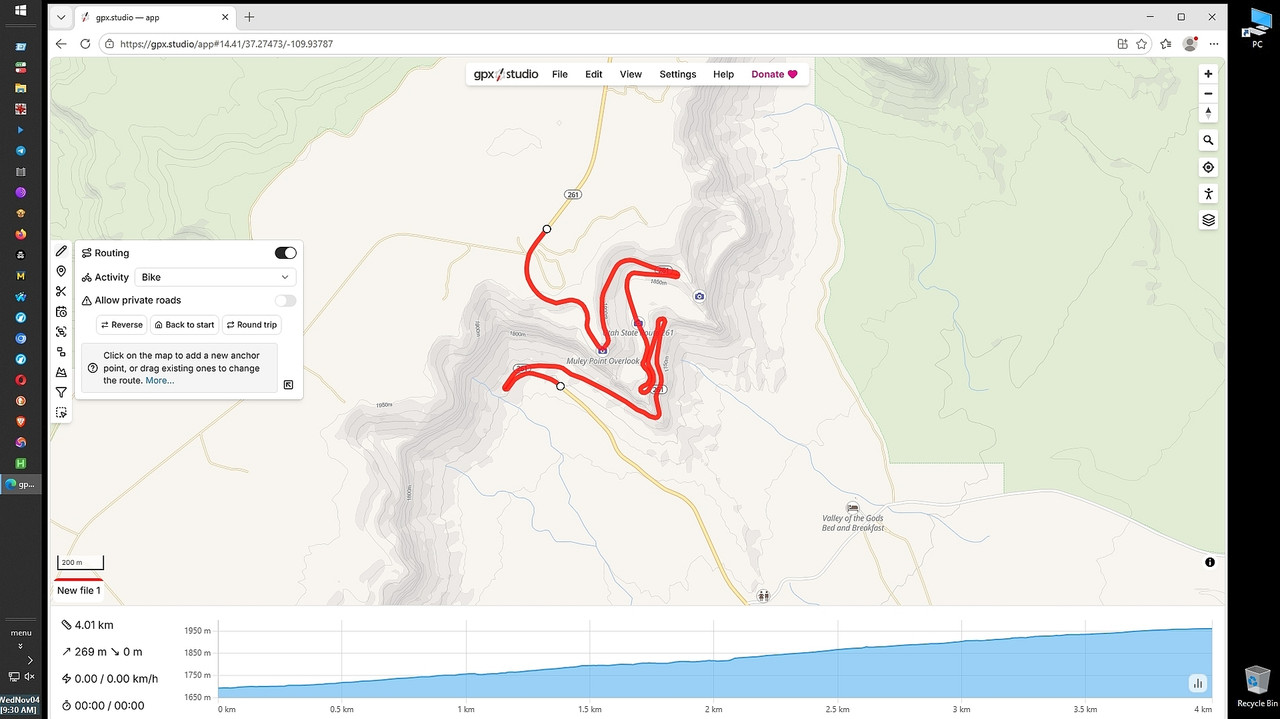
see how well the Linux/macOS/Win script works in roads elsewhere in the US. Moki Dugway
I've already run a half-dozen tests on my own local roads, but I want toMoki Dugway
see how well the Linux/macOS/Win script works in roads elsewhere in the US. >>
Shafer Canyon
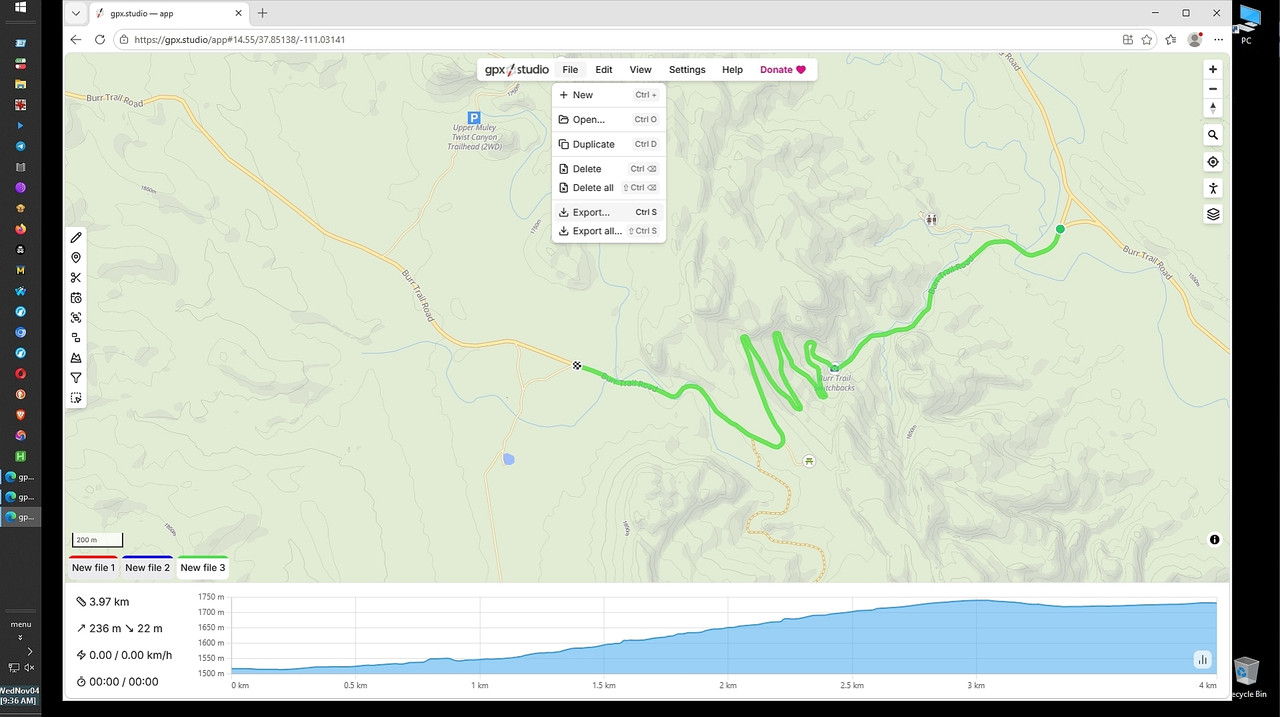
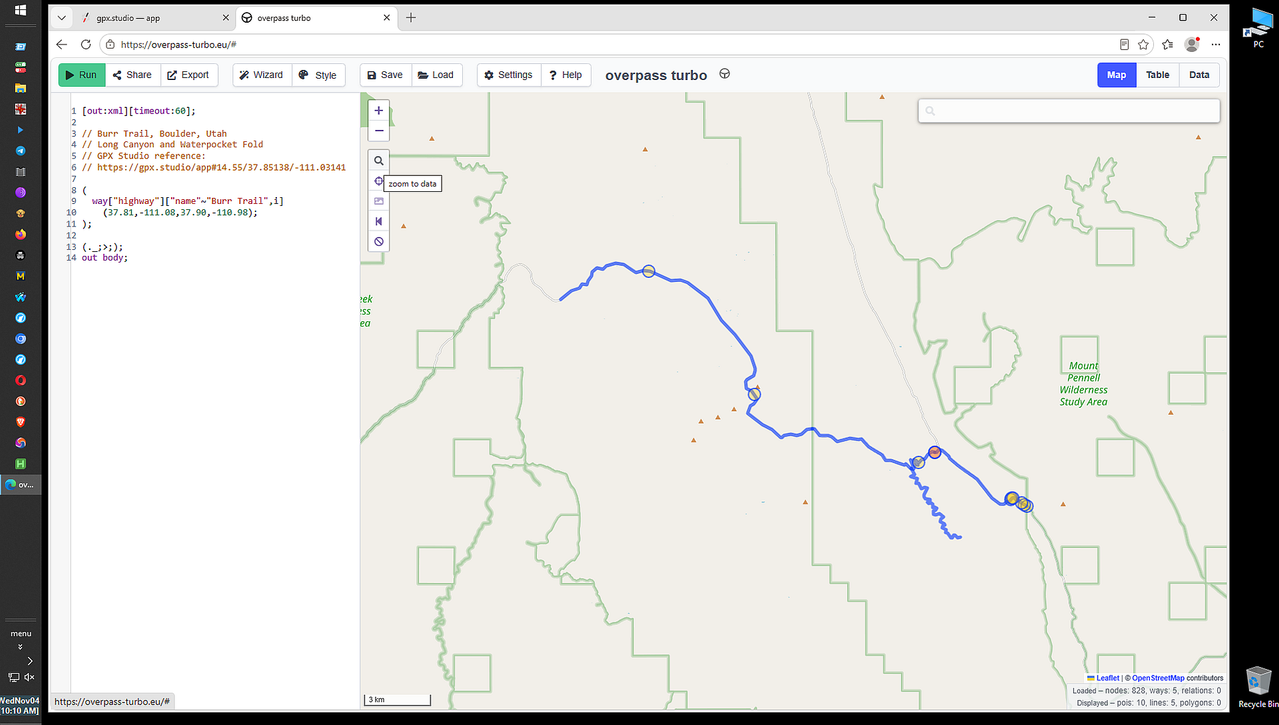
Burr Trail
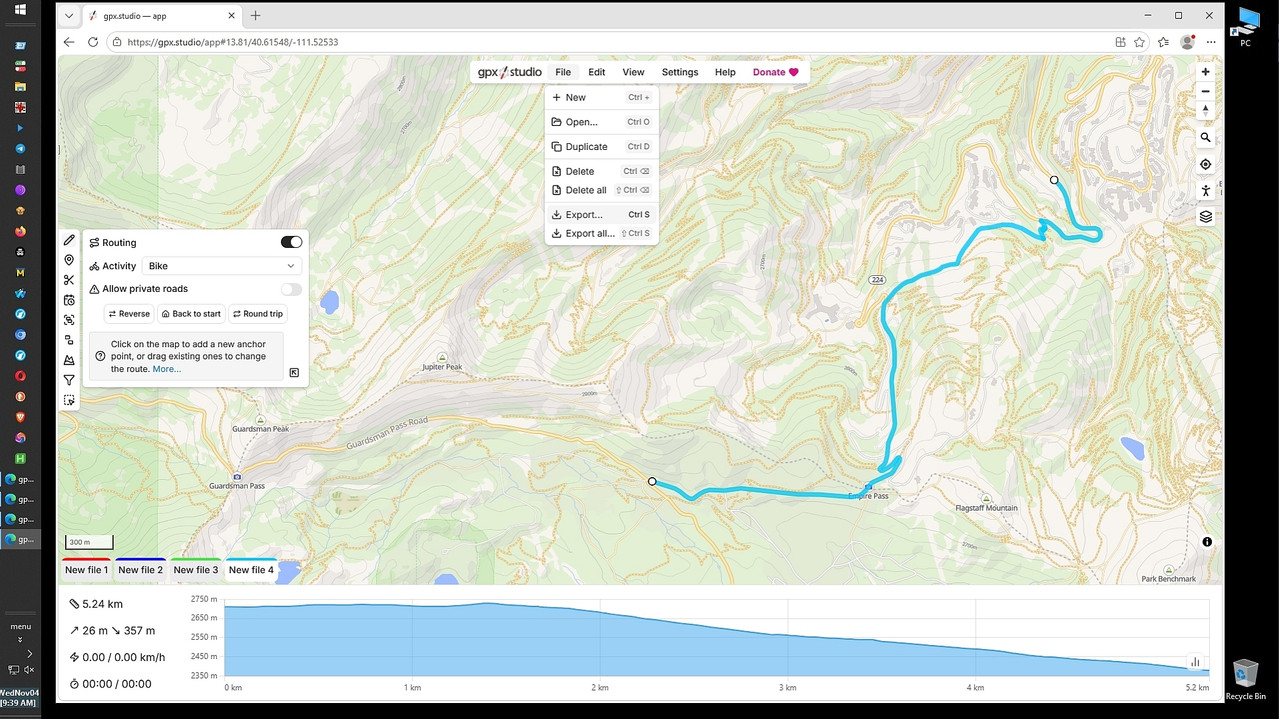
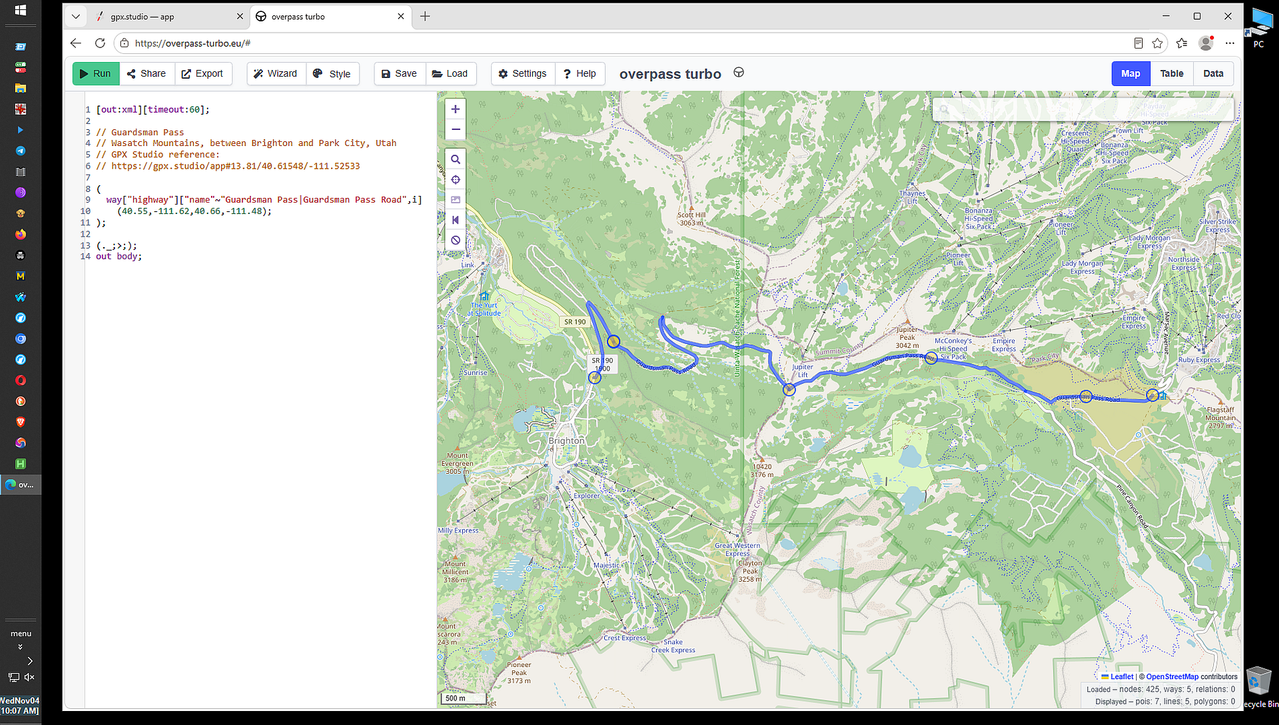
Guardsman Pass
python mountaincurves.py mokidugway.gpxLoaded 220 raw track points from 'mokidugway.gpx'.
python mountaincurves.py shafercanyon.gpxLoaded 162 raw track points from 'shafercanyon.gpx'.
python mountaincurves.py burrtrail.gpxLoaded 199 raw track points from 'burrtrail.gpx'.
python mountaincurves.py guardsmanpass.gpxLoaded 219 raw track points from 'guardsmanpass.gpx'.
Blaine wrote:
I've already run a half-dozen tests on my own local roads, but I want to >>> see how well the Linux/macOS/Win script works in roads elsewhere in the US. >>>Moki Dugway
Shafer Canyon
Burr Trail
Guardsman Pass
On 11/4/26 11:01, Maria Sophia wrote:
Blaine wrote:
I've already run a half-dozen tests on my own local roads, but I want to >>>> see how well the Linux/macOS/Win script works in roads elsewhere in the US.Moki Dugway
Shafer Canyon
Burr Trail
Guardsman Pass
Angeles Crest (CA 2) north of Los Angeles. Mulholland Drive in
Hollywood. People regularly kill themselves on these roads.
Maria Sophia wrote:
Python analysis of abnormal front tire wear on windy US mountain roadsShafer Canyon
I'd like to run a test of my Python code analyzing abnormal tire wear
under the specific conditions of steep short windy curvy US mountain roads. >>
If someone will choose about 3 steep windy curvy hairpin'ny mountain roads >> in your community, I will run a python script (I just wrote) on those roads >> to predict the abnormal wear the front outboard tire shoulders will incur. >>
To limit the number of datapoints, since I'm running Python on an 2009
Windows 10 box, try to keep each road to less than about 10 miles long.
I've already run a half-dozen tests on my own local roads, but I want to
see how well the Linux/macOS/Win script works in roads elsewhere in the US. >> Moki Dugway
Burr Trail
Guardsman Pass
Python analysis of abnormal front tire wear on windy US mountain roads
I'd like to run a test of my Python code analyzing abnormal tire wear
under the specific conditions of steep short windy curvy US mountain roads.
If someone will choose about 3 steep windy curvy hairpin'ny mountain roads
in your community, I will run a python script (I just wrote) on those roads to predict the abnormal wear the front outboard tire shoulders will incur.
To limit the number of datapoints, since I'm running Python on an 2009 Windows 10 box, try to keep each road to less than about 10 miles long.
I've already run a half-dozen tests on my own local roads, but I want to
see how well the Linux/macOS/Win script works in roads elsewhere in the US.
I've already run a half-dozen tests on my own local roads, but I want to
see how well the Linux/macOS/Win script works in roads elsewhere in the US.
How can you test this?
I mean, ground truth data is there?
Do you have? Can you get it?
I've already run a half-dozen tests on my own local roads, but I want to >>> see how well the Linux/macOS/Win script works in roads elsewhere in the US. >>> Moki DugwayShafer Canyon
Burr Trail
Guardsman Pass
Simply driving on a road doesn't create "abnormal wear". Abnormal wear
on a tyre is due to incorrect air pressure in the tire, misaligned
wheels, unbalanced wheels, and/or bad driving (including doing wheel
spins, donuts, etc.).
Piergiorgio Sartor wrote:
I've already run a half-dozen tests on my own local roads, but I want to >>> see how well the Linux/macOS/Win script works in roads elsewhere in the US. >>How can you test this?
I mean, ground truth data is there?
Do you have? Can you get it?
Anyone who commutes on mountain roads has *already* measured this.
Or are you asking about road inherency metrics obtained from the GPX files?
Or about basic suspension engineering related to tire wear under cornering?
How can you test this?
I mean, ground truth data is there?
Do you have? Can you get it?
Anyone who commutes on mountain roads has *already* measured this.
So you have the ground truth data already?
Why you are then asking for roads?
I do not get it...
Or are you asking about road inherency metrics obtained from the GPX files? >>
Or about basic suspension engineering related to tire wear under cornering?
I understood you want to test your code
and asked for some roads.
Now, what should the code do?
Take the road, in some data formant, and spit
out what? The tyre wear, I understood.
To know if this is correct, you need the
measurement done by someone, or not?
Do you have this data?
If you have it, you have the road too, I think.
Maybe I understood this completely wrongly.
Sorry, if this would be the case. Apologises.
Huh? I'm testing the python script. I need eyes on it.
The roads are data. Control data. I said I already ran it on local roads.
It's a script. It's gonna have bugs.
What have you found so far by examining it?
Now, what should the code do?
Take the road, in some data formant, and spit
out what? The tyre wear, I understood.
To know if this is correct, you need the
measurement done by someone, or not?
There isn't a person alive, who commutes in single-lane mountain roads, who hasn't had a tire shop not honor the warranty saying the tires were abused.
Do you have this data?
If you have it, you have the road too, I think.
I live in a mountain community where EVERYONE knows that even Costco won't honor the tire-wear warranty, even at the very first scheduled rotation.
You can feel the abnormal tire wear on the front tires within 100 miles.
Maybe I understood this completely wrongly.
Sorry, if this would be the case. Apologises.
Driving on a mountain road is considered "abuse" by tire warranty shops.
I explained in the post to "Your Name" what the engineering reasons are.
The goal here was to get others to run the code on their local roads.
And then we'd find bugs, or necessary enhancements and/or improvements.
What enhancements do you suggest now that you've looked the code over?
On 04/11/2026 23.22, Maria Sophia wrote:
[...]
Huh? I'm testing the python script. I need eyes on it.
The roads are data. Control data. I said I already ran it on local roads.
Input, I understood, and output?
Do you have the output to compare with
your script output?
If you have it, again, why ask for roads?
Piergiorgio Sartor wrote:
On 04/11/2026 23.22, Maria Sophia wrote:
[...]
Huh? I'm testing the python script. I need eyes on it.
The roads are data. Control data. I said I already ran it on local
roads.
Input, I understood, and output?
Do you have the output to compare with
your script output?
If you have it, again, why ask for roads?
Why not, dude? What are you doing?
The point of Usenet is for smart people to help each other & for results
to be archived so that anyone can access our immense tribal knowledge.
On 04/11/2026 23.51, Blaine wrote:
Piergiorgio Sartor wrote:
On 04/11/2026 23.22, Maria Sophia wrote:
[...]
Huh? I'm testing the python script. I need eyes on it.
The roads are data. Control data. I said I already ran it on local
roads.
Input, I understood, and output?
Do you have the output to compare with
your script output?
If you have it, again, why ask for roads?
Why not, dude? What are you doing?
Just curious, I mean, again maybe I did
not understand the point, but asking for
data to test a piece of code makes sense
if one has the output to check.
At least some expected output...
There are metrics.
If you have the data, why ask for something
more *without* ground truth?
Or there is a ground truth?
Otherwise one can generate some plausible
pseudo random data and be fine.
I just wanted to understand the process, if any.
That's all.--Sometimes I just feel like I need to get away
Or there is a ground truth?
You should do some reading on statistics. It's useful to have data 'out
of left field' to test corner cases and general hypotheses.
As I said, I have no complaint about the information provided on the 4
Utah mountain passes. Mission Accomplished, as they say.
I just wanted to understand the process, if any.
Perhaps it's a bit rude. It looks to me like you are a wild animal
waiting to pounce on some perceived affront to the Python computer
language or perhaps coding in general.
On 05/11/2026 00.16, Blaine wrote:
[...]
Or there is a ground truth?
You should do some reading on statistics. It's useful to have data 'out
of left field' to test corner cases and general hypotheses.
I beg to differ. Without data, no statistics.
And here half data is missing.
But, I repeat myself, maybe I do not get it.
So, please explain.
As I said, I have no complaint about the information provided on the 4
Utah mountain passes. Mission Accomplished, as they say.
Why should you complain?
Why you think about complains?
I just wanted to understand the process, if any.
Perhaps it's a bit rude. It looks to me like you are a wild animal
waiting to pounce on some perceived affront to the Python computer
language or perhaps coding in general.
Well, what should I say.
I apologized a couple of time, I mention multiple
times that maybe I do not understand the point.
All I get is complains and no answers.
I'm not sure about who is the "wild animal" here.
bye,
On 2026-11-04 15:18:48 +0000, Blaine said:
Maria Sophia wrote:
Python analysis of abnormal front tire wear on windy US mountain roadsShafer Canyon
I'd like to run a test of my Python code analyzing abnormal tire wear
under the specific conditions of steep short windy curvy US mountain roads. >>>
If someone will choose about 3 steep windy curvy hairpin'ny mountain roads >>> in your community, I will run a python script (I just wrote) on those roads >>> to predict the abnormal wear the front outboard tire shoulders will incur. >>>
To limit the number of datapoints, since I'm running Python on an 2009
Windows 10 box, try to keep each road to less than about 10 miles long.
I've already run a half-dozen tests on my own local roads, but I want to >>> see how well the Linux/macOS/Win script works in roads elsewhere in the US. >>> Moki Dugway
Burr Trail
Guardsman Pass
Simply driving on a road doesn't create "abnormal wear". Abnormal wear
on a tyre is due to incorrect air pressure in the tire, misaligned
wheels, unbalanced wheels, and/or bad driving (including doing wheel
spins, donuts, etc.).
Maria Sophia wrote on 11/4/2026 4:22 PM:
The point of Usenet is for smart people to help each other & for results
to be archived so that anyone can access our immense tribal knowledge.
Yes indeed Mary.-a When will you start this new tribal project?
Simply driving on a road doesn't create "abnormal wear". Abnormal wear
on a tyre is due to incorrect air pressure in the tire, misaligned
wheels, unbalanced wheels, and/or bad driving (including doing wheel
spins, donuts, etc.).
Yep. He is calling the expected *rapid* tire wear "abnormal". If you drive a car aound a race track at its limits, where there is little difference from those mountain twisties, that's going to cause rapid wear, but it's expected, therefore not abnormal. And he didn't include in his list the make and model of any specific vehicles, and they all have different suspension components, which includes all the rubber and plastic parts that are the bushings. The alignment specs are important, but not all that has to be considered. Cars with identical specs but different soft parts will have different tire wear. When he started on this 20 some years ago, i think he referred to some Chevy or GMC full size SUV. The GM engineers knew about the tire wear thing, and did
not consider it abnormal, and the bushings had something to do with it on that
heavy vehicle. There are tradeoffs in design. Arlen can't live with that.
The point of Usenet is for smart people to help each other & for results >>> to be archived so that anyone can access our immense tribal knowledge.
He posts the stupidest sigs.
If you have the data, why ask for something
more *without* ground truth?
It likely makes use of an API. It is doubtful that the program contains
all the pass information for every mountain pass in the US.
He was posting about this tire wear
thing at least 20 years ago on rec.autos.tech, or some auto group used by mechanics.
Python analysis of abnormal front tire wear on windy US mountain roads
I'd like to run a test of my Python code analyzing abnormal tire wear
under the specific conditions of steep short windy curvy US mountain roads.
If someone will choose about 3 steep windy curvy hairpin'ny mountain roads
in your community, I will run a python script (I just wrote) on those roads to predict the abnormal wear the front outboard tire shoulders will incur.
To limit the number of datapoints, since I'm running Python on an 2009 Windows 10 box, try to keep each road to less than about 10 miles long.
I've already run a half-dozen tests on my own local roads, but I want to
see how well the Linux/macOS/Win script works in roads elsewhere in the US.
Your script, if I understand correctly, predicts tire wear resulting
from driving on mountain roads. Are you comparing the script's
predictions to actual measured wear resulting from driving those
roads?
Keith Thompson wrote:
Your script, if I understand correctly, predicts tire wear resulting
from driving on mountain roads. Are you comparing the script's
predictions to actual measured wear resulting from driving those
roads?
I've been studying this issue for decades, where I've been driving the same mountain roads for those same decades, when I was in a conversation with other mountain folk recently on an alias that has 5000 residents on it.
We *all* mentioned the same anecdotes, no matter which vehicle, no matter
the drive train, the suspension, the "bushings" (as Bob West waxed laconically over), even as we drive completely different commutes
I wrote the Python code to COMPARE the commutes, where the whole goal was
to look at the inherency of the road in the downhill direction, and compare roads for how they would affect the very special tire wear that occurs in mountain driving (i.e., low speed, braking with shift, lateral g forces, etc.)
When I compared a half-dozen of our mountain roads, we were all pleasantly surprised (much as Blaine seems to have been) how *accurate* the inherency comparisons were, given we discussed it among scores of respondents and all of us agreed on the particulars of our roads.
Road A, wore the front-left tire more, and that was the prediction.
Road B, wore the front-right tire more, and that too was the prediction.
Road C wore both front tires' outboard edges reasonably the same,
and *that* was also predicted by the results of the Python script.
Notice, given I have multiple degrees in a variety of fields, that it took engineering knowledge, programming acumen and mapping skills to write the program and test it on the variety of roads tested, so I was "hoping" to
find other intelligent people on these newsgroups who might know more about this subject than I do, which would IMPROVE the results for everyone.
It started off well, in that INTELIGENT people UNDERSTOOD the challenge. Unfortunately, the uneducated trolls infested the thread, as they are wont
to do, such as Hank, Old McDonals, Bob West, Pergiorgio, et al.
Not one of them understood a single line of the Python code.
Not one of them has any education whatsoever in engineering.
All of them came up with utterly absurd challenges to the science involved, even down to the wholly uneducated claim the "bushings" make a difference.
If we added up their combined knowledge of Python, creating GPX routes, and how the automotive suspension works from all of them, it would still be negative.
That was disheartening, that there are so few intelligent people on this
ng, but the bright light was that a few, not many, but a few, were intelligent, and that is what we do on Usenet to share our efforts.
It's 1:99 intelligent people to the morons on this newsgroup.
But I'm hopeful at least ONE person will run the code on their commute.
Is there a single intelligent person on this ng who can run Python code?
How about you?
Keith Thompson wrote:
Your script, if I understand correctly, predicts tire wear resulting
from driving on mountain roads. Are you comparing the script's
predictions to actual measured wear resulting from driving those
roads?
I've been studying this issue for decades, where I've been driving the same mountain roads for those same decades, when I was in a conversation with other mountain folk recently on an alias that has 5000 residents on it.
Road A, wore the front-left tire more, and that was the prediction.
Road B, wore the front-right tire more, and that too was the prediction.
Road C wore both front tires' outboard edges reasonably the same,
and *that* was also predicted by the results of the Python script.
Bob West wrote:
He was posting about this tire wear
thing at least 20 years ago on rec.autos.tech, or some auto group used by
mechanics.
Hi Bob,
I get it you want to infest this thread with your childish trolls, Bob.
We go way back where you've been desperate to insult me for two decades.
I feel sorry for you because you couldn't make it into college so you don't own the knowledge necessary to understand what the Python script actually accomplishes, nor how downhill mountain road inherence overwhelms typical suspension geometries and drive train particulars.
However, given you've been desperate to insult me for decades, you're actually right about one thing.
I have been studying this problem set for decades, where I could wager that maybe, oh, one out of ten thousand people understand it as well as I do.
Maybe one out of a million.
Dunno.
Certainly only one or two people who posted to this thread understood it.
Given your absurd argument about the drive train, it's clear you haven't learned a single thing in those twenty years, which, well, it's just sad.
Meanwhile, I've actually done the empirical work, built the tools, and learned what actually moves the needle, and just as importantly, what
doesn't (like realizing road banking or a minor cross-slope is basically a rounding error compared to the brutal geometry of a 4.8-meter hairpin).
You've spent 20 years clinging to basic alignment checks and irrelevant drivetrain trivia because you've never bothered to look at road relevance.
Your claim that all roads are the same, and worse, that all directions are the same, is so absurd at to ring loudly and clearly that I'm insulted that you TRIED to insult me, by proving you don't understand a thing about it.
That's just sad.
You're so embarrassed you know nothing, that you try to insult me.
Why?
Why have you been acting childishly like that for the past 20 years?
When, if ever, will you grow up?
Since you've had two decades to learn about this problem set, let's ask you which specific suspension bushing or alignment setting prevents a tire from experiencing lateral contact patch scrub at extreme steering lock under downhill braking?
Let's see your math, or at least an educated explanation, why you feel the direction of travel & road inherence doesn't overwhelm "bushing" design.
Q: What were your results when you ran the Python script on your commute?
A: ?
Maria Sophia <mariasophia@comprehension.com> writes:
Python analysis of abnormal front tire wear on windy US mountain roads
I'd like to run a test of my Python code analyzing abnormal tire wear
under the specific conditions of steep short windy curvy US mountain roads. >>
If someone will choose about 3 steep windy curvy hairpin'ny mountain roads >> in your community, I will run a python script (I just wrote) on those roads >> to predict the abnormal wear the front outboard tire shoulders will incur. >>
To limit the number of datapoints, since I'm running Python on an 2009
Windows 10 box, try to keep each road to less than about 10 miles long.
I've already run a half-dozen tests on my own local roads, but I want to
see how well the Linux/macOS/Win script works in roads elsewhere in the US.
What exactly do you mean by "how well" the script works?
Disclaimer: I don't drive on mountain roads, I haven't examined
your Python code, and I'm not planning to run it.
Your script, if I understand correctly, predicts tire wear resulting
from driving on mountain roads. Are you comparing the script's
predictions to actual measured wear resulting from driving those
roads?
I've been following this thread, and I see it's led to some insults
(which I largely don't care about) but I don't recall any mention
of measured data from actual tires. It's possible I've missed it;
if so, please point me to the information I missed.
Bob West wrote:
He was posting about this tire wear
thing at least 20 years ago on rec.autos.tech, or some auto group used by
mechanics.
Hi Bob,
I get it you want to infest this thread with your childish trolls, Bob.
We go way back where you've been desperate to insult me for two decades.
I feel sorry for you because you couldn't make it into college so you don't own the knowledge necessary to understand what the Python script actually accomplishes, nor how downhill mountain road inherence overwhelms typical suspension geometries and drive train particulars.
However, given you've been desperate to insult me for decades, you're actually right about one thing.
I have been studying this problem set for decades, where I could wager that maybe, oh, one out of ten thousand people understand it as well as I do.
Maybe one out of a million.
Dunno.
Certainly only one or two people who posted to this thread understood it.
Given your absurd argument about the drive train, it's clear you haven't learned a single thing in those twenty years, which, well, it's just sad.
Meanwhile, I've actually done the empirical work, built the tools, and learned what actually moves the needle, and just as importantly, what
doesn't (like realizing road banking or a minor cross-slope is basically a rounding error compared to the brutal geometry of a 4.8-meter hairpin).
You've spent 20 years clinging to basic alignment checks and irrelevant drivetrain trivia because you've never bothered to look at road relevance.
Your claim that all roads are the same, and worse, that all directions are the same, is so absurd at to ring loudly and clearly that I'm insulted that you TRIED to insult me, by proving you don't understand a thing about it.
That's just sad.
You're so embarrassed you know nothing, that you try to insult me.
Why?
Why have you been acting childishly like that for the past 20 years?
When, if ever, will you grow up?
Since you've had two decades to learn about this problem set, let's ask you which specific suspension bushing or alignment setting prevents a tire from experiencing lateral contact patch scrub at extreme steering lock under downhill braking?
Let's see your math, or at least an educated explanation, why you feel the direction of travel & road inherence doesn't overwhelm "bushing" design.
Q: What were your results when you ran the Python script on your commute?
A: ?
Good perspective about models generally, aside from this
specific problem. See also 'Global Warming".
Python analysis of abnormal front tire wear on windy US mountain roads
I'd like to run a test of my Python code analyzing abnormal tire wear
under the specific conditions of steep short windy curvy US mountain roads. >>
If someone will choose about 3 steep windy curvy hairpin'ny mountain roads >> in your community, I will run a python script (I just wrote) on those roads >> to predict the abnormal wear the front outboard tire shoulders will incur. >>
To limit the number of datapoints, since I'm running Python on an 2009
Windows 10 box, try to keep each road to less than about 10 miles long.
I've already run a half-dozen tests on my own local roads, but I want to
see how well the Linux/macOS/Win script works in roads elsewhere in the US.
What exactly do you mean by "how well" the script works?
Disclaimer: I don't drive on mountain roads, I haven't examined
your Python code, and I'm not planning to run it.
Your script, if I understand correctly, predicts tire wear resulting
from driving on mountain roads. Are you comparing the script's
predictions to actual measured wear resulting from driving those
roads?
I've been following this thread, and I see it's led to some insults
(which I largely don't care about) but I don't recall any mention
of measured data from actual tires. It's possible I've missed it;
if so, please point me to the information I missed.
You still have not answered Keith question, which is the same as
Piergiorgio Sartor did. I also have the same doubt. You refuse to
answer, that's clear, but I don't understand why. You are surely
intelligent enough to understand the question...
AMuzi wrote:
Good perspective about models generally, aside from this
specific problem. See also 'Global Warming".
By including intelligent people from multiple Usenet newsgroups,
this thread was clearly intended to IMPROVE existing testcases & models.
Hence, it's obvious this thread was hoping to add to the modeling for
1. GPS: How to calculate the track for any given mountain road
2. Python: How to compare any set of tracks that have been calculated
3. Suspension: How to correlate with real-world abnormal-wear experience
That's expressly why these specific ngs of intelligent people were included
1. alt.satellite.gps
2. comp.lang.python, alt.comp.os.windows-10
3. rec.autos.tech
The choice of newsgroups makes it obvious we're seeking
1. Better methods of obtaining measured inherence of mountain roads
2. Better methods of calculation & prediction for specific metrics
3. Better correlation with the real-world shoulder wear we all see daily
Thankfully, we partially accomplished the goal of adding to our test sets
the ability to predict (using map software and the python script), abnormal front tire shoulder wear in an arbitrary set of steep windy mountain roads.
But we haven't exposed yet the algorithmic flaws in the python script.
The script calculates a circumcircle through three consecutive GPX points. That gives a local geometric radius, but the result is sensitive to GPX
point spacing and route-tracing accuracy (which brings up mapping
software).
Initially, I obtained tracks from helpful cyclists who emailed me their GPX tracks, but unfortunately all were done differently, so we decided to normalize the mapping activity to the methods previously described
a. <https://gpx.studio/>
b. <https://overpass-turbo.eu/>
c. Others?
That can't be the only sites that provide road-inherency metrics, can it?
It may be that intelligent people on the mapping newsgroup are aware of a
far better method to obtain road inherency for any steep mountain pass.
Likewise, it may be that intelligent people on the Python newsgroup are
aware of better algorithms for calculating specific road inherency forces.
In particular, we're aware that the same physical road can produce
different calculated radii depending on sampling density, and that several consecutive measurements can represent one physical corner, rather than independent corners.
For example, I'm sure there are bugs in the Python code, as the reported 2.04-meter radius for Guardsman Pass deserves investigation, does it not?
It may be a sampling or tracing artifact, for example.
Also, for the intelligent people on the automotive newsgroup, some should note that a mere count of left/right curvature observations may not be equivalent to a count of actual turns or a measurement of tire loading.
I acknowledge these limitations where the whole point of including trained programmers, automotive experts and mapping experts was to improve the
tool.
Maria Sophia <mariasophia@comprehension.com> writes:
Keith Thompson wrote:
Your script, if I understand correctly, predicts tire wear resulting
from driving on mountain roads. Are you comparing the script's
predictions to actual measured wear resulting from driving those
roads?
I've been studying this issue for decades, where I've been driving the same >> mountain roads for those same decades, when I was in a conversation with
other mountain folk recently on an alias that has 5000 residents on it.
I'm sure that's great, but I was really just looking for a yes or no
answer.
[...]
Road A, wore the front-left tire more, and that was the prediction.
Road B, wore the front-right tire more, and that too was the prediction.
Road C wore both front tires' outboard edges reasonably the same,
and *that* was also predicted by the results of the Python script.
It sounds like the answer to my question is yes. Is that correct?
Keith Thompson wrote:
Python analysis of abnormal front tire wear on windy US mountain roadsWhat exactly do you mean by "how well" the script works?
I'd like to run a test of my Python code analyzing abnormal tire wear
under the specific conditions of steep short windy curvy US mountain roads. >>>
If someone will choose about 3 steep windy curvy hairpin'ny mountain roads >>> in your community, I will run a python script (I just wrote) on those roads >>> to predict the abnormal wear the front outboard tire shoulders will incur. >>>
To limit the number of datapoints, since I'm running Python on an 2009
Windows 10 box, try to keep each road to less than about 10 miles long.
I've already run a half-dozen tests on my own local roads, but I want to >>> see how well the Linux/macOS/Win script works in roads elsewhere in the US. >>
Disclaimer: I don't drive on mountain roads, I haven't examined
your Python code, and I'm not planning to run it.
Your script, if I understand correctly, predicts tire wear resulting
from driving on mountain roads. Are you comparing the script's
predictions to actual measured wear resulting from driving those
roads?
I've been following this thread, and I see it's led to some insults
(which I largely don't care about) but I don't recall any mention
of measured data from actual tires. It's possible I've missed it;
if so, please point me to the information I missed.
Carlos E. R. wrote:
You still have not answered Keith question, which is the same as
Piergiorgio Sartor did. I also have the same doubt. You refuse to
answer, that's clear, but I don't understand why. You are surely
intelligent enough to understand the question...
Hi Carlos,
Ah! My bad. I goofed. Mea culpa.
I apologize for falling into the trap of reacting to the uneducated trolls (mainly, Hank Rogers, Bob West, Old McDonald) so I will reset my response.
By reacting to the uneducated trolls, I wasted everyone's valuable time.
There are explicit reasons why intelligent people were asked to help:
a. The mapping ng can help us obtain road inherency metrics
b. The Python/OS ngs can help us write the calculation/prediction code
c. The automotive ng can help model the shoulder-rollover camber scrub
To help us all improve the tool, the questions from Keith is fair.
From his question, I realize I haven't explained the background adequately, and my earlier responses didn't directly answer what you were asking.
Let me try again since there are multiple aspects to this investigation.
1. The existing real-world observations
Our local Santa Cruz Mountain community has experienced decades observing a particular type of abnormal front-tire outside-shoulder wear on our steep, winding roads, which we've been discussing lately on our local reflectors.
Our local community includes approximately 5,000 mountain residents.
Over the years, we've exchanged photographs and discussed similar wear patterns on numerous vehicles with different drivetrains, suspension configurations and alignments. We've even set up roadblocks, in the past,
on weekends, to stop all vehicles and examine their tire wear patterns.
We set up a weekend visit to all mountain homes that accepted our request
to document their abnormal tire wear in the past, so the abnormal tire wear is well known to us in our specific mountain community.
Recurring examples emerged in out studies of local abnormal tire wear.
a. Road A: Predominantly premature front-left outside-shoulder wear.
b. Road B: Predominantly premature front-right outside-shoulder wear.
c. Road C: Relatively equal premature outside-shoulder wear on both.
These observations motivated the investigation.
They weren't conclusions generated by the Python program.
In fact, the Python program doesn't even make conclusions or predictions.
2. The Python analysis
After decades of study as shown above, and during a recent spate of complaints that the local Costco wouldn't even honor the first scheduled rotation on new tires, I developed the previously included Python program
on my Windows PC (which should work on macOS & Linux equally well) to
examine road geometry, particularly corner radii and the distribution of left-hand and right-hand turns, but note that I didn't add the steepness, which is also a factor given the initial braking sets up the tire wear.
The intention was to investigate whether inherent road geometry, combined with downhill braking and steering-related tire loading, could help
calculate road metrics such that we can explain the data that we've all
seen, where some roads wear the left, some the right, and some both.
Therefore we needed a method of obtaining/comparing road inherency metrics.
As noted in the original post, I first tested the program against approximately half a dozen local mountain roads, where its qualitative predictions were consistent with the representative observations above.
However, I want to be precise about what that Python script establishes.
The current program analyzes road geometry so that we can compare roads.
The Python script makes no attempt to calculate actual tread loss, predict miles to the wear bars or establish a quantitative relationship between curvature and tire life. It simply compares road inherency metrics.
Clearly, we haven't conducted a controlled experiment measuring tread-depth loss over known mileage on the Utah roads, but my hope was to find other experienced mountain commuters with whom we can compare road inherency metrics to correlate to THEIR particular front-tire shoulder wear patterns.
3. Why I asked this group for help
The original request was an attempt to extend the investigation beyond our local roads and to obtain expertise that our community might not have.
Specifically:
a. Mapping expertise:
Better GPX tracks, road geometry, elevation and grade information.
b. Python expertise:
Improved algorithms and more sophisticated calculations.
c. Automotive engineering expertise:
Tire loading, suspension behavior, camber effects
and steering-induced tire scrub on downhill right-radius curves.
I was hoping to have intelligent people suggest roads they knew well so
that we could compare their tire-wear observations on their mountain
geometry with our existing mountain observations to improve the model.
Keith, your question about comparing predictions with actual measured tire wear is entirely legitimate. That's an important distinction between a plausible model and a quantitatively validated one.
Carlos, I wasn't deliberately refusing to answer. I was trying to explain
the broader background, but I can see that I wasn't answering the specific question being asked, as I was unduly flustered by the ignorant trolls.
I apologize.
I should have made the distinction clear from the beginning.
I'm not claiming that the present Python script proves a universal
tire-wear theory. I'm trying to develop and improve a model that might explain a phenomenon we've observed repeatedly in the real world.
Constructive criticism, better algorithms and additional expertise are precisely what I was hoping to get from this discussion.
Specifically:
a. Mapping newsgroup: How to get better road-inherency metrics?
b. Python newsgroup: How to improve the road-inherency comparisons?
c. Automotive newsgroup: How to predict/explain the abnormal tire wear?
Does that answer your concerns so we can improve the tools together?
Nice summary of the details and hat's off to you for making
the effort.
After a few years of comparing predicted mileage against
actual mileage, you'll probably be able to correct any
errors in your code.
Constructive criticism, better algorithms and additional expertise are
precisely what I was hoping to get from this discussion.
Specifically:
a. Mapping newsgroup: How to get better road-inherency metrics?
b. Python newsgroup: How to improve the road-inherency comparisons?
c. Automotive newsgroup: How to predict/explain the abnormal tire wear?
Does that answer your concerns so we can improve the tools together?
It's not the tool per se.
Yes, there is an actual problem but no, there is no
practical solution. Dramatically reducing vehicle speed
would change the wear rates, but no one's going to do that
willingly. A few billion or tens of billions of dollars for
rock demolition, bridge spans and roadbuilding generally
might reduce tire wear rates but I'd bet the residents
wouldn't stand for the change of scenery and the taxpayers
wouldn't go along willingly either.
So, at best, your program may predict tire replacement
intervals but hasn't provided any actual resolution.
asymmetric
Keith Thompson wrote:
Python analysis of abnormal front tire wear on windy US mountain roads
Specifically:
a. Mapping newsgroup: How to get better road-inherency metrics?
b. Python newsgroup: How to improve the road-inherency comparisons?
c. Automotive newsgroup: How to predict/explain the abnormal tire wear?
Does that answer your concerns so we can improve the tools together?
I goofed!
I humbly apologize as I errantly conflated Sergio & Keith's intentionally helpful questions about the methodology with those of the intentionally unhelpful ignorant trolls (Bob West, Old McDonald & Hank Rogers).
On 11/4/26 15:04, Hank Rogers wrote:
Maria Sophia wrote on 11/4/2026 4:22 PM:
The point of Usenet is for smart people to help each other & for results >>> to be archived so that anyone can access our immense tribal knowledge.
Yes indeed Mary.-a When will you start this new tribal project?
He's circling the drain.
He posts the stupidest sigs.
Old McDonald wrote on 11/4/2026 6:46 PM:
On 11/4/26 15:04, Hank Rogers wrote:
Maria Sophia wrote on 11/4/2026 4:22 PM:
The point of Usenet is for smart people to help each
other & for results
to be archived so that anyone can access our immense
tribal knowledge.
Yes indeed Mary.-a When will you start this new tribal
project?
He's circling the drain.
He posts the stupidest sigs.
He has some good ideas, but I think he has the same brain
worms that infected RFK.
AMuzi wrote:
Constructive criticism, better algorithms and additional expertise are
precisely what I was hoping to get from this discussion.
Specifically:
a. Mapping newsgroup: How to get better road-inherency metrics?
b. Python newsgroup: How to improve the road-inherency comparisons?
c. Automotive newsgroup: How to predict/explain the abnormal tire wear? >>>
Does that answer your concerns so we can improve the tools together?
It's not the tool per se.
Yes, there is an actual problem but no, there is no
practical solution. Dramatically reducing vehicle speed
would change the wear rates, but no one's going to do that
willingly. A few billion or tens of billions of dollars for
rock demolition, bridge spans and roadbuilding generally
might reduce tire wear rates but I'd bet the residents
wouldn't stand for the change of scenery and the taxpayers
wouldn't go along willingly either.
So, at best, your program may predict tire replacement
intervals but hasn't provided any actual resolution.
THANK YOU!
You bring up a great point that all the theory in the world doesn't change the fact that our 50K expected-life tires last only 15K to 20K even with rotations, due to the abnormal wear on the outboard front shoulders.
One amelioration, of course, is a directed rotation pattern, which is the same as many but DIFFERENT from others as the "driving wheels" don't influence the cross-rotation pattern so much as the FRONT wheels do.
That is, there are well-established cross-rotation patterns which take into account the driving wheels when "flipping the carcass" (asymetric treads).
But the rotation pattern we've collectively come up with is thus:
1. First rotation:
a. Move the front wheels to the rear (keeping rotation direction)
b. Move the rear wheels to the front (keeping rotation direction)
2. Second rotation: (assuming non-whitewall asymmetric treads)
a. Move the front wheels to the rear (keeping rotation direction)
b. Flip the carcass on the rear wheels (outboard side inboard)
c. Cross rotate the rear wheels to the front (keeping rotation)
3. Repeat as needed (there are few rotations since the tires still wear).
Note that we've studied the old wives' tale myth about radial tire carcass rotation direction and we've found it might have been a factor when radial tires first came out, but nobody today says not to change direction for
tires that are able to be flipped.
Yes. We are aware of various fundamental styles of tread patterns:
a. Directional
b. Non-directional
c. Symmetric across the centerline, versus asymmetric across it
d. Whitewall on one side only
Clearly I fully agree with your pragmatic assessment, although I think
there may be more practical mitigation options than dramatically reducing vehicle speed or rebuilding mountain roads.
The purpose of the program isn't necessarily to eliminate the underlying
road geometry problem. It's to understand the mechanism well enough that we can identify practical ways to reduce its consequences.
In fact, we've already experimented with two possible mitigation approaches in our local mountain community.
1. Increasing front negative camber
We've experimented with increasing front negative camber to compensate for the outside-shoulder loading associated with repeated cornering.
The hope is to compensate for expected loading forces by modifying the
static alignment to better accommodate the dynamic camber changes and tire loading encountered on these roads for the outside tire outboard shoulder.
Of course, there's a tradeoff when we commute into the Silicon Valley flatland, where too much negative camber can move the abnormal wear toward the inside shoulder, in addition to affecting handling.
2. Increasing tire pressure slightly
We've also experimented with increasing tire pressure by a few PSI, within appropriate operating limits, to increase sidewall stiffness to better
combat tire deformation which helps to mitigate outside-shoulder wear.
Again, this isn't necessarily a universal solution. Tire construction, vehicle weight, suspension geometry and operating conditions all matter.
As you note, these are practical variables that mountain commuters can implement without waiting for a billion-dollar road reconstruction project.
3. Why I'm interested in the road geometry
What I really want to understand is why one mountain road appears to
produce predominantly left-front outside-shoulder wear, another
predominantly right-front wear, and another relatively equal wear on both front tires.
If we can identify the geometric characteristics responsible for those differences, we may be able to make better-informed decisions about
alignment settings, tire selection, inflation pressure and other mitigation strategies.
For example, knowing that a particular commute has a sustained downhill sequence of tight right-hand curves is potentially more useful than simply knowing that someone lives in the mountains.
The current Python program is only an initial attempt to quantify those
road characteristics.
4. I agree that a prediction without a practical application has limited value.
I'm not proposing that mountain residents rebuild their roads, nor am I suggesting that everyone should dramatically reduce their commuting speeds.
I'm trying to understand the physical mechanism behind a recurring and expensive problem, then determine whether relatively inexpensive vehicle setup changes can reduce its effects.
If we can improve the model sufficiently to identify which road characteristics are associated with which wear patterns, we might
eventually be able to recommend more appropriate tire, alignment and suspension configurations for particular mountain-driving conditions.
That's a considerably more achievable objective than rebuilding the Santa Cruz Mountains.
I'd be particularly interested in seasoned automotive perspectives on
whether the negative-camber and tire-pressure approaches are addressing the likely mechanisms, or whether there are other practical variables we should investigate.
Thanks for raising the practical side of the problem.
It's an important part of the investigation.
What do automotive guys think of the camber/pressure/rotation resolutions?
What do automotive guys think of the camber/pressure/rotation resolutions?
First, I'll ignore your insults because even though I used to think that you are a nutcase, I've downgraded that to just another quirky personality on usenet. But I am an automotive guy, so you addressed me.
The first problem is that you keep saying "road inherence". That is used in the context of a problem that needs solving. You have finally admitted above that there is a problem, but it's not really solvable in any practicable manner.
My problem with what you are doing is that your python exercise
amounts to coding masturbation. It might satisfy you, but it serves no purpose.
Everyone sentient being knows that everything you describe causes
accelerated tire wear. You don't need maps of anything to know that, and about
.000001% of the earth's population would be concerned with any solution that involved any effort or expense. F1 teams could be interested in your script, but they already have all the data, and most importantly they have actual measurements of tire wear. You are not breaking ground here. You can even get that kind of date in sim-racing apps.
And you keep complaining that tire shops won't warranty tires with the sort of
wear you are describing. They don't, but only because there is nothing wrong with the tires.
They are working as designed. The original post about this
referred to a full size GM SUV. I worked in Las Vegas and saw a lot of the tire wear you describe on those vehicles, and you clearly know that area is pretty flat. There are just too many variations in all the factors included in
this to ever come up with any helpful info or solutions. And the reason I brought up bushings is that you included steering geomety in causes, and soft bushings change the steering geometry. That is why there is a pretty good market for aftermarket stiff bushings.
My thought on your resolutions? I had a VW. Their advice was to never rotate, and as each pair wears out, you just replace that pair. I have used that advice forever. I keep the vehicles aligned and the tires balanced, and have never had any tires wear out at any premature mileage.
Performance tires? They
wear out quick. HIgh mileage tires? Lower traction. There are tradeoffs.
You
are obsessing over nothing at all. That's why I downgraded you to just another
quirky personality.
Whatever happened to nospam? He fell off the face of the earth. Is he dead?
Blaine wrote:
I've already run a half-dozen tests on my own local roads, but I want to >>> see how well the Linux/macOS/Win script works in roads elsewhere in the US. >>>Moki Dugway
Shafer Canyon
Burr Trail
Guardsman Pass
Perfect! Thank you for providing a random test sample, which helps
us improve the program as it's tested on control conditions now.
With more eyes on the program & results, we can improve it together!
Maria Sophia <mariasophia@comprehension.com> wrote:
Blaine wrote:
I've already run a half-dozen tests on my own local roads, but I want to >>>> see how well the Linux/macOS/Win script works in roads elsewhere in the US.Moki Dugway
Shafer Canyon
Burr Trail
Guardsman Pass
Perfect! Thank you for providing a random test sample, which helps
us improve the program as it's tested on control conditions now.
With more eyes on the program & results, we can improve it together!
Which is impossible with python code posted on usenet as you cannot
guarantee preservation of whitespace.
As I've told you many times, it would be much more helpful for you to post code where it makes sense i.e. github
Here's your code on a gh account thet only took 5 min to set up. Am sure
you could do the same with a throwaway email address once you've verified
it
https://github.com/ithinkiam-ng/roadCurvature/blob/main/mountaincurves.py
Of course, the code doesn't work given the issues above. I encourage Arlen
to edit it to make it work.
It is also impossible for others to test as we don't have an example
dataset to run it on. I also encourage him to share a test file.
My observations of the code are:
* no consideration for the gradient of road. a significant issue on "mountain roads"
* the curvature calc is hugely dependent on the gps track. Slight
variations will make big differences.
* the curvature calc is based only on three points which again is highly dependent on the gps resolution/accuracy. It could potentially find non-existent bends.
* no checking of travel direction.
* no checking of side of the road. A rh turn will naturally be tighter then
a lh turn *of the same bend*.
Given the above, have you tested the code for the same road but measured by different people at different times? Have you compared the script with real world, physical measurements of the bends?
You really, really do need to add gradient information. You're completely ignoring the third dimension which is nonsensical. It's like drawing a straight line on a map of the world and saying that's the shortest route
for a flight between LA and London.
Of course, this whole exercise is based on the predicate of "abnormal"
wear. It seems obvious that constantly driving up and down high gradient, twisty roads will wear tyres faster than a daily commute into the city.
This is entirely *normal* and predicable wear.
Hi Carlos,
Wow. I'm impressed. Really. You added a *lot* of value to the team!
Thank you.
Chris wrote:
Maria Sophia <mariasophia@comprehension.com> wrote:
Blaine wrote:
I've already run a half-dozen tests on my own local roads, but I want to >>>>> see how well the Linux/macOS/Win script works in roads elsewhere in the US.Moki Dugway
Shafer Canyon
Burr Trail
Guardsman Pass
Perfect! Thank you for providing a random test sample, which helps
us improve the program as it's tested on control conditions now.
With more eyes on the program & results, we can improve it together!
Which is impossible with python code posted on usenet as you cannot
guarantee preservation of whitespace.
As I've told you many times, it would be much more helpful for you to post >> code where it makes sense i.e. github
Here's your code on a gh account thet only took 5 min to set up. Am sure
you could do the same with a throwaway email address once you've verified
it
https://github.com/ithinkiam-ng/roadCurvature/blob/main/mountaincurves.py
Of course, the code doesn't work given the issues above. I encourage Arlen >> to edit it to make it work.
It is also impossible for others to test as we don't have an example
dataset to run it on. I also encourage him to share a test file.
Hi Carlos,
Wow. I'm impressed. Really. You added a *lot* of value to the team!
Thank you.
You even taught me some things (see below).
I'll implement most of them, in fact.
But first, the dataset...
You're not the first person to think that I didn't include a "sample dataset" (i.e., a GPX file), but I actually did because I showed
how to get the file (i.e., I 'taught a man how to fish for it').
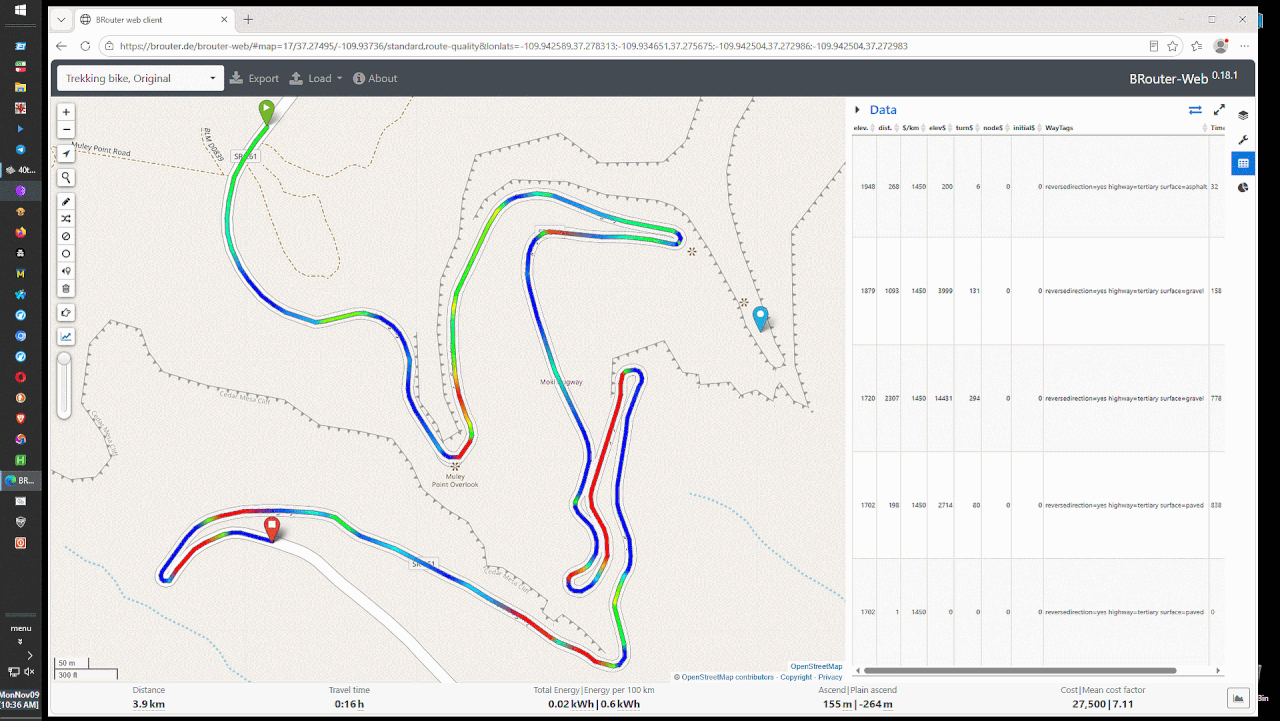
This *is* the dataset, for example, for the Moki Dugway GPX file.
<https://gpx.studio/app#14.41/37.27473/-109.93787>
Of course, I "could" have posted the GPX files but anyone can
use the web site to get the same GPX file that I had used.
<https://i.postimg.cc/DydH9gFb/mokidugway.jpg>
I showed in the code and in the writeups HOW to obtain the data set.
For any given section of road, we can find the GPX inherence using this:
<https://gpx.studio/>
1. Open the appropriate road link listed below.
2. Select File > New.
3. Select the route-planning tool (pen icon).
4. Select the appropriate routing mode (e.g., bicycle to stay on asphalt)
5. Trace the complete road (or just click beginning & ending points).
6. Select File > Export > Download GPX file.
7. Save using the suggested road-based below filename.
8. Run the Python analysis.
python mountaincurves.py mokidugway.gpx
python mountaincurves.py shafercanyon.gpx
python mountaincurves.py burrtrail.gpx
python mountaincurves.py guardsmanpass.gpx
python mountaincurves.py angelescrest.gpx
python mountaincurves.py mulholland.gpx
For example, for the given unbiased kindly volunteered testcases,
the python script generated an apples-to-apples commute comparison.
Moki Dugway
<https://gpx.studio/app#14.41/37.27473/-109.93787>
<https://i.postimg.cc/DydH9gFb/mokidugway.jpg>
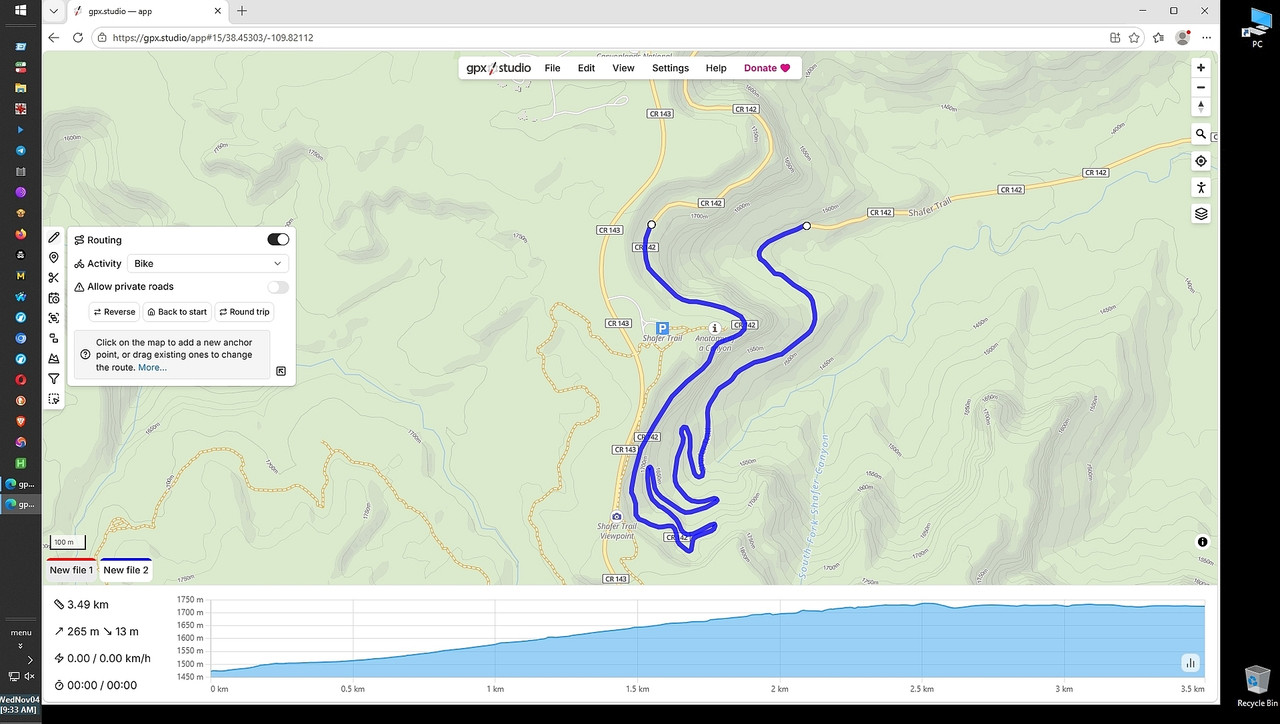
Shafer Canyon Road
<https://i.postimg.cc/HLjN71MB/shafercanyon.jpg>
<https://gpx.studio/app#15/38.45303/-109.82112>
Burr Trail
<https://i.postimg.cc/X7f6VWKC/burrtrail.jpg>
<https://gpx.studio/app#14.55/37.85138/-111.03141>
Guardsman Pass
<https://i.postimg.cc/JnDSSC4x/guardsmanpass.jpg>
<https://gpx.studio/app#13.81/40.61548/-111.52533>
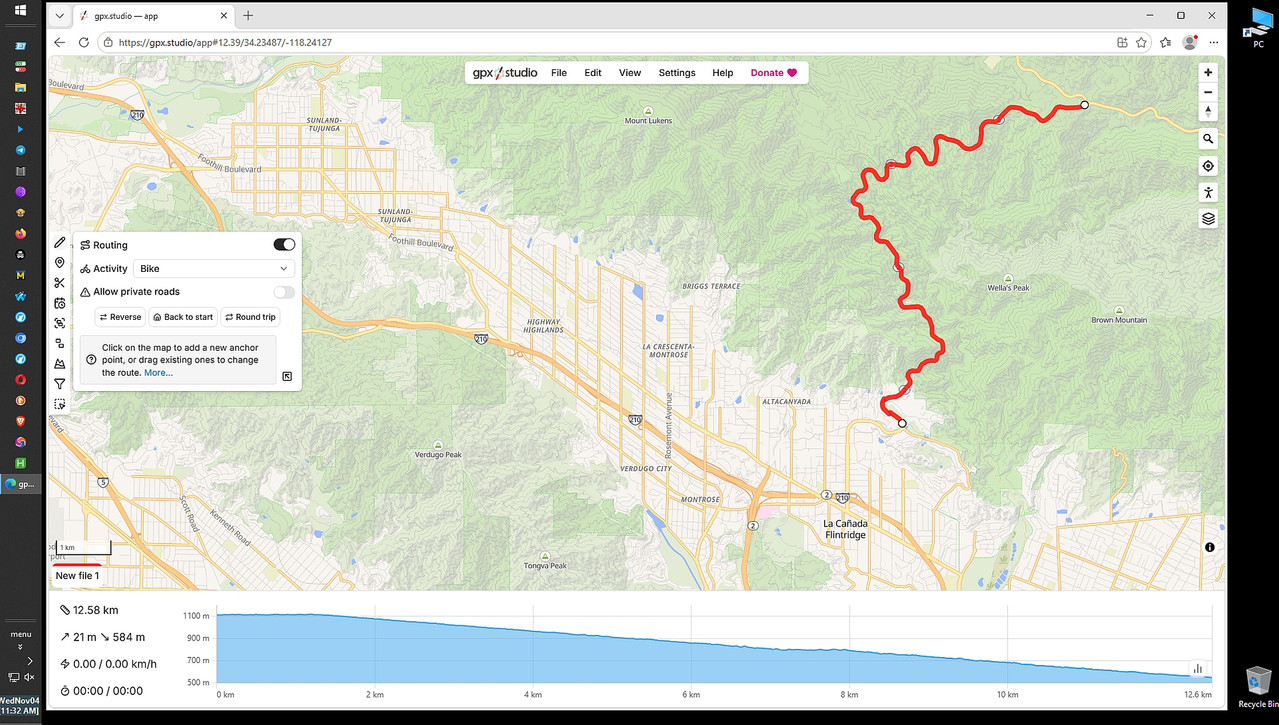
Angeles Crest Highway (CA-2):
<https://gpx.studio/app#12.39/34.23487/-118.24127>
<https://i.postimg.cc/dV8qhd8f/angelescrest.jpg>
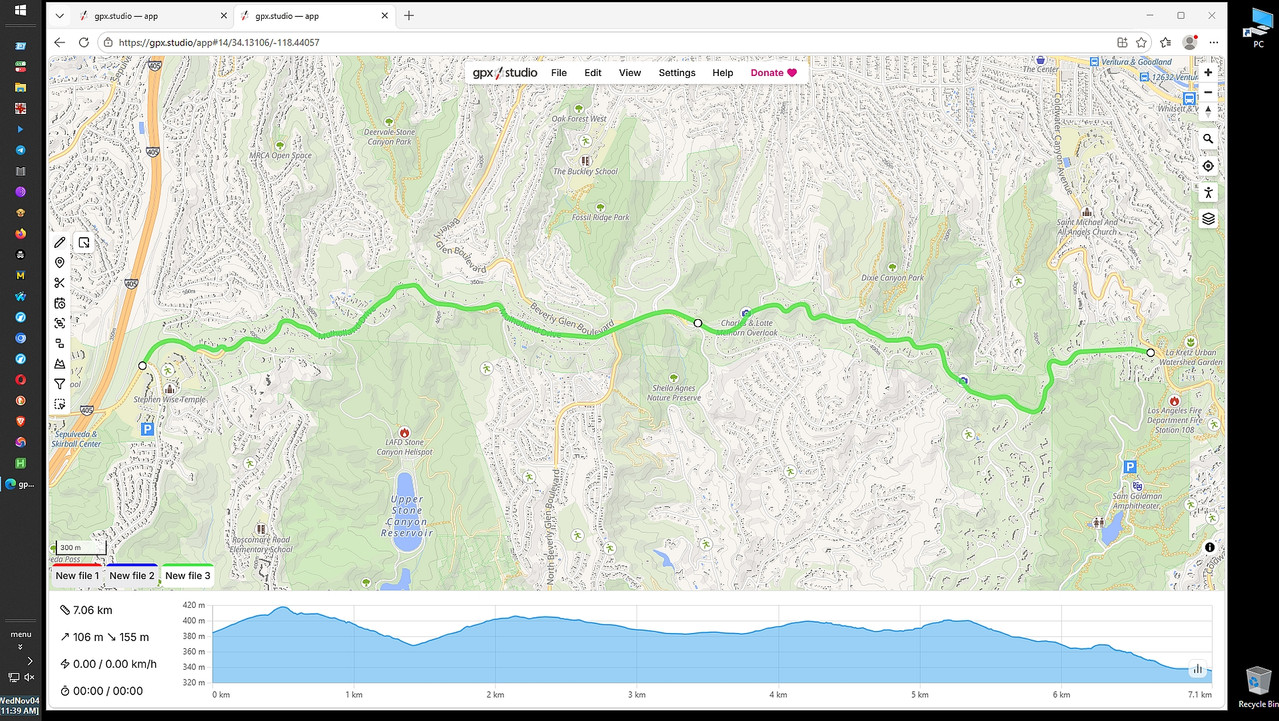
Mulholland Drive (Hollywood Hills):
<https://gpx.studio/app#14/34.13106/-118.44057>
<https://i.postimg.cc/8kB9fH36/mulholland.jpg>
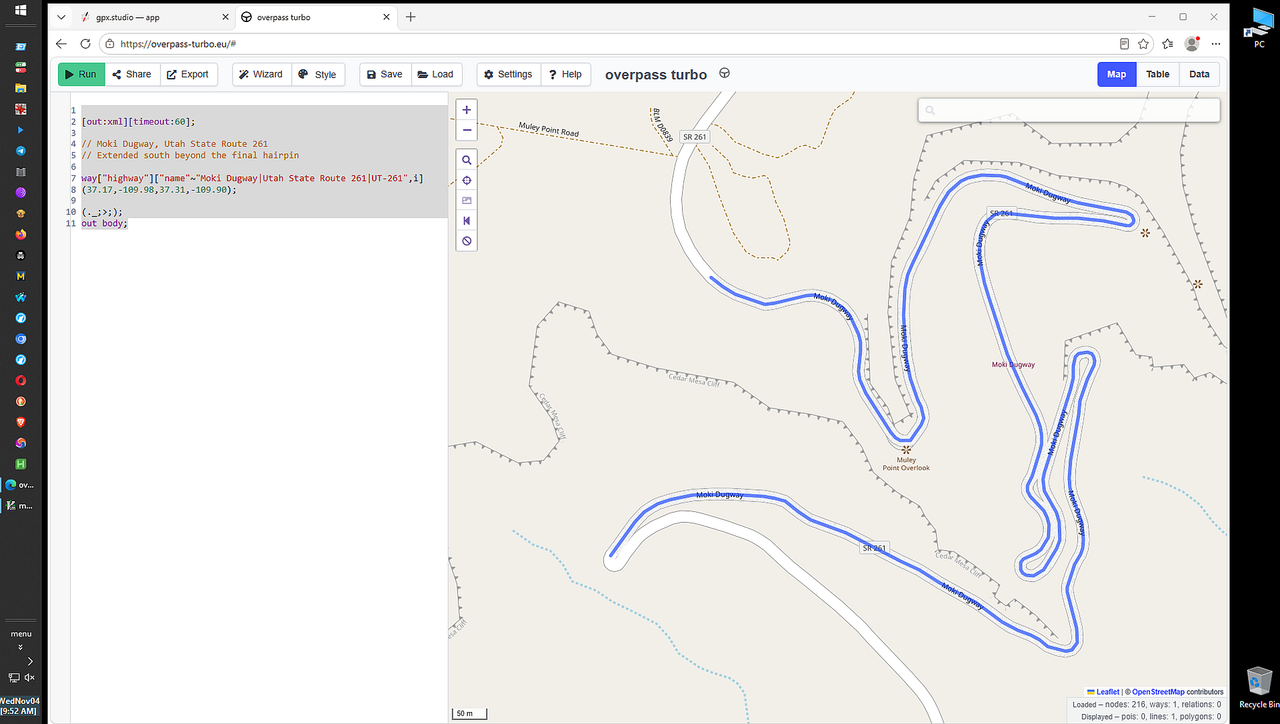
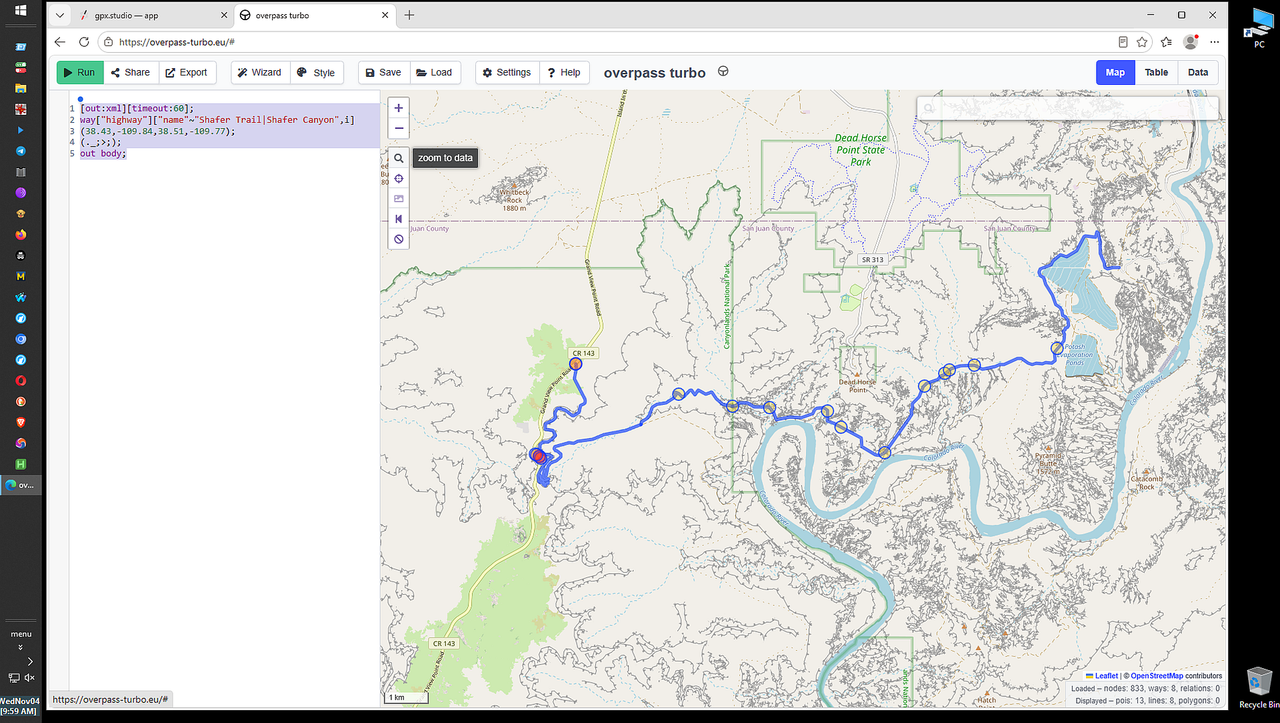
Note that I provided another more detailed method of obtaining a GPX
file using the <https://overpass-turbo.eu/> web site as shown below.
<https://i.postimg.cc/3x8VYvxN/mokidugway.png>
<https://i.postimg.cc/9M7NJPJ1/shafercanyon.png>
<https://i.postimg.cc/CxJyq4Q0/burrtrail.png>
<https://i.postimg.cc/G3DZQR55/guardsmanpass.png>
My observations of the code are:
* no consideration for the gradient of road. a significant issue on
"mountain roads"
Yup. Since we're ONLY looking at the DOWNHILL direction, the
elevation needs to be taken into account. It's my first WIP.
* the curvature calc is hugely dependent on the gps track. Slight
variations will make big differences.
* the curvature calc is based only on three points which again is highly
dependent on the gps resolution/accuracy. It could potentially find
non-existent bends.
Yeah. I know. I don't like taking just 3 points in the curve.
I need to assess the TYPE of curve, and take as many points as needed.
That's my second WIP!
* no checking of travel direction.
You made me think about that, and you're right. I need to doublecheck
that the GPX track is always downhill, and, what's worse, it can go
over the hump, and then I have to decide how to calculate the wear points.
This was NOT on my radar screen, but I've added it as the fourth WIP.
I thank you for catching that lack of error-checking in the Python script.
* no checking of side of the road. A rh turn will naturally be tighter then >> a lh turn *of the same bend*.
That is completely correct but since the goal is to take only the DOWNHILL motion, that should not matter as there is only one direction of curve
going in the downhill direction.
Given the above, have you tested the code for the same road but measured by >> different people at different times? Have you compared the script with real >> world, physical measurements of the bends?
The measurements come from the web sites, where I simply put a dot at the beginning of the road and another dot at the end, whenever possible.
That means everyone would get almost the same GPX file out of any given
road, as long as that road is simple enough that there's an obvious before and after (although I noticed a "loop" on a road Blaine suggested).
You really, really do need to add gradient information. You're completely
ignoring the third dimension which is nonsensical. It's like drawing a
straight line on a map of the world and saying that's the shortest route
for a flight between LA and London.
What I'm missing is not only the grade (e.g., 9% or 10%) but also the pitch of the road for runoff, which is NOT crowned on our local roads.
On our local roads, the cross slope is for drainage, and it always slopes into the mountain wall, so it's a different pitch per turn of a degree or two. This may be impossible to calculate so I may need to estimate it.
I suspect it won't make a big difference, but I need to test it first.
That's my third WIP.
Of course, this whole exercise is based on the predicate of "abnormal"
wear. It seems obvious that constantly driving up and down high gradient,
twisty roads will wear tyres faster than a daily commute into the city.
This is entirely *normal* and predicable wear.
Well, it's "normal" wear for a steep twisty mountain road.
And, more importantly, the mapping expertise, programming algorithms, and automotive suspension particulars are technical tidbits which have far-reaching implications in any similar exercise when comparing commutes.
Thanks for looking at the code and suggesting improvements, almost
all of which I easily agree with as I'm nothing if not sensible.
This *is* the dataset, for example, for the Moki Dugway GPX file.
<https://gpx.studio/app#14.41/37.27473/-109.93787>
No it isn't. That's an app. Provide a file that can be used reproducible by anyone.
Supply a file. You could have done it far more quickly by now rather then repetitively responding to everyone why you aren't.
Bob West wrote:
What do automotive guys think of the camber/pressure/rotation resolutions? >>First, I'll ignore your insults because even though I used to think that you >> are a nutcase, I've downgraded that to just another quirky personality on
usenet. But I am an automotive guy, so you addressed me.
Wow. I'm impressed. Really.
Thank you for writing a post worthy of an adult purview.
In fact, here's an excerpt from *that* Stanford professor, who gave us hope that it can be done, &, in reality, who sparked me to write the code comparing his commute to my commute (since nobody on my hill can get
anywhere near those kinds of miles on the inherence of our mountain road).
-------- Begin Forwarded Message --------
Subject: Why your front tires are unduly wearing the outside shoulder
Tire wear is a subject of substantial interest to me, living at 3800' ASL
at the end of XXXREDACTEDXXX Road, another windy, abrasive mountain road.
Many years ago I bought a new Honda CRX, and I was stunned when the tires
were worn out at just 3,000 miles! When I complained, the dealer said,
"You're not supposed to drive it so hard." Bah.
I've spent quite of bit of effort since then, and the last set of tires
on my Mini Cooper JCW lasted 50,000 miles. In large part, this was a
result
of things I'd learned in auto racing, see my recent race-winning video at
XXXREDACTEDXXX https://www.youtube.com/watch?v=XXXREDACTEDXXX.
In setting up a race car, we adjusted camber and tire pressure to get the
same temperature across the tread after several hard laps. If it was too
hot on the outside, more negative camber (or vice versa). Then if it was
too hot at the edges, raise the pressure to bulge the middle (again, or
vice versa). That process made the average tread essentially flat for a
given suspension setup, and lap times showed it. Of course our expectation
of tire life was dramatically different, but today I still use a variation
on these two techniques, and it's made a big difference.
I do essentially the same process, without the temperature measurement,
on our cars. Each car may have a different weight, drive wheels and
suspension design, but especially on front-drive cars I start the front
at the negative limit of factory settings, and go 1/2-# more if I see
excess wear on the outside. On some of our cars, we've had to install
conservative suspension mods to do this. Then I typically run +2-3 psi
pressure to keep the center working, and go even higher if I see too
much wear at the edges. Especially on rear drive cars, I'm more
conservative on the drive wheels, since they aren't steering.
But the same concept applies.
This optimizes the setup for the curvy, abrasive XXXREDACTEDXXX-mile road
we drive fairly vigorously every time we're going anywhere. Since the tire
wear is mostly from our runs up and down our hill, we don't find adapting
to this use makes much difference in traction or wear in the rest of our
driving on freeways or city streets. We're not racing, and we're not
looking for the huge show-off negative camber you see sometimes, just
enough to correct the car from general-driving setting to our primary use.
But 50,000 miles? Yep, the secret is a tire that sticks very well,
but has very high tread wear rating. I've settled on Michelin Pilot Sport
All Season (we get snow up here, and I no longer feel like swapping
seasonal tires). The tread wear rating on these is an amazing 540 with
still good wet/dry traction, and they're guaranteed for 45,000 miles.
Last, re reliable tire service, the jury is still out. I agree most
places don't pay enough attention. One I won't name tightened the wheel
lugs so tight I had to replace them, even though I told them the torque
I wanted, and had the torque wrench with me. If I find a gem, I won't be
shy.
I hope this adds to your discussion.
-------- End Forwarded Message --------
These cars are immaculately maintained. Bushings and all.
The alignment is not wrong (on almost all of them).
For a vehicle in flatland, for the wear patterns we are discussing, if the vehicle is properly maintained, the wear you claim is patently impossible (assuming the vehicle is well maintained & only drives typically on flats, i.e., they don't do 180's in the Las Vegas parking lots to wear the tires).
Am I wrong?
Performance tires? They
wear out quick. HIgh mileage tires? Lower traction. There are tradeoffs.
As you know, I'm well educated, so I know that statement to be false.
At least in terms of information printed on every passenger tire sold in
the USA.
But it's not really the point of this thread that I can find tons of passenger tires rated for high treadwear and also high wet straight-line traction, just as I can find passenger tires rated for low treadware and
low straight-line traction, and every permutation in between.
But that's simply because of the information printed on every USA passenger-tire sidewall is inherently insufficient to make any claims
that treadwear and traction *must* oppose each other.
In short, that's an interesting discussion for a different thread.
You
are obsessing over nothing at all. That's why I downgraded you to just another
quirky personality.
I'm different than most people on Usenet for a few reasons, one of which is I'm extremely knowledgeable, and part of that knowledge is gained by having an excellent memory on Usenet threads over the decades, where Zeno was instrumental in helping all of us understand, long ago, what's happening.
I'm also very different from many Usenet posters as most seem to treat it
as entertainment, and even fewer seem to have any education on the topics.
I'm also different in that I have access to my old Stanford and Harvard professors, which most people here wouldn't have that kind of contact.
In addition, I'm wired to the core to write helpful tutorials and PSAs as
I'm someone who cares deeply that others can do what I can do.
Whatever happened to nospam? He fell off the face of the earth. Is he dead?
There's a recent thread from this week about him.
Some say he was paid by Apple to deny everything bad about Apple on the iOS newsgroups, where when we pointed that out, he instantly disappeared.
Who knows what really happened to him, or David Empson (who truly
understood his stuff) or Michelle Steiner (who fought for the group to be included as misc.phone.mobile.iphone) or the Apple religious zealots JF
Mezei or Alan Browne (both of whom believed every word in every Apple white paper).
There's only Ant, and badgolferman, Chris and maybe we can include -hh,
left who have any sense. Although, the uneducated trolls such as Jolly
Roger, Alan Baker, Haemactylus, Joerg Lorenz, Snit, Rod Speed, and Your
Name still post.
In setting up a race car, we adjusted camber and tire pressure to get the >> same temperature across the tread after several hard laps. If it was too
hot on the outside, more negative camber (or vice versa). Then if it was
too hot at the edges, raise the pressure to bulge the middle (again, or
vice versa). That process made the average tread essentially flat for a
given suspension setup, and lap times showed it. Of course our expectation >> of tire life was dramatically different, but today I still use a variation >> on these two techniques, and it's made a big difference.
I do essentially the same process, without the temperature measurement,
on our cars. Each car may have a different weight, drive wheels and
suspension design, but especially on front-drive cars I start the front
at the negative limit of factory settings, and go 1/2# more if I see
excess wear on the outside. On some of our cars, we've had to install
conservative suspension mods to do this. Then I typically run +2-3 psi
pressure to keep the center working, and go even higher if I see too
much wear at the edges. Especially on rear drive cars, I'm more
conservative on the drive wheels, since they aren't steering.
But the same concept applies.
This optimizes the setup for the curvy, abrasive XXXREDACTEDXXX-mile road >> we drive fairly vigorously every time we're going anywhere. Since the tire >> wear is mostly from our runs up and down our hill, we don't find adapting >> to this use makes much difference in traction or wear in the rest of our
driving on freeways or city streets. We're not racing, and we're not
looking for the huge show-off negative camber you see sometimes, just
enough to correct the car from general-driving setting to our primary use. >>
But 50,000 miles? Yep, the secret is a tire that sticks very well,
but has very high tread wear rating. I've settled on Michelin Pilot Sport >> All Season (we get snow up here, and I no longer feel like swapping
seasonal tires). The tread wear rating on these is an amazing 540 with
still good wet/dry traction, and they're guaranteed for 45,000 miles.
Last, re reliable tire service, the jury is still out. I agree most
places don't pay enough attention. One I won't name tightened the wheel
lugs so tight I had to replace them, even though I told them the torque
I wanted, and had the torque wrench with me. If I find a gem, I won't be
shy.
I hope this adds to your discussion.
-------- End Forwarded Message --------
I agree with all he says, and he even concedes that the long life is mostly because of those very expensive tires. And a Mini...
These cars are immaculately maintained. Bushings and all.
The alignment is not wrong (on almost all of them).
For a vehicle in flatland, for the wear patterns we are discussing, if the >> vehicle is properly maintained, the wear you claim is patently impossible
(assuming the vehicle is well maintained & only drives typically on flats, >> i.e., they don't do 180's in the Las Vegas parking lots to wear the tires). >>
Am I wrong?
Sort of. First, I was not talking about failed bushings, I am talking about bushings that have the designed amount of give in them. That give is what changes the steering and suspension geometry under load, and not for the better. That is why people put polyurethane bushings in. And "typically on flats" does not mean only on flats, and when they make turns at full lock - even just pulling into a parking spot, there is substantial wear on those heavy rear drive vehicles. Just stand outside one as a driver accelerates at full steering lock. It's ugly to look at, and you can see the distortion of the geometry. The vehicle really wants to understeer even at low speeds, and that scrubs the tires in the area you are talking about. That is why I saw so much of that, and the engineers just shrugged.
Performance tires? They
wear out quick. HIgh mileage tires? Lower traction. There are tradeoffs.
In short, that's an interesting discussion for a different thread.
My comment was in very general terms for midline consumer tires. Michelin Pilot Sports are not those, and not cheap. I know - I had them on my bikes. so
that relates to my other comments. Even if you find some solution, how much would anyone be willing to pay in time and money for a tire life extension of 1%? 5%? 10%? Some people have money to throw around, so at what % would you feel a fix is worth it?
You
are obsessing over nothing at all. That's why I downgraded you to just another
quirky personality.
I'm different than most people on Usenet for a few reasons, one of which is >> I'm extremely knowledgeable, and part of that knowledge is gained by having >> an excellent memory on Usenet threads over the decades, where Zeno was
instrumental in helping all of us understand, long ago, what's happening.
In addition, I'm wired to the core to write helpful tutorials and PSAs as
I'm someone who cares deeply that others can do what I can do.
I have never doubted that you are highly educated and intelligent and have a very good memory, which means you can grasp complex subjects. But it's reasonable to ask if there aren't better uses for your abilities. But you make
choices and so do I, and I choose often enough to do things that are not very useful. It just entertains me.
Whatever happened to nospam? He fell off the face of the earth. Is he dead? >>There's a recent thread from this week about him.
I remember that you and him used to squabble over Mac. I have no use for Apple
evangelists, but I did switch over, and to me I think he was right about them just working, but I also understand why. They work fine for me, as opposed to my Win science projects. There's no right answer.
Looking at your information in a clean light, I appreciate the distinction you're drawing that it's not failed bushings per se, but the designed compliance in them that lets the geometry shift under load. This is a much more subtle and convincing explanation than blaming worn parts.
On my K1200, I used Continental tires, but they wore out within 8K miles, but, as you are aware, beemer tires don't last as long as bimmer tires do.
I must agree that the "solution" may be more onerous than the cost of
simply replacing tires every year or two, but we can't make that
calculation reasonable without knowing what the possible solutions are.
1. 'Better' tires (in terms of sidewall stiffness and tire wear ratings)
2. 'Better' bushings (in terms of stiffness to geometric deflection)
3. 'Better' rotation pattern (in terms of X-rotation & carcass flipping)
4. 'Better' alignment (in terms of increased negative camber)
5. 'Better' maintenance (in terms of stiffer tires due to adding pressure)
Anything else?
Whatever happened to nospam? He fell off the face of the earth. Is he dead?
There's a recent thread from this week about him.
I remember that you and him used to squabble over Mac. I have no use for Apple
evangelists, but I did switch over, and to me I think he was right about them
just working, but I also understand why. They work fine for me, as opposed to
my Win science projects. There's no right answer.
Be careful in that in my decades of posting to Usenet, I have posted facts, and, when/if those facts were wrong, I openly and publicly corrected them.
Also note, that due to my scientific and engineering training, I don't fall for statements that nospam and the like would claim that are marketing BS.
An example is Android had 200% the RAM and Apple products had half the RAM but an "efficiency" of 1% that "supposedly" made up for the lack of RAM.
My point?
The absurdity of Apple's Marketing bullshit what we sparred over.
What nospam and I sparred over was his absurd claims for Apple products. Witness we sparred over the efficiency of Apple's crappy batteries, where
the very first EU benchmarks proved Apple's claims to have been a lie.
Fancy that.
Apple lied.
HINT: We sparred because nospam always propagated the Apple lies.
That doesn't happen on the adult operating system newsgroups simply
because nobody is gonna defend Google, M$ or RedHat to the death.
I've already run a half-dozen tests on my own local roads, but I want to
see how well the Linux/macOS/Win script works in roads elsewhere in the US.
Moki Dugway
Shafer Canyon
Burr Trail
Guardsman Pass
1. 'Better' tires (in terms of sidewall stiffness and tire wear ratings)
2. 'Better' bushings (in terms of stiffness to geometric deflection)
3. 'Better' rotation pattern (in terms of X-rotation & carcass flipping)
4. 'Better' alignment (in terms of increased negative camber)
5. 'Better' maintenance (in terms of stiffer tires due to adding pressure) >>
Anything else?
The higher your percentage of driving that is done in those mountains, the more sense it makes to move to negative camber. And the toe-on-turns measurements aren't always done in a normal alignment, or they are not paid attention to. There is no adjustment for that, but if it's off, it's a bad thing, and you just need to replace the bent parts. Always check that on your alignment printout, and if it's not there, tell the shop you need to know that.
HINT: We sparred because nospam always propagated the Apple lies.
That doesn't happen on the adult operating system newsgroups simply
because nobody is gonna defend Google, M$ or RedHat to the death.
I like my macbook, but have no love for the company. And even if someone is getting paid to say things, i have no problem with that as long as the person believes what he is saying. I liked him on RPD because he helped with photgraphy issues. The tech stuff you are referring to is of no real interest to me, and over my head anyways. I had no way of knowing who was right.
Chris wrote:
This *is* the dataset, for example, for the Moki Dugway GPX file.
<https://gpx.studio/app#14.41/37.27473/-109.93787>
No it isn't. That's an app. Provide a file that can be used reproducible by >> anyone.
OK. For the Angeles Crest Highway
Python analysis of abnormal front tire wear on windy US mountain roads
I'd like to run a test of my Python code analyzing abnormal tire wear
under the specific conditions of steep short windy curvy US mountain roads.
If someone will choose about 3 steep windy curvy hairpin'ny mountain roads
in your community, I will run a python script (I just wrote) on those roads to predict the abnormal wear the front outboard tire shoulders will incur.
To limit the number of datapoints, since I'm running Python on an 2009 Windows 10 box, try to keep each road to less than about 10 miles long.
I've already run a half-dozen tests on my own local roads, but I want to
see how well the Linux/macOS/Win script works in roads elsewhere in the US.
Your Name wrote:
I've already run a half-dozen tests on my own local roads, but I want to >>>> see how well the Linux/macOS/Win script works in roads elsewhere in the US.Shafer Canyon
Moki Dugway
Burr Trail
Guardsman Pass
Simply driving on a road doesn't create "abnormal wear". Abnormal wear
on a tyre is due to incorrect air pressure in the tire, misaligned
wheels, unbalanced wheels, and/or bad driving (including doing wheel
spins, donuts, etc.).
Many people don't live in the mountains, but *everyone* who does, knows
there is abnormal tire wear on the front outboard outside tire shoulder.
A vehicle, perfectly aligned to OEM specs, with even a bit extra negative camber, and maybe even a few psi extra sidewall stiffening, will *still* experience abnormal tire wear, as compared to those who live in flatland.
The mechanism is dynamic tire loading and suspension geometry under
sustained cornering, particularly on steep mountain roads with tight, slow-speed switchbacks.
Several things contribute.
1. Lateral weight transfer: When negotiating a tight turn, vehicle weight transfers toward the outside wheels. The outside front tire carries a disproportionately large share of the cornering load.
2. Body roll and camber change: As the suspension compresses on the
outside, body roll and suspension geometry can cause the outside front
wheel to lose negative camber or gain positive camber relative to the road. This concentrates loading on the outer shoulder.
3. Steering angle and tire scrub: At very low speeds and high steering angles, the front tires experience considerable lateral deformation and scrub. This is especially pronounced in tight hairpins and full-lock turns.
4. Combined braking and cornering forces: Descending steep grades while negotiating sharp turns adds longitudinal braking forces to the already substantial lateral forces. The front tires have to manage both simultaneously.
5. Repeated exposure: Roads such as Moki Dugway, Shafer Canyon, Burr Trail, and Guardsman Pass can involve repeated tight turns, steep grades, changing road camber, and substantial steering inputs. Repetition makes the wear pattern more pronounced.
People who commute in the mountains have already tested this for decades.
On Nov 4, 2026 at 2:43:10rC>PM CST, "Your Name" <YourName@YourISP.com> wrote:
On 2026-11-04 15:18:48 +0000, Blaine said:
Maria Sophia wrote:
Python analysis of abnormal front tire wear on windy US mountain roads >>>>Shafer Canyon
I'd like to run a test of my Python code analyzing abnormal tire wear
under the specific conditions of steep short windy curvy US mountain roads.
If someone will choose about 3 steep windy curvy hairpin'ny mountain roads >>>> in your community, I will run a python script (I just wrote) on those roads
to predict the abnormal wear the front outboard tire shoulders will incur. >>>>
To limit the number of datapoints, since I'm running Python on an 2009 >>>> Windows 10 box, try to keep each road to less than about 10 miles long. >>>>
I've already run a half-dozen tests on my own local roads, but I want to >>>> see how well the Linux/macOS/Win script works in roads elsewhere in the US.
Moki Dugway
Burr Trail
Guardsman Pass
Simply driving on a road doesn't create "abnormal wear". Abnormal wear
on a tyre is due to incorrect air pressure in the tire, misaligned
wheels, unbalanced wheels, and/or bad driving (including doing wheel
spins, donuts, etc.).
Yep. He is calling the expected *rapid* tire wear "abnormal". If you drive a car aound a race track at its limits, where there is little difference from those mountain twisties, that's going to cause rapid wear, but it's expected, therefore not abnormal. And he didn't include in his list the make and model of any specific vehicles, and they all have different suspension components, which includes all the rubber and plastic parts that are the bushings. The alignment specs are important, but not all that has to be considered. Cars with identical specs but different soft parts will have different tire wear. When he started on this 20 some years ago, i think he referred to some Chevy or GMC full size SUV. The GM engineers knew about the tire wear thing, and did
not consider it abnormal, and the bushings had something to do with it on that
heavy vehicle. There are tradeoffs in design. Arlen can't live with that.
Bob West wrote:
Simply driving on a road doesn't create "abnormal wear". Abnormal wear
on a tyre is due to incorrect air pressure in the tire, misaligned
wheels, unbalanced wheels, and/or bad driving (including doing wheel
spins, donuts, etc.).
Yep. He is calling the expected *rapid* tire wear "abnormal". If you drive a
car aound a race track at its limits, where there is little difference from >> those mountain twisties, that's going to cause rapid wear, but it's expected,
therefore not abnormal. And he didn't include in his list the make and model >> of any specific vehicles, and they all have different suspension components, >> which includes all the rubber and plastic parts that are the bushings. The >> alignment specs are important, but not all that has to be considered. Cars >> with identical specs but different soft parts will have different tire wear. >> When he started on this 20 some years ago, i think he referred to some Chevy >> or GMC full size SUV. The GM engineers knew about the tire wear thing, and did
not consider it abnormal, and the bushings had something to do with it on that
heavy vehicle. There are tradeoffs in design. Arlen can't live with that.
I'm going to make a very strong point, so that people can LEARN from this.
1. Run the python script on your daily commute
2. If you're not SHOCKED (you'll have a heart attack!), I'll be surprised
3. Your commute, most likely, is child's play compared to mountain roads
The strongly held point I'm going to make anyone who claims to disagreewith what happens with mountain driving, needs to run the python code.
Just running it once, on their commute, will turn them into a knowledgeable person from a novice, since the road inherence is TREMENDOUSLY different.
For example, people who know nothing about the problem always bring up the drive train, but the drive train essentially has no meaning at all.
People "think" it does.
Because they don't understand the problem set.
People who have never studied the problem set, think the drive train would matter, and yet, the fact is, it doesn't. Not in the downhill direction.
I don't know why people don't understand, but I think they are thinking everything is flat, and when things are flat, drivetrain differences can
have a greater effect on tire wear than when we're talking DOWNHILL runs.
Most people have never driven on mountain roads day in and day out, so they have no idea that the similarities to flatland wear and tear don't exist.
In the argument above, Bob conflates conflating general tire maintenance
and suspension compliance with high-geometric-load cornering.
I realize I didn't emphasize this enough initially, but we are looking specifically at downhill driving on tight mountain roads.
When you're going downhill:
The drivetrain is almost irrelevant: The engine isn't putting power down to accelerate through the turns. Gravity and braking forces dominate. Whether it's FWD, RWD, or AWD, the front tires are handling the steering lock and braking loads entirely on the overrun.
Camber scrub overrides bushings: While soft rubber bushings, vehicle
weight, and alignment specs change the rate of wear or how a specific suspension loads up, they don't cause the primary phenomenon. When a 4.8-meter hairpin forces near-maximum steering lock, the contact patch undergoes severe lateral scrubbing. The tire is literally being dragged sideways across the asphalt under a forward weight transfer.
Semantics on "Abnormal": You call it "expected rapid wear" like a track
day, which is fair that if you drive a road with 600 hairpins, rapid wear
is the expected physical result. But for the average driver who just
visited Costco for the first scheduled rotation, seeing an outer tire shoulder chewed down to the cords while the rest of the tread has 60% life left looks and acts like an anomaly compared to normal commuting wear.
The road geometry itself is what dictates the high-slip-angle scrub.
The make, model, and drivetrain are just secondary variables turning the volume up or down, but EVERY passenger car in the mountains wears tires the same way.
That's why the Python script concentrates on inherent road metrics.
What did you get when you ran the script on your daily commute?
Bob West wrote:
1. 'Better' tires (in terms of sidewall stiffness and tire wear ratings) >>> 2. 'Better' bushings (in terms of stiffness to geometric deflection)
3. 'Better' rotation pattern (in terms of X-rotation & carcass flipping) >>> 4. 'Better' alignment (in terms of increased negative camber)
5. 'Better' maintenance (in terms of stiffer tires due to adding pressure) >>>
Anything else?
The higher your percentage of driving that is done in those mountains, the >> more sense it makes to move to negative camber. And the toe-on-turns
measurements aren't always done in a normal alignment, or they are not paid >> attention to. There is no adjustment for that, but if it's off, it's a bad >> thing, and you just need to replace the bent parts. Always check that on your
alignment printout, and if it's not there, tell the shop you need to know
that.
That's a good point, and I appreciate you brought up the bushing material.
Since I've owned bimmers & beemers for decades, one thing I've learned is that never is the car aligned correctly at alignment shops simply because either techs don't know how, or more likely, don't care to do it right.
Never in my life, have I watched an alignment done correctly, nor a tire mounting and balancing done by the book either, for that matter.
In the case of bimmer alignment, there is a design position which is not as simple as simulating a drive since the weight is a specific amount to
obtain a specific level BEFORE the car is touched for alignment purposes.
Each model can be different, but you set the ride height first, with
weights such as 68 kg (150 lbs) in each front seat, plus 68 kg (150 lbs) in the center of the rear seat, 21 kg (46 lbs) in the luggage trunk and a full fuel tank (or compensating with extra weight in the trunk).
<https://www.e90post.com/forums/attachment.php?attachmentid=1584213&d=1488750075>
I bring gas containers filled with water as my weight when I used to
bring my bimmer for alignment. but most shops don't carry that weight.
So all alignments are done wrong when they skip factory-mandated steps.
HINT: We sparred because nospam always propagated the Apple lies.
That doesn't happen on the adult operating system newsgroups simply
because nobody is gonna defend Google, M$ or RedHat to the death.
I like my macbook, but have no love for the company. And even if someone is >> getting paid to say things, i have no problem with that as long as the person
believes what he is saying. I liked him on RPD because he helped with
photgraphy issues. The tech stuff you are referring to is of no real interest
to me, and over my head anyways. I had no way of knowing who was right.
Assume I'm always right for a whole bunch of reasons, not the least of
which is nobody on any newsgroup has ever found my facts to be wrong.
On 2026-11-09 12:11, Maria Sophia wrote:
Each model can be different, but you set the ride height first, with
weights such as 68 kg (150 lbs) in each front seat, plus 68 kg (150 lbs) in >> the center of the rear seat, 21 kg (46 lbs) in the luggage trunk and a full >> fuel tank (or compensating with extra weight in the trunk).
<https://www.e90post.com/forums/attachment.php?attachmentid=1584213&d=1488750075>
I bring gas containers filled with water as my weight when I used to
bring my bimmer for alignment. but most shops don't carry that weight.
So all alignments are done wrong when they skip factory-mandated steps.
A simply ridiculous refinement that will make ZERO difference in normal
road driving.
Since I've owned bimmers & beemers for decades, one thing I've learned is that never is the car aligned correctly at alignment shops simply because either techs don't know how, or more likely, don't care to do it right.
Never in my life, have I watched an alignment done correctly, nor a tire mounting and balancing done by the book either, for that matter.
The other reason I'm "more likely" to be right, by the way, is I defend
no mothership to the death, whereas on Apple groups, they're nutcases that think standing outside all night when you can't wait to ditch your old
phone for a new phone, is "proof" that all facts about Apple are wrong.
And what he fails to acknowledge is that the same things that increase
tire loads going down a mountain road, decrease those loads when you
travel up it.
They may experience MORE wear going down a road, simply because the
loads from braking and cornering my tend to be somewhat greater,
but on
the way up that road, those loads will be proportionately less.
A simply ridiculous refinement that will make ZERO difference in normal
road driving.
I can 50% agree with that, but there are two problems: First - and least important, if you call yourself the Ultimate Driving Machine, you have to act like it, which would include giving the owners necessary info to spend the time and money to make the car exactly that - useful for the track or very "spirited" driving. The other more important one is that with the driver assist tech in cars today, you need to get everything exactly right to minimize those pesky stability warning lights. If they come on, the dealer can
play gotcha and say the alignment was not properly done. Then you pay. And it's a lot.
Never in my life, have I watched an alignment done correctly, nor a tire
mounting and balancing done by the book either, for that matter.
Techs tend to be paid by the specific job, not hourly. So they get 1.5 hours of pay for an alignment whether it takes them 3 hours, or 15 minutes. So what you're saying is the predictable result.
The other reason I'm "more likely" to be right, by the way, is I defend
no mothership to the death, whereas on Apple groups, they're nutcases that >> think standing outside all night when you can't wait to ditch your old
phone for a new phone, is "proof" that all facts about Apple are wrong.
Yeah, those iphone lines were the reason they couldn't be ridiculed enough. I bought a shockingly inexpensive used iphone because there were a couple of ios
only soft-synths I wanted for my music gear. I just don't get the worship for those things. It's usable, but whatever... Android is the phone I use for everything but those apps.
On Nov 9, 2026 at 1:30:42rC>PM CST, "Alan" <nuh-uh@nope.com> wrote:
They may experience MORE wear going down a road, simply because the
loads from braking and cornering my tend to be somewhat greater,
I would change that to "will be much greater".
but on
the way up that road, those loads will be proportionately less.
That crossed my mind too, but I think it would be pretty close to the same, especially if you are taking into account all 4 tires.
Bob West wrote:
A simply ridiculous refinement that will make ZERO difference in normal
road driving.
I can 50% agree with that, but there are two problems: First - and least
important, if you call yourself the Ultimate Driving Machine, you have to act
like it, which would include giving the owners necessary info to spend the >> time and money to make the car exactly that - useful for the track or very >> "spirited" driving. The other more important one is that with the driver
assist tech in cars today, you need to get everything exactly right to
minimize those pesky stability warning lights. If they come on, the dealer can
play gotcha and say the alignment was not properly done. Then you pay. And >> it's a lot.
Oh no, the Apple trolls (Alan Baker) have begun to infest this thread.
There's somethings strangely and rather oddly *different* about a person
who thinks that waiting in line outside a store all night because you can't wait until morning to ditch your existing iPhone in a trade-in for the next model is proof positive (to the Apple trolls) that everything Apple
marketing says is correct.
These Apple religious zealots have no idea how propaganda influences them.
I think it's because they lack any vestige of formal education, where none
of them has so much as a single college course under their belt, which is easy to tell because they don't know the simplest of the most basic things.
The particular troll above insisted for *weeks* that it's impossible to change the newsreader line in the header (of all things to insist upon).
He also claimed to be an expert BMW owner & a racer and yet, he had no clue what BMW racing "vehicles" are called by *everyone* in racing circuits.
Worse, he has no STEM training so he didn't even know what a catenary was, and, in fact, he couldn't mentally tilt it 90 degrees from vertical to horizontal to see how it applies to curves, which, interestingly enough,
has some (passing) relevance to this particular thread on downhill curves.
As for my observation that I've never seen any alignment done correctly,
nor any tire mounting and balancing, I'm on record for saying that for
years where I also mention that cars aren't falling over cliffs as a
result.
For example, when balancing on those fancy Hunter road-force machines, they don't bother to check the red/blue/white/yellow/etc (mine are usually red
and yellow) alignment marks or match-mounting marks on the wheels.
Why does that matter?
Well, do we think the OEMs put those marks there just for amusement?
As for tire mounting, the bimmer has a BBS wheel which has a plastic hubcap which twists off using a stop-light-shaped tool, where the mechanics can't spend the two minutes to use it and just pry them off with a screwdriver.
Likewise, it would be too time consuming for mechanics to look up the
torque for the lug bolts (yes, bolts) so they torque all nuts/bolts the
same on all cars, as it's too much trouble to change the torque wrench settings per vehicle. Likewise, with the air pressure, where my bimmer specified different PSI for front/rear and yet the mechanics are too lazy
to look inside the front driver side door frame to adjust accordingly.
I've seen them plug a tire from outside (which, to be fair, I've done
myself a million times, but patch plugs are the "right" way to do it).
My main point is not that tires are falling off vehicles, but that I've
never watched a mounting, balancing or alignment that was ever done by the book.
Which... by the way... is why I do it all myself, in my pajamas, at home.
All you need are:
a. Harbor Freight tire mounting jig (handles up to about 17 inch diameter)
b. Harbor Freight bead breaker (the one with the mounting tool sucks)
c. Harbor Freight static balancer (the dynamic balance check is free)
d. Camber gauge, alignment bars & turn plates with matching tape rules
Has anyone else here done proper mounting & balancing at home like I have? It's easy most of the time. And you can do it right, at home, in pajamas.
On Nov 9, 2026 at 1:30:42rC>PM CST, "Alan" <nuh-uh@nope.com> wrote:
They may experience MORE wear going down a road, simply because the
loads from braking and cornering my tend to be somewhat greater,
I would change that to "will be much greater".
but on
the way up that road, those loads will be proportionately less.
That crossed my mind too, but I think it would be pretty close to the same, especially if you are taking into account all 4 tires.
On Nov 9, 2026 at 1:56:50rC>PM CST, "Alan" <nuh-uh@nope.com> wrote:
On 2026-11-09 12:11, Maria Sophia wrote:
Each model can be different, but you set the ride height first, with
weights such as 68 kg (150 lbs) in each front seat, plus 68 kg (150 lbs) in >>> the center of the rear seat, 21 kg (46 lbs) in the luggage trunk and a full >>> fuel tank (or compensating with extra weight in the trunk).
<https://www.e90post.com/forums/attachment.php?attachmentid=1584213&d=1488750075>
I bring gas containers filled with water as my weight when I used to
bring my bimmer for alignment. but most shops don't carry that weight.
So all alignments are done wrong when they skip factory-mandated steps.
A simply ridiculous refinement that will make ZERO difference in normal
road driving.
I can 50% agree with that, but there are two problems: First - and least important, if you call yourself the Ultimate Driving Machine, you have to act like it, which would include giving the owners necessary info to spend the time and money to make the car exactly that - useful for the track or very "spirited" driving. The other more important one is that with the driver assist tech in cars today, you need to get everything exactly right to minimize those pesky stability warning lights. If they come on, the dealer can
play gotcha and say the alignment was not properly done. Then you pay. And it's a lot.
Bob West wrote:
A simply ridiculous refinement that will make ZERO difference in normal
road driving.
I can 50% agree with that, but there are two problems: First - and least
important, if you call yourself the Ultimate Driving Machine, you have to act
like it, which would include giving the owners necessary info to spend the >> time and money to make the car exactly that - useful for the track or very >> "spirited" driving. The other more important one is that with the driver
assist tech in cars today, you need to get everything exactly right to
minimize those pesky stability warning lights. If they come on, the dealer can
play gotcha and say the alignment was not properly done. Then you pay. And >> it's a lot.
Oh no, the Apple trolls (Alan Baker) have begun to infest this thread.
He also claimed to be an expert BMW owner & a racer and yet, he had no clue what BMW racing "vehicles" are called by *everyone* in racing circuits.
Worse, he has no STEM training so he didn't even know what a catenary was,
and, in fact, he couldn't mentally tilt it 90 degrees from vertical to horizontal to see how it applies to curves, which, interestingly enough,
has some (passing) relevance to this particular thread on downhill curves.
As for my observation that I've never seen any alignment done correctly,
nor any tire mounting and balancing, I'm on record for saying that for
years where I also mention that cars aren't falling over cliffs as a
result.
For example, when balancing on those fancy Hunter road-force machines, they don't bother to check the red/blue/white/yellow/etc (mine are usually red
and yellow) alignment marks or match-mounting marks on the wheels.
Why does that matter?
Well, do we think the OEMs put those marks there just for amusement?
As for tire mounting, the bimmer has a BBS wheel which has a plastic hubcap which twists off using a stop-light-shaped tool, where the mechanics can't spend the two minutes to use it and just pry them off with a screwdriver.
Likewise, it would be too time consuming for mechanics to look up the
torque for the lug bolts (yes, bolts) so they torque all nuts/bolts the
same on all cars, as it's too much trouble to change the torque wrench settings per vehicle. Likewise, with the air pressure, where my bimmer specified different PSI for front/rear and yet the mechanics are too lazy
to look inside the front driver side door frame to adjust accordingly.
Alan <nuh-uh@nope.com> writes:Believing that anything that "Maria Sophia" states as "fact" is in any
[...]
And what he fails to acknowledge is that the same things that increase
tire loads going down a mountain road, decrease those loads when you
travel up it.
Disclaimer: I know next to nothing about tire wear. My comments are
based entirely on what's been posted here and a bit of common sense.
Assuming your statement is correct, how sure are you that it
invalidates the claims? Suppose, hypothetically, that driving
down increases tire wear (relative to driving on a straight flat
road) by a factor of 5, and driving up decreases it by a factor
of 2. Then surely the result would be substantially increased
wear, by a factor of about 4.5.
I made up those numbers. Do you have better ones? Are you anexpert on the subject?
Are you asserting that driving on winding mountain roads *doesn't* substantially increase tire wear? "Maria Sophia" has described
drivers experiencing increased ("abnormal") tire wear on mountain
roads; are they making it all up?
On 2026-11-09 15:39, Keith Thompson wrote:
Alan <nuh-uh@nope.com> writes:
[...]
And what he fails to acknowledge is that the same things that increase
tire loads going down a mountain road, decrease those loads when you
travel up it.
Disclaimer: I know next to nothing about tire wear. My comments are
based entirely on what's been posted here and a bit of common sense.
Assuming your statement is correct, how sure are you that it
invalidates the claims? Suppose, hypothetically, that driving
down increases tire wear (relative to driving on a straight flat
road) by a factor of 5, and driving up decreases it by a factor
of 2. Then surely the result would be substantially increased
wear, by a factor of about 4.5.
I made up those numbers. Do you have better ones? Are you an
expert on the subject?
Are you asserting that driving on winding mountain roads *doesn't*
substantially increase tire wear? "Maria Sophia" has described
drivers experiencing increased ("abnormal") tire wear on mountain
roads; are they making it all up?
Believing that anything that "Maria Sophia" states as "fact" is in any
way related to reality is your first mistake.
Alan <nuh-uh@nope.com> writes:
On 2026-11-09 15:39, Keith Thompson wrote:
Alan <nuh-uh@nope.com> writes:
[...]
And what he fails to acknowledge is that the same things that increase >>>> tire loads going down a mountain road, decrease those loads when you
travel up it.
Disclaimer: I know next to nothing about tire wear. My comments are
based entirely on what's been posted here and a bit of common sense.
Assuming your statement is correct, how sure are you that it
invalidates the claims? Suppose, hypothetically, that driving
down increases tire wear (relative to driving on a straight flat
road) by a factor of 5, and driving up decreases it by a factor
of 2. Then surely the result would be substantially increased
wear, by a factor of about 4.5.
I made up those numbers. Do you have better ones? Are you an
expert on the subject?
Are you asserting that driving on winding mountain roads *doesn't*
substantially increase tire wear? "Maria Sophia" has described
drivers experiencing increased ("abnormal") tire wear on mountain
roads; are they making it all up?
Believing that anything that "Maria Sophia" states as "fact" is in any
way related to reality is your first mistake.
I know nothing about either of you. It seems there's a lot of
history. I'm delighted to be ignorant about it. I have no basis
for judging "Maria Sophia"'s statements -- or yours -- other than
what I've read in this thread.
I read comp.lang.python fairly regularly. When this thread showed
up, I found some aspects of it mildly interesting.
I've asked you a few technical questions about what you've written
here, and you've answered none of them. Even if your opinions
about "Maria Sophia" are accurate, I would think you could address
my questions.
As an outsider to this topic, I merely observe that even if tire
loads are increased when going downhill and decreased when going
uphill (and I have no basis for judging the accuracy of that claim),
that doesn't imply that the effects neatly cancel out, nor, as far as
I can tell, does it refute anything "Maria Sophia" has posted here.
Do you have any comment on that?
Ummmmm...no.
The difference between an alignment done with a driver's worth of weight
in the driver's seat and one done without will NOT change whether or not
the stability warning lights come on or not.
Furthermore, what gives you the idea that cars record the number of
times the stability augmentation systems have been activated?
I did a little checking and no current production vehicle keeps a log of
when the stability systems have been activated.
Bob West wrote:
On Nov 9, 2026 at 1:30:42rC>PM CST, "Alan" <nuh-uh@nope.com> wrote:
They may experience MORE wear going down a road, simply because the
loads from braking and cornering my tend to be somewhat greater,
I would change that to "will be much greater".
but on
the way up that road, those loads will be proportionately less.
That crossed my mind too, but I think it would be pretty close to the same, >> especially if you are taking into account all 4 tires.
Hi Bob West,
First off, Alan Baker is an uneducated Apple religious zealot troll who happens to have recently infested this thread, but notice that it doesn't matter, mathematically, that you drive DOWN in the morning, and then UP in the evening.
Think about it.
Think...
Think...
Think....
Do you realize yet why almost all the wear is on the way down or not?
You could drive five miles down and ten thousand miles up, and it wouldn't change the wear pattern.
So the fact you agreed with Alan Baker on the directional math is scary.
On Nov 9, 2026 at 8:46:55rC>PM CST, "Alan" <nuh-uh@nope.com> wrote:
Ummmmm...no.
The difference between an alignment done with a driver's worth of weight
in the driver's seat and one done without will NOT change whether or not
the stability warning lights come on or not.
Furthermore, what gives you the idea that cars record the number of
times the stability augmentation systems have been activated?
I did a little checking and no current production vehicle keeps a log of
when the stability systems have been activated.
Okay, I've been forever using "stability" loosely as an all encompassing term for driver assist systems - lane keep, emergency braking, self driving, and more that I can't think of right now. Those systems can have issues if the alignment is not done properly. Those weight procedures might make very little
difference, but it might be enough to push it past the tipping point for error
codes, like when the alignment is in spec, but at the edge of the specs.
On 2026-11-09 15:44, Bob West wrote:
On Nov 9, 2026 at 1:30:42rC>PM CST, "Alan" <nuh-uh@nope.com> wrote:
They may experience MORE wear going down a road, simply because the
loads from braking and cornering my tend to be somewhat greater,
I would change that to "will be much greater".
Ummmmm...no.
That would depend entirely on HOW you drive down those roads.
but on
the way up that road, those loads will be proportionately less.
That crossed my mind too, but I think it would be pretty close to the same, >> especially if you are taking into account all 4 tires.
Nope.
If one argues that the downward grade increases loads, then how can the upward grade of the other half of the "commute" not result in
proportional decreases in the load on the tires?
On Nov 9, 2026 at 8:40:03rC>PM CST, "Alan" <nuh-uh@nope.com> wrote:Except for the fact that this is about TIRE wear.
On 2026-11-09 15:44, Bob West wrote:
On Nov 9, 2026 at 1:30:42rC>PM CST, "Alan" <nuh-uh@nope.com> wrote:
They may experience MORE wear going down a road, simply because the
loads from braking and cornering my tend to be somewhat greater,
I would change that to "will be much greater".
Ummmmm...no.
That would depend entirely on HOW you drive down those roads.
but on
the way up that road, those loads will be proportionately less.
That crossed my mind too, but I think it would be pretty close to the same, >>> especially if you are taking into account all 4 tires.
Nope.
If one argues that the downward grade increases loads, then how can the
upward grade of the other half of the "commute" not result in
proportional decreases in the load on the tires?
Because you are fighting inertia in either direction. A flat, straight road will have the least wear, and any uphill or downhill twisty road will have more wear. And please don't bring up straight downhill roads. They are irrelevant for our purposes.
On 2026-11-09 21:50, Bob West wrote:
On Nov 9, 2026 at 8:46:55rC>PM CST, "Alan" <nuh-uh@nope.com> wrote:
Ummmmm...no.
The difference between an alignment done with a driver's worth of weight >>> in the driver's seat and one done without will NOT change whether or not >>> the stability warning lights come on or not.
Furthermore, what gives you the idea that cars record the number of
times the stability augmentation systems have been activated?
I did a little checking and no current production vehicle keeps a log of >>> when the stability systems have been activated.
Okay, I've been forever using "stability" loosely as an all encompassing term
for driver assist systems - lane keep, emergency braking, self driving, and >> more that I can't think of right now. Those systems can have issues if the >> alignment is not done properly. Those weight procedures might make very little
difference, but it might be enough to push it past the tipping point for error
codes, like when the alignment is in spec, but at the edge of the specs.
I'm not sure where you're getting this claim:
"Those systems can have issues if the alignment is not done properly."
I'm going to need some source for that, because (and don't take this
poorly) it sounds like complete nonsense.
On 2026-11-09 22:00, Bob West wrote:
On Nov 9, 2026 at 8:40:03rC>PM CST, "Alan" <nuh-uh@nope.com> wrote:Except for the fact that this is about TIRE wear.
On 2026-11-09 15:44, Bob West wrote:
On Nov 9, 2026 at 1:30:42rC>PM CST, "Alan" <nuh-uh@nope.com> wrote:
They may experience MORE wear going down a road, simply because the
loads from braking and cornering my tend to be somewhat greater,
I would change that to "will be much greater".
Ummmmm...no.
That would depend entirely on HOW you drive down those roads.
but on
the way up that road, those loads will be proportionately less.
That crossed my mind too, but I think it would be pretty close to the same,
especially if you are taking into account all 4 tires.
Nope.
If one argues that the downward grade increases loads, then how can the
upward grade of the other half of the "commute" not result in
proportional decreases in the load on the tires?
Because you are fighting inertia in either direction. A flat, straight road >> will have the least wear, and any uphill or downhill twisty road will have >> more wear. And please don't bring up straight downhill roads. They are
irrelevant for our purposes.
And if you "fight inertia" by braking in a straight line, you only wear
your brake pads; well, you certainly don't cause asymmetric wear on your tires.
But if going downhill leaves you with greater momentum approaching a
corner that you must deal with, then going uphill will reduce the
problem of added momentum due to gravity, right?
On Nov 9, 2026 at 10:56:03rC>PM CST, "Alan" <nuh-uh@nope.com> wrote:
On 2026-11-09 21:50, Bob West wrote:
On Nov 9, 2026 at 8:46:55rC>PM CST, "Alan" <nuh-uh@nope.com> wrote:
Ummmmm...no.
The difference between an alignment done with a driver's worth of weight >>>> in the driver's seat and one done without will NOT change whether or not >>>> the stability warning lights come on or not.
Furthermore, what gives you the idea that cars record the number of
times the stability augmentation systems have been activated?
I did a little checking and no current production vehicle keeps a log of >>>> when the stability systems have been activated.
Okay, I've been forever using "stability" loosely as an all encompassing term
for driver assist systems - lane keep, emergency braking, self driving, and >>> more that I can't think of right now. Those systems can have issues if the >>> alignment is not done properly. Those weight procedures might make very little
difference, but it might be enough to push it past the tipping point for error
codes, like when the alignment is in spec, but at the edge of the specs.
I'm not sure where you're getting this claim:
"Those systems can have issues if the alignment is not done properly."
I'm going to need some source for that, because (and don't take this
poorly) it sounds like complete nonsense.
The cars have at minimum steering sensors and cameras. To simplify, if the steering sensor says the car is going straight, but it is not going straight, the car senses a fault. If any sensor does not agree with other sensors, you are going to get a trouble code.
On Nov 9, 2026 at 11:03:48rC>PM CST, "Alan" <nuh-uh@nope.com> wrote:
On 2026-11-09 22:00, Bob West wrote:
On Nov 9, 2026 at 8:40:03rC>PM CST, "Alan" <nuh-uh@nope.com> wrote:Except for the fact that this is about TIRE wear.
On 2026-11-09 15:44, Bob West wrote:
On Nov 9, 2026 at 1:30:42rC>PM CST, "Alan" <nuh-uh@nope.com> wrote:
They may experience MORE wear going down a road, simply because the >>>>>> loads from braking and cornering my tend to be somewhat greater,
I would change that to "will be much greater".
Ummmmm...no.
That would depend entirely on HOW you drive down those roads.
but on
the way up that road, those loads will be proportionately less.
That crossed my mind too, but I think it would be pretty close to the same,
especially if you are taking into account all 4 tires.
Nope.
If one argues that the downward grade increases loads, then how can the >>>> upward grade of the other half of the "commute" not result in
proportional decreases in the load on the tires?
Because you are fighting inertia in either direction. A flat, straight road >>> will have the least wear, and any uphill or downhill twisty road will have >>> more wear. And please don't bring up straight downhill roads. They are
irrelevant for our purposes.
And if you "fight inertia" by braking in a straight line, you only wear
your brake pads; well, you certainly don't cause asymmetric wear on your
tires.
But if going downhill leaves you with greater momentum approaching a
corner that you must deal with, then going uphill will reduce the
problem of added momentum due to gravity, right?
Downhill or uphill, the front tires are scrubbing in turns.
Do you agree that
going uphill lightens the front, which in turn makes it easier for the fronts to understeer? I don't get why you're arguing this. Pulling into a parking spot wears the front tires.
So the fact you agreed with Alan Baker on the directional math is scary.
I didn't. You misread what I said, and I replied in another post. But do you see above where I said that the wear would be about the same up and down? That
is the opposite of agreeing with him, but there is more detail in my other reply.
Downhill or uphill, the front tires are scrubbing in turns.
On 2026-11-09 22:20, Bob West wrote:
On Nov 9, 2026 at 10:56:03rC>PM CST, "Alan" <nuh-uh@nope.com> wrote:
On 2026-11-09 21:50, Bob West wrote:
On Nov 9, 2026 at 8:46:55rC>PM CST, "Alan" <nuh-uh@nope.com> wrote:I'm not sure where you're getting this claim:
Ummmmm...no.
The difference between an alignment done with a driver's worth of weight >>>>> in the driver's seat and one done without will NOT change whether or not >>>>> the stability warning lights come on or not.
Furthermore, what gives you the idea that cars record the number of
times the stability augmentation systems have been activated?
I did a little checking and no current production vehicle keeps a log of >>>>> when the stability systems have been activated.
Okay, I've been forever using "stability" loosely as an all encompassing term
for driver assist systems - lane keep, emergency braking, self driving, and
more that I can't think of right now. Those systems can have issues if the >>>> alignment is not done properly. Those weight procedures might make very little
difference, but it might be enough to push it past the tipping point for error
codes, like when the alignment is in spec, but at the edge of the specs. >>>
"Those systems can have issues if the alignment is not done properly."
I'm going to need some source for that, because (and don't take this
poorly) it sounds like complete nonsense.
The cars have at minimum steering sensors and cameras. To simplify, if the >> steering sensor says the car is going straight, but it is not going straight,
the car senses a fault. If any sensor does not agree with other sensors, you >> are going to get a trouble code.
You're going pretty far afield here.
You have show not only that they have sensors...
...but that they also record the output of those sensors to be review later.
And they just don't.
On Nov 9, 2026 at 11:37:29rC>PM CST, "Alan" <nuh-uh@nope.com> wrote:
On 2026-11-09 22:20, Bob West wrote:
On Nov 9, 2026 at 10:56:03rC>PM CST, "Alan" <nuh-uh@nope.com> wrote:
On 2026-11-09 21:50, Bob West wrote:
On Nov 9, 2026 at 8:46:55rC>PM CST, "Alan" <nuh-uh@nope.com> wrote:I'm not sure where you're getting this claim:
Ummmmm...no.
The difference between an alignment done with a driver's worth of weight >>>>>> in the driver's seat and one done without will NOT change whether or not >>>>>> the stability warning lights come on or not.
Furthermore, what gives you the idea that cars record the number of >>>>>> times the stability augmentation systems have been activated?
I did a little checking and no current production vehicle keeps a log of >>>>>> when the stability systems have been activated.
Okay, I've been forever using "stability" loosely as an all encompassing term
for driver assist systems - lane keep, emergency braking, self driving, and
more that I can't think of right now. Those systems can have issues if the
alignment is not done properly. Those weight procedures might make very little
difference, but it might be enough to push it past the tipping point for error
codes, like when the alignment is in spec, but at the edge of the specs. >>>>
"Those systems can have issues if the alignment is not done properly." >>>>
I'm going to need some source for that, because (and don't take this
poorly) it sounds like complete nonsense.
The cars have at minimum steering sensors and cameras. To simplify, if the >>> steering sensor says the car is going straight, but it is not going straight,
the car senses a fault. If any sensor does not agree with other sensors, you
are going to get a trouble code.
You're going pretty far afield here.
You have show not only that they have sensors...
...but that they also record the output of those sensors to be review later. >>
And they just don't.
You misunderstand. The car is not going to throw a code on the alignment rack,
it will throw it while driving after the alignment. It is not dependent on recording the sensors. I have no idea if it has sensors because i don't know what specific car we are talking about. What I do know is that whenever I heard about that type of strict procedure, it tended to be a car with all that
driver assist stuff. For any car that doesn't have it, you should obviously ignore what I said.
On 2026-11-09 23:29, Bob West wrote:
On Nov 9, 2026 at 11:37:29rC>PM CST, "Alan" <nuh-uh@nope.com> wrote:
On 2026-11-09 22:20, Bob West wrote:
On Nov 9, 2026 at 10:56:03rC>PM CST, "Alan" <nuh-uh@nope.com> wrote:
On 2026-11-09 21:50, Bob West wrote:
On Nov 9, 2026 at 8:46:55rC>PM CST, "Alan" <nuh-uh@nope.com> wrote: >>>>>>I'm not sure where you're getting this claim:
Ummmmm...no.
The difference between an alignment done with a driver's worth of weight
in the driver's seat and one done without will NOT change whether or not
the stability warning lights come on or not.
Furthermore, what gives you the idea that cars record the number of >>>>>>> times the stability augmentation systems have been activated?
I did a little checking and no current production vehicle keeps a log of
when the stability systems have been activated.
Okay, I've been forever using "stability" loosely as an all encompassing term
for driver assist systems - lane keep, emergency braking, self driving, and
more that I can't think of right now. Those systems can have issues if the
alignment is not done properly. Those weight procedures might make very little
difference, but it might be enough to push it past the tipping point for error
codes, like when the alignment is in spec, but at the edge of the specs. >>>>>
"Those systems can have issues if the alignment is not done properly." >>>>>
I'm going to need some source for that, because (and don't take this >>>>> poorly) it sounds like complete nonsense.
The cars have at minimum steering sensors and cameras. To simplify, if the >>>> steering sensor says the car is going straight, but it is not going straight,
the car senses a fault. If any sensor does not agree with other sensors, you
are going to get a trouble code.
You're going pretty far afield here.
You have show not only that they have sensors...
...but that they also record the output of those sensors to be review later.
And they just don't.
You misunderstand. The car is not going to throw a code on the alignment rack,
it will throw it while driving after the alignment. It is not dependent on >> recording the sensors. I have no idea if it has sensors because i don't know >> what specific car we are talking about. What I do know is that whenever I
heard about that type of strict procedure, it tended to be a car with all that
driver assist stuff. For any car that doesn't have it, you should obviously >> ignore what I said.
No, I don't misunderstand at all.
Your claim was that this code would be seen by the manufacturer and be
used to deny a claim.
But cars don't store codes for stability systems.
Not for anti-lock braking.
Not for traction control.
Not for steering.
And very few (if any) cars HAVE cameras.
On Nov 10, 2026 at 12:34:32rC>AM CST, "Alan" <nuh-uh@nope.com> wrote:
On 2026-11-09 23:29, Bob West wrote:
On Nov 9, 2026 at 11:37:29rC>PM CST, "Alan" <nuh-uh@nope.com> wrote:
On 2026-11-09 22:20, Bob West wrote:
On Nov 9, 2026 at 10:56:03rC>PM CST, "Alan" <nuh-uh@nope.com> wrote: >>>>>
On 2026-11-09 21:50, Bob West wrote:
On Nov 9, 2026 at 8:46:55rC>PM CST, "Alan" <nuh-uh@nope.com> wrote: >>>>>>>
Ummmmm...no.
The difference between an alignment done with a driver's worth of weight
in the driver's seat and one done without will NOT change whether or not
the stability warning lights come on or not.
Furthermore, what gives you the idea that cars record the number of >>>>>>>> times the stability augmentation systems have been activated?
I did a little checking and no current production vehicle keeps a log of
when the stability systems have been activated.
Okay, I've been forever using "stability" loosely as an all encompassing term
for driver assist systems - lane keep, emergency braking, self driving, and
more that I can't think of right now. Those systems can have issues if the
alignment is not done properly. Those weight procedures might make very little
difference, but it might be enough to push it past the tipping point for error
codes, like when the alignment is in spec, but at the edge of the specs.
I'm not sure where you're getting this claim:
"Those systems can have issues if the alignment is not done properly." >>>>>>
I'm going to need some source for that, because (and don't take this >>>>>> poorly) it sounds like complete nonsense.
The cars have at minimum steering sensors and cameras. To simplify, if the
steering sensor says the car is going straight, but it is not going straight,
the car senses a fault. If any sensor does not agree with other sensors, you
are going to get a trouble code.
You're going pretty far afield here.
You have show not only that they have sensors...
...but that they also record the output of those sensors to be review later.
And they just don't.
You misunderstand. The car is not going to throw a code on the alignment rack,
it will throw it while driving after the alignment. It is not dependent on >>> recording the sensors. I have no idea if it has sensors because i don't know
what specific car we are talking about. What I do know is that whenever I >>> heard about that type of strict procedure, it tended to be a car with all that
driver assist stuff. For any car that doesn't have it, you should obviously >>> ignore what I said.
No, I don't misunderstand at all.
Your claim was that this code would be seen by the manufacturer and be
used to deny a claim.
But cars don't store codes for stability systems.
Not for anti-lock braking.
Not for traction control.
Not for steering.
And very few (if any) cars HAVE cameras.
I want to say, huh? But now I smell trolling.
On 2026-11-09 23:39, Bob West wrote:
On Nov 10, 2026 at 12:34:32rC>AM CST, "Alan" <nuh-uh@nope.com> wrote:
On 2026-11-09 23:29, Bob West wrote:
On Nov 9, 2026 at 11:37:29rC>PM CST, "Alan" <nuh-uh@nope.com> wrote:
On 2026-11-09 22:20, Bob West wrote:
On Nov 9, 2026 at 10:56:03rC>PM CST, "Alan" <nuh-uh@nope.com> wrote: >>>>>>
On 2026-11-09 21:50, Bob West wrote:
On Nov 9, 2026 at 8:46:55rC>PM CST, "Alan" <nuh-uh@nope.com> wrote: >>>>>>>>
Ummmmm...no.
The difference between an alignment done with a driver's worth of weight
in the driver's seat and one done without will NOT change whether or not
the stability warning lights come on or not.
Furthermore, what gives you the idea that cars record the number of >>>>>>>>> times the stability augmentation systems have been activated? >>>>>>>>>
I did a little checking and no current production vehicle keeps a log of
when the stability systems have been activated.
Okay, I've been forever using "stability" loosely as an all encompassing term
for driver assist systems - lane keep, emergency braking, self driving, and
more that I can't think of right now. Those systems can have issues if the
alignment is not done properly. Those weight procedures might make very little
difference, but it might be enough to push it past the tipping point for error
codes, like when the alignment is in spec, but at the edge of the specs.
I'm not sure where you're getting this claim:
"Those systems can have issues if the alignment is not done properly." >>>>>>>
I'm going to need some source for that, because (and don't take this >>>>>>> poorly) it sounds like complete nonsense.
The cars have at minimum steering sensors and cameras. To simplify, if the
steering sensor says the car is going straight, but it is not going straight,
the car senses a fault. If any sensor does not agree with other sensors, you
are going to get a trouble code.
You're going pretty far afield here.
You have show not only that they have sensors...
...but that they also record the output of those sensors to be review later.
And they just don't.
You misunderstand. The car is not going to throw a code on the alignment rack,
it will throw it while driving after the alignment. It is not dependent on >>>> recording the sensors. I have no idea if it has sensors because i don't know
what specific car we are talking about. What I do know is that whenever I >>>> heard about that type of strict procedure, it tended to be a car with all that
driver assist stuff. For any car that doesn't have it, you should obviously
ignore what I said.
No, I don't misunderstand at all.
Your claim was that this code would be seen by the manufacturer and be
used to deny a claim.
But cars don't store codes for stability systems.
Not for anti-lock braking.
Not for traction control.
Not for steering.
And very few (if any) cars HAVE cameras.
I want to say, huh? But now I smell trolling.
Nope.
I refer you to your earlier statement:
'The other more important one is that with the driver assist tech in
cars today, you need to get everything exactly right to minimize those
pesky stability warning lights. If they come on, the dealer can play
gotcha and say the alignment was not properly done. Then you pay. And
it's a lot.'
And it's simply not so.
On Nov 10, 2026 at 12:48:05rC>AM CST, "Alan" <nuh-uh@nope.com> wrote:
On 2026-11-09 23:39, Bob West wrote:
On Nov 10, 2026 at 12:34:32rC>AM CST, "Alan" <nuh-uh@nope.com> wrote:
On 2026-11-09 23:29, Bob West wrote:
On Nov 9, 2026 at 11:37:29rC>PM CST, "Alan" <nuh-uh@nope.com> wrote: >>>>>
On 2026-11-09 22:20, Bob West wrote:
On Nov 9, 2026 at 10:56:03rC>PM CST, "Alan" <nuh-uh@nope.com> wrote: >>>>>>>
On 2026-11-09 21:50, Bob West wrote:
On Nov 9, 2026 at 8:46:55rC>PM CST, "Alan" <nuh-uh@nope.com> wrote: >>>>>>>>>
Ummmmm...no.
The difference between an alignment done with a driver's worth of weight
in the driver's seat and one done without will NOT change whether or not
the stability warning lights come on or not.
Furthermore, what gives you the idea that cars record the number of >>>>>>>>>> times the stability augmentation systems have been activated? >>>>>>>>>>
I did a little checking and no current production vehicle keeps a log of
when the stability systems have been activated.
Okay, I've been forever using "stability" loosely as an all encompassing term
for driver assist systems - lane keep, emergency braking, self driving, and
more that I can't think of right now. Those systems can have issues if the
alignment is not done properly. Those weight procedures might make very little
difference, but it might be enough to push it past the tipping point for error
codes, like when the alignment is in spec, but at the edge of the specs.
I'm not sure where you're getting this claim:
"Those systems can have issues if the alignment is not done properly." >>>>>>>>
I'm going to need some source for that, because (and don't take this >>>>>>>> poorly) it sounds like complete nonsense.
The cars have at minimum steering sensors and cameras. To simplify, if the
steering sensor says the car is going straight, but it is not going straight,
the car senses a fault. If any sensor does not agree with other sensors, you
are going to get a trouble code.
You're going pretty far afield here.
You have show not only that they have sensors...
...but that they also record the output of those sensors to be review later.
And they just don't.
You misunderstand. The car is not going to throw a code on the alignment rack,
it will throw it while driving after the alignment. It is not dependent on
recording the sensors. I have no idea if it has sensors because i don't know
what specific car we are talking about. What I do know is that whenever I >>>>> heard about that type of strict procedure, it tended to be a car with all that
driver assist stuff. For any car that doesn't have it, you should obviously
ignore what I said.
No, I don't misunderstand at all.
Your claim was that this code would be seen by the manufacturer and be >>>> used to deny a claim.
But cars don't store codes for stability systems.
Not for anti-lock braking.
Not for traction control.
Not for steering.
And very few (if any) cars HAVE cameras.
I want to say, huh? But now I smell trolling.
Nope.
I refer you to your earlier statement:
'The other more important one is that with the driver assist tech in
cars today, you need to get everything exactly right to minimize those
pesky stability warning lights. If they come on, the dealer can play
gotcha and say the alignment was not properly done. Then you pay. And
it's a lot.'
And it's simply not so.
Google is your friend. I'm not your research assistant.
On 2026-11-09 23:57, Bob West wrote:
On Nov 10, 2026 at 12:48:05rC>AM CST, "Alan" <nuh-uh@nope.com> wrote:
On 2026-11-09 23:39, Bob West wrote:
On Nov 10, 2026 at 12:34:32rC>AM CST, "Alan" <nuh-uh@nope.com> wrote:
On 2026-11-09 23:29, Bob West wrote:
On Nov 9, 2026 at 11:37:29rC>PM CST, "Alan" <nuh-uh@nope.com> wrote: >>>>>>
On 2026-11-09 22:20, Bob West wrote:
On Nov 9, 2026 at 10:56:03rC>PM CST, "Alan" <nuh-uh@nope.com> wrote: >>>>>>>>
On 2026-11-09 21:50, Bob West wrote:
On Nov 9, 2026 at 8:46:55rC>PM CST, "Alan" <nuh-uh@nope.com> wrote: >>>>>>>>>>
Ummmmm...no.
The difference between an alignment done with a driver's worth of weight
in the driver's seat and one done without will NOT change whether or not
the stability warning lights come on or not.
Furthermore, what gives you the idea that cars record the number of >>>>>>>>>>> times the stability augmentation systems have been activated? >>>>>>>>>>>
I did a little checking and no current production vehicle keeps a log of
when the stability systems have been activated.
Okay, I've been forever using "stability" loosely as an all encompassing term
for driver assist systems - lane keep, emergency braking, self driving, and
more that I can't think of right now. Those systems can have issues if the
alignment is not done properly. Those weight procedures might make very little
difference, but it might be enough to push it past the tipping point for error
codes, like when the alignment is in spec, but at the edge of the specs.
I'm not sure where you're getting this claim:
"Those systems can have issues if the alignment is not done properly."
I'm going to need some source for that, because (and don't take this >>>>>>>>> poorly) it sounds like complete nonsense.
The cars have at minimum steering sensors and cameras. To simplify, if the
steering sensor says the car is going straight, but it is not going straight,
the car senses a fault. If any sensor does not agree with other sensors, you
are going to get a trouble code.
You're going pretty far afield here.
You have show not only that they have sensors...
...but that they also record the output of those sensors to be review later.
And they just don't.
You misunderstand. The car is not going to throw a code on the alignment rack,
it will throw it while driving after the alignment. It is not dependent on
recording the sensors. I have no idea if it has sensors because i don't know
what specific car we are talking about. What I do know is that whenever I
heard about that type of strict procedure, it tended to be a car with all that
driver assist stuff. For any car that doesn't have it, you should obviously
ignore what I said.
No, I don't misunderstand at all.
Your claim was that this code would be seen by the manufacturer and be >>>>> used to deny a claim.
But cars don't store codes for stability systems.
Not for anti-lock braking.
Not for traction control.
Not for steering.
And very few (if any) cars HAVE cameras.
I want to say, huh? But now I smell trolling.
Nope.
I refer you to your earlier statement:
'The other more important one is that with the driver assist tech in
cars today, you need to get everything exactly right to minimize those
pesky stability warning lights. If they come on, the dealer can play
gotcha and say the alignment was not properly done. Then you pay. And
it's a lot.'
And it's simply not so.
Google is your friend. I'm not your research assistant.
How is that even responsive?
You claimed that "the dealer" could discover that an "alignment was not properly done" based on "stability warning lights".
And it JUST ISN'T SO, dude.
On Nov 10, 2026 at 1:00:23rC>AM CST, "Alan" <nuh-uh@nope.com> wrote:
On 2026-11-09 23:57, Bob West wrote:
On Nov 10, 2026 at 12:48:05rC>AM CST, "Alan" <nuh-uh@nope.com> wrote:
On 2026-11-09 23:39, Bob West wrote:
On Nov 10, 2026 at 12:34:32rC>AM CST, "Alan" <nuh-uh@nope.com> wrote: >>>>>
On 2026-11-09 23:29, Bob West wrote:
On Nov 9, 2026 at 11:37:29rC>PM CST, "Alan" <nuh-uh@nope.com> wrote: >>>>>>>
On 2026-11-09 22:20, Bob West wrote:
On Nov 9, 2026 at 10:56:03rC>PM CST, "Alan" <nuh-uh@nope.com> wrote: >>>>>>>>>
On 2026-11-09 21:50, Bob West wrote:
On Nov 9, 2026 at 8:46:55rC>PM CST, "Alan" <nuh-uh@nope.com> wrote: >>>>>>>>>>>
Ummmmm...no.
The difference between an alignment done with a driver's worth of weight
in the driver's seat and one done without will NOT change whether or not
the stability warning lights come on or not.
Furthermore, what gives you the idea that cars record the number of
times the stability augmentation systems have been activated? >>>>>>>>>>>>
I did a little checking and no current production vehicle keeps a log of
when the stability systems have been activated.
Okay, I've been forever using "stability" loosely as an all encompassing term
for driver assist systems - lane keep, emergency braking, self driving, and
more that I can't think of right now. Those systems can have issues if the
alignment is not done properly. Those weight procedures might make very little
difference, but it might be enough to push it past the tipping point for error
codes, like when the alignment is in spec, but at the edge of the specs.
I'm not sure where you're getting this claim:
"Those systems can have issues if the alignment is not done properly."
I'm going to need some source for that, because (and don't take this >>>>>>>>>> poorly) it sounds like complete nonsense.
The cars have at minimum steering sensors and cameras. To simplify, if the
steering sensor says the car is going straight, but it is not going straight,
the car senses a fault. If any sensor does not agree with other sensors, you
are going to get a trouble code.
You're going pretty far afield here.
You have show not only that they have sensors...
...but that they also record the output of those sensors to be review later.
And they just don't.
You misunderstand. The car is not going to throw a code on the alignment rack,
it will throw it while driving after the alignment. It is not dependent on
recording the sensors. I have no idea if it has sensors because i don't know
what specific car we are talking about. What I do know is that whenever I
heard about that type of strict procedure, it tended to be a car with all that
driver assist stuff. For any car that doesn't have it, you should obviously
ignore what I said.
No, I don't misunderstand at all.
Your claim was that this code would be seen by the manufacturer and be >>>>>> used to deny a claim.
But cars don't store codes for stability systems.
Not for anti-lock braking.
Not for traction control.
Not for steering.
And very few (if any) cars HAVE cameras.
I want to say, huh? But now I smell trolling.
Nope.
I refer you to your earlier statement:
'The other more important one is that with the driver assist tech in
cars today, you need to get everything exactly right to minimize those >>>> pesky stability warning lights. If they come on, the dealer can play
gotcha and say the alignment was not properly done. Then you pay. And
it's a lot.'
And it's simply not so.
Google is your friend. I'm not your research assistant.
How is that even responsive?
You claimed that "the dealer" could discover that an "alignment was not
properly done" based on "stability warning lights".
And it JUST ISN'T SO, dude.
You clearly know very little about auto repair, and the same about reading the
written word. If you take your car in for a warning light, many things can cause that.
If the dealer follows the diagnosis to an improper alignment, that
is only one of the original possibilities. There is no trouble code for an improper alignment. Did you stop learning about cars in 1975? Why don't you start with Googling "do cars store antilock brake codes?" And then go down your list and ask the same about the rest of your list. And then you can come back and say, "oops", or you can just get ignored going forward. It's time for
me to sleep now.
On 2026-11-10 00:13, Bob West wrote:
On Nov 10, 2026 at 1:00:23rC>AM CST, "Alan" <nuh-uh@nope.com> wrote:
On 2026-11-09 23:57, Bob West wrote:
On Nov 10, 2026 at 12:48:05rC>AM CST, "Alan" <nuh-uh@nope.com> wrote:
On 2026-11-09 23:39, Bob West wrote:
On Nov 10, 2026 at 12:34:32rC>AM CST, "Alan" <nuh-uh@nope.com> wrote: >>>>>>
On 2026-11-09 23:29, Bob West wrote:
On Nov 9, 2026 at 11:37:29rC>PM CST, "Alan" <nuh-uh@nope.com> wrote: >>>>>>>>
On 2026-11-09 22:20, Bob West wrote:
On Nov 9, 2026 at 10:56:03rC>PM CST, "Alan" <nuh-uh@nope.com> wrote: >>>>>>>>>>
On 2026-11-09 21:50, Bob West wrote:
On Nov 9, 2026 at 8:46:55rC>PM CST, "Alan" <nuh-uh@nope.com> wrote:
Ummmmm...no.
The difference between an alignment done with a driver's worth of weight
in the driver's seat and one done without will NOT change whether or not
the stability warning lights come on or not.
Furthermore, what gives you the idea that cars record the number of
times the stability augmentation systems have been activated? >>>>>>>>>>>>>
I did a little checking and no current production vehicle keeps a log of
when the stability systems have been activated.
Okay, I've been forever using "stability" loosely as an all encompassing term
for driver assist systems - lane keep, emergency braking, self driving, and
more that I can't think of right now. Those systems can have issues if the
alignment is not done properly. Those weight procedures might make very little
difference, but it might be enough to push it past the tipping point for error
codes, like when the alignment is in spec, but at the edge of the specs.
I'm not sure where you're getting this claim:
"Those systems can have issues if the alignment is not done properly."
I'm going to need some source for that, because (and don't take this
poorly) it sounds like complete nonsense.
The cars have at minimum steering sensors and cameras. To simplify, if the
steering sensor says the car is going straight, but it is not going straight,
the car senses a fault. If any sensor does not agree with other sensors, you
are going to get a trouble code.
You're going pretty far afield here.
You have show not only that they have sensors...
...but that they also record the output of those sensors to be review later.
And they just don't.
You misunderstand. The car is not going to throw a code on the alignment rack,
it will throw it while driving after the alignment. It is not dependent on
recording the sensors. I have no idea if it has sensors because i don't know
what specific car we are talking about. What I do know is that whenever I
heard about that type of strict procedure, it tended to be a car with all that
driver assist stuff. For any car that doesn't have it, you should obviously
ignore what I said.
No, I don't misunderstand at all.
Your claim was that this code would be seen by the manufacturer and be >>>>>>> used to deny a claim.
But cars don't store codes for stability systems.
Not for anti-lock braking.
Not for traction control.
Not for steering.
And very few (if any) cars HAVE cameras.
I want to say, huh? But now I smell trolling.
Nope.
I refer you to your earlier statement:
'The other more important one is that with the driver assist tech in >>>>> cars today, you need to get everything exactly right to minimize those >>>>> pesky stability warning lights. If they come on, the dealer can play >>>>> gotcha and say the alignment was not properly done. Then you pay. And >>>>> it's a lot.'
And it's simply not so.
Google is your friend. I'm not your research assistant.
How is that even responsive?
You claimed that "the dealer" could discover that an "alignment was not
properly done" based on "stability warning lights".
And it JUST ISN'T SO, dude.
You clearly know very little about auto repair, and the same about reading the
written word. If you take your car in for a warning light, many things can >> cause that.
Except the indicators for stability systems are NOT "warning lights".
If the dealer follows the diagnosis to an improper alignment, that
is only one of the original possibilities. There is no trouble code for an >> improper alignment. Did you stop learning about cars in 1975? Why don't you >> start with Googling "do cars store antilock brake codes?" And then go down >> your list and ask the same about the rest of your list. And then you can come
back and say, "oops", or you can just get ignored going forward. It's time for
me to sleep now.
They store codes when the ABS system has a FAILURE...
...NOT when you simply brake hard enough that you cause the ABS to activate.
On Nov 10, 2026 at 2:00:39rC>AM CST, "Alan" <nuh-uh@nope.com> wrote:
On 2026-11-10 00:13, Bob West wrote:
On Nov 10, 2026 at 1:00:23rC>AM CST, "Alan" <nuh-uh@nope.com> wrote:
On 2026-11-09 23:57, Bob West wrote:
On Nov 10, 2026 at 12:48:05rC>AM CST, "Alan" <nuh-uh@nope.com> wrote: >>>>>
On 2026-11-09 23:39, Bob West wrote:
On Nov 10, 2026 at 12:34:32rC>AM CST, "Alan" <nuh-uh@nope.com> wrote: >>>>>>>
On 2026-11-09 23:29, Bob West wrote:
On Nov 9, 2026 at 11:37:29rC>PM CST, "Alan" <nuh-uh@nope.com> wrote: >>>>>>>>>
On 2026-11-09 22:20, Bob West wrote:
On Nov 9, 2026 at 10:56:03rC>PM CST, "Alan" <nuh-uh@nope.com> wrote:
On 2026-11-09 21:50, Bob West wrote:
On Nov 9, 2026 at 8:46:55rC>PM CST, "Alan" <nuh-uh@nope.com> wrote:
Ummmmm...no.
The difference between an alignment done with a driver's worth of weight
in the driver's seat and one done without will NOT change whether or not
the stability warning lights come on or not.
Furthermore, what gives you the idea that cars record the number of
times the stability augmentation systems have been activated? >>>>>>>>>>>>>>
I did a little checking and no current production vehicle keeps a log of
when the stability systems have been activated.
Okay, I've been forever using "stability" loosely as an all encompassing term
for driver assist systems - lane keep, emergency braking, self driving, and
more that I can't think of right now. Those systems can have issues if the
alignment is not done properly. Those weight procedures might make very little
difference, but it might be enough to push it past the tipping point for error
codes, like when the alignment is in spec, but at the edge of the specs.
I'm not sure where you're getting this claim:
"Those systems can have issues if the alignment is not done properly."
I'm going to need some source for that, because (and don't take this
poorly) it sounds like complete nonsense.
The cars have at minimum steering sensors and cameras. To simplify, if the
steering sensor says the car is going straight, but it is not going straight,
the car senses a fault. If any sensor does not agree with other sensors, you
are going to get a trouble code.
You're going pretty far afield here.
You have show not only that they have sensors...
...but that they also record the output of those sensors to be review later.
And they just don't.
You misunderstand. The car is not going to throw a code on the alignment rack,
it will throw it while driving after the alignment. It is not dependent on
recording the sensors. I have no idea if it has sensors because i don't know
what specific car we are talking about. What I do know is that whenever I
heard about that type of strict procedure, it tended to be a car with all that
driver assist stuff. For any car that doesn't have it, you should obviously
ignore what I said.
No, I don't misunderstand at all.
Your claim was that this code would be seen by the manufacturer and be >>>>>>>> used to deny a claim.
But cars don't store codes for stability systems.
Not for anti-lock braking.
Not for traction control.
Not for steering.
And very few (if any) cars HAVE cameras.
I want to say, huh? But now I smell trolling.
Nope.
I refer you to your earlier statement:
'The other more important one is that with the driver assist tech in >>>>>> cars today, you need to get everything exactly right to minimize those >>>>>> pesky stability warning lights. If they come on, the dealer can play >>>>>> gotcha and say the alignment was not properly done. Then you pay. And >>>>>> it's a lot.'
And it's simply not so.
Google is your friend. I'm not your research assistant.
How is that even responsive?
You claimed that "the dealer" could discover that an "alignment was not >>>> properly done" based on "stability warning lights".
And it JUST ISN'T SO, dude.
You clearly know very little about auto repair, and the same about reading the
written word. If you take your car in for a warning light, many things can >>> cause that.
Except the indicators for stability systems are NOT "warning lights".
Straight outta Lewis Carroll.
If the dealer follows the diagnosis to an improper alignment, that
is only one of the original possibilities. There is no trouble code for an >>> improper alignment. Did you stop learning about cars in 1975? Why don't you >>> start with Googling "do cars store antilock brake codes?" And then go down >>> your list and ask the same about the rest of your list. And then you can come
back and say, "oops", or you can just get ignored going forward. It's time for
me to sleep now.
They store codes when the ABS system has a FAILURE...
Uh, if you look up a bit on this page, you can see that you said cars "don't store codes" for a list of things, including ABS. Did you change your mind?
...NOT when you simply brake hard enough that you cause the ABS to activate.
An intelligent person always considers the possibility that he is wrong. So you either think you know everything when the polar opposite is true, or you are a troll. You could have Googled all of this and found that everything you have said is wrong, but you didn't. I guess I'll be moving on.
Bob West wrote:
Downhill or uphill, the front tires are scrubbing in turns.
Hi Bob,
I always strive to make claims that are eminently logically defensible.
To prevent confusion, I'm going to ignore anything that you respond to with respect to Alan (as I don't see his posts) but I do want to categorically state that we are discussing front tire outboard shoulder wear exclusively.
It's my claim that downhill forces on the front outside tire outboard shoulder are completely different than uphill forces on the front outside tire outboard shoulder (even as I agree the number of turns is equal and opposite).
Specifically, on a 10% grade at low speeds, the downhill leg loads the
front tires heavily through braking and braking-while-cornering, while the uphill leg barely loads the front tires at all (although your parking-lot analogy certainly holds that there is always going to be 'some' wear).
OK. For the Angeles Crest Highway
Is this a joke? Post a link.
On 2026-11-10 09:54, Bob West wrote:
On Nov 10, 2026 at 2:00:39rC>AM CST, "Alan" <nuh-uh@nope.com> wrote:
On 2026-11-10 00:13, Bob West wrote:
On Nov 10, 2026 at 1:00:23rC>AM CST, "Alan" <nuh-uh@nope.com> wrote:
On 2026-11-09 23:57, Bob West wrote:
On Nov 10, 2026 at 12:48:05rC>AM CST, "Alan" <nuh-uh@nope.com> wrote: >>>>>>
On 2026-11-09 23:39, Bob West wrote:
On Nov 10, 2026 at 12:34:32rC>AM CST, "Alan" <nuh-uh@nope.com> wrote: >>>>>>>>
On 2026-11-09 23:29, Bob West wrote:
On Nov 9, 2026 at 11:37:29rC>PM CST, "Alan" <nuh-uh@nope.com> >>>>>>>>>> wrote:
On 2026-11-09 22:20, Bob West wrote:
On Nov 9, 2026 at 10:56:03rC>PM CST, "Alan" <nuh-uh@nope.com> >>>>>>>>>>>> wrote:
On 2026-11-09 21:50, Bob West wrote:
On Nov 9, 2026 at 8:46:55rC>PM CST, "Alan" <nuh-uh@nope.com> >>>>>>>>>>>>>> wrote:
Ummmmm...no.
The difference between an alignment done with a driver's >>>>>>>>>>>>>>> worth of weight
in the driver's seat and one done without will NOT change >>>>>>>>>>>>>>> whether or not
the stability warning lights come on or not.
Furthermore, what gives you the idea that cars record the >>>>>>>>>>>>>>> number of
times the stability augmentation systems have been >>>>>>>>>>>>>>> activated?
I did a little checking and no current production vehicle >>>>>>>>>>>>>>> keeps a log of
when the stability systems have been activated.
Okay, I've been forever using "stability" loosely as an >>>>>>>>>>>>>> all encompassing term
for driver assist systems - lane keep, emergency braking, >>>>>>>>>>>>>> self driving, and
more that I can't think of right now. Those systems can >>>>>>>>>>>>>> have issues if the
alignment is not done properly. Those weight procedures >>>>>>>>>>>>>> might make very little
difference, but it might be enough to push it past the >>>>>>>>>>>>>> tipping point for error
codes, like when the alignment is in spec, but at the edge >>>>>>>>>>>>>> of the specs.
I'm not sure where you're getting this claim:
"Those systems can have issues if the alignment is not done >>>>>>>>>>>>> properly."
I'm going to need some source for that, because (and don't >>>>>>>>>>>>> take this
poorly) it sounds like complete nonsense.
The cars have at minimum steering sensors and cameras. To >>>>>>>>>>>> simplify, if the
steering sensor says the car is going straight, but it is >>>>>>>>>>>> not going straight,
the car senses a fault. If any sensor does not agree with >>>>>>>>>>>> other sensors, you
are going to get a trouble code.
You're going pretty far afield here.
You have show not only that they have sensors...
...but that they also record the output of those sensors to >>>>>>>>>>> be review later.
And they just don't.
You misunderstand. The car is not going to throw a code on the >>>>>>>>>> alignment rack,
it will throw it while driving after the alignment. It is not >>>>>>>>>> dependent on
recording the sensors. I have no idea if it has sensors
because i don't know
what specific car we are talking about. What I do know is that >>>>>>>>>> whenever I
heard about that type of strict procedure, it tended to be a >>>>>>>>>> car with all that
driver assist stuff. For any car that doesn't have it, you >>>>>>>>>> should obviously
ignore what I said.
No, I don't misunderstand at all.
Your claim was that this code would be seen by the manufacturer >>>>>>>>> and be
used to deny a claim.
But cars don't store codes for stability systems.
Not for anti-lock braking.
Not for traction control.
Not for steering.
And very few (if any) cars HAVE cameras.
I want to say, huh? But now I smell trolling.
Nope.
I refer you to your earlier statement:
'The other more important one is that with the driver assist tech in >>>>>>> cars today, you need to get everything exactly right to minimize >>>>>>> those
pesky stability warning lights. If they come on, the dealer can play >>>>>>> gotcha and say the alignment was not properly done. Then you pay. >>>>>>> And
it's a lot.'
And it's simply not so.
Google is your friend. I'm not your research assistant.
How is that even responsive?
You claimed that "the dealer" could discover that an "alignment was >>>>> not
properly done" based on "stability warning lights".
And it JUST ISN'T SO, dude.
You clearly know very little about auto repair, and the same about
reading the
written word. If you take your car in for a warning light, many
things can
cause that.
Except the indicators for stability systems are NOT "warning lights".
Straight outta Lewis Carroll.
If the dealer follows the diagnosis to an improper alignment, that
is only one of the original possibilities. There is no trouble code
for an
improper alignment. Did you stop learning about cars in 1975? Why
don't you
start with Googling "do cars store antilock brake codes?" And then
go down
your list and ask the same about the rest of your list. And then you
can come
back and say, "oops", or you can just get ignored going forward.
It's time for
me to sleep now.
They store codes when the ABS system has a FAILURE...
Uh, if you look up a bit on this page, you can see that you said cars
"don't
store codes" for a list of things, including ABS. Did you change your
mind?
...NOT when you simply brake hard enough that you cause the ABS to
activate.
An intelligent person always considers the possibility that he is
wrong. So
you either think you know everything when the polar opposite is true,
or you
are a troll. You could have Googled all of this and found that
everything you
have said is wrong, but you didn't. I guess I'll be moving on.
Wow.
There is so much about this you don't understand it's hard to know where
to begin.
Your thesis was (apparently) that if you got a fault code (which you
didn't articulate very well) that involved one of the vehicles
"stability systems" that a minor variance in the vehicles alignment
might result in the dealer denying coverage for the problem.
And that's bullshit for some many reasons.
But the biggest one is that you don't understand how minor the variance
from ideal alignment no loading the car with the recommended weights
would be...
...when compared to the tolerances that are permitted in the alignment value.
My 2012 BMW 135i weighs 3,373 lb with about a 52%/48% F/R weight distribution. Assuming the position of the driver's centre of gravity is approximately at 48% of the wheelbase behind the front axle, then my
weigh (about 195 lb) will be divided the same way between front and rear
as the car's own distribution.
So the empty weight on the front example empty would be 1,754 lb, and
with the driver, 1,855 lb. That's an increase of 5%.
So assuming a linear wheel rate, that would decrease the ride height by about 5%.
The ground clearance of the 135i is about 4". So adding the driver will change that by about 0.2"
How much do you think the front tire camber changes with 0.2" of bounce travel? Answer: almost zero. To be specific, the camber change per inch
is about 0.6 degrees, so the camber change would be 0.12-#.
The alignment spec for a 2012 BMW 135i's front wheel camber has an acceptable range of +0.2-# to -0.5-#
So assuming you even COULD set the camber to the minimum value of -0.5-#, when the driver drops into the seat, you'd increase by only a small fraction.
Caster: not affected materially by the driver's weight.
Toe: not affected.
Your whole thesis...
...is bullshit.
On 2026-11-10 11:56, Alan wrote:
On 2026-11-10 09:54, Bob West wrote:Shocking.
On Nov 10, 2026 at 2:00:39rC>AM CST, "Alan" <nuh-uh@nope.com> wrote:
On 2026-11-10 00:13, Bob West wrote:
On Nov 10, 2026 at 1:00:23rC>AM CST, "Alan" <nuh-uh@nope.com> wrote: >>>>>
On 2026-11-09 23:57, Bob West wrote:
On Nov 10, 2026 at 12:48:05rC>AM CST, "Alan" <nuh-uh@nope.com> wrote: >>>>>>>
On 2026-11-09 23:39, Bob West wrote:
On Nov 10, 2026 at 12:34:32rC>AM CST, "Alan" <nuh-uh@nope.com> wrote: >>>>>>>>>
On 2026-11-09 23:29, Bob West wrote:
On Nov 9, 2026 at 11:37:29rC>PM CST, "Alan" <nuh-uh@nope.com> >>>>>>>>>>> wrote:
On 2026-11-09 22:20, Bob West wrote:
On Nov 9, 2026 at 10:56:03rC>PM CST, "Alan" <nuh-uh@nope.com> >>>>>>>>>>>>> wrote:
On 2026-11-09 21:50, Bob West wrote:
On Nov 9, 2026 at 8:46:55rC>PM CST, "Alan" <nuh-uh@nope.com> >>>>>>>>>>>>>>> wrote:
Ummmmm...no.
The difference between an alignment done with a driver's >>>>>>>>>>>>>>>> worth of weight
in the driver's seat and one done without will NOT change >>>>>>>>>>>>>>>> whether or not
the stability warning lights come on or not.
Furthermore, what gives you the idea that cars record the >>>>>>>>>>>>>>>> number of
times the stability augmentation systems have been >>>>>>>>>>>>>>>> activated?
I did a little checking and no current production vehicle >>>>>>>>>>>>>>>> keeps a log of
when the stability systems have been activated. >>>>>>>>>>>>>>>
Okay, I've been forever using "stability" loosely as an >>>>>>>>>>>>>>> all encompassing term
for driver assist systems - lane keep, emergency braking, >>>>>>>>>>>>>>> self driving, and
more that I can't think of right now. Those systems can >>>>>>>>>>>>>>> have issues if the
alignment is not done properly. Those weight procedures >>>>>>>>>>>>>>> might make very little
difference, but it might be enough to push it past the >>>>>>>>>>>>>>> tipping point for error
codes, like when the alignment is in spec, but at the edge >>>>>>>>>>>>>>> of the specs.
I'm not sure where you're getting this claim:
"Those systems can have issues if the alignment is not done >>>>>>>>>>>>>> properly."
I'm going to need some source for that, because (and don't >>>>>>>>>>>>>> take this
poorly) it sounds like complete nonsense.
The cars have at minimum steering sensors and cameras. To >>>>>>>>>>>>> simplify, if the
steering sensor says the car is going straight, but it is >>>>>>>>>>>>> not going straight,
the car senses a fault. If any sensor does not agree with >>>>>>>>>>>>> other sensors, you
are going to get a trouble code.
You're going pretty far afield here.
You have show not only that they have sensors...
...but that they also record the output of those sensors to >>>>>>>>>>>> be review later.
And they just don't.
You misunderstand. The car is not going to throw a code on the >>>>>>>>>>> alignment rack,
it will throw it while driving after the alignment. It is not >>>>>>>>>>> dependent on
recording the sensors. I have no idea if it has sensors
because i don't know
what specific car we are talking about. What I do know is that >>>>>>>>>>> whenever I
heard about that type of strict procedure, it tended to be a >>>>>>>>>>> car with all that
driver assist stuff. For any car that doesn't have it, you >>>>>>>>>>> should obviously
ignore what I said.
No, I don't misunderstand at all.
Your claim was that this code would be seen by the manufacturer >>>>>>>>>> and be
used to deny a claim.
But cars don't store codes for stability systems.
Not for anti-lock braking.
Not for traction control.
Not for steering.
And very few (if any) cars HAVE cameras.
I want to say, huh? But now I smell trolling.
Nope.
I refer you to your earlier statement:
'The other more important one is that with the driver assist tech in >>>>>>>> cars today, you need to get everything exactly right to minimize >>>>>>>> those
pesky stability warning lights. If they come on, the dealer can play >>>>>>>> gotcha and say the alignment was not properly done. Then you pay. >>>>>>>> And
it's a lot.'
And it's simply not so.
Google is your friend. I'm not your research assistant.
How is that even responsive?
You claimed that "the dealer" could discover that an "alignment was >>>>>> not
properly done" based on "stability warning lights".
And it JUST ISN'T SO, dude.
You clearly know very little about auto repair, and the same about
reading the
written word. If you take your car in for a warning light, many
things can
cause that.
Except the indicators for stability systems are NOT "warning lights".
Straight outta Lewis Carroll.
If the dealer follows the diagnosis to an improper alignment, that
is only one of the original possibilities. There is no trouble code
for an
improper alignment. Did you stop learning about cars in 1975? Why
don't you
start with Googling "do cars store antilock brake codes?" And then
go down
your list and ask the same about the rest of your list. And then you >>>>> can come
back and say, "oops", or you can just get ignored going forward.
It's time for
me to sleep now.
They store codes when the ABS system has a FAILURE...
Uh, if you look up a bit on this page, you can see that you said cars
"don't
store codes" for a list of things, including ABS. Did you change your
mind?
...NOT when you simply brake hard enough that you cause the ABS to
activate.
An intelligent person always considers the possibility that he is
wrong. So
you either think you know everything when the polar opposite is true,
or you
are a troll. You could have Googled all of this and found that
everything you
have said is wrong, but you didn't. I guess I'll be moving on.
Wow.
There is so much about this you don't understand it's hard to know where
to begin.
Your thesis was (apparently) that if you got a fault code (which you
didn't articulate very well) that involved one of the vehicles
"stability systems" that a minor variance in the vehicles alignment
might result in the dealer denying coverage for the problem.
And that's bullshit for some many reasons.
But the biggest one is that you don't understand how minor the variance
from ideal alignment no loading the car with the recommended weights
would be...
...when compared to the tolerances that are permitted in the alignment
value.
My 2012 BMW 135i weighs 3,373 lb with about a 52%/48% F/R weight
distribution. Assuming the position of the driver's centre of gravity is
approximately at 48% of the wheelbase behind the front axle, then my
weigh (about 195 lb) will be divided the same way between front and rear
as the car's own distribution.
So the empty weight on the front example empty would be 1,754 lb, and
with the driver, 1,855 lb. That's an increase of 5%.
So assuming a linear wheel rate, that would decrease the ride height by
about 5%.
The ground clearance of the 135i is about 4". So adding the driver will
change that by about 0.2"
How much do you think the front tire camber changes with 0.2" of bounce
travel? Answer: almost zero. To be specific, the camber change per inch
is about 0.6 degrees, so the camber change would be 0.12-#.
The alignment spec for a 2012 BMW 135i's front wheel camber has an
acceptable range of +0.2-# to -0.5-#
So assuming you even COULD set the camber to the minimum value of -0.5-#,
when the driver drops into the seat, you'd increase by only a small
fraction.
Caster: not affected materially by the driver's weight.
Toe: not affected.
Your whole thesis...
...is bullshit.
I provide quantitative analysis of the issue you THOUGHT you understood...
...and you have nothing to say.
On Nov 11, 2026 at 9:42:08rC>PM CST, "Alan" <nuh-uh@nope.com> wrote:
On 2026-11-10 11:56, Alan wrote:
On 2026-11-10 09:54, Bob West wrote:Shocking.
On Nov 10, 2026 at 2:00:39rC>AM CST, "Alan" <nuh-uh@nope.com> wrote:
On 2026-11-10 00:13, Bob West wrote:Straight outta Lewis Carroll.
On Nov 10, 2026 at 1:00:23rC>AM CST, "Alan" <nuh-uh@nope.com> wrote: >>>>>>
On 2026-11-09 23:57, Bob West wrote:
On Nov 10, 2026 at 12:48:05rC>AM CST, "Alan" <nuh-uh@nope.com> wrote: >>>>>>>>
On 2026-11-09 23:39, Bob West wrote:
On Nov 10, 2026 at 12:34:32rC>AM CST, "Alan" <nuh-uh@nope.com> wrote:
On 2026-11-09 23:29, Bob West wrote:
On Nov 9, 2026 at 11:37:29rC>PM CST, "Alan" <nuh-uh@nope.com> >>>>>>>>>>>> wrote:
On 2026-11-09 22:20, Bob West wrote:
On Nov 9, 2026 at 10:56:03rC>PM CST, "Alan" <nuh-uh@nope.com> >>>>>>>>>>>>>> wrote:
On 2026-11-09 21:50, Bob West wrote:
On Nov 9, 2026 at 8:46:55rC>PM CST, "Alan" <nuh-uh@nope.com> >>>>>>>>>>>>>>>> wrote:
Ummmmm...no.
The difference between an alignment done with a driver's >>>>>>>>>>>>>>>>> worth of weight
in the driver's seat and one done without will NOT change >>>>>>>>>>>>>>>>> whether or not
the stability warning lights come on or not. >>>>>>>>>>>>>>>>>
Furthermore, what gives you the idea that cars record the >>>>>>>>>>>>>>>>> number of
times the stability augmentation systems have been >>>>>>>>>>>>>>>>> activated?
I did a little checking and no current production vehicle >>>>>>>>>>>>>>>>> keeps a log of
when the stability systems have been activated. >>>>>>>>>>>>>>>>
Okay, I've been forever using "stability" loosely as an >>>>>>>>>>>>>>>> all encompassing term
for driver assist systems - lane keep, emergency braking, >>>>>>>>>>>>>>>> self driving, and
more that I can't think of right now. Those systems can >>>>>>>>>>>>>>>> have issues if the
alignment is not done properly. Those weight procedures >>>>>>>>>>>>>>>> might make very little
difference, but it might be enough to push it past the >>>>>>>>>>>>>>>> tipping point for error
codes, like when the alignment is in spec, but at the edge >>>>>>>>>>>>>>>> of the specs.
I'm not sure where you're getting this claim:
"Those systems can have issues if the alignment is not done >>>>>>>>>>>>>>> properly."
I'm going to need some source for that, because (and don't >>>>>>>>>>>>>>> take this
poorly) it sounds like complete nonsense.
The cars have at minimum steering sensors and cameras. To >>>>>>>>>>>>>> simplify, if the
steering sensor says the car is going straight, but it is >>>>>>>>>>>>>> not going straight,
the car senses a fault. If any sensor does not agree with >>>>>>>>>>>>>> other sensors, you
are going to get a trouble code.
You're going pretty far afield here.
You have show not only that they have sensors...
...but that they also record the output of those sensors to >>>>>>>>>>>>> be review later.
And they just don't.
You misunderstand. The car is not going to throw a code on the >>>>>>>>>>>> alignment rack,
it will throw it while driving after the alignment. It is not >>>>>>>>>>>> dependent on
recording the sensors. I have no idea if it has sensors >>>>>>>>>>>> because i don't know
what specific car we are talking about. What I do know is that >>>>>>>>>>>> whenever I
heard about that type of strict procedure, it tended to be a >>>>>>>>>>>> car with all that
driver assist stuff. For any car that doesn't have it, you >>>>>>>>>>>> should obviously
ignore what I said.
No, I don't misunderstand at all.
Your claim was that this code would be seen by the manufacturer >>>>>>>>>>> and be
used to deny a claim.
But cars don't store codes for stability systems.
Not for anti-lock braking.
Not for traction control.
Not for steering.
And very few (if any) cars HAVE cameras.
I want to say, huh? But now I smell trolling.
Nope.
I refer you to your earlier statement:
'The other more important one is that with the driver assist tech in >>>>>>>>> cars today, you need to get everything exactly right to minimize >>>>>>>>> those
pesky stability warning lights. If they come on, the dealer can play >>>>>>>>> gotcha and say the alignment was not properly done. Then you pay. >>>>>>>>> And
it's a lot.'
And it's simply not so.
Google is your friend. I'm not your research assistant.
How is that even responsive?
You claimed that "the dealer" could discover that an "alignment was >>>>>>> not
properly done" based on "stability warning lights".
And it JUST ISN'T SO, dude.
You clearly know very little about auto repair, and the same about >>>>>> reading the
written word. If you take your car in for a warning light, many
things can
cause that.
Except the indicators for stability systems are NOT "warning lights". >>>>
If the dealer follows the diagnosis to an improper alignment, that >>>>>> is only one of the original possibilities. There is no trouble code >>>>>> for an
improper alignment. Did you stop learning about cars in 1975? Why
don't you
start with Googling "do cars store antilock brake codes?" And then >>>>>> go down
your list and ask the same about the rest of your list. And then you >>>>>> can come
back and say, "oops", or you can just get ignored going forward.
It's time for
me to sleep now.
They store codes when the ABS system has a FAILURE...
Uh, if you look up a bit on this page, you can see that you said cars
"don't
store codes" for a list of things, including ABS. Did you change your
mind?
...NOT when you simply brake hard enough that you cause the ABS to
activate.
An intelligent person always considers the possibility that he is
wrong. So
you either think you know everything when the polar opposite is true,
or you
are a troll. You could have Googled all of this and found that
everything you
have said is wrong, but you didn't. I guess I'll be moving on.
Wow.
There is so much about this you don't understand it's hard to know where >>> to begin.
Your thesis was (apparently) that if you got a fault code (which you
didn't articulate very well) that involved one of the vehicles
"stability systems" that a minor variance in the vehicles alignment
might result in the dealer denying coverage for the problem.
And that's bullshit for some many reasons.
But the biggest one is that you don't understand how minor the variance
from ideal alignment no loading the car with the recommended weights
would be...
...when compared to the tolerances that are permitted in the alignment
value.
My 2012 BMW 135i weighs 3,373 lb with about a 52%/48% F/R weight
distribution. Assuming the position of the driver's centre of gravity is >>> approximately at 48% of the wheelbase behind the front axle, then my
weigh (about 195 lb) will be divided the same way between front and rear >>> as the car's own distribution.
So the empty weight on the front example empty would be 1,754 lb, and
with the driver, 1,855 lb. That's an increase of 5%.
So assuming a linear wheel rate, that would decrease the ride height by
about 5%.
The ground clearance of the 135i is about 4". So adding the driver will
change that by about 0.2"
How much do you think the front tire camber changes with 0.2" of bounce
travel? Answer: almost zero. To be specific, the camber change per inch
is about 0.6 degrees, so the camber change would be 0.12-#.
The alignment spec for a 2012 BMW 135i's front wheel camber has an
acceptable range of +0.2-# to -0.5-#
So assuming you even COULD set the camber to the minimum value of -0.5-#, >>> when the driver drops into the seat, you'd increase by only a small
fraction.
Caster: not affected materially by the driver's weight.
Toe: not affected.
Your whole thesis...
...is bullshit.
I provide quantitative analysis of the issue you THOUGHT you understood... >>
...and you have nothing to say.
Everyone knows different things. No one knows everything, although you believe
you do. What I have to say is based on not only master tech certs in ASE and all the GM lines, but also spending decades working in service departments of new car dealers, where I had - and used - direct access to the factory reps, engineers, and tech support. I know what they do on warranty claims, and plenty of it is absurd. I was trying to tell everyone how they think, and how they justify their positions. I would never bother putting weights in my own car to align it. I don't need all the tech spew above to know it would change nothing at all for my purposes. And yes, some forms of misalignment can set a code and warning light, in spite of your ridicule. Just look it up if you don't believe me. And again, if the car doesn't have all those new driver assist features, then of course it won't set a code. Do I really have to tell you that? Of course I do, because you simply cannot accept that you might be wrong about your stupid little arguments over nothing at all. You would argue that a misfire won't set a CEL, and then tell me that you drive a 55 Chevy. And the only reason I bother with this is that I have this enjoyment from making fun of ridiculous people.
On 2026-11-11 21:59, Bob West wrote:
On Nov 11, 2026 at 9:42:08rC>PM CST, "Alan" <nuh-uh@nope.com> wrote:
On 2026-11-10 11:56, Alan wrote:
On 2026-11-10 09:54, Bob West wrote:Shocking.
On Nov 10, 2026 at 2:00:39rC>AM CST, "Alan" <nuh-uh@nope.com> wrote: >>>>>
On 2026-11-10 00:13, Bob West wrote:Straight outta Lewis Carroll.
On Nov 10, 2026 at 1:00:23rC>AM CST, "Alan" <nuh-uh@nope.com> wrote: >>>>>>>
On 2026-11-09 23:57, Bob West wrote:
On Nov 10, 2026 at 12:48:05rC>AM CST, "Alan" <nuh-uh@nope.com> wrote: >>>>>>>>>
On 2026-11-09 23:39, Bob West wrote:
On Nov 10, 2026 at 12:34:32rC>AM CST, "Alan" <nuh-uh@nope.com> wrote:
On 2026-11-09 23:29, Bob West wrote:
On Nov 9, 2026 at 11:37:29rC>PM CST, "Alan" <nuh-uh@nope.com> >>>>>>>>>>>>> wrote:
On 2026-11-09 22:20, Bob West wrote:
On Nov 9, 2026 at 10:56:03rC>PM CST, "Alan" <nuh-uh@nope.com> >>>>>>>>>>>>>>> wrote:
On 2026-11-09 21:50, Bob West wrote:
On Nov 9, 2026 at 8:46:55rC>PM CST, "Alan" <nuh-uh@nope.com> >>>>>>>>>>>>>>>>> wrote:
Ummmmm...no.
The difference between an alignment done with a driver's >>>>>>>>>>>>>>>>>> worth of weight
in the driver's seat and one done without will NOT change >>>>>>>>>>>>>>>>>> whether or not
the stability warning lights come on or not. >>>>>>>>>>>>>>>>>>
Furthermore, what gives you the idea that cars record the >>>>>>>>>>>>>>>>>> number of
times the stability augmentation systems have been >>>>>>>>>>>>>>>>>> activated?
I did a little checking and no current production vehicle >>>>>>>>>>>>>>>>>> keeps a log of
when the stability systems have been activated. >>>>>>>>>>>>>>>>>
Okay, I've been forever using "stability" loosely as an >>>>>>>>>>>>>>>>> all encompassing term
for driver assist systems - lane keep, emergency braking, >>>>>>>>>>>>>>>>> self driving, and
more that I can't think of right now. Those systems can >>>>>>>>>>>>>>>>> have issues if the
alignment is not done properly. Those weight procedures >>>>>>>>>>>>>>>>> might make very little
difference, but it might be enough to push it past the >>>>>>>>>>>>>>>>> tipping point for error
codes, like when the alignment is in spec, but at the edge >>>>>>>>>>>>>>>>> of the specs.
I'm not sure where you're getting this claim:
"Those systems can have issues if the alignment is not done >>>>>>>>>>>>>>>> properly."
I'm going to need some source for that, because (and don't >>>>>>>>>>>>>>>> take this
poorly) it sounds like complete nonsense.
The cars have at minimum steering sensors and cameras. To >>>>>>>>>>>>>>> simplify, if the
steering sensor says the car is going straight, but it is >>>>>>>>>>>>>>> not going straight,
the car senses a fault. If any sensor does not agree with >>>>>>>>>>>>>>> other sensors, you
are going to get a trouble code.
You're going pretty far afield here.
You have show not only that they have sensors...
...but that they also record the output of those sensors to >>>>>>>>>>>>>> be review later.
And they just don't.
You misunderstand. The car is not going to throw a code on the >>>>>>>>>>>>> alignment rack,
it will throw it while driving after the alignment. It is not >>>>>>>>>>>>> dependent on
recording the sensors. I have no idea if it has sensors >>>>>>>>>>>>> because i don't know
what specific car we are talking about. What I do know is that >>>>>>>>>>>>> whenever I
heard about that type of strict procedure, it tended to be a >>>>>>>>>>>>> car with all that
driver assist stuff. For any car that doesn't have it, you >>>>>>>>>>>>> should obviously
ignore what I said.
No, I don't misunderstand at all.
Your claim was that this code would be seen by the manufacturer >>>>>>>>>>>> and be
used to deny a claim.
But cars don't store codes for stability systems.
Not for anti-lock braking.
Not for traction control.
Not for steering.
And very few (if any) cars HAVE cameras.
I want to say, huh? But now I smell trolling.
Nope.
I refer you to your earlier statement:
'The other more important one is that with the driver assist tech in >>>>>>>>>> cars today, you need to get everything exactly right to minimize >>>>>>>>>> those
pesky stability warning lights. If they come on, the dealer can play >>>>>>>>>> gotcha and say the alignment was not properly done. Then you pay. >>>>>>>>>> And
it's a lot.'
And it's simply not so.
Google is your friend. I'm not your research assistant.
How is that even responsive?
You claimed that "the dealer" could discover that an "alignment was >>>>>>>> not
properly done" based on "stability warning lights".
And it JUST ISN'T SO, dude.
You clearly know very little about auto repair, and the same about >>>>>>> reading the
written word. If you take your car in for a warning light, many
things can
cause that.
Except the indicators for stability systems are NOT "warning lights". >>>>>
If the dealer follows the diagnosis to an improper alignment, that >>>>>>> is only one of the original possibilities. There is no trouble code >>>>>>> for an
improper alignment. Did you stop learning about cars in 1975? Why >>>>>>> don't you
start with Googling "do cars store antilock brake codes?" And then >>>>>>> go down
your list and ask the same about the rest of your list. And then you >>>>>>> can come
back and say, "oops", or you can just get ignored going forward. >>>>>>> It's time for
me to sleep now.
They store codes when the ABS system has a FAILURE...
Uh, if you look up a bit on this page, you can see that you said cars >>>>> "don't
store codes" for a list of things, including ABS. Did you change your >>>>> mind?
...NOT when you simply brake hard enough that you cause the ABS to >>>>>> activate.
An intelligent person always considers the possibility that he is
wrong. So
you either think you know everything when the polar opposite is true, >>>>> or you
are a troll. You could have Googled all of this and found that
everything you
have said is wrong, but you didn't. I guess I'll be moving on.
Wow.
There is so much about this you don't understand it's hard to know where >>>> to begin.
Your thesis was (apparently) that if you got a fault code (which you
didn't articulate very well) that involved one of the vehicles
"stability systems" that a minor variance in the vehicles alignment
might result in the dealer denying coverage for the problem.
And that's bullshit for some many reasons.
But the biggest one is that you don't understand how minor the variance >>>> from ideal alignment no loading the car with the recommended weights
would be...
...when compared to the tolerances that are permitted in the alignment >>>> value.
My 2012 BMW 135i weighs 3,373 lb with about a 52%/48% F/R weight
distribution. Assuming the position of the driver's centre of gravity is >>>> approximately at 48% of the wheelbase behind the front axle, then my
weigh (about 195 lb) will be divided the same way between front and rear >>>> as the car's own distribution.
So the empty weight on the front example empty would be 1,754 lb, and
with the driver, 1,855 lb. That's an increase of 5%.
So assuming a linear wheel rate, that would decrease the ride height by >>>> about 5%.
The ground clearance of the 135i is about 4". So adding the driver will >>>> change that by about 0.2"
How much do you think the front tire camber changes with 0.2" of bounce >>>> travel? Answer: almost zero. To be specific, the camber change per inch >>>> is about 0.6 degrees, so the camber change would be 0.12-#.
The alignment spec for a 2012 BMW 135i's front wheel camber has an
acceptable range of +0.2-# to -0.5-#
So assuming you even COULD set the camber to the minimum value of -0.5-#, >>>> when the driver drops into the seat, you'd increase by only a small
fraction.
Caster: not affected materially by the driver's weight.
Toe: not affected.
Your whole thesis...
...is bullshit.
I provide quantitative analysis of the issue you THOUGHT you understood... >>>
...and you have nothing to say.
Everyone knows different things. No one knows everything, although you believe
you do. What I have to say is based on not only master tech certs in ASE and >> all the GM lines, but also spending decades working in service departments of
new car dealers, where I had - and used - direct access to the factory reps, >> engineers, and tech support. I know what they do on warranty claims, and
plenty of it is absurd. I was trying to tell everyone how they think, and how
they justify their positions. I would never bother putting weights in my own >> car to align it. I don't need all the tech spew above to know it would change
nothing at all for my purposes. And yes, some forms of misalignment can set a
code and warning light, in spite of your ridicule. Just look it up if you
don't believe me. And again, if the car doesn't have all those new driver
assist features, then of course it won't set a code. Do I really have to tell
you that? Of course I do, because you simply cannot accept that you might be >> wrong about your stupid little arguments over nothing at all. You would argue
that a misfire won't set a CEL, and then tell me that you drive a 55 Chevy. >> And the only reason I bother with this is that I have this enjoyment from
making fun of ridiculous people.
And yet you don't address a single factual point I just made...
You say "look it up"...
...but won't provide a source.
Illuminating.
On Nov 11, 2026 at 11:07:02rC>PM CST, "Alan" <nuh-uh@nope.com> wrote:
On 2026-11-11 21:59, Bob West wrote:
On Nov 11, 2026 at 9:42:08rC>PM CST, "Alan" <nuh-uh@nope.com> wrote:
On 2026-11-10 11:56, Alan wrote:
On 2026-11-10 09:54, Bob West wrote:Shocking.
On Nov 10, 2026 at 2:00:39rC>AM CST, "Alan" <nuh-uh@nope.com> wrote: >>>>>>
On 2026-11-10 00:13, Bob West wrote:Straight outta Lewis Carroll.
On Nov 10, 2026 at 1:00:23rC>AM CST, "Alan" <nuh-uh@nope.com> wrote: >>>>>>>>
On 2026-11-09 23:57, Bob West wrote:
On Nov 10, 2026 at 12:48:05rC>AM CST, "Alan" <nuh-uh@nope.com> wrote:
On 2026-11-09 23:39, Bob West wrote:
On Nov 10, 2026 at 12:34:32rC>AM CST, "Alan" <nuh-uh@nope.com> wrote:
On 2026-11-09 23:29, Bob West wrote:
On Nov 9, 2026 at 11:37:29rC>PM CST, "Alan" <nuh-uh@nope.com> >>>>>>>>>>>>>> wrote:
On 2026-11-09 22:20, Bob West wrote:
On Nov 9, 2026 at 10:56:03rC>PM CST, "Alan" <nuh-uh@nope.com> >>>>>>>>>>>>>>>> wrote:
On 2026-11-09 21:50, Bob West wrote:
On Nov 9, 2026 at 8:46:55rC>PM CST, "Alan" <nuh-uh@nope.com> >>>>>>>>>>>>>>>>>> wrote:
Ummmmm...no.
The difference between an alignment done with a driver's >>>>>>>>>>>>>>>>>>> worth of weight
in the driver's seat and one done without will NOT change >>>>>>>>>>>>>>>>>>> whether or not
the stability warning lights come on or not. >>>>>>>>>>>>>>>>>>>
Furthermore, what gives you the idea that cars record the >>>>>>>>>>>>>>>>>>> number of
times the stability augmentation systems have been >>>>>>>>>>>>>>>>>>> activated?
I did a little checking and no current production vehicle >>>>>>>>>>>>>>>>>>> keeps a log of
when the stability systems have been activated. >>>>>>>>>>>>>>>>>>
Okay, I've been forever using "stability" loosely as an >>>>>>>>>>>>>>>>>> all encompassing term
for driver assist systems - lane keep, emergency braking, >>>>>>>>>>>>>>>>>> self driving, and
more that I can't think of right now. Those systems can >>>>>>>>>>>>>>>>>> have issues if the
alignment is not done properly. Those weight procedures >>>>>>>>>>>>>>>>>> might make very little
difference, but it might be enough to push it past the >>>>>>>>>>>>>>>>>> tipping point for error
codes, like when the alignment is in spec, but at the edge >>>>>>>>>>>>>>>>>> of the specs.
I'm not sure where you're getting this claim: >>>>>>>>>>>>>>>>>
"Those systems can have issues if the alignment is not done >>>>>>>>>>>>>>>>> properly."
I'm going to need some source for that, because (and don't >>>>>>>>>>>>>>>>> take this
poorly) it sounds like complete nonsense.
The cars have at minimum steering sensors and cameras. To >>>>>>>>>>>>>>>> simplify, if the
steering sensor says the car is going straight, but it is >>>>>>>>>>>>>>>> not going straight,
the car senses a fault. If any sensor does not agree with >>>>>>>>>>>>>>>> other sensors, you
are going to get a trouble code.
You're going pretty far afield here.
You have show not only that they have sensors... >>>>>>>>>>>>>>>
...but that they also record the output of those sensors to >>>>>>>>>>>>>>> be review later.
And they just don't.
You misunderstand. The car is not going to throw a code on the >>>>>>>>>>>>>> alignment rack,
it will throw it while driving after the alignment. It is not >>>>>>>>>>>>>> dependent on
recording the sensors. I have no idea if it has sensors >>>>>>>>>>>>>> because i don't know
what specific car we are talking about. What I do know is that >>>>>>>>>>>>>> whenever I
heard about that type of strict procedure, it tended to be a >>>>>>>>>>>>>> car with all that
driver assist stuff. For any car that doesn't have it, you >>>>>>>>>>>>>> should obviously
ignore what I said.
No, I don't misunderstand at all.
Your claim was that this code would be seen by the manufacturer >>>>>>>>>>>>> and be
used to deny a claim.
But cars don't store codes for stability systems.
Not for anti-lock braking.
Not for traction control.
Not for steering.
And very few (if any) cars HAVE cameras.
I want to say, huh? But now I smell trolling.
Nope.
I refer you to your earlier statement:
'The other more important one is that with the driver assist tech in
cars today, you need to get everything exactly right to minimize >>>>>>>>>>> those
pesky stability warning lights. If they come on, the dealer can play
gotcha and say the alignment was not properly done. Then you pay. >>>>>>>>>>> And
it's a lot.'
And it's simply not so.
Google is your friend. I'm not your research assistant.
How is that even responsive?
You claimed that "the dealer" could discover that an "alignment was >>>>>>>>> not
properly done" based on "stability warning lights".
And it JUST ISN'T SO, dude.
You clearly know very little about auto repair, and the same about >>>>>>>> reading the
written word. If you take your car in for a warning light, many >>>>>>>> things can
cause that.
Except the indicators for stability systems are NOT "warning lights". >>>>>>
If the dealer follows the diagnosis to an improper alignment, that >>>>>>>> is only one of the original possibilities. There is no trouble code >>>>>>>> for an
improper alignment. Did you stop learning about cars in 1975? Why >>>>>>>> don't you
start with Googling "do cars store antilock brake codes?" And then >>>>>>>> go down
your list and ask the same about the rest of your list. And then you >>>>>>>> can come
back and say, "oops", or you can just get ignored going forward. >>>>>>>> It's time for
me to sleep now.
They store codes when the ABS system has a FAILURE...
Uh, if you look up a bit on this page, you can see that you said cars >>>>>> "don't
store codes" for a list of things, including ABS. Did you change your >>>>>> mind?
...NOT when you simply brake hard enough that you cause the ABS to >>>>>>> activate.
An intelligent person always considers the possibility that he is
wrong. So
you either think you know everything when the polar opposite is true, >>>>>> or you
are a troll. You could have Googled all of this and found that
everything you
have said is wrong, but you didn't. I guess I'll be moving on.
Wow.
There is so much about this you don't understand it's hard to know where >>>>> to begin.
Your thesis was (apparently) that if you got a fault code (which you >>>>> didn't articulate very well) that involved one of the vehicles
"stability systems" that a minor variance in the vehicles alignment
might result in the dealer denying coverage for the problem.
And that's bullshit for some many reasons.
But the biggest one is that you don't understand how minor the variance >>>>> from ideal alignment no loading the car with the recommended weights >>>>> would be...
...when compared to the tolerances that are permitted in the alignment >>>>> value.
My 2012 BMW 135i weighs 3,373 lb with about a 52%/48% F/R weight
distribution. Assuming the position of the driver's centre of gravity is >>>>> approximately at 48% of the wheelbase behind the front axle, then my >>>>> weigh (about 195 lb) will be divided the same way between front and rear >>>>> as the car's own distribution.
So the empty weight on the front example empty would be 1,754 lb, and >>>>> with the driver, 1,855 lb. That's an increase of 5%.
So assuming a linear wheel rate, that would decrease the ride height by >>>>> about 5%.
The ground clearance of the 135i is about 4". So adding the driver will >>>>> change that by about 0.2"
How much do you think the front tire camber changes with 0.2" of bounce >>>>> travel? Answer: almost zero. To be specific, the camber change per inch >>>>> is about 0.6 degrees, so the camber change would be 0.12-#.
The alignment spec for a 2012 BMW 135i's front wheel camber has an
acceptable range of +0.2-# to -0.5-#
So assuming you even COULD set the camber to the minimum value of -0.5-#, >>>>> when the driver drops into the seat, you'd increase by only a small
fraction.
Caster: not affected materially by the driver's weight.
Toe: not affected.
Your whole thesis...
...is bullshit.
I provide quantitative analysis of the issue you THOUGHT you understood... >>>>
...and you have nothing to say.
Everyone knows different things. No one knows everything, although you believe
you do. What I have to say is based on not only master tech certs in ASE and
all the GM lines, but also spending decades working in service departments of
new car dealers, where I had - and used - direct access to the factory reps,
engineers, and tech support. I know what they do on warranty claims, and >>> plenty of it is absurd. I was trying to tell everyone how they think, and how
they justify their positions. I would never bother putting weights in my own
car to align it. I don't need all the tech spew above to know it would change
nothing at all for my purposes. And yes, some forms of misalignment can set a
code and warning light, in spite of your ridicule. Just look it up if you >>> don't believe me. And again, if the car doesn't have all those new driver >>> assist features, then of course it won't set a code. Do I really have to tell
you that? Of course I do, because you simply cannot accept that you might be
wrong about your stupid little arguments over nothing at all. You would argue
that a misfire won't set a CEL, and then tell me that you drive a 55 Chevy. >>> And the only reason I bother with this is that I have this enjoyment from >>> making fun of ridiculous people.
And yet you don't address a single factual point I just made...
You say "look it up"...
...but won't provide a source.
Illuminating.
Because I am not your research assistant. I am not your trained monkey. I guess you don't use Google because you know everything it knows, right? LIke I
said, people like you never learn anything. Answer one question. Have you ever
said the words, "I didn't know that"?
Chris wrote:
OK. For the Angeles Crest Highway
Is this a joke? Post a link.
That particular roadway was suggested by "The Real Bev", Chris.
Since I'm a well-educated engineer & scientist, everything I post is fully reproducible by anyone, since I provide the GPX files & the scripts.
| Sysop: | Amessyroom |
|---|---|
| Location: | Fayetteville, NC |
| Users: | 76 |
| Nodes: | 6 (0 / 6) |
| Uptime: | 53:29:15 |
| Calls: | 1,265 |
| Calls today: | 1 |
| Files: | 1,362 |
| D/L today: |
3 files (2,684K bytes) |
| Messages: | 285,430 |