From Newsgroup: alt.os.linux.mint
On Mon, 7/6/2026 5:54 AM, german newsgroups wrote:
apr|?s avoir d|-monter quelques cpu, ils sont " curves ",
concave quoi, du |a la pression du clapet qui maintient
le CPU dans le socket.
ce clapet aurait du maintenir rien de plus, mais la pression
n'|-tant pas r|-gl|-e, ajust|-e par les fabriquant , |oa courbe
les CPU.
puis vient, le point sensible, celui du radiateur aluminium,
4 vis, on sait pour quoi il est l|a, et pour mois, le CPU
ne risque pas de s'envoler !!!
or, comment |-tre certain que le radiateur est bien en contact
avec le CPU ! la platine de fixation du radiateur a plusieurs
mod|?le...et les vis du radiateur sont alors ajust|-es...
mais en r|-el, comment |-tre certain tout est correct ? la surface
de contact du radiateur est assez grande ! normal ! le clapet n'est
pas loin...
quelles sont vos valeurs SVP pour la commande sensors en terminal ?
translate.google.com output...
after disassembling a few CPUs, they are "curved",
concave what, due to the pressure of the valve which maintains
the CPU in the socket.
this valve should have maintained nothing more, but the pressure
not being regulated, adjusted by the manufacturer, it curves CPUs.
then comes the sensitive point, that of the aluminum radiator,
4 screws, we know what it is there for, and for months, the CPU
there is no risk of flying away!!!
however, how can you be sure that the radiator is in good contact
with the CPU! the radiator mounting plate has several
model...and the radiator screws are then adjusted...
but in reality, how can you be sure everything is correct? the surface
radiator contact is quite large! normal ! the valve is not
not far...
what are your values please for the sensors command in terminal?
******* answer *******
Curved CPU tops, may be curved that way for the low temperature solder
between the lid and the top of the silicon die.
The 4930K has a soldered lid. The 5930K uses a TIM (thermal interface material) and does not use solder and it has a flat top. Applying a compressive
force to the one with the TIM interface, does not cause it to squish out inside.
"Normal force" (the vector in the -Z direction that presses the heat
spreader against the heatsink+fan), applies enough force such that
if the PC is dropped or kicked, the cooling system should remain
in contact with the CPU.
The Intel socket may have a mechanism to prevent too much normal force
from being applied.
*******
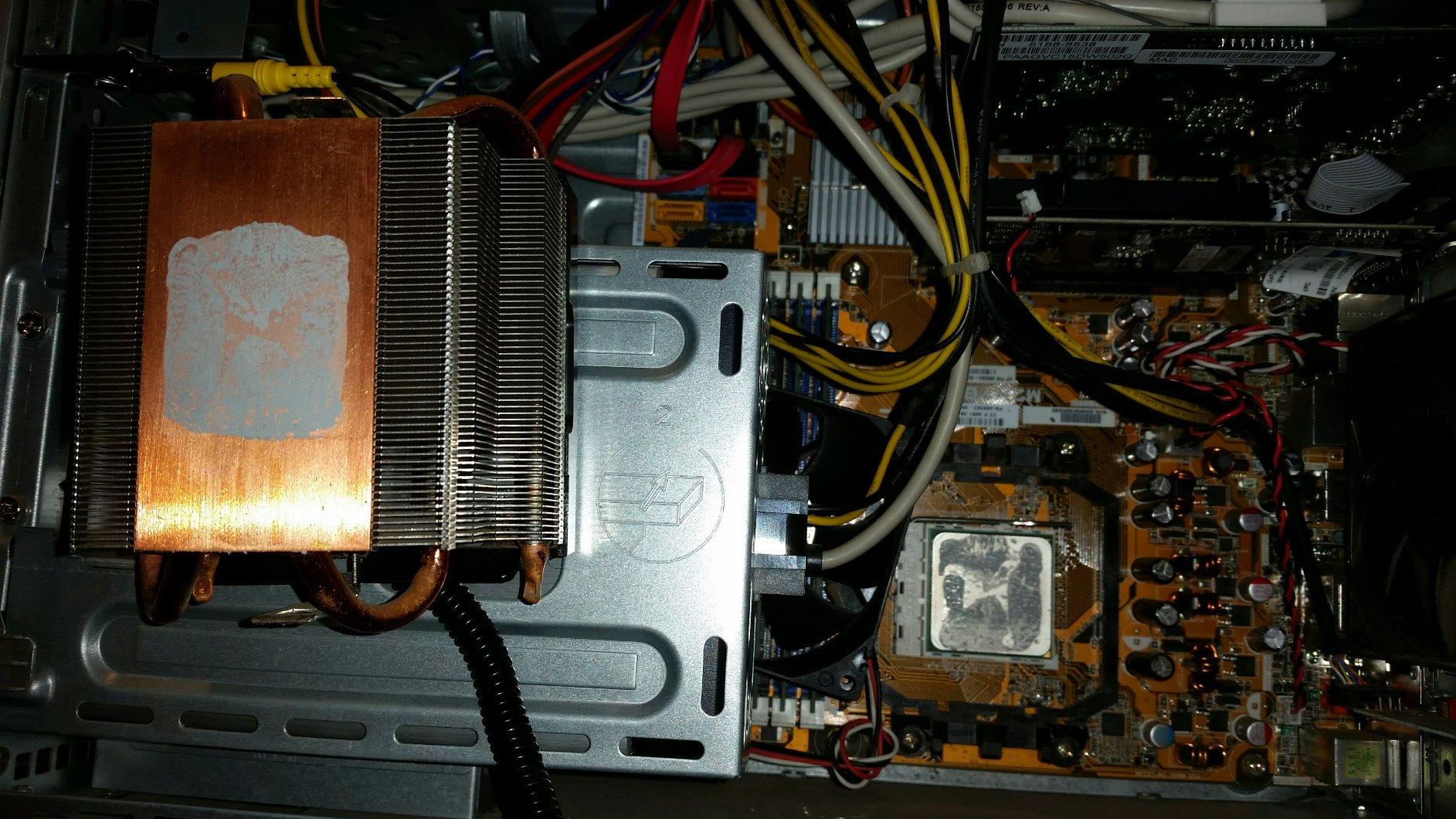
How we determine whether the grease is working, is to do a test fitting
with some AS5 and see whether there is enough material. Usually, you
would apply too little, and then need to verify how much to add to that.
Once there is enough (light colored) grease, you should see some wet the
joint between the CPU and the heatsink. You may need an "inspection mirror"
to check this (check the mounted CPU, from the side) . The view here, is
to check whether the one-dot or five-dot method you used, has spread adequately,
without squishing out and making a mess.
https://www.ofzenandcomputing.com/wp-content/uploads/2025/10/B07L9BDY3T_customer_2-1.jpg
Paul
--- Synchronet 3.22a-Linux NewsLink 1.2