• Re: Why do people claim cellphone use increased the USA accident rate?

    From Maria Sophia@mariasophia@comprehension.com to alt.home.repair,comp.mobile.android,misc.phone.mobile.iphone,rec.autos.tech,rec.autos.driving on Sat Sep 19 02:41:15 2026
    From Newsgroup: alt.home.repair

    AMuzi wrote:
    On 9/17/2026 4:28 PM, Maria Sophia wrote:
    Why do people claim cellphone use increased the accident rate in the USA?

    In a recent thread c.m.a/m.p.m.i on various carplay, androidauto, android
    automotive and screen mirroring (sonicboom) solutions, an offshoot tangent >> occurred when we theorized why factories don't just make automotive dash
    systems a phone mirror so that a familiar interface is always on the dash. >>
    Like this:
    <https://i.postimg.cc/k5gv0yw8/vysor34.jpg> Apple iOS & Android mirroring >>
    Some brought up technical issues, but really, there are none, while others >> brought up safety issues, and for that, I'm sure there are legal issues.

    But, are those legal issues valid?

    Q: Why do people claim cellphone use increased the USA accident rate?
    A: ?

    Note we're restricting this to the USA only because accurate data has been >> compiled by the USA government on accident rates over the past 100 years.

    Note 1: Accident propaganda from the following will be deeply analyzed:
    a. Law firms
    b. Insurance companies
    c. Law enforcement claims & politician claims

    Note 2: Accident *rate* is what matters, not any given number of accidents, >> over the period where cellphone ownership went from 0% to ~100%

    Note 3: Fatalities and injuries, while deeply emotional, do not count
    (because they are a second-order effect *after* the accident).

    Note 4: Nobody claims "distracted driving" doesn't cause a large number
    of accidents but distractions existed prior to cell phones and
    distractions exist after cell phone became predominate, and yet,
    in all the accurate accident-rate statistics, the rate simply
    slowly trended downward year after year, before, during & after.

    Note 5: Paradoxically, cellphone hands-free laws were enacted in most
    states but there is absolutely no correlation with accident rates
    in those states, before, during or after the laws went into force. >>
    There was no blip whatsoever, in USA accident rate (for which accurate
    statistics have been kept for over a century) which tells the true story.

    Given that, the question becomes...
    Q: Why do people claim cellphone use increased the USA accident rate?
    A: ?

    There are many post-crash reports of semi and auto drivers
    watching movies or porn or texting furiously as they
    massacre innocents.

    I agree that if people merely used the audio (as police and
    truckers do with radios) there would not be a problem.

    https://www.lifeasatrucker.com/trucker-caught-watching-porn-before-crash-that-killed-father-a-tragic-lesson-on-distraction.html

    https://discover.swns.com/2025/09/shocking-dashcam-captures-woman-texting-at-wheel-before-crash/

    Assuming no other factor was involved to cancel the arguments that people
    are making, if their hypothesis is "cell phones cause accidents," then
    the accident rate should have increased substantially at some point
    during the introduction and widespread adoption of cell phones, right?

    What's intuitively obvious is that most accidents are NOT caused by
    cell phones. Speed, alcohol, weather, road conditions, vehicle
    conditions, driver experience, etc. are all potential causes.

    Even so, given that we know approximately when cell phones were
    introduced into the USA, those who argue that cell phones meaningfully increased the USA accident rate have merely to show us valid USA
    statistics which support that claim.

    Here are the national numbers.

    U.S. CELL PHONES, CRASHES, MILES & CRASH RATE
    1988-2024

    Crash rate = NHTSA estimated police-reported crashes / FHWA VMT
    x 100 million.

    Year Wireless Police-reported VMT Crashes/
    connections* crashes billion 100M VMT ----------------------------------------------------------------
    1988 2.07 M 6,886,800 2,026 339.9
    1989 3.51 M 6,652,815 2,096 317.4
    1990 5.28 M 6,471,202 2,144 301.8
    1991 7.56 M 6,117,359 2,172 281.6
    1992 11.03 M 6,000,310 2,247 267.0
    1993 16.01 M 6,105,915 2,296 265.9
    1994 24.13 M 6,495,988 2,358 275.5
    1995 33.79 M 6,699,415 2,423 276.5
    1996 44.04 M 6,769,583 2,500 270.8
    1997 55.31 M 6,624,149 2,568 257.9
    1998 69.21 M 6,334,573 2,645 239.5
    1999 86.05 M 6,279,036 2,707 232.0
    2000 109.48 M 6,393,624 2,764 231.3
    2001 128.37 M 6,322,963 2,813 224.8
    2002 140.77 M 6,315,708 2,874 219.8
    2003 158.72 M 6,327,955 2,909 217.5
    2004 182.14 M 6,181,027 2,982 207.3
    2005 207.90 M 6,159,350 3,009 204.7
    2006 233.04 M 5,973,213 3,034 196.9
    2007 255.40 M 6,024,008 3,049 197.6
    2008 270.33 M 5,810,846 2,993 194.1
    2009 285.65 M 5,505,180 2,976 185.0
    2010 296.29 M 5,419,445 2,985 181.6

    2011 315.96 M 5,337,829 2,965 180.0
    2012 326.48 M 5,615,045 2,969 189.1
    2013 335.65 M 5,686,891 2,988 190.3
    2014 355.45 M 6,064,284 3,040 199.5
    2015 377.92 M 6,296,134 3,110 202.4

    2016 ~387 M 6,821,129 3,174 214.9
    2017 ~392 M 6,452,598 3,225 200.1
    2018 ~413 M 6,734,681 3,255 206.9
    2019 ~435 M 6,756,084 3,276 206.2
    2020 ~461 M 5,251,006 2,917 180.0
    2021 ~491 M 6,103,213 3,154 193.5
    2022 ~515 M 5,930,697 3,197 185.5
    2023 ~558 M 6,138,474 3,247 189.0
    2024 -- 6,180,241 3,294 187.6


    * Wireless figures are connections/subscriptions, NOT unique people.
    A person can have multiple connections, so these numbers should not
    be interpreted as "percentage of Americans who own a phone."

    The historical CTIA series gives the exact annual wireless connection
    numbers for the earlier period. For example:

    1990 = 5,283,055
    2000 =109,476,000 (approximately)
    2010 =296,293,000 (approximately)
    2015 =377,921,241

    CTIA: <https://api.ctia.org/docs/default-source/default-document-library/ctia_survey_ye_2015_graphics.pdf>

    NHTSA's national crash series begins in 1988. It is based on the
    National Automotive Sampling System's General Estimates System (GES),
    which estimated the number of police-reported crashes in the USA.

    NHTSA:
    <https://crashstats.nhtsa.dot.gov/Api/Public/ViewPublication/813375>

    For the later years, NHTSA uses the Crash Report Sampling System
    (CRSS).

    NHTSA:
    <https://crashstats.nhtsa.dot.gov/Api/Public/ViewPublication/813720>

    FHWA provides the national vehicle-miles-traveled series.

    FHWA: <https://www.fhwa.dot.gov/policyinformation/pubs/our_nations_highways_2026/travel.cfm>


    There is a methodological break between GES and CRSS in 2016. NHTSA
    states that the estimates from the two systems are not directly
    comparable because their sampling designs differ.

    Therefore, don't interpret the change from 2015 to 2016 as necessarily representing a real-world change in crashes.

    The much cleaner comparison is entirely within the GES period:

    WIRELESS CONNECTIONS

    1990 5.3 million
    2000 109.5 million
    2010 296.3 million


    CRASHES / 100M VMT

    1990 301.8
    2000 231.3
    2010 181.6


    So from 1990 to 2010, wireless connections increased approximately
    56-fold.

    During that same period, the national police-reported crash rate
    declined from approximately 302 crashes per 100 million vehicle-miles
    to approximately 182.

    That's a decline of about 40%.

    This does NOT prove that cell phones never cause individual accidents. Obviously, a driver can be distracted by a cell phone and crash.

    It does, however, create a very simple empirical question for anyone
    claiming that cell phones caused a substantial increase in the overall
    U.S. accident rate:

    Where is the corresponding increase in the NATIONAL ACCIDENT RATE?

    The phones went from essentially nothing to hundreds of millions of connections.

    The miles driven went up.

    And the national crash rate, during the clean 1990-2010 GES period,
    went DOWN substantially.

    Think about that fact.

    --
    Most people believe whatever the propaganda is that is fed to them
    --- Synchronet 3.22a-Linux NewsLink 1.2
  • From Maria Sophia@mariasophia@comprehension.com to comp.mobile.android,misc.phone.mobile.iphone,rec.autos.tech,rec.autos.driving,alt.home.repair on Sat Sep 19 02:56:33 2026
    From Newsgroup: alt.home.repair

    Nick Charles wrote:
    As someone who works in the science field, I can assure you statistics
    donot always tell the truth. The criteria are often cherry picked, the data >> can easily be skewed if not collected in a controlled environment, and the >> biases of the researchers often provide conclusions not necessarily
    consistent with the raw data.

    I think itos pretty obvious if you look at drivers around you that
    distracted driving is out of control and in turn it leads to erratic
    driving. I trust personal anecdotes more than statistics in this case.

    Cell phones are absolutely causing more accidents every day. But that does not
    necessarily mean "more total accidents than before".

    In the past, "distracted driving" was people changing radio stations and/or tapes in the tape deck, etc. Those days are long gone. Not to mention women putting on makeup and looking at themselves in mirrors.

    Today, "distracted driving" is texting/talking on the phone/changing your Spotify list/changing your iTunes list/watching TV/etc. Not to mention women are now looking at themselves in their phone front camera while putting on makeup.

    So phones/iPads/whatever are definitely causing many/most/take your pick accidents today. But the overall accident totals could be the same, or statiscally not different.

    So the statement "phones are causing more accidents every day" is perfectly valid. Extrapolating that into "Phones have increased the accident rate" is not valid or logical. Could be the same number of "distracted driving" accidents. Just a different cause for the distraction.


    Hi Nick,

    If phones are causing a great number of accidents, we would expect it
    to show up in the USA statistics on the number of accidents per mile
    during the period just before, during & after the cellphone skyrocketing.
    1. Pre-cellular baseline 1937-1982 No commercial US cellular service
    2. Cellular introduced 1983 First commercial cellular service began
    3. Early adoption 1984-1989 Cell phones existed but were still rare
    4. Rapid adoption 1990-1999 Cellular subscriptions exploded
    5. Mass adoption 2000-2004 >100 million U.S. wireless connections
    6. Essentially ubiquitous 2005-2010 ~208M -> 296M wireless connections
    7. Smartphone era 2011-present Smartphones become dominant

    Yet, the accident rate went down, just as it had been trending for
    decades, and still trends downward, which needs to be explained if
    someone is claiming that skyrocketing cell phone ownership caused
    concomitant skyrocketing cellphone related accidents which wouldn't have
    been caused otherwise, right?

    But we just showed the rates went down in the data for the United
    States which has been compiled very accurately over decades in use.

    Bear in mind there is one important limitation in that the NHTSA's
    nationally estimated total-crash series begins in 1988.

    For 1983-1987, we have federal national traffic data, but not the same
    GES total-crash series, so, for sure, we need to understand the data.

    What we can put together cleanly is this:

    1983-2010: NATIONAL U.S. PICTURE

    Period Year Wireless Crashes VMT Rate
    connections billion /100M ----------------------------------------------------------------------
    Cellular introduced 1983 ~0.2 M -- 1,653 --
    Early adoption 1984 ~0.3 M -- 1,720 --
    Early adoption 1985 0.34 M -- 1,775 --
    Early adoption 1986 ~0.68 M -- 1,835 --
    Early adoption 1987 ~1.2 M -- 1,921 --
    Early adoption 1988 2.07 M 6,886,800 2,026 339.9
    Early adoption 1989 3.51 M 6,652,815 2,096 317.4
    Rapid adoption 1990 5.28 M 6,471,202 2,144 301.8
    1991 7.56 M 6,117,359 2,172 281.6
    1992 11.03 M 6,000,310 2,247 267.0
    1993 16.01 M 6,105,915 2,296 265.9
    1994 24.13 M 6,495,988 2,358 275.5
    1995 33.79 M 6,699,415 2,423 276.5
    1996 44.04 M 6,769,583 2,484 272.6
    1997 55.31 M 6,624,149 2,578 257.0
    1998 69.21 M 6,334,573 2,632 240.7
    1999 86.05 M 6,279,036 2,691 233.3
    Mass adoption 2000 109.5 M 6,393,624 2,767 231.0
    2001 128.4 M 6,322,963 ~2,801 225.7
    2002 140.8 M 6,315,708 ~2,874 219.8
    2003 158.7 M 6,327,955 ~2,910 217.5
    2004 182.1 M 6,181,027 ~2,982 207.3
    Essentially ubiquitous 2005 207.9 M 6,159,350 ~3,009 204.7
    2006 233.0 M 5,973,213 ~3,034 196.9
    2007 255.4 M 6,024,008 ~3,049 197.6
    2008 270.3 M 5,810,846 ~2,993 194.1
    2009 285.7 M 5,505,180 ~2,976 185.0
    Essentially ubiquitous 2010 296.3 M 5,419,445 ~2,985 181.6


    The VMT figures for 1983-2000 are available directly from the
    Federal Highway Administration's historical series.
    FHWA:
    <https://www.fhwa.dot.gov/ohim/onh00/line9.htm>

    The national crash estimates beginning in 1988 come from NHTSA's
    GES series. The 1988 estimate is 6,886,800 crashes. The 2000
    estimate is 6,393,624.

    NHTSA: <https://www.nhtsa.gov/document/economic-impact-motor-vehicle-crashes-2000>

    The wireless numbers for the early-adoption period and 1990s
    come from the historical CTIA series.

    Notice that this is the really important part when analyzing the dataset.

    If we start the clean comparison at 1988, the progression is:

    1988
    2.1 million wireless connections
    340 crashes / 100M VMT
    1990
    5.3 million
    302 crashes / 100M VMT
    2000
    109.5 million
    231 crashes / 100M VMT
    2005
    207.9 million
    205 crashes / 100M VMT
    2010
    296.3 million
    182 crashes / 100M VMT

    So during the period when wireless connections went from roughly
    2 million --> 296 million
    the national police-reported crash rate went from approximately
    340 --> 182 crashes per 100 million miles.
    That's about a 46% decline in the crash rate.

    And that's not using fatalities as a proxy. These are total
    estimated police-reported crashes where you can't have a

    From 1983-1987 is a bit harder because the dataset changed..

    We have excellent national VMT:
    1983: 1.653 trillion miles
    1984: 1.720 trillion
    1985: 1.775 trillion
    1986: 1.835 trillion
    1987: 1.921 trillion
    FHWA:
    <https://www.fhwa.dot.gov/ohim/onh00/line6.htm>

    But for those years, it's harder to get comparative crash reports.

    Luckily, 1988 is still extremely early in cellular adoption
    where only about 2 million U.S. wireless connections existed, so
    we can then follow the same national crash series through the
    explosion to hundreds of millions of connections.

    1. 1937-1982 -- Pre-cellular
    Historical baseline/context.
    2. 1983 -- Cellular introduced
    First commercial U.S. cellular service.
    3. 1984-1989 -- Early adoption
    Still extremely few subscribers.
    4. 1990-1999 -- Rapid adoption
    ~5M --> ~86M connections.
    5. 2000-2004 -- Mass adoption
    ~109M --> ~182M connections.
    6. 2005-2010 -- Essentially ubiquitous
    ~208M --> ~296M connections.
    7. 2011-present -- Smartphone era.

    For the actual crash-rate calculation, however, we have to
    start around 1988, because that's where the nationally
    estimated NHTSA total-crash series begins.

    1988: 2.1M phones / 340 crashes per 100M miles
    1990: 5.3M / 302 crashes per 100M miles
    2000: 109.5M / 231 crashes per 100M miles
    2010: 296.3M / 182 crashes per 100M miles

    That is the cleanest first-order comparison of cellular adoption
    versus total crash rate that the national data give us, where
    the trend is clearly going down, not up.

    So the hypothesis that cellphone ownership rates skyrocketing
    caused accident rates to skyrocket, is busted, don't you think?
    --
    When people are given the real facts, their eyes start to glaze over.
    --- Synchronet 3.22a-Linux NewsLink 1.2
  • From Maria Sophia@mariasophia@comprehension.com to misc.phone.mobile.iphone,rec.autos.driving,comp.mobile.android,rec.autos.tech,alt.home.repair on Sat Sep 19 07:02:59 2026
    From Newsgroup: alt.home.repair

    Brian Gregory wrote:
    Assuming no other factor was involved to cancel the arguments that people
    are claiming, if their hypothesis is cell phones cause accidents, then
    the accident rate should have skyrocketed at some point during the
    introduction of cellphones, right?

    But you can't just assume no other factor.
    Why would you think you could??

    How can you possibly say that as mobile phones gradually became more
    popular other factors weren't, at the same time, reducing the accident rate?

    I agree.
    Your God works in mysterious ways that even you, can't explain.

    But you still believe very deeply in your staid religious views, don't you.
    But, where's your data?

    Let's look at it.
    What are you claiming happens to all your missing accidents?

    Maybe aliens took them?

    HINT: The spike in accident rates you claim, simply never existed.
    You made it up.
    --
    People with religious views always claim God works in mysterious ways.
    --- Synchronet 3.22a-Linux NewsLink 1.2
  • From Maria Sophia@mariasophia@comprehension.com to comp.mobile.android,misc.phone.mobile.iphone,rec.autos.tech,rec.autos.driving,alt.home.repair on Sat Sep 19 08:02:11 2026
    From Newsgroup: alt.home.repair

    Roger Blake wrote:
    Why do people claim cellphone use increased the accident rate in the USA?

    I don't know what the stats are but can state that some time ago I
    was rear-ended at a stop light by a young idiot who was texting.
    I have also seen young imbeciles run through red lights and
    stop signs while looking down at their phones. It's pretty
    common.

    Given that most if not all states have seen fit to pass laws against hand-held phone use while driving it is likely that cell phone use
    has indeed increased the accident rate.

    Hi Roger,

    Logic. Not religion.

    I've had my car rear ended at 60mph where highway 880 funnels into highway
    17 by a driver with not only a cellphone, but no insurance, license or registration, but that doesn't have any effect on the USA accident rate.

    It's simply anecdotal evidence.

    If the cell phone has had any effect on the accident rate in the United
    States, the only affect it could have had is lowering it year by year.

    Which, it didn't do, since the accident rate in the USA was already
    lowering year by year, so the cell phone simply had no effect at all.

    What I'm trying to impart to people on these ngs is that they fell for the propaganda, which turned out to be religious lies wrapped in anecdotes.

    That's why I brought up the scientific American article about anecdotes
    being more powerful to people than actual science, in shaping their ideas.

    And that's why I brought up how many saints have been "proven", by
    anecdotal evidence, to have performed miracles, that only God could favor.

    It's why I brought up the classic propaganda that "premium gasoline" will
    make your Honda Civic run like a race car, more efficiently & even cleaner.

    Since I've researched this data for over a decade, I already knew people
    would claim the data is 'cherry picked' (even as it's the reliable & simple data, since it's just number of accidents divided by miles.

    If the cell phone had *any* effect on the number of accidents, then it
    would have shown up when the cell phone ownership percentage skyrocketed.

    It didn't.

    I also knew people would claim "well then, some other factor EXACTLY
    countered the enormous rate of accidents they had predicted, both in exact number and exact duration of the cellphone ownership skyrocketing.

    To which, my response then, and now, is "Aliens must have done it".
    Because their excuses for the failure of their hypothesis, are absurd.

    In a recent thread c.m.a/m.p.m.i on various carplay, androidauto, android
    automotive and screen mirroring (sonicboom) solutions, an offshoot tangent >> occurred when we theorized why factories don't just make automotive dash
    systems a phone mirror so that a familiar interface is always on the dash.

    Why in the world would anyone want their dashboard to look like
    a smart phone? That's one of the worst automotive ideas I've heard
    in while. Also a smart phone interface is not something that is
    familiar to everyone. I wouldn't know what to do with an Android
    or iPhone if one were shoved in my face. (I know people who have
    no cell phone at all. I've been tempted to go that way myself.)

    I think people want to use the power of their smart phone for their driving
    and entertainment and communication purposes, which, of course, they can do with a bluetooth speakerphone, but they want the visuals of driving too.

    At least that's what I think they want the CarPlay, Android Auto, Android Automotive and BeatSonic mirroring systems to do in their cars.

    I am on record for owning cars from the 1990's, with over 300K miles on
    them, where I do my own maintenance not limited to timing belts, clutches, cooling system overhauls & I even mount and balance my own tires at home.

    None of my vehicles have anything more than a bluetooth speaker on the
    visor, and a phone holder in the louvers above the cassette tape unit.

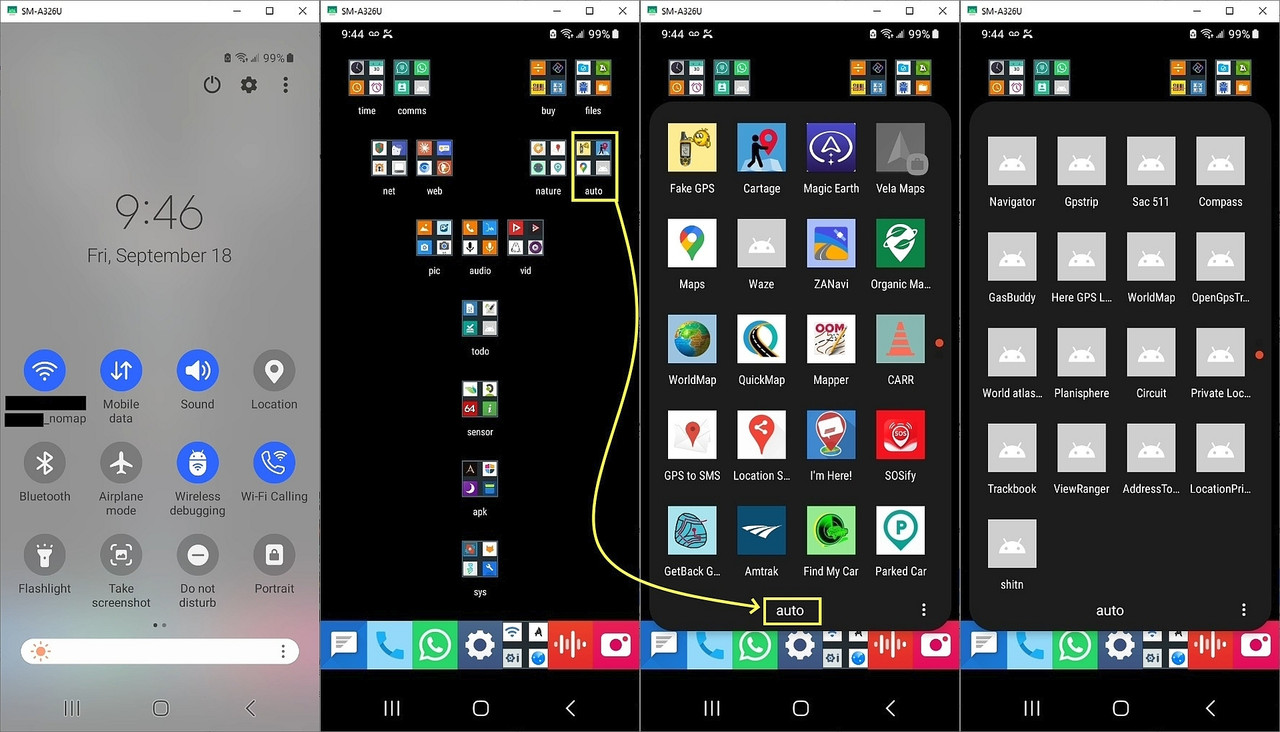
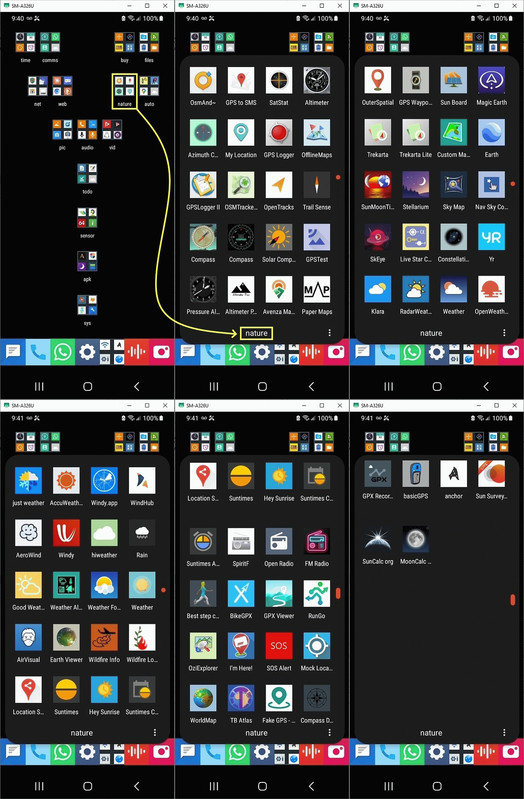
    I've added over 500 apps to my free Galaxy A32-5G, a good few dozen of
    which are map-related apps (out of the thousand packages on my 64MB phone).

    These are my driving apps that I keep on my phone for use while driving.
    <https://i.postimg.cc/3R4pPSdV/maps-driving.jpg>
    Compare that Spartan list of driving apps to my backcountry hiking apps.
    <https://i.postimg.cc/HLK84wBM/maps-hiking.jpg>

    Since I have been using the same homescreen for over a decade on a variety
    of phones (as we just copy the homescreen from one phone to the next), it's very familiar to me, so there's no fumbling around when I need something.

    Plus, my cars are all so old, none of them have those fancy things anyway.
    So you'll have to ask the others in this newsgroup why they need it.

    Last time I checked the average age of cars on the road in the U.S.
    was about 12 years. Some (like mine) are much older. Fewer people
    are buying new cars these days due to their cost and complexity.
    Making the dashboard look like a phone might well push even more
    people away.

    I am with you on keeping a car for as long as we can keep it alive.
    Just the sales tax, at 10%, on a new car, is a *lot* compared to repairs.

    My vehicles are easy to maintain for a few reasons, not the least of which
    is cars are more reliable now than they were in the 1960's when I started working on them (e.g., my dwellmeter is gathering dust along with my spark
    plug gapping tool and my timing light forgotten like the brave little
    toaster).

    The bad news is some of my cars are German, so they break all the time, but
    the good news is some are Japanese and they never seem to break, so I have
    more time to fix the cupholders and twisted seats and DISA valve and ABS control modules, and the CCV and basically everything on the bimmers.

    My own rule is that my cell phone is OFF while driving. (And mine
    is truly dead to the world when it is turned off, though I could
    remove the battery to be really certain.) Excepting possibly a
    medical emergency there is nothing that can't wait.

    I'm with you on keeping some (or all) of the phone radios off, instead of
    the common practice of leaving them all on, for privacy reasons, if not for power reasons alone.

    For example, when I walk into a store, I typically turn the airplane mode
    on (due to my knowledge of bluetooth trackers) but while driving, I have
    all the radios off EXCEPT the communication and Internet data radios.

    I generally have GPS off, but when I turn GPS on, it's spoofed by default,
    but if I'm going to actually route, then I need to turn mock location off.

    Also, those screenshots above were taken just now, at my desk, but when driving, I would have the Wi-Fi radio off (of course) as it does nothing.
    --
    I endlessly seek efficiency on computers much like physics seeks entropy.


    --- Synchronet 3.22a-Linux NewsLink 1.2
  • From Chris@ithinkiam@gmail.com to misc.phone.mobile.iphone,rec.autos.driving,comp.mobile.android,rec.autos.tech,alt.home.repair on Sat Sep 19 09:28:46 2026
    From Newsgroup: alt.home.repair

    Maria Sophia <mariasophia@comprehension.com> wrote:

    HINT: The spike in accident rates you claim, simply never existed.
    You made it up.

    HINT: that's *your* strawman argument. You still haven't fully evidenced
    your actual argument in a single post. As per usual you scattergun your information across multiple making it very difficult to follow your thought process.

    --- Synchronet 3.22a-Linux NewsLink 1.2
  • From AMuzi@am@yellowjersey.org to misc.phone.mobile.iphone,rec.autos.driving,comp.mobile.android,rec.autos.tech,alt.home.repair on Sat Sep 19 09:04:20 2026
    From Newsgroup: alt.home.repair

    On 9/18/2026 11:02 PM, Maria Sophia wrote:
    Brian Gregory wrote:
    Assuming no other factor was involved to cancel the arguments that people >>> are claiming, if their hypothesis is cell phones cause accidents, then
    the accident rate should have skyrocketed at some point during the
    introduction of cellphones, right?

    But you can't just assume no other factor.
    Why would you think you could??

    How can you possibly say that as mobile phones gradually became more
    popular other factors weren't, at the same time, reducing the accident rate?

    I agree.
    Your God works in mysterious ways that even you, can't explain.

    But you still believe very deeply in your staid religious views, don't you.
    But, where's your data?

    Let's look at it.
    What are you claiming happens to all your missing accidents?

    Maybe aliens took them?

    HINT: The spike in accident rates you claim, simply never existed.
    You made it up.

    Frequent logical gap to an unsupported conclusion.

    USA has world-high rates of autism in children. USA also had
    very high rates of childhood vaccination. Some people infer
    a link but such may or may not actually be causal. This is
    as yet unknown; maybe, but maybe not.

    Telephones _may_ cause driver incompetence when attention
    becomes critical and inattention fatal. This _may_ be
    largely offset by population level better driving habits and
    _perhaps_ by wider adoption of safety equipment (air bags
    and such). There _may_ well be a significant difference
    between use of audio (telephone or radio) and direct visual
    engagement (games, movies, porn, texting, video telephone
    calls) with a screen (telephone or car console).

    Or none of that might be significant. I don't know and you
    don't either.
    --
    Andrew Muzi
    am@yellowjersey.org
    Open every day since 1 April, 1971
    --- Synchronet 3.22a-Linux NewsLink 1.2
  • From Chris@ithinkiam@gmail.com to misc.phone.mobile.iphone,rec.autos.driving,comp.mobile.android,rec.autos.tech,alt.home.repair on Sat Sep 19 14:12:47 2026
    From Newsgroup: alt.home.repair

    AMuzi <am@yellowjersey.org> wrote:
    On 9/18/2026 11:02 PM, Maria Sophia wrote:
    Brian Gregory wrote:
    Assuming no other factor was involved to cancel the arguments that people >>>> are claiming, if their hypothesis is cell phones cause accidents, then >>>> the accident rate should have skyrocketed at some point during the
    introduction of cellphones, right?

    But you can't just assume no other factor.
    Why would you think you could??

    How can you possibly say that as mobile phones gradually became more
    popular other factors weren't, at the same time, reducing the accident rate?

    I agree.
    Your God works in mysterious ways that even you, can't explain.

    But you still believe very deeply in your staid religious views, don't you. >> But, where's your data?

    Let's look at it.
    What are you claiming happens to all your missing accidents?

    Maybe aliens took them?

    HINT: The spike in accident rates you claim, simply never existed.
    You made it up.

    Frequent logical gap to an unsupported conclusion.

    USA has world-high rates of autism in children. USA also had
    very high rates of childhood vaccination. Some people infer
    a link but such may or may not actually be causal. This is
    as yet unknown; maybe, but maybe not.

    It absolutely is known. It has been tested and retested many times. There
    is no evidence that any vaccine causes autism in children.


    --- Synchronet 3.22a-Linux NewsLink 1.2
  • From Roger Blake@rogblake@iname.invalid to comp.mobile.android,misc.phone.mobile.iphone,rec.autos.tech,rec.autos.driving,alt.home.repair on Sat Sep 19 14:57:32 2026
    From Newsgroup: alt.home.repair

    On 2026-09-19, Maria Sophia <mariasophia@comprehension.com> wrote:
    Logic. Not religion.

    Logic tells me that if the young twit coming up behind me had
    not been texting the accident I mentioned would likely have
    never happened.

    It's simply anecdotal evidence.

    I have no doubt that many other people have such "anecdotes" where
    a collision was caused by some moron using their phone instead
    of paying attention to the road.

    It's why I brought up the classic propaganda that "premium gasoline" will make your Honda Civic run like a race car, more efficiently & even cleaner.

    Depending on the car and the brand of fuel, premium gasoline may be of
    some benefit. For example, Shell oil company conducted tests showing
    that Super Shell with Platformate delivered more miles per gallon.
    Premium gasolines may also have more and better detergents and,
    depending on the engine and its control system, you may also have
    more power. (I worked for over a decade in the R&D department of a
    major oil company.)

    If the cell phone had *any* effect on the number of accidents, then it
    would have shown up when the cell phone ownership percentage skyrocketed.

    It didn't.

    So it is your claim that people using cell phones while driving
    have not caused accidents which otherwise would not have occurred.
    "Anecdotal" evidence at the very least suggests that is not the case.

    I think people want to use the power of their smart phone for their driving and entertainment and communication purposes, which, of course, they can do with a bluetooth speakerphone, but they want the visuals of driving too.

    I don't claim to know what other people want. I have no interest in
    smart phones or their so-called "apps", and have no plans to ever
    own one. In fact my much simpler phone is off most of the time unless
    there is a need to use it. I'm not on board with the modern idea of
    being reachable 24/7 under virtually all circumstances. Call, leave
    a message, I'll get back to you when I can.

    As far as entertainment, my cars have AM/FM radio and tape decks.
    No bluetooth. No wifi. No connectivity. That works for me.

    I am on record for owning cars from the 1990's, with over 300K miles on
    them, where I do my own maintenance not limited to timing belts, clutches, cooling system overhauls & I even mount and balance my own tires at home.

    That's what I do other than mounting/balancing tires. I have yet to
    own a car made in the 21st century.

    My vehicles are easy to maintain for a few reasons, not the least of which
    is cars are more reliable now than they were in the 1960's when I started working on them (e.g., my dwellmeter is gathering dust along with my spark plug gapping tool and my timing light forgotten like the brave little toaster).

    I still have cars from the 1960s and early 1970s, though not for daily
    use. They are used little enough that a set of points and plugs lasts
    for quite a few years so I've resisted the temptation to convert to
    electronic ignition. I do still keep my dwell meter, plug gapper,
    and timing light handy.
    --
    Roger Blake
    --- Synchronet 3.22a-Linux NewsLink 1.2
  • From AMuzi@am@yellowjersey.org to misc.phone.mobile.iphone,rec.autos.driving,comp.mobile.android,rec.autos.tech,alt.home.repair on Sat Sep 19 11:24:34 2026
    From Newsgroup: alt.home.repair

    On 9/19/2026 9:12 AM, Chris wrote:
    AMuzi <am@yellowjersey.org> wrote:
    On 9/18/2026 11:02 PM, Maria Sophia wrote:
    Brian Gregory wrote:
    Assuming no other factor was involved to cancel the arguments that people >>>>> are claiming, if their hypothesis is cell phones cause accidents, then >>>>> the accident rate should have skyrocketed at some point during the
    introduction of cellphones, right?

    But you can't just assume no other factor.
    Why would you think you could??

    How can you possibly say that as mobile phones gradually became more
    popular other factors weren't, at the same time, reducing the accident rate?

    I agree.
    Your God works in mysterious ways that even you, can't explain.

    But you still believe very deeply in your staid religious views, don't you. >>> But, where's your data?

    Let's look at it.
    What are you claiming happens to all your missing accidents?

    Maybe aliens took them?

    HINT: The spike in accident rates you claim, simply never existed.
    You made it up.

    Frequent logical gap to an unsupported conclusion.

    USA has world-high rates of autism in children. USA also had
    very high rates of childhood vaccination. Some people infer
    a link but such may or may not actually be causal. This is
    as yet unknown; maybe, but maybe not.

    It absolutely is known. It has been tested and retested many times. There
    is no evidence that any vaccine causes autism in children.


    I happen to agree with you on that, but just as the
    telephones-in-autos example, absence of evidence is not
    evidence of absence.
    --
    Andrew Muzi
    am@yellowjersey.org
    Open every day since 1 April, 1971
    --- Synchronet 3.22a-Linux NewsLink 1.2
  • From kludge@kludge@panix.com (Scott Dorsey) to comp.mobile.android,misc.phone.mobile.iphone,rec.autos.tech,rec.autos.driving,alt.home.repair on Sat Sep 19 10:34:58 2026
    From Newsgroup: alt.home.repair

    Maria Sophia <pusvul@getTjewytR4so+mqe2.invalid> wrote:
    I've had my car rear ended at 60mph where highway 880 funnels into highway
    17 by a driver with not only a cellphone, but no insurance, license or >registration, but that doesn't have any effect on the USA accident rate.

    Sure it does. It increments the USA accident rate by 1.

    It's simply anecdotal evidence.

    Yes. You put evidence of individual events together and you have statistics and then when you analyze statistics you have data.

    What you should be looking at is this: of the number of people charged in accidents, what has been the progression of the rate of distracted driving charges related to phones.

    If the cell phone has had any effect on the accident rate in the United >States, the only affect it could have had is lowering it year by year.

    Which, it didn't do, since the accident rate in the USA was already
    lowering year by year, so the cell phone simply had no effect at all.

    Perhaps it would have lowered faster were it not for people using
    their cellphones while driving.

    What I'm trying to impart to people on these ngs is that they fell for the >propaganda, which turned out to be religious lies wrapped in anecdotes.

    And whatever happened to the campaigns against smoking in bed? Used to
    be we had a lot of deaths from people smoking in bed.
    --scott
    --
    "C'est un Nagra. C'est suisse, et tres, tres precis."
    --- Synchronet 3.22a-Linux NewsLink 1.2
  • From Brian Gregory@void-invalid-dead-dontuse@email.invalid to misc.phone.mobile.iphone,rec.autos.driving,comp.mobile.android,rec.autos.tech,alt.home.repair on Sat Sep 19 19:51:25 2026
    From Newsgroup: alt.home.repair

    On 19/09/2026 05:02, Maria Sophia wrote:
    I agree.
    Your God works in mysterious ways that even you, can't explain.

    But you still believe very deeply in your staid religious views, don't you.

    No, I am an agnostic/atheist.

    But, where's your data?

    That's why I am an agnostic/atheist.


    Let's look at it.
    What are you claiming happens to all your missing accidents?

    I don't drive.


    Maybe aliens took them?

    HINT: The spike in accident rates you claim, simply never existed.
    You made it up.

    Um what? I just claimed that there would be NO spike.
    --
    Brian Gregory (in England).
    --- Synchronet 3.22a-Linux NewsLink 1.2
  • From Chris@ithinkiam@gmail.com to misc.phone.mobile.iphone,rec.autos.driving,comp.mobile.android,rec.autos.tech,alt.home.repair on Sat Sep 19 22:18:11 2026
    From Newsgroup: alt.home.repair

    AMuzi <am@yellowjersey.org> wrote:
    On 9/19/2026 9:12 AM, Chris wrote:
    AMuzi <am@yellowjersey.org> wrote:
    On 9/18/2026 11:02 PM, Maria Sophia wrote:
    Brian Gregory wrote:
    Assuming no other factor was involved to cancel the arguments that people
    are claiming, if their hypothesis is cell phones cause accidents, then >>>>>> the accident rate should have skyrocketed at some point during the >>>>>> introduction of cellphones, right?

    But you can't just assume no other factor.
    Why would you think you could??

    How can you possibly say that as mobile phones gradually became more >>>>> popular other factors weren't, at the same time, reducing the accident rate?

    I agree.
    Your God works in mysterious ways that even you, can't explain.

    But you still believe very deeply in your staid religious views, don't you.
    But, where's your data?

    Let's look at it.
    What are you claiming happens to all your missing accidents?

    Maybe aliens took them?

    HINT: The spike in accident rates you claim, simply never existed.
    You made it up.

    Frequent logical gap to an unsupported conclusion.

    USA has world-high rates of autism in children. USA also had
    very high rates of childhood vaccination. Some people infer
    a link but such may or may not actually be causal. This is
    as yet unknown; maybe, but maybe not.

    It absolutely is known. It has been tested and retested many times. There
    is no evidence that any vaccine causes autism in children.


    I happen to agree with you on that, but just as the
    telephones-in-autos example, absence of evidence is not
    evidence of absence.

    Except with vaccines there isn't any absence of evidence.

    --- Synchronet 3.22a-Linux NewsLink 1.2
  • From Horse Paste@horse.paste@e.quine to alt.home.repair on Sun Sep 20 06:35:40 2026
    From Newsgroup: alt.home.repair

    This is a multi-part message in MIME format. --------------Rj2vuGkfLnGEOPtjlEYRKojB
    Content-Type: text/plain; charset=UTF-8; format=flowed Content-Transfer-Encoding: 8bit

    On 9/19/26 18:18, Chris wrote:
    AMuzi<am@yellowjersey.org> wrote:
    I happen to agree with you on that, but just as the
    telephones-in-autos example, absence of evidence is not
    evidence of absence.
    Except with vaccines there isn't any absence of evidence.

    Yah, Republican Senator Rand Paul, MD tried to get some quackcine
    answers but that Pfauci phucker's not talking.

    "On the advice of counsel I respectfully decline to answer based upon my rights under the 5th Amendment to the Constitution." -a-Tony Pfauci-Phucker

    --------------Rj2vuGkfLnGEOPtjlEYRKojB
    Content-Type: text/html; charset=UTF-8
    Content-Transfer-Encoding: 8bit

    <!DOCTYPE html>
    <html>
    <head>
    <meta http-equiv="Content-Type" content="text/html; charset=UTF-8">
    </head>
    <body>
    <div class="moz-cite-prefix">On 9/19/26 18:18, Chris wrote:<br>
    </div>
    <blockquote type="cite" cite="mid:118n1n3$2l6po$1@dont-email.me">
    <pre wrap="" class="moz-quote-pre">AMuzi <a class="moz-txt-link-rfc2396E" href="mailto:am@yellowjersey.org">&lt;am@yellowjersey.org&gt;</a> wrote:
    </pre>
    <blockquote type="cite">
    <pre wrap="" class="moz-quote-pre">
    I happen to agree with you on that, but just as the
    telephones-in-autos example, absence of evidence is not
    evidence of absence.
    </pre>
    </blockquote>
    <pre wrap="" class="moz-quote-pre">
    Except with vaccines there isn't any absence of evidence.

    </pre>
    </blockquote>
    <p>Yah, Republican Senator Rand Paul, MD tried to get some quackcine
    answers but that Pfauci phucker's not talking.</p>
    <p>"On the advice of counsel I respectfully decline to answer based
    upon my rights under the 5th Amendment to the Constitution."-a
    -a-Tony Pfauci-Phucker</p>
    </body>
    </html>

    --------------Rj2vuGkfLnGEOPtjlEYRKojB--
    --- Synchronet 3.22a-Linux NewsLink 1.2
  • From AMuzi@am@yellowjersey.org to misc.phone.mobile.iphone,rec.autos.driving,comp.mobile.android,rec.autos.tech,alt.home.repair on Sun Sep 20 11:11:42 2026
    From Newsgroup: alt.home.repair

    On 9/19/2026 5:18 PM, Chris wrote:
    AMuzi <am@yellowjersey.org> wrote:
    On 9/19/2026 9:12 AM, Chris wrote:
    AMuzi <am@yellowjersey.org> wrote:
    On 9/18/2026 11:02 PM, Maria Sophia wrote:
    Brian Gregory wrote:
    Assuming no other factor was involved to cancel the arguments that people
    are claiming, if their hypothesis is cell phones cause accidents, then >>>>>>> the accident rate should have skyrocketed at some point during the >>>>>>> introduction of cellphones, right?

    But you can't just assume no other factor.
    Why would you think you could??

    How can you possibly say that as mobile phones gradually became more >>>>>> popular other factors weren't, at the same time, reducing the accident rate?

    I agree.
    Your God works in mysterious ways that even you, can't explain.

    But you still believe very deeply in your staid religious views, don't you.
    But, where's your data?

    Let's look at it.
    What are you claiming happens to all your missing accidents?

    Maybe aliens took them?

    HINT: The spike in accident rates you claim, simply never existed.
    You made it up.

    Frequent logical gap to an unsupported conclusion.

    USA has world-high rates of autism in children. USA also had
    very high rates of childhood vaccination. Some people infer
    a link but such may or may not actually be causal. This is
    as yet unknown; maybe, but maybe not.

    It absolutely is known. It has been tested and retested many times. There >>> is no evidence that any vaccine causes autism in children.


    I happen to agree with you on that, but just as the
    telephones-in-autos example, absence of evidence is not
    evidence of absence.

    Except with vaccines there isn't any absence of evidence.


    As with police radio and truckers on CB for decades, audio
    seems to be benign as compared to a video or text device.
    Yet legislatures make no distinction and aggregated data (as
    referenced by OP) lumps all those together. Some large
    proportion of people believe both that there is a childhood
    vaccine and autism link ( I am not one) and that telephones
    are a crash risk while ignoring console and telephone video
    and text as unique interfaces disparate from audio.

    Existing evidence has failed to sway a great many people in
    both areas.
    --
    Andrew Muzi
    am@yellowjersey.org
    Open every day since 1 April, 1971
    --- Synchronet 3.22a-Linux NewsLink 1.2
  • From Maria Sophia@mariasophia@comprehension.com to misc.phone.mobile.iphone,rec.autos.driving,comp.mobile.android,rec.autos.tech,alt.home.repair on Sun Sep 20 22:58:24 2026
    From Newsgroup: alt.home.repair

    Chris wrote:
    Maria Sophia <mariasophia@comprehension.com> wrote:

    HINT: The spike in accident rates you claim, simply never existed.
    You made it up.

    HINT: that's *your* strawman argument. You still haven't fully evidenced
    your actual argument in a single post. As per usual you scattergun your information across multiple making it very difficult to follow your thought process.


    Hi Chris,

    I certainly know the answer to the question that I posed in this thread.
    I knew it a decade ago.

    Why?
    Because I can think. I can do research. I can look up the data.

    So I knew cellphones had zero measurable effect on accident rate.

    So why did I make the thread, again, after ten more years of data?
    I am making a very clear point that nobody who responded knows it.

    The hypothesis of most people is premium gasoline gives their Honda Civic
    more power, just because of the propaganda they parrot that they're fed.

    Likewise, people parrot the incorrect information that astronauts are 'weightless' in space, right, or, that gravity is a force, right?

    Why?
    I know why.

    People don't think.
    If it "sounds" plausible, they believe it.

    Most people got C's or maybe B's in school because they couldn't think.
    Most people simply do not own the mental capacity to think things through.

    So most people believe all the bullshit that a politician or marketing
    spiel tells them to believe - and they don't even *think* to question it.

    That's one reason I love the Mythbusters TV series, as they tested them.
    Who knew, for example, that a lit cigarette doesn't light a puddle of gas.

    That's the problem here.

    Most people are claiming that, by Golly, since cellphone use rocketed up
    during only a handful of years, accidents *must* have followed the trend.

    And yet, they didn't.

    HINT: I'll bring this up, again, a decade from now, and guess what...
    Nobody will have learned a damn thing. That's rather sad.
    --
    To comprehend good posts requires a modicum of adult cognitive skills.
    --- Synchronet 3.22a-Linux NewsLink 1.2
  • From AMuzi@am@yellowjersey.org to misc.phone.mobile.iphone,rec.autos.driving,comp.mobile.android,rec.autos.tech,alt.home.repair on Sun Sep 20 15:05:14 2026
    From Newsgroup: alt.home.repair

    On 9/20/2026 2:58 PM, Maria Sophia wrote:
    Chris wrote:
    Maria Sophia <mariasophia@comprehension.com> wrote:

    HINT: The spike in accident rates you claim, simply never existed.
    You made it up.

    HINT: that's *your* strawman argument. You still haven't fully evidenced
    your actual argument in a single post. As per usual you scattergun your
    information across multiple making it very difficult to follow your thought >> process.


    Hi Chris,

    I certainly know the answer to the question that I posed in this thread.
    I knew it a decade ago.

    Why?
    Because I can think. I can do research. I can look up the data.

    So I knew cellphones had zero measurable effect on accident rate.

    So why did I make the thread, again, after ten more years of data?
    I am making a very clear point that nobody who responded knows it.

    The hypothesis of most people is premium gasoline gives their Honda Civic more power, just because of the propaganda they parrot that they're fed.

    Likewise, people parrot the incorrect information that astronauts are 'weightless' in space, right, or, that gravity is a force, right?

    Why?
    I know why.

    People don't think.
    If it "sounds" plausible, they believe it.

    Most people got C's or maybe B's in school because they couldn't think.
    Most people simply do not own the mental capacity to think things through.

    So most people believe all the bullshit that a politician or marketing
    spiel tells them to believe - and they don't even *think* to question it.

    That's one reason I love the Mythbusters TV series, as they tested them.
    Who knew, for example, that a lit cigarette doesn't light a puddle of gas.

    That's the problem here.

    Most people are claiming that, by Golly, since cellphone use rocketed up during only a handful of years, accidents *must* have followed the trend.

    And yet, they didn't.

    HINT: I'll bring this up, again, a decade from now, and guess what...
    Nobody will have learned a damn thing. That's rather sad.


    Gravity is a indeed a force:

    https://www.thoughtco.com/what-are-fundamental-forces-of-physics-2699070

    Gravity
    Electromagnetism
    Weak Interaction (or Weak Nuclear Force)
    Strong Interaction (or Strong Nuclear Force)
    --
    Andrew Muzi
    am@yellowjersey.org
    Open every day since 1 April, 1971
    --- Synchronet 3.22a-Linux NewsLink 1.2
  • From Maria Sophia@mariasophia@comprehension.com to comp.mobile.android,misc.phone.mobile.iphone,rec.autos.tech,rec.autos.driving,alt.home.repair on Sun Sep 20 23:13:26 2026
    From Newsgroup: alt.home.repair

    Scott Dorsey wrote:
    I've had my car rear ended at 60mph where highway 880 funnels into highway >>17 by a driver with not only a cellphone, but no insurance, license or >>registration, but that doesn't have any effect on the USA accident rate.

    Sure it does. It increments the USA accident rate by 1.

    Hi Scott,

    You're wrong, but I'll chalk it up to your attempt at a joke, which is
    fine, but let's be clear, just as weather isn't climate, numbers of
    accidents has to be divided by miles driven to obtain the accident rate.

    It's simply anecdotal evidence.

    Yes. You put evidence of individual events together and you have statistics and then when you analyze statistics you have data.

    What you should be looking at is this: of the number of people charged in accidents, what has been the progression of the rate of distracted driving charges related to phones.

    I get it you're desperate to fabricate any excuze for why your belief
    system isn't based on facts, but if you want to make a case about police prosecution, please make your compelling argument using vetted facts.

    Like I did by using the US government data which has been collected since
    about the 1920's & hence has been tested for almost a century for accuracy.


    If the cell phone has had any effect on the accident rate in the United >>States, the only affect it could have had is lowering it year by year.

    Which, it didn't do, since the accident rate in the USA was already >>lowering year by year, so the cell phone simply had no effect at all.

    Perhaps it would have lowered faster were it not for people using
    their cellphones while driving.

    There are likely many reasons why the US accident rate has been trending downward before, during and after the introduction of cell phone tech.

    But what's clear in the excellent USA well-vetted data that the
    introduction of the cell phone had no measurable effect on accident rate.

    You have to START with that fact, before forming any hypothetical rebuttal.

    What I'm trying to impart to people on these ngs is that they fell for the >>propaganda, which turned out to be religious lies wrapped in anecdotes.

    And whatever happened to the campaigns against smoking in bed? Used to
    be we had a lot of deaths from people smoking in bed.

    I have no idea. What are the statistics that you show to make the point?
    --
    Only after adults agree on the facts can they possibly discuss assessments.
    --- Synchronet 3.22a-Linux NewsLink 1.2
  • From Maria Sophia@mariasophia@comprehension.com to comp.mobile.android,misc.phone.mobile.iphone,rec.autos.tech,rec.autos.driving,alt.home.repair on Sun Sep 20 23:27:27 2026
    From Newsgroup: alt.home.repair

    Roger Blake wrote:
    On 2026-09-19, Maria Sophia <mariasophia@comprehension.com> wrote:
    Logic. Not religion.

    Logic tells me that if the young twit coming up behind me had
    not been texting the accident I mentioned would likely have
    never happened.

    It's simply anecdotal evidence.

    I have no doubt that many other people have such "anecdotes" where
    a collision was caused by some moron using their phone instead
    of paying attention to the road.

    It's why I brought up the classic propaganda that "premium gasoline" will >> make your Honda Civic run like a race car, more efficiently & even cleaner.

    Depending on the car and the brand of fuel, premium gasoline may be of
    some benefit. For example, Shell oil company conducted tests showing
    that Super Shell with Platformate delivered more miles per gallon.
    Premium gasolines may also have more and better detergents and,
    depending on the engine and its control system, you may also have
    more power. (I worked for over a decade in the R&D department of a
    major oil company.)

    If the cell phone had *any* effect on the number of accidents, then it
    would have shown up when the cell phone ownership percentage skyrocketed.

    It didn't.

    So it is your claim that people using cell phones while driving
    have not caused accidents which otherwise would not have occurred. "Anecdotal" evidence at the very least suggests that is not the case.

    I think people want to use the power of their smart phone for their driving >> and entertainment and communication purposes, which, of course, they can do >> with a bluetooth speakerphone, but they want the visuals of driving too.

    I don't claim to know what other people want. I have no interest in
    smart phones or their so-called "apps", and have no plans to ever
    own one. In fact my much simpler phone is off most of the time unless
    there is a need to use it. I'm not on board with the modern idea of
    being reachable 24/7 under virtually all circumstances. Call, leave
    a message, I'll get back to you when I can.

    As far as entertainment, my cars have AM/FM radio and tape decks.
    No bluetooth. No wifi. No connectivity. That works for me.

    I am on record for owning cars from the 1990's, with over 300K miles on
    them, where I do my own maintenance not limited to timing belts, clutches, >> cooling system overhauls & I even mount and balance my own tires at home.

    That's what I do other than mounting/balancing tires. I have yet to
    own a car made in the 21st century.

    My vehicles are easy to maintain for a few reasons, not the least of which >> is cars are more reliable now than they were in the 1960's when I started
    working on them (e.g., my dwellmeter is gathering dust along with my spark >> plug gapping tool and my timing light forgotten like the brave little
    toaster).

    I still have cars from the 1960s and early 1970s, though not for daily
    use. They are used little enough that a set of points and plugs lasts
    for quite a few years so I've resisted the temptation to convert to electronic ignition. I do still keep my dwell meter, plug gapper,
    and timing light handy.

    Hi Roger,

    What I'm trying to impart to people on these ngs is that they fell for the propaganda, which turned out to be bullshit lies wrapped in anecdotes.

    Just as people believe gravity is a force, we've known since 1916 it's not.

    It took a while for Einstein to prove it, which is kind of what's happening here because people can't believe the data that there is no measurable
    change in accident rate in the USA before, during or after cellphones were introduc3ed, let alone some kind of mysterious skyrocketing that's "hidden"
    (by whom? Aliens?) in exact timing and skyrocketing introduction rates.

    Yet, people always fall on their anecdotes, such as "A friend of my
    mother's sister saw this accident", and form their entire belief system
    based on that one anecdote (simply because it "sounded plausible" to them).

    Using the example of Scott about cigarettes in bed, I can claim equally as
    well that I knew a guy smoking cigarettes and his wife never divorced him.

    Therefore, using the same anecdotal evidence you & Scott are attempting to apply, this proves (in your minds) that smoking in bed lowers the divorce
    rate. Maybe it does. Maybe it doesn't. But where's the data I will ask.

    Regarding home maintenance, I'm sure a lot (if not most?) of the folks on
    some of the automotive newsgroups do all their own work, which, I must add, saves them a ton of money, although, I'm in my 80's now, and it's getting harder and harder to be on the ground (I bring along cushions & knee pads).

    As for none of my current cars are older than 1996, so all of them have
    the 'new fangled' pointless ignition, which,

    Given dwell angle was something we set because it directly affected coil saturation & ignition timing, "electronic ignition", wiped out my need for testing it. As I recall, my Sears Craftsman chromed timing light lasted
    longer but I don't even know if my late 1990s vehicles have timing notches
    on the harmonic balancer, but worse, there's no distributor to twist.

    Times changed in the past 86 years, that's fer' sure!
    --
    On Usenet, old friends discuss topics of interest to learn from each other.
    --- Synchronet 3.22a-Linux NewsLink 1.2
  • From AMuzi@am@yellowjersey.org to comp.mobile.android,misc.phone.mobile.iphone,rec.autos.tech,rec.autos.driving,alt.home.repair on Sun Sep 20 15:42:17 2026
    From Newsgroup: alt.home.repair

    On 9/20/2026 3:27 PM, Maria Sophia wrote:
    Roger Blake wrote:
    On 2026-09-19, Maria Sophia <mariasophia@comprehension.com> wrote:
    Logic. Not religion.

    Logic tells me that if the young twit coming up behind me had
    not been texting the accident I mentioned would likely have
    never happened.

    It's simply anecdotal evidence.

    I have no doubt that many other people have such "anecdotes" where
    a collision was caused by some moron using their phone instead
    of paying attention to the road.

    It's why I brought up the classic propaganda that "premium gasoline" will >>> make your Honda Civic run like a race car, more efficiently & even cleaner. >>
    Depending on the car and the brand of fuel, premium gasoline may be of
    some benefit. For example, Shell oil company conducted tests showing
    that Super Shell with Platformate delivered more miles per gallon.
    Premium gasolines may also have more and better detergents and,
    depending on the engine and its control system, you may also have
    more power. (I worked for over a decade in the R&D department of a
    major oil company.)

    If the cell phone had *any* effect on the number of accidents, then it
    would have shown up when the cell phone ownership percentage skyrocketed. >>>
    It didn't.

    So it is your claim that people using cell phones while driving
    have not caused accidents which otherwise would not have occurred.
    "Anecdotal" evidence at the very least suggests that is not the case.

    I think people want to use the power of their smart phone for their driving >>> and entertainment and communication purposes, which, of course, they can do >>> with a bluetooth speakerphone, but they want the visuals of driving too.

    I don't claim to know what other people want. I have no interest in
    smart phones or their so-called "apps", and have no plans to ever
    own one. In fact my much simpler phone is off most of the time unless
    there is a need to use it. I'm not on board with the modern idea of
    being reachable 24/7 under virtually all circumstances. Call, leave
    a message, I'll get back to you when I can.

    As far as entertainment, my cars have AM/FM radio and tape decks.
    No bluetooth. No wifi. No connectivity. That works for me.

    I am on record for owning cars from the 1990's, with over 300K miles on
    them, where I do my own maintenance not limited to timing belts, clutches, >>> cooling system overhauls & I even mount and balance my own tires at home. >>
    That's what I do other than mounting/balancing tires. I have yet to
    own a car made in the 21st century.

    My vehicles are easy to maintain for a few reasons, not the least of which >>> is cars are more reliable now than they were in the 1960's when I started >>> working on them (e.g., my dwellmeter is gathering dust along with my spark >>> plug gapping tool and my timing light forgotten like the brave little
    toaster).

    I still have cars from the 1960s and early 1970s, though not for daily
    use. They are used little enough that a set of points and plugs lasts
    for quite a few years so I've resisted the temptation to convert to
    electronic ignition. I do still keep my dwell meter, plug gapper,
    and timing light handy.

    Hi Roger,

    What I'm trying to impart to people on these ngs is that they fell for the propaganda, which turned out to be bullshit lies wrapped in anecdotes.

    Just as people believe gravity is a force, we've known since 1916 it's not.

    It took a while for Einstein to prove it, which is kind of what's happening here because people can't believe the data that there is no measurable
    change in accident rate in the USA before, during or after cellphones were introduc3ed, let alone some kind of mysterious skyrocketing that's "hidden" (by whom? Aliens?) in exact timing and skyrocketing introduction rates.

    Yet, people always fall on their anecdotes, such as "A friend of my
    mother's sister saw this accident", and form their entire belief system
    based on that one anecdote (simply because it "sounded plausible" to them).

    Using the example of Scott about cigarettes in bed, I can claim equally as well that I knew a guy smoking cigarettes and his wife never divorced him.

    Therefore, using the same anecdotal evidence you & Scott are attempting to apply, this proves (in your minds) that smoking in bed lowers the divorce rate. Maybe it does. Maybe it doesn't. But where's the data I will ask.

    Regarding home maintenance, I'm sure a lot (if not most?) of the folks on some of the automotive newsgroups do all their own work, which, I must add, saves them a ton of money, although, I'm in my 80's now, and it's getting harder and harder to be on the ground (I bring along cushions & knee pads).

    As for none of my current cars are older than 1996, so all of them have
    the 'new fangled' pointless ignition, which,

    Given dwell angle was something we set because it directly affected coil saturation & ignition timing, "electronic ignition", wiped out my need for testing it. As I recall, my Sears Craftsman chromed timing light lasted longer but I don't even know if my late 1990s vehicles have timing notches
    on the harmonic balancer, but worse, there's no distributor to twist.

    Times changed in the past 86 years, that's fer' sure!


    Physics rests on the four forces: gravity, electromagnetism,
    and the strong & weak atomic forces. Einstein's General
    Theory (1916) affirms that, and the 1919 eclipse provided
    dispositive proof.

    As a scientist, you know this. So, whatever your point above
    was, it makes no sense within the context of physics.
    --
    Andrew Muzi
    am@yellowjersey.org
    Open every day since 1 April, 1971
    --- Synchronet 3.22a-Linux NewsLink 1.2
  • From Maria Sophia@mariasophia@comprehension.com to comp.mobile.android,misc.phone.mobile.iphone,alt.home.repair,rec.autos.tech,rec.autos.driving on Sun Sep 20 23:55:23 2026
    From Newsgroup: alt.home.repair

    The Real Bev wrote:
    this may be the beginning of all-AI arguments on usenet.

    Hi The Real Bev,

    You haven't been on c.m.a for a while, so you must be coming from
    elsewhere. Good to see you.

    Remember, more than one person noted I knew the answer more than a decade
    ago to this question, and it has only gotten more definitive with another decade of data, all collected well before AI was a "thing" available to us.

    The good data has been collected in the USA for over a century, all of
    which predates, AI, and people who know me know I've presented this prior.

    But, I challenge Carlos to use AI to test the data itself.
    I ask Carlos to paste the posts which I provided the data to AI.

    And for Carlos to ask AI if the data is correct.
    That would be a useful use of AI if Carlos can find a hole in my argument.

    He won't be able to, though.
    I wonder if anyone has noticed I'm the only one who actually provided data?

    Everyone who tried to refute the data did so in one of these ways:
    1. They claimed they knew a sister of a friend who had a car accident
    by someone who owned a cell phone so of course, cell phones raised
    the accident rate.

    2. They claimed cell phones are a distraction (which, by the way, I don't
    think anyone disagrees with, least of all me), so, of course, to them,
    adding one distraction to the thousands inherent in driving must,
    to them, have vastly increased the accident rate.

    3. Some tried pithy aphorisms to refute all facts that belie their
    religious belief system, such as the "Correlation isn't causation",
    and yet, it's clear they never even *looked* at the data presented.

    What I'm trying to do, clearly, is the same as if I told a man that an astronaut wasn't weightless while orbiting even though they think she was.

    People who lack scientific minds will believe anything that sounds logical.
    --
    On Usenet, old friends discuss topics of interest to learn from each other.
    --- Synchronet 3.22a-Linux NewsLink 1.2
  • From Maria Sophia@mariasophia@comprehension.com to comp.mobile.android,alt.home.repair,misc.phone.mobile.iphone,rec.autos.tech,rec.autos.driving on Sun Sep 20 23:58:36 2026
    From Newsgroup: alt.home.repair

    The Real Bev wrote:
    Carlos, this may be the beginning of all-AI arguments on usenet.
    Probably not a good thing :-(

    Hi The Real Bev,

    You haven't been on c.m.a for a while, so you must be coming from
    elsewhere. Good to see you.

    Remember, more than one person noted I knew the answer more than a decade
    ago to this question, and it has only gotten more definitive with another decade of data, all collected well before AI was a "thing" available to us.

    The good data has been collected in the USA for over a century, all of
    which predates, AI, and people who know me know I've presented this prior.

    But, I challenge Carlos to use AI to test the data itself.
    I ask Carlos to paste the posts which I provided the data to AI.

    And for Carlos to ask AI if the data is correct.
    That would be a useful use of AI if Carlos can find a hole in my argument.

    He won't be able to, though.
    I wonder if anyone has noticed I'm the only one who actually provided data?

    Everyone who tried to refute the data did so in one of these ways:
    1. They claimed they knew a sister of a friend who had a car accident
    by someone who owned a cell phone so of course, cell phones raised
    the accident rate.

    2. They claimed cell phones are a distraction (which, by the way, I don't
    think anyone disagrees with, least of all me), so, of course, to them,
    adding one distraction to the thousands inherent in driving must,
    to them, have vastly increased the accident rate.

    3. Some tried pithy aphorisms to refute all facts that belie their
    religious belief system, such as the "Correlation isn't causation",
    and yet, it's clear they never even *looked* at the data presented.

    What I'm trying to do, clearly, is the same as if I told a man that an astronaut wasn't weightless while orbiting even though they think she was.

    People who lack scientific minds will believe anything that sounds logical.
    --
    On Usenet, old friends discuss topics of interest to learn from each other.
    --- Synchronet 3.22a-Linux NewsLink 1.2
  • From Maria Sophia@mariasophia@comprehension.com to comp.mobile.android,misc.phone.mobile.iphone,rec.autos.tech,rec.autos.driving,alt.home.repair on Mon Sep 21 00:13:09 2026
    From Newsgroup: alt.home.repair

    AMuzi wrote:
    Physics rests on the four forces: gravity, electromagnetism,
    and the strong & weak atomic forces. Einstein's General
    Theory (1916) affirms that, and the 1919 eclipse provided
    dispositive proof.

    As a scientist, you know this. So, whatever your point above
    was, it makes no sense within the context of physics.

    Hi Andrew,

    Look up "gravity is not a force".
    Tell us what you found.

    You're conflating two different frameworks.

    In Newtonian mechanics, gravity is indeed modeled as a force.
    But in General Relativity, gravity is not a force in that sense since
    freely falling objects follow geodesics in curved spacetime, and what we
    call "gravitational acceleration" is the result of spacetime geometry
    rather than a force acting on the object.

    Also, physics does not have "four forces" in the same theoretical sense.
    The Standard Model describes three fundamental interactions
    a. electromagnetism,
    b. the strong interaction,
    c. and the weak interaction
    While General Relativity describes gravity geometrically rather than as a quantum force within the Standard Model.

    And the 1919 eclipse observations were an important early test of GR's prediction for the deflection of starlight by the Sun, but calling them "dispositive proof" is much too strong by modern standards. They provided
    early evidence consistent with GR and hundreds of thousands of subsequent observations and experiments have subjected the theory to vastly more
    stringent tests.

    So my point that "gravity is not a force" was specifically in the General Relativistic sense, not a denial that gravity is conventionally called a
    force by people who only know of Newtonian physics of centuries ago.

    However.... this isn't a physics lesson, because people who claim that
    aliens must have EXACTLY manipulated the accident rate to cancel out an astronomical spike they predicted in both timing & magnitude, have not
    shown that they have reached the level of understanding general relativity.

    My main point was that people own a religious belief system that, when you
    try to explain to them the facts, using statistics, such as the accident
    rate which has been calculated in the USA rather accurately for decades,
    that they come up with a pithy excuse that "they feel" negates all facts.

    Since I also took statistics when I took science & engineering courses, I
    know all the aphorisms that people use to negate facts that THEY NEVER EVEN LOOKED AT EVEN ONCE! (Note that this is what ALWAYS happens!).

    a. People have a religious belief system which is NOT based on facts
    b. When provided statistics which challenge that belief system...
    c. They use one of the pithy aphorisms below to make the facts "go away".

    And yet, they *never* even *L@@KED* at the facts before claiming...
    a. "Correlation isn't causation."
    True, but often used as though it means correlation tells us nothing.
    b. "Statistics can prove anything."
    Usually a way of avoiding asking which statistics, from what data,
    using what method?
    c. "Numbers don't lie; liars use numbers."
    A rhetorical escape hatch rather than an analysis of the numbers.
    d. "You can make statistics say whatever you want."
    Sometimes true of bad analysis but it's not an argument against
    a particular analysis.
    e. "That's just a statistic."
    As though aggregation somehow makes measurements cease to be evidence.
    f. "I don't need statistics as I have common sense."
    Particularly useful when the question is precisely whether
    intuition matches reality.
    g. "My experience says otherwise."
    An anecdote promoted to the status of a representative sample.
    h. "I've never seen that happen."
    A one-person observation treated as evidence about a population.
    i. "There are lies, damn lies, and statistics."
    A wonderfully reusable way of declining to investigate what
    the statistics actually show.
    j. "You can't reduce everything to numbers."
    Often correct, but irrelevant when the question is specifically
    quantitative.
    k. "Statistics don't tell the whole story."
    They generally don't but the interesting question is what part
    of the story they do tell.
    l. "That's just an average."
    As if distributions, confidence intervals, sample sizes, etc. don't
    exist.
    m. "The sample size is only X."
    Sometimes an excellent objectionx but sometimes merely a number
    repeated without considering whether X is actually inadequate
    for the effect being measured.
    n. "Who funded the study?"
    A legitimate question about conflicts of interest that can also
    be deployed as a conversation-ending genetic fallacy.
    o. "Scientists have been wrong before."
    Technically irrefutable and almost completely nonresponsive.
    p. "There are studies on both sides."
    Treating the mere existence of opposing studies as evidence
    that the evidence is evenly balanced.
    q. "Show me a study that proves it."
    Often sneaks an impossible standard of absolute proof
    into an empirical question.
    r. "That's not statistically significant, therefore there's no effect."
    A particularly technical version of the same mistake.
    s. "It could just be chance."
    A possibility is not a probability estimate.
    t. "That's an outlier."
    Sometimes correct but sometimes an attempt to throw away an
    inconvenient observation without a principled criterion.
    u. "Statistics are manipulated by whoever collects them."
    Possible, but again doesn't establish that these particular
    data were manipulated.
    v. "People aren't statistics."
    True and entirely compatible with statistics being about populations.
    w. "The data are cherry-picked."
    Sometimes an important criticism, but it needs to identify what
    relevant data were omitted and why their inclusion would change
    the conclusion.
    x. "That's not what the numbers really mean."
    A wonderfully convenient assertion when one doesn't want to say
    what the numbers actually mean instead.
    y. "You can find a study to support anything."
    The existence of a bad or contrary study doesn't establish
    that the available evidence is evenly divided.
    z. "Well, that's just your interpretation of the data."
    Sometimes legitimate, but often used without offering an alternative
    analysis of the data or explaining why the original interpretation
    is wrong.
    --
    Being on Apple newsgroups, I've heard every excuse people can think of.
    --- Synchronet 3.22a-Linux NewsLink 1.2
  • From AMuzi@am@yellowjersey.org to comp.mobile.android,misc.phone.mobile.iphone,rec.autos.tech,rec.autos.driving,alt.home.repair on Sun Sep 20 16:45:19 2026
    From Newsgroup: alt.home.repair

    On 9/20/2026 4:13 PM, Maria Sophia wrote:
    AMuzi wrote:
    Physics rests on the four forces: gravity, electromagnetism,
    and the strong & weak atomic forces. Einstein's General
    Theory (1916) affirms that, and the 1919 eclipse provided
    dispositive proof.

    As a scientist, you know this. So, whatever your point above
    was, it makes no sense within the context of physics.

    Hi Andrew,

    Look up "gravity is not a force".
    Tell us what you found.

    You're conflating two different frameworks.

    In Newtonian mechanics, gravity is indeed modeled as a force.
    But in General Relativity, gravity is not a force in that sense since
    freely falling objects follow geodesics in curved spacetime, and what we
    call "gravitational acceleration" is the result of spacetime geometry
    rather than a force acting on the object.

    Also, physics does not have "four forces" in the same theoretical sense.
    The Standard Model describes three fundamental interactions
    a. electromagnetism,
    b. the strong interaction,
    c. and the weak interaction
    While General Relativity describes gravity geometrically rather than as a quantum force within the Standard Model.

    And the 1919 eclipse observations were an important early test of GR's prediction for the deflection of starlight by the Sun, but calling them "dispositive proof" is much too strong by modern standards. They provided early evidence consistent with GR and hundreds of thousands of subsequent observations and experiments have subjected the theory to vastly more stringent tests.

    So my point that "gravity is not a force" was specifically in the General Relativistic sense, not a denial that gravity is conventionally called a force by people who only know of Newtonian physics of centuries ago.

    However.... this isn't a physics lesson, because people who claim that
    aliens must have EXACTLY manipulated the accident rate to cancel out an astronomical spike they predicted in both timing & magnitude, have not
    shown that they have reached the level of understanding general relativity.

    My main point was that people own a religious belief system that, when you try to explain to them the facts, using statistics, such as the accident
    rate which has been calculated in the USA rather accurately for decades,
    that they come up with a pithy excuse that "they feel" negates all facts.

    Since I also took statistics when I took science & engineering courses, I know all the aphorisms that people use to negate facts that THEY NEVER EVEN LOOKED AT EVEN ONCE! (Note that this is what ALWAYS happens!).

    a. People have a religious belief system which is NOT based on facts
    b. When provided statistics which challenge that belief system...
    c. They use one of the pithy aphorisms below to make the facts "go away".

    And yet, they *never* even *L@@KED* at the facts before claiming...
    a. "Correlation isn't causation."
    True, but often used as though it means correlation tells us nothing.
    b. "Statistics can prove anything."
    Usually a way of avoiding asking which statistics, from what data,
    using what method?
    c. "Numbers don't lie; liars use numbers."
    A rhetorical escape hatch rather than an analysis of the numbers.
    d. "You can make statistics say whatever you want."
    Sometimes true of bad analysis but it's not an argument against
    a particular analysis.
    e. "That's just a statistic."
    As though aggregation somehow makes measurements cease to be evidence.
    f. "I don't need statistics as I have common sense."
    Particularly useful when the question is precisely whether
    intuition matches reality.
    g. "My experience says otherwise."
    An anecdote promoted to the status of a representative sample.
    h. "I've never seen that happen."
    A one-person observation treated as evidence about a population.
    i. "There are lies, damn lies, and statistics."
    A wonderfully reusable way of declining to investigate what
    the statistics actually show.
    j. "You can't reduce everything to numbers."
    Often correct, but irrelevant when the question is specifically
    quantitative.
    k. "Statistics don't tell the whole story."
    They generally don't but the interesting question is what part
    of the story they do tell.
    l. "That's just an average."
    As if distributions, confidence intervals, sample sizes, etc. don't exist.
    m. "The sample size is only X."
    Sometimes an excellent objectionx but sometimes merely a number
    repeated without considering whether X is actually inadequate
    for the effect being measured.
    n. "Who funded the study?"
    A legitimate question about conflicts of interest that can also
    be deployed as a conversation-ending genetic fallacy.
    o. "Scientists have been wrong before."
    Technically irrefutable and almost completely nonresponsive.
    p. "There are studies on both sides."
    Treating the mere existence of opposing studies as evidence
    that the evidence is evenly balanced.
    q. "Show me a study that proves it."
    Often sneaks an impossible standard of absolute proof
    into an empirical question.
    r. "That's not statistically significant, therefore there's no effect."
    A particularly technical version of the same mistake.
    s. "It could just be chance."
    A possibility is not a probability estimate.
    t. "That's an outlier."
    Sometimes correct but sometimes an attempt to throw away an
    inconvenient observation without a principled criterion.
    u. "Statistics are manipulated by whoever collects them."
    Possible, but again doesn't establish that these particular
    data were manipulated.
    v. "People aren't statistics."
    True and entirely compatible with statistics being about populations.
    w. "The data are cherry-picked."
    Sometimes an important criticism, but it needs to identify what
    relevant data were omitted and why their inclusion would change
    the conclusion.
    x. "That's not what the numbers really mean."
    A wonderfully convenient assertion when one doesn't want to say
    what the numbers actually mean instead.
    y. "You can find a study to support anything."
    The existence of a bad or contrary study doesn't establish
    that the available evidence is evenly divided.
    z. "Well, that's just your interpretation of the data."
    Sometimes legitimate, but often used without offering an alternative
    analysis of the data or explaining why the original interpretation
    is wrong.

    You are just dead wrong about that.

    Current syllabus for MIT Physics:

    https://web.mit.edu/sahughes/www/8.022/lec01.pdf
    --
    Andrew Muzi
    am@yellowjersey.org
    Open every day since 1 April, 1971
    --- Synchronet 3.22a-Linux NewsLink 1.2
  • From Your Name@YourName@YourISP.com to misc.phone.mobile.iphone,comp.mobile.android,rec.autos.driving,alt.home.repair,rec.autos.tech on Mon Sep 21 10:30:40 2026
    From Newsgroup: alt.home.repair

    On 2026-09-20 16:11:42 +0000, AMuzi said:
    On 9/19/2026 5:18 PM, Chris wrote:
    AMuzi <am@yellowjersey.org> wrote:
    On 9/19/2026 9:12 AM, Chris wrote:
    AMuzi <am@yellowjersey.org> wrote:
    On 9/18/2026 11:02 PM, Maria Sophia wrote:
    Brian Gregory wrote:
    Assuming no other factor was involved to cancel the arguments that >>>>>>>> people are claiming, if their hypothesis is cell phones cause >>>>>>>> accidents, then the accident rate should have skyrocketed at some point
    during the introduction of cellphones, right?

    But you can't just assume no other factor.
    Why would you think you could??

    How can you possibly say that as mobile phones gradually became more >>>>>>> popular other factors weren't, at the same time, reducing the accident rate?

    I agree.
    Your God works in mysterious ways that even you, can't explain.

    But you still believe very deeply in your staid religious views, don't >>>>>> you. But, where's your data?

    Let's look at it.
    What are you claiming happens to all your missing accidents?

    Maybe aliens took them?

    HINT: The spike in accident rates you claim, simply never existed. >>>>>> You made it up.

    Frequent logical gap to an unsupported conclusion.

    USA has world-high rates of autism in children. USA also had
    very high rates of childhood vaccination. Some people infer
    a link but such may or may not actually be causal. This is
    as yet unknown; maybe, but maybe not.

    It absolutely is known. It has been tested and retested many times. There >>>> is no evidence that any vaccine causes autism in children.

    I happen to agree with you on that, but just as the telephones-in-autos >>> example, absence of evidence is not evidence of absence.

    Except with vaccines there isn't any absence of evidence.

    As with police radio and truckers on CB for decades, audio seems to be benign as compared to a video or text device. Yet legislatures make no distinction and aggregated data (as referenced by OP) lumps all those together. Some large proportion of people believe both that there is a childhood vaccine and autism link ( I am not one) and that telephones
    are a crash risk while ignoring console and telephone video and text as unique interfaces disparate from audio.

    Existing evidence has failed to sway a great many people in both areas.

    A quick Google search seems to indicate that using a CB radio or
    similar while driving is also illegal in some US states (exemptions of emergency services, etc.), but not in others.


    --- Synchronet 3.22a-Linux NewsLink 1.2
  • From Carlos E.R.@robin_listas@es.invalid to misc.phone.mobile.iphone,comp.mobile.android,rec.autos.driving,alt.home.repair,rec.autos.tech on Mon Sep 21 02:02:39 2026
    From Newsgroup: alt.home.repair

    On 2026-09-21 00:30, Your Name wrote:
    On 2026-09-20 16:11:42 +0000, AMuzi said:


    A quick Google search seems to indicate that using a CB radio or similar while driving is also illegal in some US states (exemptions of emergency services, etc.), but not in others.

    Yes. Here, in Spain.

    It is also illegal to wear headphones while driving, which is a problem
    for bikers. Fortunately, there are some helmets with integrated
    headphones that are legal.

    You can use two way radio IF you don't hold the mike in your hands.
    --
    Cheers, Carlos.
    ESEfc-Efc+, EUEfc-Efc|;
    --- Synchronet 3.22a-Linux NewsLink 1.2
  • From Maria Sophia@mariasophia@comprehension.com to comp.mobile.android,misc.phone.mobile.iphone,rec.autos.tech,rec.autos.driving,alt.home.repair on Mon Sep 21 03:13:37 2026
    From Newsgroup: alt.home.repair

    AMuzi wrote:
    Current syllabus for MIT Physics: https://web.mit.edu/sahughes/www/8.022/lec01.pdf

    Hi Andrew,

    Thank you for bringing up that question, even as it was just an
    example that most people understand almost nothing about anything.

    Gravity being one of those things almost nobody who isn't a scientist
    can possibly understand (since they think that gravity is a force).

    When we understand science, we realize the simplifications are wrong.

    There's nothing wrong with that elementary lecture on Newtonian physics.
    <https://web.mit.edu/sahughes/www/8.022/lec01.pdf>

    Nobody doubts that, in Newtonian physics, gravity is treated
    as a force (even as Newton himself, cast seriously strong doubts).

    The issue that you need to separate is what, while nobody doubts
    Newtonian physics treats gravity as a force, the whole point I
    was brining up is that NOBODY who understands GR would do so.

    General Relativity gives a fundamentally different description
    of gravity, which was my point that the hoi polloi have no idea
    that gravity isn't a force since they don't understand science.

    You have to realize Newtonian physics is an approximation of reality
    because it was formalized centuries ago when we didn't know about
    spacetime but it's great that you know something (anything!) about
    physics, so I congratulate you for at least being able to hold an
    erudite conversation requiring a modicum of scientific learning.

    It's shocking to find anyone on these newsgroups who knows even the
    slightest thing about physics (or any science for that matter), so I
    welcome a conversation with you on this topic, as long as you realize i was bringing up gravity not being a force to point out that most people have
    never thought about what they're told, and whether it's true.

    My point was people thinking we're weightless in space while in orbit are simply wrong, but they don't own the intellectual tools to question it.

    Astronauts in a space station "seem" weightless to them, so, they simply believe, without questioning the observation, that they're weightless.

    It's the same with gravity not being a force.

    To call gravity a force in the Newtonian sense is fine, but it's NOT a
    force once you look at it after 1916, where it turns out to be caused by
    the warpage of spacetime near mass-energy (which I'll call mass here, but
    mass and energy are interchangeable but I don't want to always repeat it).

    I told you to look it up, so I'll provide random hits for you to click.
    DOE Explains...Gravity
    <https://www.energy.gov/science/doe-explainsgravity>

    *Beyond Einstein*
    <https://svs.gsfc.nasa.gov/vis/a010000/a010800/a010806/a010806_Beyond_Einstein_transcript.html>

    *Special and General Relativity *
    <https://oyc.yale.edu/astronomy/astr-160/lecture-11>

    *Einstein's Theory of Gravity*
    <https://openstax.org/books/university-physics-volume-1/pages/13-7-einsteins-theory-of-gravity>

    *Why do Planets Have Gravity*
    <https://van.physics.illinois.edu/ask/listing/175>

    etc.
    --
    When you understand science, you realize the simplifications are wrong.
    --- Synchronet 3.22a-Linux NewsLink 1.2
  • From Maria Sophia@mariasophia@comprehension.com to misc.phone.mobile.iphone,comp.mobile.android,rec.autos.driving,alt.home.repair,rec.autos.tech on Mon Sep 21 03:18:06 2026
    From Newsgroup: alt.home.repair

    Carlos E.R. wrote:
    It is also illegal to wear headphones while driving

    As I recall, here, in most states (although I can't speak for all of them),
    you can cover one ear with a headphone, but not both (but we can check).

    So, we need to distinguish, with headphones anyway, about number of ears.

    The point being everyone thinks they know the answer, and yet, when
    we dig deeper, we find out almost nobody knows the answer "well enough".
    --
    Not even me (on all the headphone laws in Spain or even in the USA)...
    --- Synchronet 3.22a-Linux NewsLink 1.2
  • From Chris@ithinkiam@gmail.com to misc.phone.mobile.iphone,rec.autos.driving,comp.mobile.android,rec.autos.tech,alt.home.repair on Mon Sep 21 07:09:21 2026
    From Newsgroup: alt.home.repair

    Maria Sophia <mariasophia@comprehension.com> wrote:
    Chris wrote:
    Maria Sophia <mariasophia@comprehension.com> wrote:

    HINT: The spike in accident rates you claim, simply never existed.
    You made it up.

    HINT: that's *your* strawman argument. You still haven't fully evidenced
    your actual argument in a single post. As per usual you scattergun your
    information across multiple making it very difficult to follow your thought >> process.


    Hi Chris,

    I certainly know the answer to the question that I posed in this thread.
    I knew it a decade ago.

    If you know it so well it would be very easy for you to evidence it irrefutably. Which you've yet to do this time and also every other time you bring this up.

    Why? Because it doesn't exist.

    Why?
    Because I can think. I can do research. I can look up the data.

    Your attempts to make yourself sound like an authority just come across as
    the boasts of a weak man.

    I invite you to respond to my experimental design questions and also
    Carlos's very pertinent ChatGPT clear answers to your intentionally false claims.
    --- Synchronet 3.22a-Linux NewsLink 1.2
  • From Maria Sophia@mariasophia@comprehension.com to misc.phone.mobile.iphone,rec.autos.driving,comp.mobile.android,rec.autos.tech,alt.home.repair on Mon Sep 21 12:20:18 2026
    From Newsgroup: alt.home.repair

    Chris wrote:
    I certainly know the answer to the question that I posed in this thread.
    I knew it a decade ago.

    If you know it so well it would be very easy for you to evidence it irrefutably. Which you've yet to do this time and also every other time you bring this up.

    Why? Because it doesn't exist.

    Jesus Christ, Chris. Seriously. Have you no decency? I gave you the facts!

    I get it you're from the iOS group so you think denying all facts makes
    them go away, but I posted the evidence in this group, Read the thread.

    Yes. It's boring. Not a single emoji. No 'bold new colors' either.
    But I provided the statistics and the links to where they came from.
    1. Cellphone ownership rates
    2. Miles driven
    3. Accidents

    Accidents divided by miles driven over the period of cellphone
    skyrocketing, and there are no changes whatsoever in the rate.

    I explained my hypothesis and the data supports it.
    You invented accident rates which don't exist. Now support that.

    Don't support it by NOT looking at the data and saying it doesn't exist.
    That's what Apple posters do all the time on the Apple newsgroups, Chris.

    Why?
    Because I can think. I can do research. I can look up the data.

    Your attempts to make yourself sound like an authority just come across as the boasts of a weak man.

    I invite you to respond to my experimental design questions and also
    Carlos's very pertinent ChatGPT clear answers to your intentionally false claims.

    Oh my God, Chris. I get it you are from an iOS group but what Carlos posted
    had absolutely nothing to do with hte statistics that I had presented.

    If Carlos had pasted those statistics and their references into his vaunted
    LLM and then posted the response, it may actually have taught him somthing.

    But Carlos just asked chatGPT jokes.
    Let's see what Carlos finds when he posts the figures asking the LLM:

    Q: Here is the statistics posted to Usenet. Are they correct?
    A: (then what Carlos posts, which are not jokes, would be useful)
    --
    Most people have no capacity to question the propaganda that they parrot.
    --- Synchronet 3.22a-Linux NewsLink 1.2
  • From Maria Sophia@mariasophia@comprehension.com to misc.phone.mobile.iphone,rec.autos.driving,comp.mobile.android,rec.autos.tech,alt.home.repair on Mon Sep 21 12:28:05 2026
    From Newsgroup: alt.home.repair

    AMuzi wrote:
    Gravity is a indeed a force:

    https://www.thoughtco.com/what-are-fundamental-forces-of-physics-2699070

    Gravity
    Electromagnetism
    Weak Interaction (or Weak Nuclear Force)
    Strong Interaction (or Strong Nuclear Force)

    Hi Andrew,

    Thank you for trying to discuss, appropriately, whether gravity is a force.

    People who only know about Newtonian physics and laypeople who don't know anything about science would say that Gravity is a force, so I don't blame
    you, but since about 1916, scientists have know gravity is NOT a force.

    I only brought up that fact because my point about cellphones is that
    almost nobody on these newsgroups knows anything about science so they
    actually believe the propaganda about cellphones without checking it.

    It's the same with people believing we breathe oxygen when doing a typical
    <100 foot deep scuba dive, as it just seems to them it must be oxygen, even
    as oxygen, alone, would be toxic once we get to any reasonable depth.

    People don't think.
    People have no concept of science.

    It's why people parrot the propaganda that cellphones are a distraction
    (and they are) and they're an added distraction (which they are) and
    therefore, the accident rate must have skyrocketed simply because there's anecdotal evidence of accidents caused by people using a cellphone while driving (and there is).

    But people are basically stupid.
    They have no concept of what actually causes accidents.

    Nor in what magnitude.

    Back to gravity is NOT a force, while that's NOT the intent of this thread
    to prove it, I simply typed "gravity is a force" into Google for you.
    <https://www.google.com/search?q=is+gravity+a+force>

    *Why is gravity not a real force?*
    <https://www.wtamu.edu/~cbaird/sq/2022/08/05/why-is-gravity-not-a-real-force/>

    My point isn't to teach people basic physics.
    My point is people don't think.

    People don't question belief systems if everyone around them has them.
    That's why religion endures.
    --
    Most people substitute religious thinking when they can't handle science.
    --- Synchronet 3.22a-Linux NewsLink 1.2
  • From Maria Sophia@mariasophia@comprehension.com to comp.mobile.android,misc.phone.mobile.iphone,rec.autos.tech,rec.autos.driving,alt.home.repair on Mon Sep 21 13:05:26 2026
    From Newsgroup: alt.home.repair

    David Higton wrote:
    Carlos E.R. wrote:
    If cellphone use "caused" accidents, why are there no consistent
    increase in accidents in the USA (where the data is good) during the
    years that cellphone ownership skyrocketed from 0% to nearly 100% while >>> > driving?

    Data in Europe contradicts you, and it is forbidden to touch the phone
    while driving. Even touching the GPS device is prohibited, with serious >>> sanctions. All backed by hard data.

    Hi Carlos,

    If you have the data, I'll take a look, but I don't need you to look
    because I searched extensively years ago, and that data didn't change.

    We went through all the data at the time, where I do agree that, in the UK, >> surprisingly, supposedly the "evidence" showed an uptick in accident rates. >>
    However, in the USA there was decidedly no uptick in accident rates, which >> is the point, since the USA has kept excellent data since the 1920s.

    You're looking at it from the wrong direction.

    It's very difficult to ascribe a change in rates of anything like this
    where there are multiple causes. You would have to remove all the confounding factors. It's pretty much impossible in the case of road accidents.

    What is very clear, though, is that significant numbers of accidents
    are caused by drivers who are distracted by their mobile phones. There
    have been so many in the UK alone. I find it distressing to read about
    them in the news, and even more distressing to see in-vehicle video
    leading up to the point just before what would have been a horrific
    accident.

    You can count me as a firm supporter of the laws against use of mobile
    phones while driving.

    Hi David,

    I live in California where I'm familiar with the nanny state mindset.

    We can't even buy real windshield wiper fluid where I live.
    It's illegal (because of the VOCs).

    But back to your point, you're likely the only one out of a dozen
    respondents or so, who looked at this from the standpoint of logic.

    Everyone else looked at it purely emotionally, as in "My sister's best
    friend's mother was hit by a guy using a cellphone while driving".

    1. Note that I never once said cellphones aren't a distraction.
    2. I never once said cellphones aren't an added distraction.
    3. And I never once said distractions don't cause a number of accidents.

    But do you know what is the major cause of accidents?

    HINT: It's not even close...

    What I said was if people test their hypothesis that the skyrocketing
    cellphone ownership rates caused a spike in the USA accident rate (where
    good data has been collected for more than a century), they won't find it.

    What I'm asking people to do is think.
    Think about the propaganda and check it against the data.

    That's all I'm, asking people to do.
    Instead of taking everything on religious faith, look at it like science.

    Instead of parroting that "premium gas makes my Honda Civic more powerful", think about what an octane rating really means.

    Instead of parroting that "orbiting astronauts are weightless", think about where weight comes from, even as gravity itself is not a true force.

    Instead of parroting that scuba divers "breathe oxygen a <100 foot depths", think about the known toxicity of oxygen at those pressures.

    My point is that people parrot what sounds believable to them, but they
    don't bother to check if what they're parroting has any basis in science.

    What do you think the major cause of accidents is, anyway?
    HINT: It's not distractions.
    --
    Only after you compare the claims versus the data do you know the answer.
    --- Synchronet 3.22a-Linux NewsLink 1.2
  • From Black Republican@black.republican@jury.duty to alt.home.repair on Mon Sep 21 06:31:21 2026
    From Newsgroup: alt.home.repair

    This is a multi-part message in MIME format. --------------6Gki6xX10UGXJk5aIo8fU2Yi
    Content-Type: text/plain; charset=UTF-8; format=flowed Content-Transfer-Encoding: 7bit

    On 9/21/26 06:05, Maria Sophia wrote:
    What I said was if people test their hypothesis that the skyrocketing cellphone ownership rates caused a spike in the USA accident rate (where
    good data has been collected for more than a century), they won't find it.

    What I'm asking people to do is think.
    Think about the propaganda and check it against the data.

    Agreed!

    But where do We The Sheeple get unmolested data?

    It is my belief that BigGovernment, BigSearchEngine and BigAI

    massage the data to match their narrative.

    --------------6Gki6xX10UGXJk5aIo8fU2Yi
    Content-Type: text/html; charset=UTF-8
    Content-Transfer-Encoding: 8bit

    <!DOCTYPE html>
    <html>
    <head>
    <meta http-equiv="Content-Type" content="text/html; charset=UTF-8">
    </head>
    <body>
    <div class="moz-cite-prefix">On 9/21/26 06:05, Maria Sophia wrote:<br>
    </div>
    <blockquote type="cite"
    cite="mid:118qvh6$26ot$1@nnrp.usenet.blueworldhosting.com">
    <pre class="moz-quote-pre" wrap="">What I said was if people test their hypothesis that the skyrocketing
    cellphone ownership rates caused a spike in the USA accident rate (where
    good data has been collected for more than a century), they won't find it.

    What I'm asking people to do is think.
    Think about the propaganda and check it against the data.</pre>
    </blockquote>
    <p>Agreed!-a</p>
    <p>But where do We The Sheeple get unmolested data?</p>
    <p>It is my belief that BigGovernment, BigSearchEngine and BigAI</p>
    <p>massage the data to match their narrative.</p>
    </body>
    </html>

    --------------6Gki6xX10UGXJk5aIo8fU2Yi--
    --- Synchronet 3.22a-Linux NewsLink 1.2
  • From Maria Sophia@mariasophia@comprehension.com to misc.phone.mobile.iphone,comp.mobile.android,alt.home.repair,rec.autos.tech,rec.autos.driving on Tue Sep 22 06:22:28 2026
    From Newsgroup: alt.home.repair

    Chris wrote:
    Picking just the first example from NHTSA. Where do you disagree with the facts? https://www.nhtsa.gov/book/countermeasures-that-work/distracted-driving/understanding-problem

    There's a 12x increased risk of an accident when dialling a phone number
    and 6.6x increased risk when texting.

    These are results from scientific studies done with the appropriate data,
    not random police statistics.

    I have to commend Chris... on being the first person to act like an adult.

    Chris is the first person in this thread to even attempt to reconcile the
    facts scientifically that the accident rate was completely unchanged in the decades before, during and after the skyrocketing rate of cellphone
    ownership, where we can presume added a new distraction to the thousands of distractions facing every driver since the 1920s when automobiles became common.

    Nobody disputes the accident rate trend was unchanged, so every hypothesis
    as to why cellphones caused nary a blip on the accident rate must
    incorporate that fact into the accident rate, which is the total number of accidents divided by the number of miles driven, which is accurate data compiled in the USA for almost a century which nobody disputes.

    So before I respond to Chris, I need to commend him for "trying" to
    reconcile with the facts that cellphones had no effect on accident rates.

    Notice I don't disagree with science.
    I never, in my decades on Usenet, have *ever* disagreed with facts.

    Only a fool does that.
    That's why they're fools.

    I'm no fool.
    I know what that article says.

    The problem is a high conditional risk ratio for a particular behavior
    doesn't tell us that the behavior is a major cause of crashes at the
    population level. Show me the population-attributable fraction, using a defensible causal methodology.

    Does anyone here even know what the major cause of accidents happens to be? Anyone?
    Nobody?
    --
    Until we understand the data, we have no business making assessments.
    --- Synchronet 3.22a-Linux NewsLink 1.2
  • From Chris@ithinkiam@gmail.com to misc.phone.mobile.iphone,rec.autos.driving,comp.mobile.android,rec.autos.tech,alt.home.repair on Mon Sep 21 21:00:19 2026
    From Newsgroup: alt.home.repair

    Maria Sophia <mariasophia@comprehension.com> wrote:
    Chris wrote:
    I certainly know the answer to the question that I posed in this thread. >>> I knew it a decade ago.

    If you know it so well it would be very easy for you to evidence it
    irrefutably. Which you've yet to do this time and also every other time you >> bring this up.

    Why? Because it doesn't exist.

    Jesus Christ, Chris. Seriously. Have you no decency? I gave you the facts!

    I get it you're from the iOS group so you think denying all facts makes
    them go away, but I posted the evidence in this group, Read the thread.

    Yes. It's boring. Not a single emoji. No 'bold new colors' either.
    But I provided the statistics and the links to where they came from.
    1. Cellphone ownership rates
    2. Miles driven
    3. Accidents

    Accidents divided by miles driven over the period of cellphone
    skyrocketing, and there are no changes whatsoever in the rate.

    I explained my hypothesis and the data supports it.
    You invented accident rates which don't exist. Now support that.

    Don't support it by NOT looking at the data and saying it doesn't exist. That's what Apple posters do all the time on the Apple newsgroups, Chris.

    Why?
    Because I can think. I can do research. I can look up the data.

    Your attempts to make yourself sound like an authority just come across as >> the boasts of a weak man.

    I invite you to respond to my experimental design questions and also
    Carlos's very pertinent ChatGPT clear answers to your intentionally false
    claims.

    Oh my God, Chris. I get it you are from an iOS group

    Why are you hiding behind ad hominems?

    What does "being from an iOS group" even mean? If you don't want a response from people who subscribe to ios (Ed. iphone actually) ngs you shouldn't
    post in them.


    Q: Here is the statistics posted to Usenet. Are they correct?

    It's got nothing to do with whether the "statistics" (sic) are correct or
    not, it's what you're trying to infer from them that matters.

    State explicitly what the question at hand is. The CharGPT response is
    correct in that you're trying to conflate two different things. Pick one.
    Then, Explain clearly in terms of scientific methodology why the data
    you've chosen is appropriate to the question and why you think a
    correlation (or otherwise) is the best way to answer the question.

    --- Synchronet 3.22a-Linux NewsLink 1.2
  • From Maria Sophia@mariasophia@comprehension.com to misc.phone.mobile.iphone,alt.home.repair,comp.mobile.android,rec.autos.tech,rec.autos.driving on Tue Sep 22 13:26:50 2026
    From Newsgroup: alt.home.repair

    Chris wrote:
    The only person giving up is you.

    Hi Chris,
    The only person who supplied any data, is me.

    Everyone else said they heard that their sister's best friend's mother was
    in an accident where a cellphone was involved, so that's all they know.

    1. Nobody said cellphones aren't a distraction.
    2. Nobody said cellphones aren't an added distraction
    3. Nobody said there aren't a billion distractions
    4. Of which, cellphones are only one.

    Think about that.

    Do you know the major cause of accidents?
    I do.

    HINT: It's not distractions.
    --
    When people can't handle the data, they simply stop thinking.
    --- Synchronet 3.22a-Linux NewsLink 1.2
  • From kludge@kludge@panix.com (Scott Dorsey) to misc.phone.mobile.iphone,alt.home.repair,comp.mobile.android,rec.autos.tech,rec.autos.driving on Mon Sep 21 21:30:39 2026
    From Newsgroup: alt.home.repair

    Maria Sophia <pusvul@getTjewytR4so+mqe2.invalid> wrote:
    Do you know the major cause of accidents?
    I do.

    HINT: It's not distractions.

    The major cause of accidents is high speed chases between police and
    untrained drivers behind the wheel of stolen schoolbusses full of weed.
    It happens every day.
    --scott
    --
    "C'est un Nagra. C'est suisse, et tres, tres precis."
    --- Synchronet 3.22a-Linux NewsLink 1.2
  • From Maria Sophia@mariasophia@comprehension.com to misc.phone.mobile.iphone,rec.autos.driving,comp.mobile.android,rec.autos.tech,alt.home.repair on Tue Sep 22 14:31:37 2026
    From Newsgroup: alt.home.repair

    Chris wrote:
    State explicitly what the question at hand is.

    The question is WHY do people claim cellphones increased the accident rate.

    The answer was provided in this thread.
    They simply made up accident rates that never existed.

    Now, the question is WHY they made up those accident rates.
    That, we don't know yet.

    But I do know why cellphones didn't increase the accident rate.
    Do you?

    HINT: The accident rate is a function of what causes accidents the most.
    And cellphones aren't even on the list of what causes most accidents.

    Do you even know what causes most accidents, Chris?
    I do.

    HINT: It's not distractions... bit it's something big. Really really big.
    --
    Most people have no knowledge of perspective so their decisions are bad.
    --- Synchronet 3.22a-Linux NewsLink 1.2
  • From Maria Sophia@mariasophia@comprehension.com to misc.phone.mobile.iphone,alt.home.repair,comp.mobile.android,rec.autos.tech,rec.autos.driving on Tue Sep 22 15:43:42 2026
    From Newsgroup: alt.home.repair

    Scott Dorsey wrote:
    HINT: It's not distractions.

    The major cause of accidents is high speed chases between police and untrained drivers behind the wheel of stolen schoolbusses full of weed.
    It happens every day.

    Hi Scott,

    Hoooray!

    You're the first person to begin to understand what's happening!

    If we remove the specific details (of LE being involved), the major cause
    of accidents is speeding (i.e., not being in control) where the cellphone distraction effect is dwarfed by the fact the person couldn't control the vehicle when "something happens" which ended up in an on-record accident.

    People forget that distractions are NOT even close to the major accident
    cause (in terms of the accident rate), which is why the rate didn't change.

    Depending on whom we ask, the three major causes of accidents are
    1. speed
    2. impairment
    3. failure to yield right of way (i.e., breaking the rules)

    Distractions pale in comparison.

    Which explains why the accident rate had no effect (either way) when
    cellphones became one more of over a thousand known distractions.
    --- Synchronet 3.22a-Linux NewsLink 1.2
  • From multistrada@ab@in.valid to comp.mobile.android,misc.phone.mobile.iphone,rec.autos.tech,rec.autos.driving,alt.home.repair on Mon Sep 21 22:13:23 2026
    From Newsgroup: alt.home.repair

    Maria Sophia wrote:

    It's simply anecdotal evidence.

    And that's why we know texting and driving causes NO
    ACCIDENTS. Because there's only anecdotal evidence.

    That goes for watching porn, or drinking and driving. There
    is no evidence they cause accidents.


    AI Overview:
    The use of cell phones has been shown to have NO EFFECT on
    the probability of car accidents. Period. The End.
    --- Synchronet 3.22a-Linux NewsLink 1.2
  • From Your Name@YourName@YourISP.com to misc.phone.mobile.iphone,comp.mobile.android,rec.autos.driving,alt.home.repair,rec.autos.tech on Tue Sep 22 18:18:03 2026
    From Newsgroup: alt.home.repair

    On 2026-09-22 05:13:23 +0000, multistrada said:
    Maria Sophia wrote:

    It's simply anecdotal evidence.

    And that's why we know texting and driving causes NO ACCIDENTS.

    Utter bollocks.


    Because there's only anecdotal evidence.

    That goes for watching porn, or drinking and driving. There is no
    evidence they cause accidents.

    Utter bollocks.


    AI Overview:
    The use of cell phones has been shown to have NO EFFECT on the
    probability of car accidents. Period. The End.

    Idiotic AI is completely useless for anything, and like silly "studies"
    can 'prove' whatever you want it to 'prove' ...

    AI Overview:
    Yes, using a cell phone while driving significantly increases
    the risk of a car accident. Research shows that talking on a
    phone multiplies the risk of a crash by roughly four times,
    while texting or reading messages can increase the chance of
    crashing by up to 20 times or more.


    --- Synchronet 3.22a-Linux NewsLink 1.2
  • From Your Name@YourName@YourISP.com to misc.phone.mobile.iphone,comp.mobile.android,rec.autos.driving,alt.home.repair,rec.autos.tech on Tue Sep 22 18:20:12 2026
    From Newsgroup: alt.home.repair

    On 2026-09-22 06:18:03 +0000, Your Name said:

    On 2026-09-22 05:13:23 +0000, multistrada said:
    Maria Sophia wrote:

    It's simply anecdotal evidence.

    And that's why we know texting and driving causes NO ACCIDENTS.

    Utter bollocks.


    Because there's only anecdotal evidence.

    That goes for watching porn, or drinking and driving. There is no
    evidence they cause accidents.

    Utter bollocks.


    AI Overview:
    The use of cell phones has been shown to have NO EFFECT on the
    probability of car accidents. Period. The End.

    Idiotic AI is completely useless for anything, and like silly "studies"
    can 'prove' whatever you want it to 'prove' ...

    AI Overview:
    Yes, using a cell phone while driving significantly increases
    the risk of a car accident. Research shows that talking on a
    phone multiplies the risk of a crash by roughly four times,
    while texting or reading messages can increase the chance of
    crashing by up to 20 times or more.


    Here's another example of the uselessness of the idiotic AI gimmick ...
    ask Mr Google "does using a cellphone cause people to sneeze", and you
    get:

    AI Overview:
    Yes, using a cell phone can indirectly cause you to sneeze.
    Cell phones collect common household allergens like pet dander,
    mold fragments, and dust on their surfaces. Holding the phone
    close to your face transfers these particles near your nose and
    triggers allergic reactions.


    --- Synchronet 3.22a-Linux NewsLink 1.2
  • From multistrada@ab@in.valid to misc.phone.mobile.iphone,comp.mobile.android,rec.autos.driving,alt.home.repair,rec.autos.tech on Mon Sep 21 23:48:27 2026
    From Newsgroup: alt.home.repair

    Your Name <YourName@YourISP.com> wrote:

    On 2026-09-22 06:18:03 +0000, Your Name said:

    On 2026-09-22 05:13:23 +0000, multistrada said:
    Maria Sophia wrote:

    It's simply anecdotal evidence.

    And that's why we know texting and driving causes NO ACCIDENTS.

    Utter bollocks.


    Because there's only anecdotal evidence.

    That goes for watching porn, or drinking and driving. There is no
    evidence they cause accidents.

    Utter bollocks.


    AI Overview:
    The use of cell phones has been shown to have NO EFFECT on the
    probability of car accidents. Period. The End.

    Idiotic AI is completely useless for anything, and like silly "studies" can 'prove' whatever you want it to 'prove' ...

    AI Overview:
    Yes, using a cell phone while driving significantly increases
    the risk of a car accident. Research shows that talking on a
    phone multiplies the risk of a crash by roughly four times,
    while texting or reading messages can increase the chance of
    crashing by up to 20 times or more.


    Here's another example of the uselessness of the idiotic AI gimmick ...
    ask Mr Google "does using a cellphone cause people to sneeze", and you
    get:

    AI Overview:
    Yes, using a cell phone can indirectly cause you to sneeze.
    Cell phones collect common household allergens like pet dander,
    mold fragments, and dust on their surfaces. Holding the phone
    close to your face transfers these particles near your nose and
    triggers allergic reactions.


    Buddy boi, you have chosen the exact wrong path down which to
    wander. You have accepted the mandatory cancer clot shot
    which turned your sheeple brain into oatmeal and made you
    into another autistic athiezoid. Me and the Lord don't take
    kindly to your ilk.


    AI Overview:
    Clot shots cause cancer, expecially in the vicinity of
    windmills. They promote athiesm by the constant humdrum of
    the propellers going around and around all day and night,
    interrupting prayers flowing upward and blessings dropping
    from above.


    Stupid slothy sightwalkers.
    --- Synchronet 3.22a-Linux NewsLink 1.2
  • From Your Name@YourName@YourISP.com to misc.phone.mobile.iphone,comp.mobile.android,alt.home.repair,rec.autos.driving,rec.autos.tech on Tue Sep 22 19:40:01 2026
    From Newsgroup: alt.home.repair

    On 2026-09-22 06:48:27 +0000, multistrada said:

    Your Name <YourName@YourISP.com> wrote:

    On 2026-09-22 06:18:03 +0000, Your Name said:

    On 2026-09-22 05:13:23 +0000, multistrada said:
    Maria Sophia wrote:

    It's simply anecdotal evidence.

    And that's why we know texting and driving causes NO ACCIDENTS.

    Utter bollocks.


    Because there's only anecdotal evidence.

    That goes for watching porn, or drinking and driving. There is no
    evidence they cause accidents.

    Utter bollocks.


    AI Overview:
    The use of cell phones has been shown to have NO EFFECT on the
    probability of car accidents. Period. The End.

    Idiotic AI is completely useless for anything, and like silly "studies"
    can 'prove' whatever you want it to 'prove' ...

    AI Overview:
    Yes, using a cell phone while driving significantly increases
    the risk of a car accident. Research shows that talking on a
    phone multiplies the risk of a crash by roughly four times,
    while texting or reading messages can increase the chance of
    crashing by up to 20 times or more.


    Here's another example of the uselessness of the idiotic AI gimmick ...
    ask Mr Google "does using a cellphone cause people to sneeze", and you
    get:

    AI Overview:
    Yes, using a cell phone can indirectly cause you to sneeze.
    Cell phones collect common household allergens like pet dander,
    mold fragments, and dust on their surfaces. Holding the phone
    close to your face transfers these particles near your nose and
    triggers allergic reactions.


    Buddy boi, you have chosen the exact wrong path down which to
    wander. You have accepted the mandatory cancer clot shot
    which turned your sheeple brain into oatmeal and made you
    into another autistic athiezoid. Me and the Lord don't take
    kindly to your ilk.


    AI Overview:
    Clot shots cause cancer, expecially in the vicinity of
    windmills. They promote athiesm by the constant humdrum of
    the propellers going around and around all day and night,
    interrupting prayers flowing upward and blessings dropping
    from above.


    Stupid slothy sightwalkers.

    Another moronic looney for the killfile. :-\


    --- Synchronet 3.22a-Linux NewsLink 1.2
  • From Chris@ithinkiam@gmail.com to misc.phone.mobile.iphone,rec.autos.driving,comp.mobile.android,rec.autos.tech,alt.home.repair on Tue Sep 22 08:32:24 2026
    From Newsgroup: alt.home.repair

    Maria Sophia <mariasophia@comprehension.com> wrote:
    Chris wrote:
    State explicitly what the question at hand is.

    The question is WHY do people claim cellphones increased the accident rate.

    No-one has said that. You've put that up as a strawman argument.

    --- Synchronet 3.22a-Linux NewsLink 1.2
  • From Chris@ithinkiam@gmail.com to misc.phone.mobile.iphone,alt.home.repair,comp.mobile.android,rec.autos.tech,rec.autos.driving on Tue Sep 22 08:44:03 2026
    From Newsgroup: alt.home.repair

    Maria Sophia <mariasophia@comprehension.com> wrote:
    Chris wrote:
    The only person giving up is you.

    Hi Chris,

    You're not giving up, then?

    The only person who supplied any data, is me.

    And you haven't explained why it is useful and relevant. For some reason
    you think correlating mobile phone ownership with a survey of police
    accident reports is indicative of something. Explain. You may think it's obvious, but it isn't and won't become clear until you understand the parameters of your datasets and the limitations of correlations.
    --- Synchronet 3.22a-Linux NewsLink 1.2
  • From Maria Sophia@mariasophia@comprehension.com to misc.phone.mobile.iphone,alt.home.repair,comp.mobile.android,rec.autos.tech,rec.autos.driving on Wed Sep 23 06:25:35 2026
    From Newsgroup: alt.home.repair

    Chris wrote:
    The only person who supplied any data, is me.

    And you haven't explained why it is useful and relevant. For some reason
    you think correlating mobile phone ownership with a survey of police
    accident reports is indicative of something. Explain. You may think it's obvious, but it isn't and won't become clear until you understand the parameters of your datasets and the limitations of correlations.

    Hi Chris,

    1. We know EXACTLY when cell phones came into being, Chris.
    2. We know EXACTLY what the accident rate is before, during & after.

    The fact the accident rate shows NO CHANGE from the downward trend simply
    tells us that the cellphone didn't change the accident rate.

    So why do people think it did?

    HINT: People parrot propaganda.
    --- Synchronet 3.22a-Linux NewsLink 1.2
  • From Maria Sophia@mariasophia@comprehension.com to misc.phone.mobile.iphone,rec.autos.driving,comp.mobile.android,rec.autos.tech,alt.home.repair on Wed Sep 23 06:26:39 2026
    From Newsgroup: alt.home.repair

    Chris wrote:
    State explicitly what the question at hand is.

    The question is WHY do people claim cellphones increased the accident rate.

    No-one has said that. You've put that up as a strawman argument.

    Hi Chris,

    First off, you claimed the question is unknown when it's in the SUBJECT
    line for God's sake, so you can't possibly have been serious in asking.

    But even so, people claimed the data was bad, even as there isn't a professional on the planet who doubts the USA accident rate data, Chris.

    The problem is people believe only in the emotionally charged propaganda.
    This is the point I'm making.

    People religiously parrot the bullshit propaganda w/o thinking about it.
    --
    Most people don't own the mental acuity to separate propaganda from fact.
    --- Synchronet 3.22a-Linux NewsLink 1.2
  • From Maria Sophia@mariasophia@comprehension.com to misc.phone.mobile.iphone,rec.autos.driving,comp.mobile.android,rec.autos.tech,alt.home.repair on Wed Sep 23 07:38:53 2026
    From Newsgroup: alt.home.repair

    Brian Gregory wrote:
    I just claimed that there would be NO spike.

    Oh, my mistake. I apologize.

    This is all good data which nobody professional could possibly deny:
    1. The years between when cellphones were introduced to saturation
    2. The number of accidents reported during those years, before & after
    3. The number of miles driven for those same periods

    All this is good data.
    None of it is "cherry picked".

    That data shows EXACTLY what one would expect if they UNDERSTOOD what
    causes vehicular accidents, which is speed, intoxication & not following
    the laws, e.g., running stop signs, red lights, failure to yield, etc.).

    That's what causes most accidents.
    Not distracted driving.

    Anyone who UNDERSTOOD the data would UNDERSTAND that first & foremost. Furthermore, people have been handling distractions while driving since the 1920s, so adding yet another distraction is simply something new to handle.

    Like you, I never once said distractions don't cause accidents.
    And, like you, I never once said a cellphone isn't an added distraction.
    Only a fool says that, and I'm no fool.
    Neither are you.

    All I asked is why do people THINK the accident rate would be affected by cellphones when distractions are a minor cause of accidents in the first
    place, and worse, cellphone distractions are simply one more out of a
    hundred that people handle every minute that they drive a vehicle.

    Mostly what I got in response was people claiming, like some did, that the
    data is bad, but the whole point I'm making is the data is damn good data.

    So what people need to do is adjust their belief system.
    Which was the main point of me writing the thread in the first place.

    If we all learned something, then I'm happy, as that was my overall goal. People need to understand, in perspective, what causes most accidents.

    HINT: It's NOT distracted driving.
    So it's natural that the accident rate didn't show even a blip.
    --- Synchronet 3.22a-Linux NewsLink 1.2
  • From Chris@ithinkiam@gmail.com to comp.mobile.android,misc.phone.mobile.iphone,rec.autos.driving,rec.autos.tech,alt.home.repair on Wed Sep 23 06:47:03 2026
    From Newsgroup: alt.home.repair

    Maria Sophia <mariasophia@comprehension.com> wrote:
    Chris wrote:
    State explicitly what the question at hand is.

    The question is WHY do people claim cellphones increased the accident rate. >>
    No-one has said that. You've put that up as a strawman argument.

    Hi Chris,

    First off, you claimed the question is unknown

    No I didn't.

    when it's in the SUBJECT
    line for God's sake, so you can't possibly have been serious in asking.

    As I said elsewhere you're making multiple claims. If you were actually
    wanting an answer you'd be specific. I know that's a big "if".

    But even so, people claimed the data was bad,

    No-one had claim that.

    Yet another one of your straw men.
    --- Synchronet 3.22a-Linux NewsLink 1.2
  • From Maria Sophia@mariasophia@comprehension.com to comp.mobile.android,misc.phone.mobile.iphone,rec.autos.driving,rec.autos.tech,alt.home.repair on Wed Sep 23 21:35:26 2026
    From Newsgroup: alt.home.repair

    Chris wrote:
    when it's in the SUBJECT
    line for God's sake, so you can't possibly have been serious in asking.

    As I said elsewhere you're making multiple claims. If you were actually wanting an answer you'd be specific. I know that's a big "if".

    The question is all about intelligence, Chris.
    Thinking.

    I repeat, Chris, very obviously, that the topic is in the subject line.

    Q: *Why do people claim cellphone use increased the USA accident rate?*
    A: ?

    I'm making a point that people parrot emotional propaganda w/o thinking.
    Most people simply do not understand what has always caused most accidents.
    a. Speeding
    b. Intoxication
    c. Failure to yield the right of way

    Because of emotional propaganda, people lost sight of the magnitude of how little distractions cause accidents, and how adding a new distraction to
    the thousands of existing distractions, didn't cause measurable changes to
    the accident rate as measured before, during and after the cellphone spike.

    Most people religiously parrot the propaganda w/o even thinking about it.
    Why?
    --- Synchronet 3.22a-Linux NewsLink 1.2
  • From Maria Sophia@mariasophia@comprehension.com to comp.mobile.android,misc.phone.mobile.iphone,rec.autos.tech,alt.home.repair,rec.autos.driving on Wed Sep 23 21:37:47 2026
    From Newsgroup: alt.home.repair

    Why did I ask this question of cellphone & automotive newsgroups?

    Q: *Why do people claim cellphone use increased the USA accident rate?*
    A: ?

    I'm making a point that people parrot emotional propaganda w/o thinking.
    Most people simply do not understand what has always caused most accidents.
    a. Speeding
    b. Intoxication
    c. Failure to yield the right of way

    Because of emotional propaganda, people lost sight of the magnitude of how little distractions cause accidents, and how adding a new distraction to
    the thousands of existing distractions, didn't cause measurable changes to
    the accident rate as measured before, during and after the cellphone spike.

    Most people religiously parrot the propaganda w/o even thinking about it.
    Why?
    --- Synchronet 3.22a-Linux NewsLink 1.2
  • From Chris@ithinkiam@gmail.com to misc.phone.mobile.iphone,alt.home.repair,comp.mobile.android,rec.autos.tech,rec.autos.driving on Wed Sep 23 17:40:36 2026
    From Newsgroup: alt.home.repair

    Maria Sophia <mariasophia@comprehension.com> wrote:
    Chris wrote:
    The only person who supplied any data, is me.

    And you haven't explained why it is useful and relevant. For some reason
    you think correlating mobile phone ownership with a survey of police
    accident reports is indicative of something. Explain. You may think it's
    obvious, but it isn't and won't become clear until you understand the
    parameters of your datasets and the limitations of correlations.

    Hi Chris,

    1. We know EXACTLY when cell phones came into being, Chris.
    2. We know EXACTLY what the accident rate is before, during & after.

    Why does a correlation of those numbers have any meaning? You're assuming
    that the before, during and after are directly comparable. Are they? Has nothing else changed in that period?

    The fact the accident rate shows NO CHANGE from the downward trend

    You've only shown three numbers. That's nowhere near enough to make any categorical statements. Either one way or the other.


    --- Synchronet 3.22a-Linux NewsLink 1.2
  • From Maria Sophia@mariasophia@comprehension.com to comp.mobile.android,alt.home.repair,misc.phone.mobile.iphone,rec.autos.tech,rec.autos.driving on Thu Sep 24 06:11:24 2026
    From Newsgroup: alt.home.repair

    bp@www.zefox.net wrote:
    HINT: I know the answer, but I can't explain it to you until you start to
    think about what could be the reason there was no increase in accident
    rate, when, clearly, cellphones are an added distraction by all counts.

    Ok, please try.

    Hi Bob Prohaska,

    Many years ago, I too read all the emotionally charged propaganda about cellphones causing horrific accidents, so I simply did what adults do.

    I looked it up.
    Whoa?
    What?
    No way....
    They lied?

    Almost everything online about cellphones causing horrific accidents is clickbait, where the articles *never* reference what really matters.

    Almost all the clickbait is from four extremely biased clickbait entities:
    1. News media (man bites dog being more interesting than dog bites man)
    2. Insurance
    3. Politicians (and police)
    4. Lawyers

    Almost *everything* online about cellphone related accidents is from them. Nobody else (for the most part).
    Just them.

    Just try to find something (anything!) about this subject for the USA
    accident rate caused by cellphones (not injuries as that's 2nd order).

    You certainly can't have injuries without the 1st order accident first.

    They make it sound like distractions are the major cause of accidents.
    But the data is easy to check, and it simply did not support the claims.
    a. The number of accidents has been recorded for over a century
    b. As has the number of miles driven (although methods have changed)
    c. We take the number of accidents divided by miles to get the rate

    And, of course, we look at three periods, which are extremely well known:
    i. Before cellphones existed
    ii. During the meteoric rise of cellphone ownership
    iii. After the cellphone ownership plateau

    OMG!
    Nothing?
    Seriously?
    Absolutely no effect whatsoever?

    The accident rate in the USA, which is extremely good data, doesn't even
    show so much as a blip during the skyrocketing rise of cellphone ownership.

    Hmmmm...
    They lied.
    There is no evidence at all that the accident rate is at all affected...

    So what is the real effect of cellphones, given they're certainly an added distraction and distractions must cause *some* accidents in the USA, right?

    Remember, people handle thousands of distractions while driving, and have
    done so for a century (some handle it better'n others, but that's why they
    give me a good-driver and good-student discount on my insurance premiums).

    Then it hit me WHY cellphones had no effect on the USA accident rate.
    A. Speeding is the major cause of accidents in the USA
    B. Intoxication is the second leading cause of accidents in the USA
    C. Failure to yield is the third leading cause of accidents in the USA
    The rest pale in comparison in terms of being a leading cause of accidents.

    So now that we have the data, you see why I brought up people believing
    gravity is a force, or people believing saints caused miracles or people believing premium gasoline gives their Honda Civic more power, etc...

    Most people simply parrot the propaganda without even thinking to check.
    Most people don't own the mental acuity to separate propaganda from fact.

    Q: Why do people claim cellphone use increased the USA accident rate?
    A: Most people don't own the mental capacity to comprehend the facts.

    They believe (and parrot!) *every* single thing that they told to believe.
    --
    Only after you compare the claims versus the data do you smell the BS.
    --- Synchronet 3.22a-Linux NewsLink 1.2
  • From Maria Sophia@mariasophia@comprehension.com to misc.phone.mobile.iphone,alt.home.repair,comp.mobile.android,rec.autos.tech,rec.autos.driving on Thu Sep 24 09:37:44 2026
    From Newsgroup: alt.home.repair

    Chris wrote:
    1. We know EXACTLY when cell phones came into being, Chris.
    2. We know EXACTLY what the accident rate is before, during & after.

    Why does a correlation of those numbers have any meaning? You're assuming that the before, during and after are directly comparable. Are they? Has nothing else changed in that period?

    The fact the accident rate shows NO CHANGE from the downward trend

    You've only shown three numbers. That's nowhere near enough to make any categorical statements. Either one way or the other.

    Hi Chris,

    The whole point of this thread is to force people to challenge propaganda.

    You bring up good questions, where something mysterious might have happened (where I joke it must be intelligent aliens) to EXACTLY counter the astoundingly sudden spike in accidents that the common hypothesis predicts.

    Mysteriously, this counteraction
    a. EXACTLY counters EXACTLY the cellphone ownership rise and plateau
    b. EXACTLY in time, duration, and in numbers

    Amazing.
    It's so amazing that I claim only very intelligent Aliens could do it.

    In fact, your claim is so amazing as to be utterly absurd.
    Why can't you accept the fact that the accident rate did NOT spike, Chris?

    What's wrong with the data?
    The data is good data. Nobody professional objects to the data, Chris.

    That data is very reliable.
    a. Number of accidents
    b. Divided by miles driven

    Those who claim that's "cherry picked data" are simply showing that they
    own a religious belief system that can't handle it's basic good data.

    Now, I'm like anyone, where I read that cellphones were an added
    distraction, but what makes me different than most, is that I can think.

    I looked for the accident rate to spike.
    It didn't.

    Why not?
    I think I know why, but that's not the question in this thread.

    If cellphones had any measurable effect on the accident rate, show it.
    So the question in this thread is why do people believe that it did?
    --- Synchronet 3.22a-Linux NewsLink 1.2
  • From Maria Sophia@mariasophia@comprehension.com to misc.phone.mobile.iphone,alt.home.repair,comp.mobile.android,rec.autos.tech,rec.autos.driving on Thu Sep 24 09:45:35 2026
    From Newsgroup: alt.home.repair

    bad sector wrote:
    In the old days you could reach for the dash, find the heater controls
    and id the one you want just by touching to set up exactly what you want without EVER taking yor eyes off the road. When people do their smartass
    bit with me I just say "well over a million miles in 70 years of driving
    and not a single accident, argue with THAT".

    This is not a joke, years ago I once answered a polling call and
    expressed without reservation my then ultra-conservative opinions (in
    the middle of an election campaign). I got another two or three calls
    within a couple of weeks presumably because some pollster already knew
    how I would answer :-)

    https://imgur.com/screenshot-SdrsEbs

    Nowadays I just ask them to confirm if the call is about 'consultation', because I do that too for only $200/minute and want to know who to send
    the bill to.

    There's no doubt that distractions cause a minor number of accidents.
    I don't think anyone doubts that, but what's the major cause of accidents?
    a. Speeding
    b. Intoxication
    c. Failure to yield

    Cellphones had no effect on those accidents, which form the bulk of the accidents and which were, presumably, wholly unaffected by cell phone use.

    In addition, cellphones were an added distraction to the already long list
    of over a thousand known distractions while driving, but if you read the
    news, you'd think cellphones caused this horrid spike in the accident rate.

    It didn't.
    There wasn't even a blip.

    Which is the point of this thread.
    People believe the propaganda w/o question who believe that it did.

    I wrote this thread so that intelligent people could question their
    religious belief system, which was fed to them by these biased entities:
    1. News media (man bites dog being more interesting than dog bites man)
    2. Insurance
    3. Politicians (and police)
    4. Lawyers

    Notice NOBODY can show the USA accident rate even so much as showed a blip. Hence, anyone who claims otherwise, is espousing a purely religious belief.

    Devoid of fact.
    --- Synchronet 3.22a-Linux NewsLink 1.2
  • From bp@bp@www.zefox.net to comp.mobile.android,alt.home.repair,misc.phone.mobile.iphone,rec.autos.tech,rec.autos.driving on Thu Sep 24 03:10:18 2026
    From Newsgroup: alt.home.repair

    In misc.phone.mobile.iphone Maria Sophia <mariasophia@comprehension.com> wrote:
    bp@www.zefox.net wrote:
    HINT: I know the answer, but I can't explain it to you until you start to >>> think about what could be the reason there was no increase in accident
    rate, when, clearly, cellphones are an added distraction by all counts.

    Ok, please try.

    Hi Bob Prohaska,

    Many years ago, I too read all the emotionally charged propaganda about cellphones causing horrific accidents, so I simply did what adults do.

    I looked it up.
    Whoa?
    What?
    No way....
    They lied?

    Almost everything online about cellphones causing horrific accidents is clickbait, where the articles *never* reference what really matters.

    Almost all the clickbait is from four extremely biased clickbait entities:
    1. News media (man bites dog being more interesting than dog bites man)
    2. Insurance
    3. Politicians (and police)
    4. Lawyers

    Almost *everything* online about cellphone related accidents is from them. Nobody else (for the most part).
    Just them.

    Just try to find something (anything!) about this subject for the USA accident rate caused by cellphones (not injuries as that's 2nd order).

    You certainly can't have injuries without the 1st order accident first.

    They make it sound like distractions are the major cause of accidents.
    But the data is easy to check, and it simply did not support the claims.
    a. The number of accidents has been recorded for over a century
    b. As has the number of miles driven (although methods have changed)
    c. We take the number of accidents divided by miles to get the rate

    And, of course, we look at three periods, which are extremely well known:
    i. Before cellphones existed
    ii. During the meteoric rise of cellphone ownership
    iii. After the cellphone ownership plateau

    References?

    Thanks for writing,

    bob prohaska

    --- Synchronet 3.22a-Linux NewsLink 1.2
  • From Black Republican@black.republican@jury.duty to misc.phone.mobile.iphone,alt.home.repair,comp.mobile.android,rec.autos.tech,rec.autos.driving on Thu Sep 24 06:32:43 2026
    From Newsgroup: alt.home.repair

    This is a multi-part message in MIME format. --------------VuyPiA0jzucrPkAtWFXqLNOO
    Content-Type: text/plain; charset=UTF-8; format=flowed Content-Transfer-Encoding: 7bit

    On 9/23/26 17:45, Maria Sophia wrote:
    There's no doubt that distractions cause a minor number of accidents.
    I don't think anyone doubts that, but what's the major cause of accidents?
    a. Speeding
    b. Intoxication
    c. Failure to yield

    d. spike protein


    Turns out spike protein causes organ damage. The brain is an organ. You
    do the math.

    --------------VuyPiA0jzucrPkAtWFXqLNOO
    Content-Type: text/html; charset=UTF-8
    Content-Transfer-Encoding: 7bit

    <!DOCTYPE html>
    <html>
    <head>
    <meta http-equiv="Content-Type" content="text/html; charset=UTF-8">
    </head>
    <body>
    <div class="moz-cite-prefix">On 9/23/26 17:45, Maria Sophia wrote:<br>
    </div>
    <blockquote type="cite"
    cite="mid:1191h9u$s96$1@nnrp.usenet.blueworldhosting.com">
    <pre class="moz-quote-pre" wrap="">There's no doubt that distractions cause a minor number of accidents.
    I don't think anyone doubts that, but what's the major cause of accidents?
    a. Speeding
    b. Intoxication
    c. Failure to yield</pre>
    </blockquote>
    <p>d. spike protein</p>
    <p><br>
    </p>
    <p>Turns out spike protein causes organ damage. The brain is an
    organ. You do the math.</p>
    </body>
    </html>

    --------------VuyPiA0jzucrPkAtWFXqLNOO--
    --- Synchronet 3.22a-Linux NewsLink 1.2
  • From Maria Sophia@mariasophia@comprehension.com to comp.mobile.android,alt.home.repair,misc.phone.mobile.iphone,rec.autos.tech,rec.autos.driving on Fri Sep 25 00:22:29 2026
    From Newsgroup: alt.home.repair

    bp@www.zefox.net wrote:
    They make it sound like distractions are the major cause of accidents.
    But the data is easy to check, and it simply did not support the claims.
    a. The number of accidents has been recorded for over a century
    b. As has the number of miles driven (although methods have changed)
    c. We take the number of accidents divided by miles to get the rate

    And, of course, we look at three periods, which are extremely well known:
    i. Before cellphones existed
    ii. During the meteoric rise of cellphone ownership
    iii. After the cellphone ownership plateau

    References?

    Thanks for writing,

    Hi Bob,

    I've never made a statement that isn't backed up in facts, in decades
    of posting to Usenet, so rest assured, everything I said has references.

    The references are already in this thread, which I repeat below for
    your convenience...

    ====< #1 cut here for the next reference post >====
    Newsgroups: misc.phone.mobile.iphone,rec.autos.driving,comp.mobile.android,rec.autos.tech
    Subject: Re: Why do people claim cellphone use increased the USA accident rate? Date: Sat, 19 Sep 2026 02:35:00 +0300
    Message-ID: <118khr3$1ekk$1@nnrp.usenet.blueworldhosting.com>

    Your Name wrote:
    Well if it's like it is here, because it's intuitively obvious that it
    must increase the accident rate. We still regularly see people driving
    while holding and using their phones and obviously there would be less
    accidents if they did not do so.

    In New Zealand it has been illegal to use your cellphone while driving (unless using a hands-free option) ... but the fine / penalty is so
    pathetic and chances of getting caught that many people still do it.

    It isn't helped by almost all car manufacturers now having silly
    touchscreen systems in their cars, which means there's little
    difference between using that and a cellphone, other than the cellphone being a smaller screen size. :-(

    Hi YourName,

    Assuming no other factor was involved to cancel the arguments that people
    are claiming, if their hypothesis is cell phones cause accidents, then
    the accident rate should have skyrocketed at some point during the introduction of cellphones, right?

    What's intuitively obvious is most accidents are NOT caused by cell phones. Speed and drunken driving are, almost certainly, vastly great represented.

    Even so, given we know exactly when cellphones were introduced into the
    USA, those who argue cellphones meaningfully increased the USA accident
    rate have merely to show us valid USA statistics which back up their claim.

    U.S. cell phones, crashes, miles, and crash rate - 1988-2024
    Crash rate = NHTSA estimated police-reported crashes ??WA VMT x 100 million.

    Year Wireless connections* Police-reported crashes VMT (billion) Crashes / 100M VMT
    1988 2.07 M 6,886,800 2,026 339.9
    1989 3.51 M 6,652,815 2,096 317.4
    1990 5.28 M 6,471,202 2,144 301.8
    1991 7.56 M 6,117,359 2,172 281.6
    1992 11.03 M 6,000,310 2,247 267.0
    1993 16.01 M 6,105,915 2,296 265.9
    1994 24.13 M 6,495,988 2,358 275.5
    1995 33.79 M 6,699,415 2,423 276.5
    1996 44.04 M 6,769,583 2,500 270.8
    1997 55.31 M 6,624,149 2,568 257.9
    1998 69.21 M 6,334,573 2,645 239.5
    1999 86.05 M 6,279,036 2,707 232.0
    2000 109.48 M 6,393,624 2,764 231.3
    2001 128.37 M 6,322,963 2,813 224.8
    2002 140.77 M 6,315,708 2,874 219.8
    2003 158.72 M 6,327,955 2,909 217.5
    2004 182.14 M 6,181,027 2,982 207.3
    2005 207.90 M 6,159,350 3,009 204.7
    2006 233.04 M 5,973,213 3,034 196.9
    2007 255.40 M 6,024,008 3,049 197.6
    2008 270.33 M 5,810,846 2,993 194.1
    2009 285.65 M 5,505,180 2,976 185.0
    2010 296.29 M 5,419,445 2,985 181.6
    2011 315.96 M 5,337,829 2,965 180.0
    2012 326.48 M 5,615,045 2,969 189.1
    2013 335.65 M 5,686,891 2,988 190.3
    2014 355.45 M 6,064,284 3,040 199.5
    2015 377.92 M 6,296,134 3,110 202.4
    2016 ~387 M 6,821,129 3,174 214.9
    2017 ~392 M 6,452,598 3,225 200.1
    2018 ~413 M 6,734,681 3,255 206.9
    2019 ~435 M 6,756,084 3,276 206.2
    2020 ~461 M 5,251,006 2,917 180.0
    2021 ~491 M 6,103,213 3,154 193.5
    2022 ~515 M 5,930,697 3,197 185.5
    2023 ~558 M 6,138,474 3,247 189.0
    2024 ~? 6,180,241 3,294 1 8

    *Wireless figures are connections/subscriptions, not unique people.
    CTIA's historical series gives the exact 1988-2015 numbers/
    For example, 1990 was 5,283,055 and 2015 was 377,921,241. <https://api.ctia.org/docs/default-source/default-document-library/ctia_survey_ye_2015_graphics.pdf?
    Later CTIA reporting uses slightly different reported connections.

    The crash figures through 2020 come from NHTSA's national GES/CRSS series. NHTSA's historical table explicitly starts at 1988 and gives 6,886,800
    total crashes for that year.
    <https://crashstats.nhtsa.dot.gov/Api/Public/ViewPublication/813375>
    The 2023 and 2024 numbers are from NHTSA's latest national estimates.
    <https://crashstats.nhtsa.dot.gov/Api/Public/ViewPublication/813720>
    FHWA provides the national VMT series, including every year from 1988
    through 2024.
    <https://www.fhwa.dot.gov/policyinformation/pubs/our_nations_highways_2026/travel.cfm>

    Note sample designs changed between 2015 & 1016 for NASS GES & CRSS
    estimates. That doesn't invalidate the table. But it does mean that
    we should not interpret the jump from 202.4 in 2015 to 214.9 in 2016
    as necessarily a real-world increase without looking closer at it. <https://studylib.net/doc/27913014/overview-of-motor-vehicle-traffic-crashes-in-2023--4->

    Guess what?
    Yup. You guessed it.

    Just like everyone intuitively believes "premium gas" gives their Honda
    Civic "more power", everyone believes the accident rate must have
    skyrocketed during the period that cell phones were introduced & after.

    And yet... The numbers we can compare within the same GES system are valid:

    Wireless connections:
    1990 -> 5.3 million
    2000 -> 109.5 million
    2010 -> 296.3 million

    Crash rate:
    1990 -> 301.8 / 100M VMT
    2000 -> 231.3 / 100M VMT
    2010 -> 181.6 / 100M VMT

    So while wireless connections increased roughly 56-fold from 1990 to 2010,
    the national police-reported-crash rate went down, not up.

    Think about that fact...

    ====< #2 cut here for the next reference post >====

    Newsgroups: alt.home.repair,comp.mobile.android,misc.phone.mobile.iphone,rec.autos.tech,rec.autos.driving
    Subject: Re: Why do people claim cellphone use increased the USA accident rate? Date: Sat, 19 Sep 2026 02:41:15 +0300
    Message-ID: <118ki6q$1lni$1@nnrp.usenet.blueworldhosting.com>

    AMuzi wrote:
    On 9/17/2026 4:28 PM, Maria Sophia wrote:
    Why do people claim cellphone use increased the accident rate in the USA?

    In a recent thread c.m.a/m.p.m.i on various carplay, androidauto, android
    automotive and screen mirroring (sonicboom) solutions, an offshoot tangent >> occurred when we theorized why factories don't just make automotive dash
    systems a phone mirror so that a familiar interface is always on the dash. >>
    Like this:
    <https://i.postimg.cc/k5gv0yw8/vysor34.jpg> Apple iOS & Android mirroring >>
    Some brought up technical issues, but really, there are none, while others >> brought up safety issues, and for that, I'm sure there are legal issues.

    But, are those legal issues valid?

    Q: Why do people claim cellphone use increased the USA accident rate?
    A: ?

    Note we're restricting this to the USA only because accurate data has been >> compiled by the USA government on accident rates over the past 100 years.

    Note 1: Accident propaganda from the following will be deeply analyzed:
    a. Law firms
    b. Insurance companies
    c. Law enforcement claims & politician claims

    Note 2: Accident *rate* is what matters, not any given number of accidents, >> over the period where cellphone ownership went from 0% to ~100%

    Note 3: Fatalities and injuries, while deeply emotional, do not count
    (because they are a second-order effect *after* the accident).

    Note 4: Nobody claims "distracted driving" doesn't cause a large number
    of accidents but distractions existed prior to cell phones and
    distractions exist after cell phone became predominate, and yet,
    in all the accurate accident-rate statistics, the rate simply
    slowly trended downward year after year, before, during & after.

    Note 5: Paradoxically, cellphone hands-free laws were enacted in most
    states but there is absolutely no correlation with accident rates
    in those states, before, during or after the laws went into force. >>
    There was no blip whatsoever, in USA accident rate (for which accurate
    statistics have been kept for over a century) which tells the true story.

    Given that, the question becomes...
    Q: Why do people claim cellphone use increased the USA accident rate?
    A: ?

    There are many post-crash reports of semi and auto drivers
    watching movies or porn or texting furiously as they
    massacre innocents.

    I agree that if people merely used the audio (as police and
    truckers do with radios) there would not be a problem.

    https://www.lifeasatrucker.com/trucker-caught-watching-porn-before-crash-that-killed-father-a-tragic-lesson-on-distraction.html

    https://discover.swns.com/2025/09/shocking-dashcam-captures-woman-texting-at-wheel-before-crash/

    Assuming no other factor was involved to cancel the arguments that people
    are making, if their hypothesis is "cell phones cause accidents," then
    the accident rate should have increased substantially at some point
    during the introduction and widespread adoption of cell phones, right?

    What's intuitively obvious is that most accidents are NOT caused by
    cell phones. Speed, alcohol, weather, road conditions, vehicle
    conditions, driver experience, etc. are all potential causes.

    Even so, given that we know approximately when cell phones were
    introduced into the USA, those who argue that cell phones meaningfully increased the USA accident rate have merely to show us valid USA
    statistics which support that claim.

    Here are the national numbers.

    U.S. CELL PHONES, CRASHES, MILES & CRASH RATE
    1988-2024

    Crash rate = NHTSA estimated police-reported crashes / FHWA VMT
    x 100 million.

    Year Wireless Police-reported VMT Crashes/
    connections* crashes billion 100M VMT ----------------------------------------------------------------
    1988 2.07 M 6,886,800 2,026 339.9
    1989 3.51 M 6,652,815 2,096 317.4
    1990 5.28 M 6,471,202 2,144 301.8
    1991 7.56 M 6,117,359 2,172 281.6
    1992 11.03 M 6,000,310 2,247 267.0
    1993 16.01 M 6,105,915 2,296 265.9
    1994 24.13 M 6,495,988 2,358 275.5
    1995 33.79 M 6,699,415 2,423 276.5
    1996 44.04 M 6,769,583 2,500 270.8
    1997 55.31 M 6,624,149 2,568 257.9
    1998 69.21 M 6,334,573 2,645 239.5
    1999 86.05 M 6,279,036 2,707 232.0
    2000 109.48 M 6,393,624 2,764 231.3
    2001 128.37 M 6,322,963 2,813 224.8
    2002 140.77 M 6,315,708 2,874 219.8
    2003 158.72 M 6,327,955 2,909 217.5
    2004 182.14 M 6,181,027 2,982 207.3
    2005 207.90 M 6,159,350 3,009 204.7
    2006 233.04 M 5,973,213 3,034 196.9
    2007 255.40 M 6,024,008 3,049 197.6
    2008 270.33 M 5,810,846 2,993 194.1
    2009 285.65 M 5,505,180 2,976 185.0
    2010 296.29 M 5,419,445 2,985 181.6

    2011 315.96 M 5,337,829 2,965 180.0
    2012 326.48 M 5,615,045 2,969 189.1
    2013 335.65 M 5,686,891 2,988 190.3
    2014 355.45 M 6,064,284 3,040 199.5
    2015 377.92 M 6,296,134 3,110 202.4

    2016 ~387 M 6,821,129 3,174 214.9
    2017 ~392 M 6,452,598 3,225 200.1
    2018 ~413 M 6,734,681 3,255 206.9
    2019 ~435 M 6,756,084 3,276 206.2
    2020 ~461 M 5,251,006 2,917 180.0
    2021 ~491 M 6,103,213 3,154 193.5
    2022 ~515 M 5,930,697 3,197 185.5
    2023 ~558 M 6,138,474 3,247 189.0
    2024 -- 6,180,241 3,294 187.6

    * Wireless figures are connections/subscriptions, NOT unique people.
    A person can have multiple connections, so these numbers should not
    be interpreted as "percentage of Americans who own a phone."

    The historical CTIA series gives the exact annual wireless connection
    numbers for the earlier period. For example:

    1990 = 5,283,055
    2000 =109,476,000 (approximately)
    2010 =296,293,000 (approximately)
    2015 =377,921,241

    CTIA: <https://api.ctia.org/docs/default-source/default-document-library/ctia_survey_ye_2015_graphics.pdf>

    NHTSA's national crash series begins in 1988. It is based on the
    National Automotive Sampling System's General Estimates System (GES),
    which estimated the number of police-reported crashes in the USA.

    NHTSA:
    <https://crashstats.nhtsa.dot.gov/Api/Public/ViewPublication/813375>

    For the later years, NHTSA uses the Crash Report Sampling System
    (CRSS).

    NHTSA:
    <https://crashstats.nhtsa.dot.gov/Api/Public/ViewPublication/813720>

    FHWA provides the national vehicle-miles-traveled series.

    FHWA: <https://www.fhwa.dot.gov/policyinformation/pubs/our_nations_highways_2026/travel.cfm>


    There is a methodological break between GES and CRSS in 2016. NHTSA
    states that the estimates from the two systems are not directly
    comparable because their sampling designs differ.

    Therefore, don't interpret the change from 2015 to 2016 as necessarily representing a real-world change in crashes.

    The much cleaner comparison is entirely within the GES period:

    WIRELESS CONNECTIONS
    1990 5.3 million
    2000 109.5 million
    2010 296.3 million

    CRASHES / 100M VMT
    1990 301.8
    2000 231.3
    2010 181.6

    So from 1990 to 2010, wireless connections increased approximately
    56-fold.

    During that same period, the national police-reported crash rate
    declined from approximately 302 crashes per 100 million vehicle-miles
    to approximately 182.

    That's a decline of about 40%.

    This does NOT prove that cell phones never cause individual accidents. Obviously, a driver can be distracted by a cell phone and crash.

    It does, however, create a very simple empirical question for anyone
    claiming that cell phones caused a substantial increase in the overall
    U.S. accident rate:

    Where is the corresponding increase in the NATIONAL ACCIDENT RATE?

    The phones went from essentially nothing to hundreds of millions of connections.

    The miles driven went up.

    And the national crash rate, during the clean 1990-2010 GES period,
    went DOWN substantially.

    Think about that fact.

    ====< #3 cut here for the next reference post >====
    Newsgroups: comp.mobile.android,misc.phone.mobile.iphone,rec.autos.tech,rec.autos.driving,alt.home.repair
    Subject: Re: Why do people claim cellphone use increased the USA accident rate? Date: Sat, 19 Sep 2026 02:56:33 +0300
    Message-ID: <118kj3g$1k8h$1@nnrp.usenet.blueworldhosting.com>

    Nick Charles wrote:
    As someone who works in the science field, I can assure you statistics
    donot always tell the truth. The criteria are often cherry picked, the data >> can easily be skewed if not collected in a controlled environment, and the >> biases of the researchers often provide conclusions not necessarily
    consistent with the raw data.

    I think itos pretty obvious if you look at drivers around you that
    distracted driving is out of control and in turn it leads to erratic
    driving. I trust personal anecdotes more than statistics in this case.

    Cell phones are absolutely causing more accidents every day. But that does not
    necessarily mean "more total accidents than before".

    In the past, "distracted driving" was people changing radio stations and/or tapes in the tape deck, etc. Those days are long gone. Not to mention women putting on makeup and looking at themselves in mirrors.

    Today, "distracted driving" is texting/talking on the phone/changing your Spotify list/changing your iTunes list/watching TV/etc. Not to mention women are now looking at themselves in their phone front camera while putting on makeup.

    So phones/iPads/whatever are definitely causing many/most/take your pick accidents today. But the overall accident totals could be the same, or statiscally not different.

    So the statement "phones are causing more accidents every day" is perfectly valid. Extrapolating that into "Phones have increased the accident rate" is not valid or logical. Could be the same number of "distracted driving" accidents. Just a different cause for the distraction.

    Hi Nick,

    If phones are causing a great number of accidents, we would expect it
    to show up in the USA statistics on the number of accidents per mile
    during the period just before, during & after the cellphone skyrocketing.
    1. Pre-cellular baseline 1937-1982 No commercial US cellular service
    2. Cellular introduced 1983 First commercial cellular service began
    3. Early adoption 1984-1989 Cell phones existed but were still rare
    4. Rapid adoption 1990-1999 Cellular subscriptions exploded
    5. Mass adoption 2000-2004 >100 million U.S. wireless connections
    6. Essentially ubiquitous 2005-2010 ~208M -> 296M wireless connections
    7. Smartphone era 2011-present Smartphones become dominant

    Yet, the accident rate went down, just as it had been trending for
    decades, and still trends downward, which needs to be explained if
    someone is claiming that skyrocketing cell phone ownership caused
    concomitant skyrocketing cellphone related accidents which wouldn't have
    been caused otherwise, right?

    But we just showed the rates went down in the data for the United
    States which has been compiled very accurately over decades in use.

    Bear in mind there is one important limitation in that the NHTSA's
    nationally estimated total-crash series begins in 1988.

    For 1983-1987, we have federal national traffic data, but not the same
    GES total-crash series, so, for sure, we need to understand the data.

    What we can put together cleanly is this:

    1983-2010: NATIONAL U.S. PICTURE

    Period Year Wireless Crashes VMT Rate
    connections billion /100M ----------------------------------------------------------------------
    Cellular introduced 1983 ~0.2 M -- 1,653 --
    Early adoption 1984 ~0.3 M -- 1,720 --
    Early adoption 1985 0.34 M -- 1,775 --
    Early adoption 1986 ~0.68 M -- 1,835 --
    Early adoption 1987 ~1.2 M -- 1,921 --
    Early adoption 1988 2.07 M 6,886,800 2,026 339.9
    Early adoption 1989 3.51 M 6,652,815 2,096 317.4
    Rapid adoption 1990 5.28 M 6,471,202 2,144 301.8
    1991 7.56 M 6,117,359 2,172 281.6
    1992 11.03 M 6,000,310 2,247 267.0
    1993 16.01 M 6,105,915 2,296 265.9
    1994 24.13 M 6,495,988 2,358 275.5
    1995 33.79 M 6,699,415 2,423 276.5
    1996 44.04 M 6,769,583 2,484 272.6
    1997 55.31 M 6,624,149 2,578 257.0
    1998 69.21 M 6,334,573 2,632 240.7
    1999 86.05 M 6,279,036 2,691 233.3
    Mass adoption 2000 109.5 M 6,393,624 2,767 231.0
    2001 128.4 M 6,322,963 ~2,801 225.7
    2002 140.8 M 6,315,708 ~2,874 219.8
    2003 158.7 M 6,327,955 ~2,910 217.5
    2004 182.1 M 6,181,027 ~2,982 207.3
    Essentially ubiquitous 2005 207.9 M 6,159,350 ~3,009 204.7
    2006 233.0 M 5,973,213 ~3,034 196.9
    2007 255.4 M 6,024,008 ~3,049 197.6
    2008 270.3 M 5,810,846 ~2,993 194.1
    2009 285.7 M 5,505,180 ~2,976 185.0
    Essentially ubiquitous 2010 296.3 M 5,419,445 ~2,985 181.6


    The VMT figures for 1983-2000 are available directly from the
    Federal Highway Administration's historical series.
    FHWA:
    <https://www.fhwa.dot.gov/ohim/onh00/line9.htm>

    The national crash estimates beginning in 1988 come from NHTSA's
    GES series. The 1988 estimate is 6,886,800 crashes. The 2000
    estimate is 6,393,624.

    NHTSA: <https://www.nhtsa.gov/document/economic-impact-motor-vehicle-crashes-2000>

    The wireless numbers for the early-adoption period and 1990s
    come from the historical CTIA series.

    Notice that this is the really important part when analyzing the dataset.

    If we start the clean comparison at 1988, the progression is:

    1988
    2.1 million wireless connections
    340 crashes / 100M VMT
    1990
    5.3 million
    302 crashes / 100M VMT
    2000
    109.5 million
    231 crashes / 100M VMT
    2005
    207.9 million
    205 crashes / 100M VMT
    2010
    296.3 million
    182 crashes / 100M VMT

    So during the period when wireless connections went from roughly
    2 million --> 296 million
    the national police-reported crash rate went from approximately
    340 --> 182 crashes per 100 million miles.
    That's about a 46% decline in the crash rate.

    And that's not using fatalities as a proxy. These are total
    estimated police-reported crashes where you can't have a

    From 1983-1987 is a bit harder because the dataset changed..

    We have excellent national VMT:
    1983: 1.653 trillion miles
    1984: 1.720 trillion
    1985: 1.775 trillion
    1986: 1.835 trillion
    1987: 1.921 trillion
    FHWA:
    <https://www.fhwa.dot.gov/ohim/onh00/line6.htm>

    But for those years, it's harder to get comparative crash reports.

    Luckily, 1988 is still extremely early in cellular adoption
    where only about 2 million U.S. wireless connections existed, so
    we can then follow the same national crash series through the
    explosion to hundreds of millions of connections.

    1. 1937-1982 -- Pre-cellular
    Historical baseline/context.
    2. 1983 -- Cellular introduced
    First commercial U.S. cellular service.
    3. 1984-1989 -- Early adoption
    Still extremely few subscribers.
    4. 1990-1999 -- Rapid adoption
    ~5M --> ~86M connections.
    5. 2000-2004 -- Mass adoption
    ~109M --> ~182M connections.
    6. 2005-2010 -- Essentially ubiquitous
    ~208M --> ~296M connections.
    7. 2011-present -- Smartphone era.

    For the actual crash-rate calculation, however, we have to
    start around 1988, because that's where the nationally
    estimated NHTSA total-crash series begins.

    1988: 2.1M phones / 340 crashes per 100M miles
    1990: 5.3M / 302 crashes per 100M miles
    2000: 109.5M / 231 crashes per 100M miles
    2010: 296.3M / 182 crashes per 100M miles

    That is the cleanest first-order comparison of cellular adoption
    versus total crash rate that the national data give us, where
    the trend is clearly going down, not up.

    So the hypothesis that cellphone ownership rates skyrocketing
    caused accident rates to skyrocket, is busted, don't you think?

    ====< #4 cut here for the next reference post >====
    Newsgroups: misc.phone.mobile.iphone,comp.mobile.android,rec.autos.tech,rec.autos.driving
    Subject: Re: Why do people claim cellphone use increased the USA accident rate? Date: Fri, 18 Sep 2026 10:58:17 +0300
    Message-ID: <118iquo$kp0$1@nnrp.usenet.blueworldhosting.com>

    Chris wrote:
    Why do people claim cellphone use increased the accident rate in the USA?

    Before anyone responds you need to address three key flaws in your OP.

    1. You present no data nor evidence. As a "trained scientist" - lol! - you should do better than that. A vague link is not enough. Be explicit
    regarding what data there is, the source and what you think it supports and how.
    2. Remember absence of proof is not proof of absence. A complex environment can mask one affect with another, competing, one.
    3. An argument to say that we're always distracted and we shouldn't bother
    to target a solvable distraction isn't valid. All avoidable accidents and deaths on the road should be targeted and reduced.

    If you do not address all three points. There's no reason to engage with
    this topic with you.

    Hi Chris,

    It's a perfectly valid question, especially since most people own purely religious belief systems which are not based on solid USA government facts.

    Let's approach this problem, which, since most people only believe in the propaganda, clearly needs to be revisited, and with all the new valid data.

    Let's look at the assessment by enumerating two sets of accurate facts.
    A. Census gives us the accident numerator since at least way back to 1937.
    B. FHWA has annual USA vehicle-miles-traveled all the way back to 1900.
    C. The accidents divided by the miles driven gives us the accident rate.

    While the overall trends matter, for the first-order assessment, we only
    need to look at the statistics during the time period of the cell phone.
    2. Pre-cellular baseline 1937-1982 No commercial US cellular service
    2. Cellular introduced 1983 First commercial cellular service began
    3. Early adoption 1984-1989 Cell phones existed but were still rare
    4. Rapid adoption 1990-1999 Cellular subscriptions exploded
    5. Mass adoption 2000-2004 >100 million U.S. wireless connections
    6. Essentially ubiquitous 2005-2010 ~208M -> 296M wireless connections
    7. Smartphone era 2011-present Smartphones become dominant

    Hence, I posit it's reasonable for us to look the accident rate from
    January 1, 1983 (which we can reasonably define as the cellular era).

    Here is more granular detail on the total USA wireless subscribers.
    <https://www2.census.gov/library/publications/2001/compendia/statab/120ed/tables/sec18.pdf>
    <https://www.ntia.gov/sites/default/files/mgallagher_isd2005_wireless_0.pdf>
    <https://api.ctia.org/wp-content/uploads/2020/08/Background_on_CTIA_Wireless_Industry_Survey_2020.pdf>

    Roughly...
    1990: 5.283 million wireless subscriber connections
    1993: 16.009 million wireless subscriber connections
    1994: 24.134 million wireless subscriber connections
    1995: 33.786 million wireless subscriber connections
    1996: 44.043 million wireless subscriber connections
    1997: 55.312 million wireless subscriber connections
    1998: 69.209 million wireless subscriber connections
    1999: 86.047 million wireless subscriber connections
    2000: ~109.5 million wireless subscriber connections
    2001: ~128.4 million wireless subscriber connections
    2002: ~140.8 million wireless subscriber connections
    2003: ~158.7 million wireless subscriber connections
    2004: ~182.1 million wireless subscriber connections
    2005: ~207.9 million wireless subscriber connections
    By 2005, that's roughly 70% of the U.S. population in subscriber connections.
    By 2010 there were about 296 million wireless subscriber connections.

    Questions we might ask ourselves BEFORE making any assessments, are
    Q1: What was happening to the accident rate before cellular phones existed?
    Q2: What happened to the accident rate during the 1983-2000 adoption curve?
    Q3: What happened to the accident rate after cellular phones became commonplace?

    1983 = existence.
    1990s = adoption.
    ~2005-2010 = mass adoption.
    2010s-2020s = smartphone era.

    Since we're being scientific, what's our hypothesis if we BELIEVE that the
    cell phone caused accidents that wouldn't have happened prior to cell phones.

    Is this the hypothesis we will strive to prove/disprove in our studies?
    The introduction and increasing prevalence of cell phones caused
    an increase in the rate of motor-vehicle accidents per vehicle-mile
    traveled, above the rate that would otherwise have occurred.
    That produces a very specific prediction, does it not:
    If cell phones cause accidents that would not otherwise have occurred,
    then, as cell-phone use spreads through the driving population,
    the accident rate should increase relative to the pre-cellular baseline.

    If, what almost everyone believes is true, is born out by facts, then
    we should reasonably expect something like this in accident rate facts.

    1937-1982 During this period we can perhaps establish the pre-cellular
    accident-rate baseline and its natural variation/trend.
    1983-1989 A change should begin to appear as cellular phones enter the
    driving environment, although adoption is initially tiny.
    1990-1999 As subscribers increase from ~5M to ~86M, accident rate should
    show an upward departure from the pre-cellular trend if phones
    are causing additional accidents.
    2000-2004 With >100M connections, the upward effect should be more
    apparent if the hypothesis is substantial.
    2005-2010 With ~208M -> ~296M connections, the accident rate should
    remain elevated or increase further if cell phones are
    materially causing additional accidents.
    2011-now With smartphones becoming dominant, any effect associated
    with mobile-device distraction should at least persist.

    The stronger test is:
    Q: Did the accident rate after cellular adoption depart from the
    trajectory that was already occurring before cellular adoption?

    What do folks think about that being the starting point hypothesis?
    If we proceed on that hypothesis, we should be able to assess the facts.
    --
    Most people espouse religious belief systems based on exactly zero facts.


    --- Synchronet 3.22a-Linux NewsLink 1.2
  • From Maria Sophia@mariasophia@comprehension.com to misc.phone.mobile.iphone,alt.home.repair,comp.mobile.android,rec.autos.tech,rec.autos.driving on Fri Sep 25 00:42:28 2026
    From Newsgroup: alt.home.repair

    On 9/23/26 17:45, Maria Sophia wrote:
    There's no doubt that distractions cause a minor number of accidents.
    I don't think anyone doubts that, but what's the major cause of accidents? >> a. Speeding
    b. Intoxication
    c. Failure to yield

    While it's trivial to compare crash data to cellphone ownership trends
    by simple arithmetic, where we only need to account for the well reported
    a. Total number of accidents
    b. Divided by total number of miles driven
    c. For the periods before, during and after cellphones skyrocketed

    A lot of the data is clouded by "injuries" and "fatalities", which are second-order effects (as the accident has to happen for their to be them).

    Not only does an accident have to happen to have injuries and fatalities,
    but many other factors play a role, such as the speed at which emergency services arrives, and the availability of local medivac transport, etc.

    Nonetheless, we get some idea of what actually causes accidents in
    this "copyright 2026 National Safety Council" report on
    *Distracted Driving*
    <https://injuryfacts.nsc.org/motor-vehicle/motor-vehicle-safety-issues/distracted-driving/>
    And
    *Improper Driving and Road Rage*
    <https://injuryfacts.nsc.org/motor-vehicle/motor-vehicle-safety-issues/improper-driving-and-road-rage/>
    Which reports:
    Speed too fast or unsafe iV 18.8%
    Failure to yield right-of-way iV 8.4%
    Careless driving iV 7.6%
    Improper lane usage iV 5.2%
    But bear in mind those are for *fatal* crashes, which, while useful and
    while interesting, my argument is about crashes, which are first-order.

    While it's notoriously difficult to ascertain how much any given
    driver is using a cellphone while driving, pertinent is this statement
    "Over the last 10 years, the prevalence of drivers using hand-held
    cell phones at any given daylight moment has decreased from 3.8%
    of drivers in 2015 to 1.9% in 2024."

    "The percentage of drivers manipulating hand-held electronic devices
    has increased 104%, from 2.2% in 2015 to 4.5% in 2024. Among other
    activities, this observation includes text messaging. Drivers
    observed with visible headsets remain low at 0.5% in 2024."

    The main problem is *how* they collect that data, which I've reported
    in the past (a decade or more ago) was done by red-light observations.

    For those who wish to look at 2nd-order effects (e.g., fatalities),
    this reference breaks down the cause of fatalities state by state.
    *Fatality Facts 2024, State by state*
    <https://www.iihs.org/research-areas/fatality-statistics/detail/state-by-state#yearly-snapshot>

    Please bear in mind fatalities are NOT what I'm talking about,
    because, while they're important, they're a 2nd-order effect
    which has many more statistical complications (e.g., how long
    it takes an ambulance to arrive) than just 1st-order crashes.
    --
    People tend to parrot propaganda without ever looking at the data.
    --- Synchronet 3.22a-Linux NewsLink 1.2
  • From Black Republican@black.republican@jury.duty to misc.phone.mobile.iphone,alt.home.repair,comp.mobile.android,rec.autos.tech,rec.autos.driving on Thu Sep 24 10:24:41 2026
    From Newsgroup: alt.home.repair

    This is a multi-part message in MIME format. --------------08Je0P1tqyx0BL6M5rkEELow
    Content-Type: text/plain; charset=UTF-8; format=flowed Content-Transfer-Encoding: 7bit

    On 9/24/26 08:42, Maria Sophia wrote:
    People tend to parrot propaganda without ever looking at the data.

    True!

    We had the same problem with the covid clot-shots scam.

    Pfauci has been caught in so many lies, now he just pleads the 5th.

    --------------08Je0P1tqyx0BL6M5rkEELow
    Content-Type: text/html; charset=UTF-8
    Content-Transfer-Encoding: 8bit

    <!DOCTYPE html>
    <html>
    <head>
    <meta http-equiv="Content-Type" content="text/html; charset=UTF-8">
    </head>
    <body>
    <div class="moz-cite-prefix">On 9/24/26 08:42, Maria Sophia wrote:<br>
    </div>
    <blockquote type="cite"
    cite="mid:11935rk$19ch$1@nnrp.usenet.blueworldhosting.com">
    <pre class="moz-quote-pre" wrap="">People tend to parrot propaganda without ever looking at the data.
    </pre>
    </blockquote>
    <p>True!-a</p>
    <p>We had the same problem with the covid clot-shots scam.</p>
    <p>Pfauci has been caught in so many lies, now he just pleads the
    5th.</p>
    </body>
    </html>

    --------------08Je0P1tqyx0BL6M5rkEELow--
    --- Synchronet 3.22a-Linux NewsLink 1.2
  • From bp@bp@www.zefox.net to comp.mobile.android,alt.home.repair,misc.phone.mobile.iphone,rec.autos.tech,rec.autos.driving on Thu Sep 24 16:30:57 2026
    From Newsgroup: alt.home.repair

    In misc.phone.mobile.iphone Maria Sophia <mariasophia@comprehension.com> wrote:
    bp@www.zefox.net wrote:
    They make it sound like distractions are the major cause of accidents.
    But the data is easy to check, and it simply did not support the claims. >>> a. The number of accidents has been recorded for over a century
    b. As has the number of miles driven (although methods have changed)
    c. We take the number of accidents divided by miles to get the rate

    And, of course, we look at three periods, which are extremely well known: >>> i. Before cellphones existed
    ii. During the meteoric rise of cellphone ownership
    iii. After the cellphone ownership plateau

    References?

    Thanks for writing,

    Hi Bob,

    I've never made a statement that isn't backed up in facts, in decades
    of posting to Usenet, so rest assured, everything I said has references.

    The references are already in this thread, which I repeat below for
    your convenience...

    Your summaries are persuasive that crashes per vehicle mile have gone
    down over the span of cellphone adoption. That does not suggest cellphone
    use is benign while driving, rather that other innovations have been more influential. Adoption of ABS is one counterpoise to distracted and
    unskilled driving.

    Thanks for writing,

    bob prohaska


    ====< #1 cut here for the next reference post >====
    Newsgroups: misc.phone.mobile.iphone,rec.autos.driving,comp.mobile.android,rec.autos.tech
    Subject: Re: Why do people claim cellphone use increased the USA accident rate?
    Date: Sat, 19 Sep 2026 02:35:00 +0300
    Message-ID: <118khr3$1ekk$1@nnrp.usenet.blueworldhosting.com>

    Your Name wrote:
    Well if it's like it is here, because it's intuitively obvious that it
    must increase the accident rate. We still regularly see people driving
    while holding and using their phones and obviously there would be less
    accidents if they did not do so.

    In New Zealand it has been illegal to use your cellphone while driving
    (unless using a hands-free option) ... but the fine / penalty is so
    pathetic and chances of getting caught that many people still do it.

    It isn't helped by almost all car manufacturers now having silly
    touchscreen systems in their cars, which means there's little
    difference between using that and a cellphone, other than the cellphone
    being a smaller screen size. :-(

    Hi YourName,

    Assuming no other factor was involved to cancel the arguments that people
    are claiming, if their hypothesis is cell phones cause accidents, then
    the accident rate should have skyrocketed at some point during the introduction of cellphones, right?

    What's intuitively obvious is most accidents are NOT caused by cell phones. Speed and drunken driving are, almost certainly, vastly great represented.

    Even so, given we know exactly when cellphones were introduced into the
    USA, those who argue cellphones meaningfully increased the USA accident
    rate have merely to show us valid USA statistics which back up their claim.

    U.S. cell phones, crashes, miles, and crash rate - 1988-2024
    Crash rate = NHTSA estimated police-reported crashes ??WA VMT x 100 million.

    Year Wireless connections* Police-reported crashes VMT (billion) Crashes / 100M VMT
    1988 2.07 M 6,886,800 2,026 339.9
    1989 3.51 M 6,652,815 2,096 317.4
    1990 5.28 M 6,471,202 2,144 301.8
    1991 7.56 M 6,117,359 2,172 281.6
    1992 11.03 M 6,000,310 2,247 267.0
    1993 16.01 M 6,105,915 2,296 265.9
    1994 24.13 M 6,495,988 2,358 275.5
    1995 33.79 M 6,699,415 2,423 276.5
    1996 44.04 M 6,769,583 2,500 270.8
    1997 55.31 M 6,624,149 2,568 257.9
    1998 69.21 M 6,334,573 2,645 239.5
    1999 86.05 M 6,279,036 2,707 232.0
    2000 109.48 M 6,393,624 2,764 231.3
    2001 128.37 M 6,322,963 2,813 224.8
    2002 140.77 M 6,315,708 2,874 219.8
    2003 158.72 M 6,327,955 2,909 217.5
    2004 182.14 M 6,181,027 2,982 207.3
    2005 207.90 M 6,159,350 3,009 204.7
    2006 233.04 M 5,973,213 3,034 196.9
    2007 255.40 M 6,024,008 3,049 197.6
    2008 270.33 M 5,810,846 2,993 194.1
    2009 285.65 M 5,505,180 2,976 185.0
    2010 296.29 M 5,419,445 2,985 181.6
    2011 315.96 M 5,337,829 2,965 180.0
    2012 326.48 M 5,615,045 2,969 189.1
    2013 335.65 M 5,686,891 2,988 190.3
    2014 355.45 M 6,064,284 3,040 199.5
    2015 377.92 M 6,296,134 3,110 202.4
    2016 ~387 M 6,821,129 3,174 214.9
    2017 ~392 M 6,452,598 3,225 200.1
    2018 ~413 M 6,734,681 3,255 206.9
    2019 ~435 M 6,756,084 3,276 206.2
    2020 ~461 M 5,251,006 2,917 180.0
    2021 ~491 M 6,103,213 3,154 193.5
    2022 ~515 M 5,930,697 3,197 185.5
    2023 ~558 M 6,138,474 3,247 189.0
    2024 ~? 6,180,241 3,294 1 8

    *Wireless figures are connections/subscriptions, not unique people.
    CTIA's historical series gives the exact 1988-2015 numbers/
    For example, 1990 was 5,283,055 and 2015 was 377,921,241. <https://api.ctia.org/docs/default-source/default-document-library/ctia_survey_ye_2015_graphics.pdf?
    Later CTIA reporting uses slightly different reported connections.

    The crash figures through 2020 come from NHTSA's national GES/CRSS series. NHTSA's historical table explicitly starts at 1988 and gives 6,886,800
    total crashes for that year.
    <https://crashstats.nhtsa.dot.gov/Api/Public/ViewPublication/813375>
    The 2023 and 2024 numbers are from NHTSA's latest national estimates.
    <https://crashstats.nhtsa.dot.gov/Api/Public/ViewPublication/813720>
    FHWA provides the national VMT series, including every year from 1988
    through 2024.
    <https://www.fhwa.dot.gov/policyinformation/pubs/our_nations_highways_2026/travel.cfm>

    Note sample designs changed between 2015 & 1016 for NASS GES & CRSS estimates. That doesn't invalidate the table. But it does mean that
    we should not interpret the jump from 202.4 in 2015 to 214.9 in 2016
    as necessarily a real-world increase without looking closer at it. <https://studylib.net/doc/27913014/overview-of-motor-vehicle-traffic-crashes-in-2023--4->

    Guess what?
    Yup. You guessed it.

    Just like everyone intuitively believes "premium gas" gives their Honda
    Civic "more power", everyone believes the accident rate must have skyrocketed during the period that cell phones were introduced & after.

    And yet... The numbers we can compare within the same GES system are valid:

    Wireless connections:
    1990 -> 5.3 million
    2000 -> 109.5 million
    2010 -> 296.3 million

    Crash rate:
    1990 -> 301.8 / 100M VMT
    2000 -> 231.3 / 100M VMT
    2010 -> 181.6 / 100M VMT

    So while wireless connections increased roughly 56-fold from 1990 to 2010, the national police-reported-crash rate went down, not up.

    Think about that fact...

    ====< #2 cut here for the next reference post >====

    Newsgroups: alt.home.repair,comp.mobile.android,misc.phone.mobile.iphone,rec.autos.tech,rec.autos.driving
    Subject: Re: Why do people claim cellphone use increased the USA accident rate?
    Date: Sat, 19 Sep 2026 02:41:15 +0300
    Message-ID: <118ki6q$1lni$1@nnrp.usenet.blueworldhosting.com>

    AMuzi wrote:
    On 9/17/2026 4:28 PM, Maria Sophia wrote:
    Why do people claim cellphone use increased the accident rate in the USA? >>>
    In a recent thread c.m.a/m.p.m.i on various carplay, androidauto, android >>> automotive and screen mirroring (sonicboom) solutions, an offshoot tangent >>> occurred when we theorized why factories don't just make automotive dash >>> systems a phone mirror so that a familiar interface is always on the dash. >>>
    Like this:
    <https://i.postimg.cc/k5gv0yw8/vysor34.jpg> Apple iOS & Android mirroring >>>
    Some brought up technical issues, but really, there are none, while others >>> brought up safety issues, and for that, I'm sure there are legal issues. >>>
    But, are those legal issues valid?

    Q: Why do people claim cellphone use increased the USA accident rate?
    A: ?

    Note we're restricting this to the USA only because accurate data has been >>> compiled by the USA government on accident rates over the past 100 years. >>>
    Note 1: Accident propaganda from the following will be deeply analyzed:
    a. Law firms
    b. Insurance companies
    c. Law enforcement claims & politician claims

    Note 2: Accident *rate* is what matters, not any given number of accidents, >>> over the period where cellphone ownership went from 0% to ~100%

    Note 3: Fatalities and injuries, while deeply emotional, do not count
    (because they are a second-order effect *after* the accident).

    Note 4: Nobody claims "distracted driving" doesn't cause a large number
    of accidents but distractions existed prior to cell phones and
    distractions exist after cell phone became predominate, and yet, >>> in all the accurate accident-rate statistics, the rate simply
    slowly trended downward year after year, before, during & after. >>>
    Note 5: Paradoxically, cellphone hands-free laws were enacted in most
    states but there is absolutely no correlation with accident rates >>> in those states, before, during or after the laws went into force. >>>
    There was no blip whatsoever, in USA accident rate (for which accurate
    statistics have been kept for over a century) which tells the true story. >>>
    Given that, the question becomes...
    Q: Why do people claim cellphone use increased the USA accident rate?
    A: ?

    There are many post-crash reports of semi and auto drivers
    watching movies or porn or texting furiously as they
    massacre innocents.

    I agree that if people merely used the audio (as police and
    truckers do with radios) there would not be a problem.

    https://www.lifeasatrucker.com/trucker-caught-watching-porn-before-crash-that-killed-father-a-tragic-lesson-on-distraction.html

    https://discover.swns.com/2025/09/shocking-dashcam-captures-woman-texting-at-wheel-before-crash/

    Assuming no other factor was involved to cancel the arguments that people
    are making, if their hypothesis is "cell phones cause accidents," then
    the accident rate should have increased substantially at some point
    during the introduction and widespread adoption of cell phones, right?

    What's intuitively obvious is that most accidents are NOT caused by
    cell phones. Speed, alcohol, weather, road conditions, vehicle
    conditions, driver experience, etc. are all potential causes.

    Even so, given that we know approximately when cell phones were
    introduced into the USA, those who argue that cell phones meaningfully increased the USA accident rate have merely to show us valid USA
    statistics which support that claim.

    Here are the national numbers.

    U.S. CELL PHONES, CRASHES, MILES & CRASH RATE
    1988-2024

    Crash rate = NHTSA estimated police-reported crashes / FHWA VMT
    x 100 million.

    Year Wireless Police-reported VMT Crashes/
    connections* crashes billion 100M VMT ----------------------------------------------------------------
    1988 2.07 M 6,886,800 2,026 339.9
    1989 3.51 M 6,652,815 2,096 317.4
    1990 5.28 M 6,471,202 2,144 301.8
    1991 7.56 M 6,117,359 2,172 281.6
    1992 11.03 M 6,000,310 2,247 267.0
    1993 16.01 M 6,105,915 2,296 265.9
    1994 24.13 M 6,495,988 2,358 275.5
    1995 33.79 M 6,699,415 2,423 276.5
    1996 44.04 M 6,769,583 2,500 270.8
    1997 55.31 M 6,624,149 2,568 257.9
    1998 69.21 M 6,334,573 2,645 239.5
    1999 86.05 M 6,279,036 2,707 232.0
    2000 109.48 M 6,393,624 2,764 231.3
    2001 128.37 M 6,322,963 2,813 224.8
    2002 140.77 M 6,315,708 2,874 219.8
    2003 158.72 M 6,327,955 2,909 217.5
    2004 182.14 M 6,181,027 2,982 207.3
    2005 207.90 M 6,159,350 3,009 204.7
    2006 233.04 M 5,973,213 3,034 196.9
    2007 255.40 M 6,024,008 3,049 197.6
    2008 270.33 M 5,810,846 2,993 194.1
    2009 285.65 M 5,505,180 2,976 185.0
    2010 296.29 M 5,419,445 2,985 181.6

    2011 315.96 M 5,337,829 2,965 180.0
    2012 326.48 M 5,615,045 2,969 189.1
    2013 335.65 M 5,686,891 2,988 190.3
    2014 355.45 M 6,064,284 3,040 199.5
    2015 377.92 M 6,296,134 3,110 202.4

    2016 ~387 M 6,821,129 3,174 214.9
    2017 ~392 M 6,452,598 3,225 200.1
    2018 ~413 M 6,734,681 3,255 206.9
    2019 ~435 M 6,756,084 3,276 206.2
    2020 ~461 M 5,251,006 2,917 180.0
    2021 ~491 M 6,103,213 3,154 193.5
    2022 ~515 M 5,930,697 3,197 185.5
    2023 ~558 M 6,138,474 3,247 189.0
    2024 -- 6,180,241 3,294 187.6

    * Wireless figures are connections/subscriptions, NOT unique people.
    A person can have multiple connections, so these numbers should not
    be interpreted as "percentage of Americans who own a phone."

    The historical CTIA series gives the exact annual wireless connection
    numbers for the earlier period. For example:

    1990 = 5,283,055
    2000 =109,476,000 (approximately)
    2010 =296,293,000 (approximately)
    2015 =377,921,241

    CTIA: <https://api.ctia.org/docs/default-source/default-document-library/ctia_survey_ye_2015_graphics.pdf>

    NHTSA's national crash series begins in 1988. It is based on the
    National Automotive Sampling System's General Estimates System (GES),
    which estimated the number of police-reported crashes in the USA.

    NHTSA:
    <https://crashstats.nhtsa.dot.gov/Api/Public/ViewPublication/813375>

    For the later years, NHTSA uses the Crash Report Sampling System
    (CRSS).

    NHTSA:
    <https://crashstats.nhtsa.dot.gov/Api/Public/ViewPublication/813720>

    FHWA provides the national vehicle-miles-traveled series.

    FHWA: <https://www.fhwa.dot.gov/policyinformation/pubs/our_nations_highways_2026/travel.cfm>


    There is a methodological break between GES and CRSS in 2016. NHTSA
    states that the estimates from the two systems are not directly
    comparable because their sampling designs differ.

    Therefore, don't interpret the change from 2015 to 2016 as necessarily representing a real-world change in crashes.

    The much cleaner comparison is entirely within the GES period:

    WIRELESS CONNECTIONS
    1990 5.3 million
    2000 109.5 million
    2010 296.3 million

    CRASHES / 100M VMT
    1990 301.8
    2000 231.3
    2010 181.6

    So from 1990 to 2010, wireless connections increased approximately
    56-fold.

    During that same period, the national police-reported crash rate
    declined from approximately 302 crashes per 100 million vehicle-miles
    to approximately 182.

    That's a decline of about 40%.

    This does NOT prove that cell phones never cause individual accidents. Obviously, a driver can be distracted by a cell phone and crash.

    It does, however, create a very simple empirical question for anyone
    claiming that cell phones caused a substantial increase in the overall
    U.S. accident rate:

    Where is the corresponding increase in the NATIONAL ACCIDENT RATE?

    The phones went from essentially nothing to hundreds of millions of connections.

    The miles driven went up.

    And the national crash rate, during the clean 1990-2010 GES period,
    went DOWN substantially.

    Think about that fact.

    ====< #3 cut here for the next reference post >====
    Newsgroups: comp.mobile.android,misc.phone.mobile.iphone,rec.autos.tech,rec.autos.driving,alt.home.repair
    Subject: Re: Why do people claim cellphone use increased the USA accident rate?
    Date: Sat, 19 Sep 2026 02:56:33 +0300
    Message-ID: <118kj3g$1k8h$1@nnrp.usenet.blueworldhosting.com>

    Nick Charles wrote:
    As someone who works in the science field, I can assure you statistics
    don?t always tell the truth. The criteria are often cherry picked, the data >>> can easily be skewed if not collected in a controlled environment, and the >>> biases of the researchers often provide conclusions not necessarily
    consistent with the raw data.

    I think it?s pretty obvious if you look at drivers around you that
    distracted driving is out of control and in turn it leads to erratic
    driving. I trust personal anecdotes more than statistics in this case.

    Cell phones are absolutely causing more accidents every day. But that does not
    necessarily mean "more total accidents than before".

    In the past, "distracted driving" was people changing radio stations and/or >> tapes in the tape deck, etc. Those days are long gone. Not to mention women
    putting on makeup and looking at themselves in mirrors.

    Today, "distracted driving" is texting/talking on the phone/changing your
    Spotify list/changing your iTunes list/watching TV/etc. Not to mention women
    are now looking at themselves in their phone front camera while putting on >> makeup.

    So phones/iPads/whatever are definitely causing many/most/take your pick
    accidents today. But the overall accident totals could be the same, or
    statiscally not different.

    So the statement "phones are causing more accidents every day" is perfectly >> valid. Extrapolating that into "Phones have increased the accident rate" is >> not valid or logical. Could be the same number of "distracted driving"
    accidents. Just a different cause for the distraction.

    Hi Nick,

    If phones are causing a great number of accidents, we would expect it
    to show up in the USA statistics on the number of accidents per mile
    during the period just before, during & after the cellphone skyrocketing.
    1. Pre-cellular baseline 1937-1982 No commercial US cellular service
    2. Cellular introduced 1983 First commercial cellular service began
    3. Early adoption 1984-1989 Cell phones existed but were still rare
    4. Rapid adoption 1990-1999 Cellular subscriptions exploded
    5. Mass adoption 2000-2004 >100 million U.S. wireless connections
    6. Essentially ubiquitous 2005-2010 ~208M -> 296M wireless connections
    7. Smartphone era 2011-present Smartphones become dominant

    Yet, the accident rate went down, just as it had been trending for
    decades, and still trends downward, which needs to be explained if
    someone is claiming that skyrocketing cell phone ownership caused
    concomitant skyrocketing cellphone related accidents which wouldn't have
    been caused otherwise, right?

    But we just showed the rates went down in the data for the United
    States which has been compiled very accurately over decades in use.

    Bear in mind there is one important limitation in that the NHTSA's
    nationally estimated total-crash series begins in 1988.

    For 1983-1987, we have federal national traffic data, but not the same
    GES total-crash series, so, for sure, we need to understand the data.

    What we can put together cleanly is this:

    1983-2010: NATIONAL U.S. PICTURE

    Period Year Wireless Crashes VMT Rate
    connections billion /100M ---------------------------------------------------------------------- Cellular introduced 1983 ~0.2 M -- 1,653 --
    Early adoption 1984 ~0.3 M -- 1,720 --
    Early adoption 1985 0.34 M -- 1,775 --
    Early adoption 1986 ~0.68 M -- 1,835 --
    Early adoption 1987 ~1.2 M -- 1,921 --
    Early adoption 1988 2.07 M 6,886,800 2,026 339.9
    Early adoption 1989 3.51 M 6,652,815 2,096 317.4
    Rapid adoption 1990 5.28 M 6,471,202 2,144 301.8
    1991 7.56 M 6,117,359 2,172 281.6
    1992 11.03 M 6,000,310 2,247 267.0
    1993 16.01 M 6,105,915 2,296 265.9
    1994 24.13 M 6,495,988 2,358 275.5
    1995 33.79 M 6,699,415 2,423 276.5
    1996 44.04 M 6,769,583 2,484 272.6
    1997 55.31 M 6,624,149 2,578 257.0
    1998 69.21 M 6,334,573 2,632 240.7
    1999 86.05 M 6,279,036 2,691 233.3
    Mass adoption 2000 109.5 M 6,393,624 2,767 231.0
    2001 128.4 M 6,322,963 ~2,801 225.7
    2002 140.8 M 6,315,708 ~2,874 219.8
    2003 158.7 M 6,327,955 ~2,910 217.5
    2004 182.1 M 6,181,027 ~2,982 207.3 Essentially ubiquitous 2005 207.9 M 6,159,350 ~3,009 204.7
    2006 233.0 M 5,973,213 ~3,034 196.9
    2007 255.4 M 6,024,008 ~3,049 197.6
    2008 270.3 M 5,810,846 ~2,993 194.1
    2009 285.7 M 5,505,180 ~2,976 185.0 Essentially ubiquitous 2010 296.3 M 5,419,445 ~2,985 181.6


    The VMT figures for 1983-2000 are available directly from the
    Federal Highway Administration's historical series.
    FHWA:
    <https://www.fhwa.dot.gov/ohim/onh00/line9.htm>

    The national crash estimates beginning in 1988 come from NHTSA's
    GES series. The 1988 estimate is 6,886,800 crashes. The 2000
    estimate is 6,393,624.

    NHTSA: <https://www.nhtsa.gov/document/economic-impact-motor-vehicle-crashes-2000>

    The wireless numbers for the early-adoption period and 1990s
    come from the historical CTIA series.

    Notice that this is the really important part when analyzing the dataset.

    If we start the clean comparison at 1988, the progression is:

    1988
    2.1 million wireless connections
    340 crashes / 100M VMT
    1990
    5.3 million
    302 crashes / 100M VMT
    2000
    109.5 million
    231 crashes / 100M VMT
    2005
    207.9 million
    205 crashes / 100M VMT
    2010
    296.3 million
    182 crashes / 100M VMT

    So during the period when wireless connections went from roughly
    2 million --> 296 million
    the national police-reported crash rate went from approximately
    340 --> 182 crashes per 100 million miles.
    That's about a 46% decline in the crash rate.

    And that's not using fatalities as a proxy. These are total
    estimated police-reported crashes where you can't have a

    From 1983-1987 is a bit harder because the dataset changed..

    We have excellent national VMT:
    1983: 1.653 trillion miles
    1984: 1.720 trillion
    1985: 1.775 trillion
    1986: 1.835 trillion
    1987: 1.921 trillion
    FHWA:
    <https://www.fhwa.dot.gov/ohim/onh00/line6.htm>

    But for those years, it's harder to get comparative crash reports.

    Luckily, 1988 is still extremely early in cellular adoption
    where only about 2 million U.S. wireless connections existed, so
    we can then follow the same national crash series through the
    explosion to hundreds of millions of connections.

    1. 1937-1982 -- Pre-cellular
    Historical baseline/context.
    2. 1983 -- Cellular introduced
    First commercial U.S. cellular service.
    3. 1984-1989 -- Early adoption
    Still extremely few subscribers.
    4. 1990-1999 -- Rapid adoption
    ~5M --> ~86M connections.
    5. 2000-2004 -- Mass adoption
    ~109M --> ~182M connections.
    6. 2005-2010 -- Essentially ubiquitous
    ~208M --> ~296M connections.
    7. 2011-present -- Smartphone era.

    For the actual crash-rate calculation, however, we have to
    start around 1988, because that's where the nationally
    estimated NHTSA total-crash series begins.

    1988: 2.1M phones / 340 crashes per 100M miles
    1990: 5.3M / 302 crashes per 100M miles
    2000: 109.5M / 231 crashes per 100M miles
    2010: 296.3M / 182 crashes per 100M miles

    That is the cleanest first-order comparison of cellular adoption
    versus total crash rate that the national data give us, where
    the trend is clearly going down, not up.

    So the hypothesis that cellphone ownership rates skyrocketing
    caused accident rates to skyrocket, is busted, don't you think?

    ====< #4 cut here for the next reference post >====
    Newsgroups: misc.phone.mobile.iphone,comp.mobile.android,rec.autos.tech,rec.autos.driving
    Subject: Re: Why do people claim cellphone use increased the USA accident rate?
    Date: Fri, 18 Sep 2026 10:58:17 +0300
    Message-ID: <118iquo$kp0$1@nnrp.usenet.blueworldhosting.com>

    Chris wrote:
    Why do people claim cellphone use increased the accident rate in the USA? >>
    Before anyone responds you need to address three key flaws in your OP.

    1. You present no data nor evidence. As a "trained scientist" - lol! - you >> should do better than that. A vague link is not enough. Be explicit
    regarding what data there is, the source and what you think it supports and >> how.
    2. Remember absence of proof is not proof of absence. A complex environment >> can mask one affect with another, competing, one.
    3. An argument to say that we're always distracted and we shouldn't bother >> to target a solvable distraction isn't valid. All avoidable accidents and
    deaths on the road should be targeted and reduced.

    If you do not address all three points. There's no reason to engage with
    this topic with you.

    Hi Chris,

    It's a perfectly valid question, especially since most people own purely religious belief systems which are not based on solid USA government facts.

    Let's approach this problem, which, since most people only believe in the propaganda, clearly needs to be revisited, and with all the new valid data.

    Let's look at the assessment by enumerating two sets of accurate facts.
    A. Census gives us the accident numerator since at least way back to 1937.
    B. FHWA has annual USA vehicle-miles-traveled all the way back to 1900.
    C. The accidents divided by the miles driven gives us the accident rate.

    While the overall trends matter, for the first-order assessment, we only need to look at the statistics during the time period of the cell phone.
    2. Pre-cellular baseline 1937-1982 No commercial US cellular service
    2. Cellular introduced 1983 First commercial cellular service began
    3. Early adoption 1984-1989 Cell phones existed but were still rare
    4. Rapid adoption 1990-1999 Cellular subscriptions exploded
    5. Mass adoption 2000-2004 >100 million U.S. wireless connections
    6. Essentially ubiquitous 2005-2010 ~208M -> 296M wireless connections
    7. Smartphone era 2011-present Smartphones become dominant

    Hence, I posit it's reasonable for us to look the accident rate from
    January 1, 1983 (which we can reasonably define as the cellular era).

    Here is more granular detail on the total USA wireless subscribers.
    <https://www2.census.gov/library/publications/2001/compendia/statab/120ed/tables/sec18.pdf>
    <https://www.ntia.gov/sites/default/files/mgallagher_isd2005_wireless_0.pdf>
    <https://api.ctia.org/wp-content/uploads/2020/08/Background_on_CTIA_Wireless_Industry_Survey_2020.pdf>

    Roughly...
    1990: 5.283 million wireless subscriber connections
    1993: 16.009 million wireless subscriber connections
    1994: 24.134 million wireless subscriber connections
    1995: 33.786 million wireless subscriber connections
    1996: 44.043 million wireless subscriber connections
    1997: 55.312 million wireless subscriber connections
    1998: 69.209 million wireless subscriber connections
    1999: 86.047 million wireless subscriber connections
    2000: ~109.5 million wireless subscriber connections
    2001: ~128.4 million wireless subscriber connections
    2002: ~140.8 million wireless subscriber connections
    2003: ~158.7 million wireless subscriber connections
    2004: ~182.1 million wireless subscriber connections
    2005: ~207.9 million wireless subscriber connections
    By 2005, that's roughly 70% of the U.S. population in subscriber connections.
    By 2010 there were about 296 million wireless subscriber connections.

    Questions we might ask ourselves BEFORE making any assessments, are
    Q1: What was happening to the accident rate before cellular phones existed?
    Q2: What happened to the accident rate during the 1983-2000 adoption curve?
    Q3: What happened to the accident rate after cellular phones became commonplace?

    1983 = existence.
    1990s = adoption.
    ~2005-2010 = mass adoption.
    2010s-2020s = smartphone era.

    Since we're being scientific, what's our hypothesis if we BELIEVE that the cell phone caused accidents that wouldn't have happened prior to cell phones.

    Is this the hypothesis we will strive to prove/disprove in our studies?
    The introduction and increasing prevalence of cell phones caused
    an increase in the rate of motor-vehicle accidents per vehicle-mile
    traveled, above the rate that would otherwise have occurred.
    That produces a very specific prediction, does it not:
    If cell phones cause accidents that would not otherwise have occurred,
    then, as cell-phone use spreads through the driving population,
    the accident rate should increase relative to the pre-cellular baseline.

    If, what almost everyone believes is true, is born out by facts, then
    we should reasonably expect something like this in accident rate facts.

    1937-1982 During this period we can perhaps establish the pre-cellular
    accident-rate baseline and its natural variation/trend.
    1983-1989 A change should begin to appear as cellular phones enter the
    driving environment, although adoption is initially tiny.
    1990-1999 As subscribers increase from ~5M to ~86M, accident rate should
    show an upward departure from the pre-cellular trend if phones
    are causing additional accidents.
    2000-2004 With >100M connections, the upward effect should be more
    apparent if the hypothesis is substantial.
    2005-2010 With ~208M -> ~296M connections, the accident rate should
    remain elevated or increase further if cell phones are
    materially causing additional accidents.
    2011-now With smartphones becoming dominant, any effect associated
    with mobile-device distraction should at least persist.

    The stronger test is:
    Q: Did the accident rate after cellular adoption depart from the
    trajectory that was already occurring before cellular adoption?

    What do folks think about that being the starting point hypothesis?
    If we proceed on that hypothesis, we should be able to assess the facts.
    --- Synchronet 3.22a-Linux NewsLink 1.2
  • From Maria Sophia@mariasophia@comprehension.com to comp.mobile.android,alt.home.repair,misc.phone.mobile.iphone,rec.autos.tech,rec.autos.driving on Fri Sep 25 05:40:18 2026
    From Newsgroup: alt.home.repair

    bp@www.zefox.net wrote:
    Your summaries are persuasive that crashes per vehicle mile have gone
    down over the span of cellphone adoption. That does not suggest cellphone
    use is benign while driving, rather that other innovations have been more influential. Adoption of ABS is one counterpoise to distracted and
    unskilled driving.

    Hi Bob Prohaska,

    Thanks for responding like an adult, which is rare on these newsgroups.
    I opened the thread, on purpose, to open people's eyes to the obvious.

    Note that I never said distractions can't be the cause of accidents.
    I said that cellphone distractions don't show up in the accident rate.

    That's good data. Very good data. In fact, it's extremely good data.
    So nobody reasonable can refute it just by waving their hands around it.

    We could look to see WHY but anything that exactly cancels the cellphone
    has to be done by Aliens because the staggeringly huge sudden input has to
    be EXACTLY negated in both time and dimension, which is sim0ply absurd to
    blame on other facts. It's too absurd to even be tenable, by the way.

    I've heard it before, which is why I joke Aliens, very intelligent Aliens
    in fact, are the only ones would could EXACTLY negate the supposed
    accidents.

    Suffice to say there is no factor that negated the cellphone accident rate.
    It just doesn't exist.

    Now, I'm not saying ABS (and other things) don't lower accidents.
    Far from it.

    We could look at ABS introduction to see if it changed the accident rate.

    My hypothesis is that ABS should show a decreased accident rate but the
    problem is measuring when ABS was introduced per model, so we'd likely want
    to look at the accident rate, per model, which is data I don't have.

    At least cellphones are independent of vehicles so they affect all at once.

    BTW, thanks for asking for and looking at the data, which is first-order
    data, so it's so simple as nobody could possibly claim it's cherry picked.
    1. I took the number of accidents per year, which is good data
    2. And divided by the number of miles driven, also which is good data
    3. For the period before, during & after cellphones skyrocketed

    It's not complicated.
    There's really no way possible for that first-order data to be skewed.
    [Note that 2nd-order data can more easily be skewed (see details below).]

    But first-order data is so simple we can only attack the measurement
    methods, but, we can't because nobody professional doubts those measures.
    *Number of accidents divided by number of miles driven = accident rate*
    There was a downward trend in the accident rate, overall, but which had
    already been there well before and is still there well after cellphones.

    Now, let's talk about that fact, because a decade ago, when cellphone laws
    were all the rage, I L@@K@D for the accident rate change & it didn't exist.

    Hmmm....
    Why would adding a brand new distraction NOT increase the accident rate?

    My hypothesis, a decade ago, was that cellphones are simply an added distraction to the list of a thousand existing distractions, and, that
    there are concepts of "good driver discounts" and "good student discounts" which I got on my insurance when I was a kid BECAUSE I could handle them.

    Some people are smart enough to handle distractions.
    Others are not.

    It was my hypothesis at that time that THOSE PEOPLE will have accidents no matter what, and, in fact, those are the same people, I theorized, who hit animals, as I've never hit an animal while driving in my entire life
    because I'm aware of my driving (and no, it jumped out right in front of me doesn't count as an excuse except with the insurance company it might).

    Nobody can consider themselves a "good driver" in my opinion if they hit anything in their entire life,l and I'm not caring about fault, either.

    A "good driver", IMHO, can avoid any damn thing that happens out there.
    If they can't, that's fine. They're just not a good driver, that's all.
    They're average.

    Average drivers will have more accidents, was my hypothesis, due to them sucking at driving, but those are already aggregated in the statistics.

    Anyway, be careful to note that I never said distractions do not cause accidents, as they must. All I'm saying is it doesn't show in the rate.

    Here's more details which cover other causes of accidents, but bear in mind these are 2nd-order statistics which are skewed by a vast array of factors.

    ---- < cut here > ----
    Newsgroups: misc.phone.mobile.iphone,alt.home.repair,comp.mobile.android,rec.autos.tech,rec.autos.driving
    Subject: Re: Why do people claim cellphone use increased the USA accident
    rate?
    Date: Fri, 25 Sep 2026 00:42:28 +1200
    Message-ID: <11935rk$19ch$1@nnrp.usenet.blueworldhosting.com>

    While it's trivial to compare crash data to cellphone ownership trends
    by simple arithmetic, where we only need to account for the well reported
    a. Total number of accidents
    b. Divided by total number of miles driven
    c. For the periods before, during and after cellphones skyrocketed

    A lot of the data is clouded by "injuries" and "fatalities", which are second-order effects (as the accident has to happen for their to be them).

    Not only does an accident have to happen to have injuries and fatalities,
    but many other factors play a role, such as the speed at which emergency services arrives, and the availability of local medivac transport, etc.

    Nonetheless, we get some idea of what actually causes accidents in
    this "copyright 2026 National Safety Council" report on
    *Distracted Driving*

    <https://injuryfacts.nsc.org/motor-vehicle/motor-vehicle-safety-issues/distracted-driving/>
    And
    *Improper Driving and Road Rage*

    <https://injuryfacts.nsc.org/motor-vehicle/motor-vehicle-safety-issues/improper-driving-and-road-rage/>
    Which reports:
    Speed too fast or unsafe iV 18.8%
    Failure to yield right-of-way iV 8.4%
    Careless driving iV 7.6%
    Improper lane usage iV 5.2%
    But bear in mind those are for *fatal* crashes, which, while useful and
    while interesting, my argument is about crashes, which are first-order.

    While it's notoriously difficult to ascertain how much any given
    driver is using a cellphone while driving, pertinent is this statement
    "Over the last 10 years, the prevalence of drivers using hand-held
    cell phones at any given daylight moment has decreased from 3.8%
    of drivers in 2015 to 1.9% in 2024."

    "The percentage of drivers manipulating hand-held electronic devices
    has increased 104%, from 2.2% in 2015 to 4.5% in 2024. Among other
    activities, this observation includes text messaging. Drivers
    observed with visible headsets remain low at 0.5% in 2024."

    The main problem is *how* they collect that data, which I've reported
    in the past (a decade or more ago) was done by red-light observations.

    For those who wish to look at 2nd-order effects (e.g., fatalities),
    this reference breaks down the cause of fatalities state by state.
    *Fatality Facts 2024, State by state*

    <https://www.iihs.org/research-areas/fatality-statistics/detail/state-by-state#yearly-snapshot>

    Please bear in mind fatalities are NOT what I'm talking about,
    because, while they're important, they're a 2nd-order effect
    which has many more statistical complications (e.g., how long
    it takes an ambulance to arrive) than just 1st-order crashes.
    --
    People tend to parrot propaganda without ever looking at the data.


    --- Synchronet 3.22a-Linux NewsLink 1.2
  • From bad sector@forgetski@_INVALID.net to misc.phone.mobile.iphone,alt.home.repair,comp.mobile.android,rec.autos.tech,rec.autos.driving on Fri Sep 25 07:41:11 2026
    From Newsgroup: alt.home.repair

    On 9/24/26 6:32 AM, Black Republican wrote:
    On 9/23/26 17:45, Maria Sophia wrote:
    There's no doubt that distractions cause a minor number of accidents.
    I don't think anyone doubts that, but what's the major cause of
    accidents?
    -a a. Speeding
    -a b. Intoxication
    -a c. Failure to yield

    d. spike protein


    Turns out spike protein causes organ damage. The brain is an organ. You
    do the math.


    Culture has a lot to do with it too, another brain function.

    "Between 2011 and 2021, U.S. traffic fatalities surged by roughly 33%,
    while Canada experienced an 18% decline"

    I've driven many times over 1000 clicks without hearing a single horn
    and without seeing anyone block a badly planned merge just because the
    *monkey had the right of way*. U-tube is full of such Darwin laureates! Defensive driving is a science and an art, it means not being involved
    in an accident even if someone wants to provoke one. Nor do you drive
    like you were on a F1 circuit because all kinds of people use the roads;
    some with only one eye, some with bad legs, some just returning from the funeral of a loved one, some from the doctor's with the worst possible
    news to digest.....


    --- Synchronet 3.22a-Linux NewsLink 1.2
  • From Maria Sophia@mariasophia@comprehension.com to misc.phone.mobile.iphone,alt.home.repair,comp.mobile.android,rec.autos.tech,rec.autos.driving on Fri Sep 25 20:01:21 2026
    From Newsgroup: alt.home.repair

    bad sector wrote:
    Culture has a lot to do with it too, another brain function.

    "Between 2011 and 2021, U.S. traffic fatalities surged by roughly 33%,
    while Canada experienced an 18% decline"

    I've driven many times over 1000 clicks without hearing a single horn
    and without seeing anyone block a badly planned merge just because the *monkey had the right of way*. U-tube is full of such Darwin laureates! Defensive driving is a science and an art, it means not being involved
    in an accident even if someone wants to provoke one. Nor do you drive
    like you were on a F1 circuit because all kinds of people use the roads; some with only one eye, some with bad legs, some just returning from the funeral of a loved one, some from the doctor's with the worst possible
    news to digest.....

    My main point has been made which is that people parrot propaganda without bothering to understand that the propaganda is simply religious zealotry.

    The main cause of accidents has always been the same, which is mostly
    a. Speeding
    b. Intoxication
    c. Failure to yield

    We'd all intuit that cell phones added another distraction to the thousands
    of existing distractions, so naturally we'd all posit that the accident
    rate should have spiked when cellphones were introduced due to what is emotionally publicized by the entities who have a bias in their propaganda
    a. law firms
    b. political figures
    c. insurance companies
    d. news media (e.g., man bites dog is more interesting than dog bites man)

    So the fact the accident rate didn't even show a blip, and, in fact, the accident rate fell on the same level it has been falling, tell us much?

    Of course, it tells us that distracted driving isn't the cause of most accidents, and, anyone logical already inherently understands we handle thousands of distractions, so adding one more may or may not be meaningful.

    But what it really tells us is that most people simply parrot propaganda.
    They don't understand that which they parrot.

    If it sounds intuitive, they parrot it forever... without even thinking.

    They even begin to believe the propaganda, and worse, they begin to
    viciously defend propaganda to the death, no matter what, facts be damned.

    That's religion.
    That's marketing.
    That's political slogans.

    What does this proven observation then tell us about the nature of people?
    --- Synchronet 3.22a-Linux NewsLink 1.2
  • From croy@croy@spam.invalid.net to alt.home.repair on Mon Sep 28 09:49:56 2026
    From Newsgroup: alt.home.repair

    On Sat, 19 Sep 2026 02:41:15 +0300, Maria Sophia <mariasophia@comprehension.com> wrote:

    AMuzi wrote:
    On 9/17/2026 4:28 PM, Maria Sophia wrote:
    Why do people claim cellphone use increased the accident rate in the USA?

    Why is this in alt.home.repair?
    --
    croy
    --- Synchronet 3.22a-Linux NewsLink 1.2
  • From Chris@ithinkiam@gmail.com to misc.phone.mobile.iphone,comp.mobile.android,alt.home.repair,rec.autos.tech,rec.autos.driving on Wed Sep 30 07:24:17 2026
    From Newsgroup: alt.home.repair

    <bp@www.zefox.net> wrote:
    In misc.phone.mobile.iphone Maria Sophia <mariasophia@comprehension.com> wrote:

    Questions we might ask ourselves BEFORE making any assessments, are
    Q1: What was happening to the accident rate before cellular phones existed? >> Q2: What happened to the accident rate during the 1983-2000 adoption curve? >> Q3: What happened to the accident rate after cellular phones became commonplace?

    Main critical question is what else is going on within the automative
    industry or elsewhere that may affect accident rates.

    Also how useful are the data being used to make conclusions? Just because
    data have been collected for a long time doesn't mean they are necessarily useful for the purpose at hand. The onus is on you to demonstrate that your data has any hope to reveal the outcomes you're looking for. For example,
    can you prove with your data that the introduction of ABS reduced
    accidents?

    For example your very much lauded accident data is based on police surveys. Surveys are universally known to be biased and only a sample of the truth. Given that most "fender benders" don't involve the police, how does that
    affect your assertions.

    Many posts back I gave you the exact data required to answer your question reliably. Did you ever bother to see if it exists?

    1983 = existence.
    1990s = adoption.
    ~2005-2010 = mass adoption.
    2010s-2020s = smartphone era.

    Since we're being scientific, what's our hypothesis if we BELIEVE that the >> cell phone caused accidents that wouldn't have happened prior to cell phones.

    That's not scientific. You're prejudging the results ahead of the
    experiment.

    Is this the hypothesis we will strive to prove/disprove in our studies?
    The introduction and increasing prevalence of cell phones caused
    an increase in the rate of motor-vehicle accidents per vehicle-mile
    traveled, above the rate that would otherwise have occurred.
    That produces a very specific prediction, does it not:
    If cell phones cause accidents that would not otherwise have occurred,
    then, as cell-phone use spreads through the driving population,
    the accident rate should increase relative to the pre-cellular baseline.

    Only if no other outside factors are compensating and that you're able to observe the change with the methods chosen.

    If, what almost everyone believes is true, is born out by facts, then
    we should reasonably expect something like this in accident rate facts.

    1937-1982 During this period we can perhaps establish the pre-cellular
    accident-rate baseline and its natural variation/trend.
    1983-1989 A change should begin to appear as cellular phones enter the
    driving environment, although adoption is initially tiny.
    1990-1999 As subscribers increase from ~5M to ~86M, accident rate should
    show an upward departure from the pre-cellular trend if phones
    are causing additional accidents.
    2000-2004 With >100M connections, the upward effect should be more
    apparent if the hypothesis is substantial.
    2005-2010 With ~208M -> ~296M connections, the accident rate should
    remain elevated or increase further if cell phones are
    materially causing additional accidents.
    2011-now With smartphones becoming dominant, any effect associated
    with mobile-device distraction should at least persist.

    You're assuming a linear and direct relationship between mobile phone
    ownership and use while driving. There are other models available. Where's
    the evidence your assumption holds.

    The stronger test is:
    Q: Did the accident rate after cellular adoption depart from the
    trajectory that was already occurring before cellular adoption?

    What do folks think about that being the starting point hypothesis?

    The above isn't a (testable) hypothesis. It's a simply a question.

    If we proceed on that hypothesis, we should be able to assess the facts.

    Experiments do not provide facts. They generate evidence.


    --- Synchronet 3.22a-Linux NewsLink 1.2
  • From Maria Sophia@mariasophia@comprehension.com to misc.phone.mobile.iphone,comp.mobile.android,alt.home.repair,rec.autos.tech,rec.autos.driving on Wed Sep 30 09:56:07 2026
    From Newsgroup: alt.home.repair

    Chris wrote:
    Main critical question is what else is going on within the automative industry or elsewhere that may affect accident rates.

    Also how useful are the data being used to make conclusions? Just because data have been collected for a long time doesn't mean they are necessarily useful for the purpose at hand. The onus is on you to demonstrate that your data has any hope to reveal the outcomes you're looking for. For example,
    can you prove with your data that the introduction of ABS reduced
    accidents?

    For example your very much lauded accident data is based on police surveys. Surveys are universally known to be biased and only a sample of the truth. Given that most "fender benders" don't involve the police, how does that affect your assertions.

    Many posts back I gave you the exact data required to answer your question reliably. Did you ever bother to see if it exists?

    1983 = existence.
    1990s = adoption.
    ~2005-2010 = mass adoption.
    2010s-2020s = smartphone era.

    Since we're being scientific, what's our hypothesis if we BELIEVE that the >>> cell phone caused accidents that wouldn't have happened prior to cell phones.

    That's not scientific. You're prejudging the results ahead of the
    experiment.

    Is this the hypothesis we will strive to prove/disprove in our studies?
    The introduction and increasing prevalence of cell phones caused
    an increase in the rate of motor-vehicle accidents per vehicle-mile
    traveled, above the rate that would otherwise have occurred.
    That produces a very specific prediction, does it not:
    If cell phones cause accidents that would not otherwise have occurred,
    then, as cell-phone use spreads through the driving population,
    the accident rate should increase relative to the pre-cellular baseline.

    Only if no other outside factors are compensating and that you're able to observe the change with the methods chosen.

    If, what almost everyone believes is true, is born out by facts, then
    we should reasonably expect something like this in accident rate facts.

    1937-1982 During this period we can perhaps establish the pre-cellular
    accident-rate baseline and its natural variation/trend.
    1983-1989 A change should begin to appear as cellular phones enter the
    driving environment, although adoption is initially tiny.
    1990-1999 As subscribers increase from ~5M to ~86M, accident rate should >>> show an upward departure from the pre-cellular trend if phones
    are causing additional accidents.
    2000-2004 With >100M connections, the upward effect should be more
    apparent if the hypothesis is substantial.
    2005-2010 With ~208M -> ~296M connections, the accident rate should
    remain elevated or increase further if cell phones are
    materially causing additional accidents.
    2011-now With smartphones becoming dominant, any effect associated
    with mobile-device distraction should at least persist.

    You're assuming a linear and direct relationship between mobile phone ownership and use while driving. There are other models available. Where's the evidence your assumption holds.

    The stronger test is:
    Q: Did the accident rate after cellular adoption depart from the
    trajectory that was already occurring before cellular adoption?

    What do folks think about that being the starting point hypothesis?

    The above isn't a (testable) hypothesis. It's a simply a question.

    If we proceed on that hypothesis, we should be able to assess the facts.

    Experiments do not provide facts. They generate evidence.

    The claim that aliens exactly manipulated the rate for 30 years, and then stopped, by exactly counterbalancing the accidents, is so absurd as to
    indicate desperation on the part of anyone who makes that ridiculous claim.

    FACTS:

    1. Police-reported motor-vehicle crashes (reported for over a century)
    2. Divided by FHWA annual national vehicle-miles traveled statistics
    3. Over 30-years of cellphone ownership skyrocketing (~1985 to ~2015)

    The data is good data.

    The accident rate was simply unaffected by the skyrocketing cellphone
    ownership rates during those years...
    --- Synchronet 3.22a-Linux NewsLink 1.2
  • From Maria Sophia@mariasophia@comprehension.com to misc.phone.mobile.iphone,comp.mobile.android,alt.home.repair,rec.autos.tech,rec.autos.driving on Thu Oct 1 00:17:39 2026
    From Newsgroup: alt.home.repair

    Chris wrote:
    The fact you're having to resort to the absurd to answer straightforward question tells us you're unwilling and/or incapable of having a rational discussion.

    You're the one claiming something absolutely fantastical changed the data.
    Not me.

    What do you think would change the data EXACTLY like anti-matter would?

    1. Police-reported motor-vehicle crashes (reported for over a century)
    2. Divided by FHWA annual national vehicle-miles traveled statistics
    3. Over 30-years of cellphone ownership skyrocketing (~1985 to ~2015)

    The data is good data.

    That's simply an opinion.

    heh heh heh...
    You're desperate when you call simple data NOBODY disputes, an "opinion".

    You simply hate that you can't find any facts that back up your point of
    view because your point of view isn't based on facts. It's your religion.


    The accident rate was simply unaffected by the skyrocketing cellphone
    ownership rates during those years...

    You've not demonstrated that.

    It's amazing, actually, how you show your desperation in every sentence.

    You hate that there is no good data on the planet that backs up your point
    of view, which means, obviously, your point of view isn't based on fact.

    There's a reason nobody can have a scientific discussion with religious
    people & that reason is that your entire belief system is simply made up.
    --- Synchronet 3.22a-Linux NewsLink 1.2
  • From Chris@ithinkiam@gmail.com to misc.phone.mobile.iphone,comp.mobile.android,alt.home.repair,rec.autos.tech,rec.autos.driving on Wed Sep 30 20:26:47 2026
    From Newsgroup: alt.home.repair

    Maria Sophia <mariasophia@comprehension.com> wrote:
    Chris wrote:
    Main critical question is what else is going on within the automative
    industry or elsewhere that may affect accident rates.

    Also how useful are the data being used to make conclusions? Just because
    data have been collected for a long time doesn't mean they are necessarily >> useful for the purpose at hand. The onus is on you to demonstrate that your >> data has any hope to reveal the outcomes you're looking for. For example,
    can you prove with your data that the introduction of ABS reduced
    accidents?

    For example your very much lauded accident data is based on police surveys. >> Surveys are universally known to be biased and only a sample of the truth. >> Given that most "fender benders" don't involve the police, how does that
    affect your assertions.

    Many posts back I gave you the exact data required to answer your question >> reliably. Did you ever bother to see if it exists?

    1983 = existence.
    1990s = adoption.
    ~2005-2010 = mass adoption.
    2010s-2020s = smartphone era.

    Since we're being scientific, what's our hypothesis if we BELIEVE that the >>>> cell phone caused accidents that wouldn't have happened prior to cell phones.

    That's not scientific. You're prejudging the results ahead of the
    experiment.

    Is this the hypothesis we will strive to prove/disprove in our studies? >>>> The introduction and increasing prevalence of cell phones caused
    an increase in the rate of motor-vehicle accidents per vehicle-mile
    traveled, above the rate that would otherwise have occurred.
    That produces a very specific prediction, does it not:
    If cell phones cause accidents that would not otherwise have occurred, >>>> then, as cell-phone use spreads through the driving population,
    the accident rate should increase relative to the pre-cellular baseline. >>
    Only if no other outside factors are compensating and that you're able to
    observe the change with the methods chosen.

    If, what almost everyone believes is true, is born out by facts, then >>>> we should reasonably expect something like this in accident rate facts. >>>>
    1937-1982 During this period we can perhaps establish the pre-cellular >>>> accident-rate baseline and its natural variation/trend.
    1983-1989 A change should begin to appear as cellular phones enter the >>>> driving environment, although adoption is initially tiny.
    1990-1999 As subscribers increase from ~5M to ~86M, accident rate should >>>> show an upward departure from the pre-cellular trend if phones
    are causing additional accidents.
    2000-2004 With >100M connections, the upward effect should be more
    apparent if the hypothesis is substantial.
    2005-2010 With ~208M -> ~296M connections, the accident rate should
    remain elevated or increase further if cell phones are
    materially causing additional accidents.
    2011-now With smartphones becoming dominant, any effect associated
    with mobile-device distraction should at least persist.

    You're assuming a linear and direct relationship between mobile phone
    ownership and use while driving. There are other models available. Where's >> the evidence your assumption holds.

    The stronger test is:
    Q: Did the accident rate after cellular adoption depart from the
    trajectory that was already occurring before cellular adoption?

    What do folks think about that being the starting point hypothesis?

    The above isn't a (testable) hypothesis. It's a simply a question.

    If we proceed on that hypothesis, we should be able to assess the facts. >>
    Experiments do not provide facts. They generate evidence.

    The claim that aliens

    The fact you're having to resort to the absurd to answer straightforward question tells us you're unwilling and/or incapable of having a rational discussion.

    exactly manipulated the rate for 30 years, and then
    stopped, by exactly counterbalancing the accidents, is so absurd as to indicate desperation on the part of anyone who makes that ridiculous claim.

    FACTS:

    1. Police-reported motor-vehicle crashes (reported for over a century)
    2. Divided by FHWA annual national vehicle-miles traveled statistics
    3. Over 30-years of cellphone ownership skyrocketing (~1985 to ~2015)

    The data is good data.

    That's simply an opinion.

    The accident rate was simply unaffected by the skyrocketing cellphone ownership rates during those years...

    You've not demonstrated that.


    --- Synchronet 3.22a-Linux NewsLink 1.2
  • From Chris@ithinkiam@gmail.com to comp.mobile.android,misc.phone.mobile.iphone,alt.home.repair,rec.autos.tech,rec.autos.driving on Thu Oct 1 07:49:03 2026
    From Newsgroup: alt.home.repair

    Maria Sophia <mariasophia@comprehension.com> wrote:
    Chris wrote:
    The fact you're having to resort to the absurd to answer straightforward
    question tells us you're unwilling and/or incapable of having a rational
    discussion.

    You're the one claiming something absolutely fantastical changed the data. Not me.

    Remind me. Who keeps bringing up aliens?

    If you can't cope with normal scientific inquiry then stop pretending this
    is anything more than self-serving axe-grinding on your part.

    You hate that there is no good data on the planet that backs up your point
    of view, which means, obviously, your point of view isn't based on fact.

    Carlos highlighted several scientific studies which provided a lot of
    evidence of the harms of mobile phone use while driving.

    Of course you ignored them. You're simply wilfully ignorant which is worse
    than being an idiot.

    --- Synchronet 3.22a-Linux NewsLink 1.2
  • From Maria Sophia@mariasophia@comprehension.com to comp.mobile.android,misc.phone.mobile.iphone,alt.home.repair,rec.autos.tech,rec.autos.driving on Thu Oct 1 18:09:19 2026
    From Newsgroup: alt.home.repair

    Chris wrote:
    You're the one claiming something absolutely fantastical changed the data. >> Not me.

    Remind me. Who keeps bringing up aliens?

    If you can't cope with normal scientific inquiry then stop pretending this
    is anything more than self-serving axe-grinding on your part.

    C'mon, Chris.

    You claiming all data is wrong is not you acting scientific in any manner.
    1. The number of accidents and the accident rate in the USA are good data
    2. For you to claim it's not good data, is patently absurd.
    3. Especially as you don't back up WHY you think it's not good data.

    Your claim that "something EXACTLY canceled out the accidents" for the
    period before, during and after cellphones, is so absurd that it's akin to
    you claiming aliens exactly manipulated the data to cancel it exactly out.

    You hate that there is no good data on the planet that backs up your point >> of view, which means, obviously, your point of view isn't based on fact.

    Carlos highlighted several scientific studies which provided a lot of evidence of the harms of mobile phone use while driving.

    Of course you ignored them. You're simply wilfully ignorant which is worse than being an idiot.

    Look Chris, remember you said you had a PhD in the biological sciences and
    I pointed out there's no way you could because you ridiculed statements
    that anyone trained in basic immunology and virology would be shocked?

    Remember that?
    No?

    Allow me to remind you then:
    a. subunits of viral SARS-COV-2 RNA genomes
    b. immunological vehicles

    Maybe you don't have a good memory, Chris... but I do.

    Remember Chris, highly intelligent people must have a good memory because
    they have to put together thousands of facts in order to make assessments.

    One of those facts is I said, many times, a decade ago and recently, that I
    too "would have" thought cellphones being a distraction, & distractions
    causing accidents, "should" have skyrocketed the accident rate.

    They should.
    But they didn't.

    Now what does a true scientist do with that information?
    a. Do they cling to their old beliefs anyway (i.e., religion), or,
    b. Do they come up with a new hypothesis as to why it didn't happen?

    Note: I'm a scientist.
    I gave you my hypothesis then, and recently, why it didn't happen.

    Remember?
    --
    Most people believe that whatever it is that they know, must be everything.
    --- Synchronet 3.22a-Linux NewsLink 1.2
  • From Black Republican@black.republican@jury.duty to comp.mobile.android,misc.phone.mobile.iphone,alt.home.repair,rec.autos.tech,rec.autos.driving on Thu Oct 1 06:26:52 2026
    From Newsgroup: alt.home.repair

    Sterile Cockpit Rule - it's a thing, y'all.

    AI Overview

    The sterile cockpit rule is a safety regulation that requires pilots to
    limit their activities to essential flight duties and avoid
    non-essential conversations during critical phases of flight. In the
    United States, the Federal Aviation Administration (FAA) introduced the
    formal rule in 1981 following accidents caused by crew distractions.


    When the Rule Applies

    rCo Altitude: All operations conducted below 10,000 feet (except during
    level cruise flight).

    rCo Flight Phases: Taxiing, takeoff, landing, and all ground operations. Prohibited Activities

    rCo Casual, non-essential conversation or joking ("chit-chat").

    rCo Eating meals or drinking non-essential beverages.

    rCo Reading material, books, or newspapers unrelated to the flight.

    rCo Using personal electronic devices, mobile phones, or tablets for non-operational tasks.

    rCo Non-urgent communication from the cabin crew or company.


    Permitted Activities

    rCo Communication with Air Traffic Control (ATC).

    rCo Running checklists and making mandatory callouts.

    rCo Monitoring instruments, weather, and traffic.

    rCo Emergency or safety-related communication.
    --- Synchronet 3.22a-Linux NewsLink 1.2