• Recently, did your Firefox stop using Microsoft Copilot in anonymous mode?

    From Maria Sophia@mariasophia@comprehension.com to alt.comp.software.firefox on Sun Jul 26 14:00:07 2026
    From Newsgroup: alt.comp.software.firefox

    Q: Can you access Microsoft Copilot today in Firefox without logging in?
    A: ???

    I've been using Copilot in Firefox in anonymous mode (not logged into
    anything) for about half a year, but recently, all attempts failed.

    Now, no matter what I do in Firefox (see the batch script to be attached in
    the next message by way of samples of the tricks I've tried on Windows 10), Firefox now insists on no longer allowing me an anonymous login to Copilot.

    It could be OS related, so I ask if others have experienced this.
    It could be region related too.

    As of recently (July 2026), can anyone out there work with Copilot in
    Firefox without logging into the set of mothership accounts it allows?

    Note: MS Edge, on Windows, still allows anonymous Copilot, but this
    question isn't about MS v Edge but about using Copilot anonymously in FF.

    Q: Can you access Microsoft Copilot today in Firefox without logging in?
    --- Synchronet 3.22a-Linux NewsLink 1.2
  • From Lawrence =?iso-8859-13?q?D=FFOliveiro?=@ldo@nz.invalid to alt.comp.software.firefox on Mon Jul 27 05:33:38 2026
    From Newsgroup: alt.comp.software.firefox

    On Sun, 26 Jul 2026 14:00:07 -0700, Maria Sophia wrote:

    Q: Can you access Microsoft Copilot today in Firefox without logging in?
    A: ???

    Is this a Windows thing?
    --- Synchronet 3.22a-Linux NewsLink 1.2
  • From David LaRue@huey.dll@tampabay.rr.com to alt.comp.software.firefox on Mon Jul 27 07:52:30 2026
    From Newsgroup: alt.comp.software.firefox

    Lawrence =?iso-8859-13?q?D=FFOliveiro?= <ldo@nz.invalid> wrote in news:1146qji$2us8k$1@dont-email.me:

    On Sun, 26 Jul 2026 14:00:07 -0700, Maria Sophia wrote:

    Q: Can you access Microsoft Copilot today in Firefox without logging in?
    A: ???

    Is this a Windows thing?

    Forgive my ignorance. Why is Microsoft pushing Copilot and other AI extensions on their users?

    Why are people seeking these unproven tools? Yes, they are mostly just
    hype. Consider for instance, if AI was very useful wouldn't a small group
    of people

    Even the USA government seems to have supported adding AI into cars, education, and of course the government itself?

    As a long term developer of computer based technologies, I've not seen AI
    that has helped people think better or lead to better products. In fact the opposite has happened.

    Education seems to be where AI has hurt societies the most, IMHO.

    Please go back to educating our young and helping them grow as responsible members of society. That includes giving our next generations the tools
    they need to solve problems they will not encounter in school, or even
    their jobs. Values and general life goals are far more important to the young.

    I realize most people have only heard the hype and not experienced real successes in their own lives.

    I'm sorry for not providing examples of everything AI Tools have
    accomplished.

    I should probably get off my soap box and let you do something else.

    Thank you,

    David
    --- Synchronet 3.22a-Linux NewsLink 1.2
  • From Professor Irritation@invalid@invalid.invalid to alt.comp.software.firefox on Mon Jul 27 16:20:56 2026
    From Newsgroup: alt.comp.software.firefox

    On 27/07/2026 08:52, David LaRue wrote:
    Forgive my ignorance. Why is Microsoft pushing Copilot and other AI extensions on their users?


    This is because Microsoft's business model is centred around selling
    products and services. By promoting Copilot and AI extensions, the
    company hopes to encourage users to subscribe. It's the same approach as offering 5GB of free OneDrive storage. Once people are accustomed to
    this, they are likely to purchase additional disk space for added
    convenience and to avoid the hassle of backing up their data.


    Does this help to irritate you even more? Some people are using Linux
    and they don't have this irritation.


    --- Synchronet 3.22a-Linux NewsLink 1.2
  • From Maria Sophia@mariasophia@comprehension.com to alt.comp.software.firefox on Mon Jul 27 10:46:41 2026
    From Newsgroup: alt.comp.software.firefox

    Professor Irritation wrote:
    Does this help to irritate you even more? Some people are using Linux
    and they don't have this irritation.

    Has anyone tried it yet?
    For me? For the team? For Firefox?

    a. I tried it on Windows (MS Edge, Chromium & Firefox).
    b. What happens is there is a server-side change in July 2026
    c. In all but one cornercase, it consistently requires a login to work

    Here is the link: (just click on it)
    https://copilot.microsoft.com/

    Has someone tried it for the team on Linux Firefox?
    Q: Does it force a login only recently (July 2026) or not?
    A: ???

    Has anyone tried it for the team outside my region (USA)?
    Q: Does it force a login only recently (July 2026) or not?
    A: ???

    The philosophy is really neat and enlightening, but first, does it work?
    --- Synchronet 3.22a-Linux NewsLink 1.2
  • From Maria Sophia@mariasophia@comprehension.com to alt.comp.software.firefox on Mon Jul 27 10:55:16 2026
    From Newsgroup: alt.comp.software.firefox

    Lawrence DiaOliveiro wrote:
    Q: Can you access Microsoft Copilot today in Firefox without logging in?
    A: ???

    Is this a Windows thing?

    Hi Lawrence,

    I know you to be understanding and helpful, where it "might" be a Windows thing, and where I use only free tools that do not require login accounts.

    I use LLMs instead of Google Search nowadays, for better or for worse.

    For LLM searches, so far, the number of free LLMs that don't require a mothership tracking account are dwindling down to only 4-1/2, and really dwindling down to only 1-1/2 if we count limitations on usage per day.

    0. https://copilot.microsoft.com/ (this used to work fine w/o limitation)
    1. https://duck.ai/ (still works without limitation but not well on VPN)
    2. https://plai.chat/ (has problems on VPN with verification challenges)

    These have restrictive usage limits
    3. https://www.perplexity.ai/
    4. https://chatgpt.com/

    But the advantage of the CoPilot is it works happily on VPN, while others
    make us jump through hoops to work on VPN, and there are no turn limits.

    So mostly I've been using CoPilot for the past half year or so, but only recently (July 2026) CoPilot enforced server-side redirects I can't bypass.

    If you, or anyone, knows of a trick I haven't tried, let me know.
    Below is the latest (Windows) copilot.bat file showing what I've tried.

    :: copilot.bat
    :: Launches Windows copilot without the mothership login being forced.
    :: ----------------------------------------------------------------------
    :: v1p3 20260726 (Firefox new-tab launch method)
    :: In July 2026, Copilot's server-side forced-login logic triggers whenever
    :: Copilot is launched from a redirect, a local server, a shortcut URL, or
    :: a fresh browser session that immediately navigates to Copilot. This causes
    :: the two-panel forced-login screen (left: "sign in to copilot", right: green
    :: blurry splash image). This is NOT the Edge sidebar; it is Copilot's own
    :: forced-login web mode.
    :: To bypass this, Firefox must already be running BEFORE Copilot is opened.
    :: Copilot must be opened in a NEW TAB inside an existing Firefox session.
    :: This produces a normal browsing context and avoids automation detection.
    :: Anonymous Copilot still works reliably ONLY in this pattern as of July 2026.
    ::
    :: v1p2 20260725 (Edge Copilot Sidebar Mode)
    :: In July 2026, Microsoft disabled most of the non-login copilot attempts.
    :: The Edge rule as of July 2026 is "If the URL is copilot.microsoft.com,
    :: then Edge overrides the launch and opens the Copilot sidebar".
    :: In July 2026, "Edge Copilot sidebar experience" overrides "use --app=",
    :: "use --new-window", "use --incognito", "use --guest",
    :: "use --disable-features" and "use --no-first-run".
    :: Edge now forcibly redirects any Copilot URL into the
    :: "Edge Copilot sidebar experience", which attaches page metadata,
    :: injects the Copilot sidebar, forces sign-in, forbids anonymous mode,
    :: forbids standalone windows and does not allow pure web Copilot.
    :: But Copilot can be used in an Edge sidebar session without logging
    :: into a mothership tracking account, but Edge metadata pollutes it.
    :: IsCurrent=true -> Edge Copilot sidebar
    :: IsCurrent=false -> copilot.microsoft.com
    :: edge_all_open_tabs = [
    :: { ... isCurrent=true },
    :: { pageTitle:"Microsoft Copilot: Your AI companion",
    :: pageUrl:"https://copilot.microsoft.com",
    :: tabId:1009037958,
    :: isCurrent:false } ]
    :: Luckily Firefox & Chromium should still allow anonymous Copilot.
    :: But Copilot's server-side redirect logic kicks in forcing the Edge
    :: Copilot sidebar mode, even though Copilot was launched inside Firefox.
    :: not the Edge sidebar.
    :: It's Copilot's forced-login web mode.
    ::
    :: v1p1 20251006 (what is this method called?)
    :: "C:\Program Files (x86)\Microsoft\Edge\Application\msedge.exe" ^
    :: --profile-directory=Default ^
    :: --app-id=aioglfahffbnednffnodjbiiojbochai ^
    :: --app-url=https://copilot.microsoft.com/ ^
    :: --app-run-on-os-login-mode=windowed ^
    :: --app-launch-source=19 ^
    :: --disable-features=msEdgeHubsSidebar,EdgeSidebar,SidePanel,EdgeSidePanel,SidePanelAutoExpand,SidePanelDragToOpen
    :: That sequences forces Edge into standalone app mode
    :: which disables the sidebar, disables the Copilot hub,
    :: disables the side panel, disables auto-expand, disables drag-to-open,
    :: and then launches Copilot as a PWA, bypassing login & metadata injection.
    ::
    :: v1p0 20250816 (what is this method called?)
    :: Launches Copilot w/o any login rquirements:
    :: "C:\Program Files (x86)\Microsoft\Edge\Application\msedge.exe" --app=https://copilot.microsoft.com/
    :: ----------------------------------------------------------------------
    @echo off

    :: v1p3 change: Remove Mongoose redirect entirely.
    :: Copilot now blocks redirect-based launches (forced-login mode).
    :: Firefox must start FIRST, then Copilot must open in a NEW TAB.

    :: Step 1 iX Launch Firefox normally (no URL)
    start "" "C:\app\browser\firefox\firefox.exe"

    :: Step 2 iX Give Firefox time to start up (2 seconds is too short)
    timeout /t 10 >nul

    :: Step 3 iX Open Copilot in a NEW TAB inside the running Firefox session
    :: This avoids automation detection and preserves anonymous mode.
    start "" "C:\app\browser\firefox\firefox.exe" -new-tab "https://copilot.microsoft.com"

    :: end of copilot.bat
    --
    Sometimes you can find helpful people on Usenet who know more than you do.
    --- Synchronet 3.22a-Linux NewsLink 1.2
  • From Carlos E. R.@robin_listas@es.invalid to alt.comp.software.firefox on Mon Jul 27 20:15:49 2026
    From Newsgroup: alt.comp.software.firefox

    On 2026-07-27 19:46, Maria Sophia wrote:
    Professor Irritation wrote:
    Does this help to irritate you even more? Some people are using Linux
    and they don't have this irritation.

    Has anyone tried it yet?
    For me? For the team? For Firefox?

    a. I tried it on Windows (MS Edge, Chromium & Firefox).
    b. What happens is there is a server-side change in July 2026
    c. In all but one cornercase, it consistently requires a login to work

    Here is the link: (just click on it)
    https://copilot.microsoft.com/

    Ok, I tried it. I have never used copilot. The page appears and asks me
    to login (Linux and Spain).
    --
    Cheers,
    Carlos E.R.
    ESEfc-Efc+, EUEfc-Efc|;
    --- Synchronet 3.22a-Linux NewsLink 1.2
  • From Carlos E. R.@robin_listas@es.invalid to alt.comp.software.firefox on Mon Jul 27 20:19:51 2026
    From Newsgroup: alt.comp.software.firefox

    On 2026-07-27 19:55, Maria Sophia wrote:
    These have restrictive usage limits
    3.https://www.perplexity.ai/
    4.https://chatgpt.com/

    I use chatgpt, and I have not found a limit. Must be big.
    No, I do not use a VPN.

    Just now I asked something, got a correct answer, said thanks, there was
    a hiccup:

    No access token when trying to use AuthHeader.

    When it gets stuck, I refresh the page or start another page (tab).
    --
    Cheers,
    Carlos E.R.
    ESEfc-Efc+, EUEfc-Efc|;
    --- Synchronet 3.22a-Linux NewsLink 1.2
  • From Maria Sophia@mariasophia@comprehension.com to alt.comp.software.firefox on Mon Jul 27 11:30:01 2026
    From Newsgroup: alt.comp.software.firefox

    Carlos E. R. wrote:
    Here is the link: (just click on it)
    https://copilot.microsoft.com/

    Ok, I tried it. I have never used copilot. The page appears and asks me
    to login (Linux and Spain).

    Hi Carlos,

    An LLM is no good as a search engine if it requires a user to log into it.

    So thanks for clicking the link in FF on Linux to determine what happens.
    https://copilot.microsoft.com/

    That it asks for a login implies it's a server-side recent change.
    That you're in a different region also implies it's a server-side change.

    I've been looking for tricks to overcome it, and, up until this latest
    change, I was able to trick the browser but, I can't trick Firefox anymore.

    This only started about a week or two ago on the desktop, as I recall.
    I haven't tried it on Android or iOS because they're completely different.

    I can still trick Edge by using the Edge sidebar integration, but not FF.
    We may be able to trick Firefox into sidebars by using Sidebar+ extensions.

    An LLM is no good as a search engine if it requires a user to log into it.
    --
    Privacy is a million little things, but most people only do 3 of them.
    --- Synchronet 3.22a-Linux NewsLink 1.2
  • From Maria Sophia@mariasophia@comprehension.com to alt.comp.software.firefox on Mon Jul 27 11:33:33 2026
    From Newsgroup: alt.comp.software.firefox

    David LaRue wrote:
    Forgive my ignorance. Why is Microsoft pushing Copilot and other AI extensions on their users?

    If we're speaking philosophically, all of us came from the dogpile days,
    where it was a boon to not have to list on our home page all our links.

    Then, at some point during the Netscape battles, Google search was born.
    It was a boon, at the time, and it did not require us to log into it.

    Since then, privacy search engines were born, which we all preferred.
    Then came LLMs.

    The beauty of an LLM for search is that the natural language is easy.
    That's why I use LLMs now, almost exclusively, instead of search.

    But... I start every message with:
    Don't bullshit me; look it up!

    And then I run my search.
    --
    Privacy is a million little things, but most people only do 3 of them.
    --- Synchronet 3.22a-Linux NewsLink 1.2
  • From Nobody@jock@soccer.com to alt.comp.software.firefox on Mon Jul 27 11:43:38 2026
    From Newsgroup: alt.comp.software.firefox

    On 2026-07-27 11:19 a.m., Carlos E. R. wrote:
    On 2026-07-27 19:55, Maria Sophia wrote:
    These have restrictive usage limits
    3.https://www.perplexity.ai/
    4.https://chatgpt.com/

    I use chatgpt, and I have not found a limit. Must be big.
    No, I do not use a VPN.

    Just now I asked something, got a correct answer

    -+Y crees los detalles?

    -iAy, caramba!
    --- Synchronet 3.22a-Linux NewsLink 1.2
  • From Maria Sophia@mariasophia@comprehension.com to alt.comp.software.firefox on Mon Jul 27 12:09:07 2026
    From Newsgroup: alt.comp.software.firefox

    Carlos E. R. wrote:
    On 2026-07-27 19:55, Maria Sophia wrote:
    These have restrictive usage limits
    3.https://www.perplexity.ai/
    4.https://chatgpt.com/

    I use chatgpt, and I have not found a limit. Must be big.
    No, I do not use a VPN.

    Just now I asked something, got a correct answer, said thanks, there was
    a hiccup:

    No access token when trying to use AuthHeader.

    When it gets stuck, I refresh the page or start another page (tab).

    Hi Carlos,

    For me, LLMs have replaced search, but the problem, for me, is finding an
    LLM that doesn't require an account, allows many turns & works on VPN.

    That's interesting that you use ChatGPT on a desktop sans limits and
    without logging into an account (which defeats the purpose of VPN).

    I noticed you said "when it gets stuck", which I presume to mean it hangs
    (for whatever reason), which happens to me also, on all chat interfaces.

    I use LLM instead of search, simply because of the natural language.
    I start off with "Don't bullshit me; look it up", and then I search.

    On Windows Firefox, not on VPN, I just now went to https://chatgpt.com/
    And it says "Ready when you are", but it's more problematic with VPN.

    And, it seems to have a turn limitation, which I'll test for the team.
    I'll test it throughout today on all my searches to see how it behaves.
    --
    Learning from those who know more than I ever will, is my favorite skill.
    --- Synchronet 3.22a-Linux NewsLink 1.2
  • From Maria Sophia@mariasophia@comprehension.com to alt.comp.software.firefox on Mon Jul 27 13:03:17 2026
    From Newsgroup: alt.comp.software.firefox

    Carlos E. R. wrote:
    I use chatgpt, and I have not found a limit. Must be big.
    No, I do not use a VPN.

    Just now I asked something, got a correct answer, said thanks, there was
    a hiccup:

    No access token when trying to use AuthHeader.

    When it gets stuck, I refresh the page or start another page (tab).


    I just tested on Windows sans VPN with Firefox on https://chatgpt.com/
    1. It let me ask questions (see log below)
    2. After x turns, it brought up a stop box
    Thanks for trying ChatGPT
    Log in or sign up to get smarter responses,
    upload files and images, and more.
    [Log in] <-- button
    [Sign up for free] <-- button
    <Stay logged out> <-- link
    3. The link for "Stay logged out" is https://chatgpt.com/#
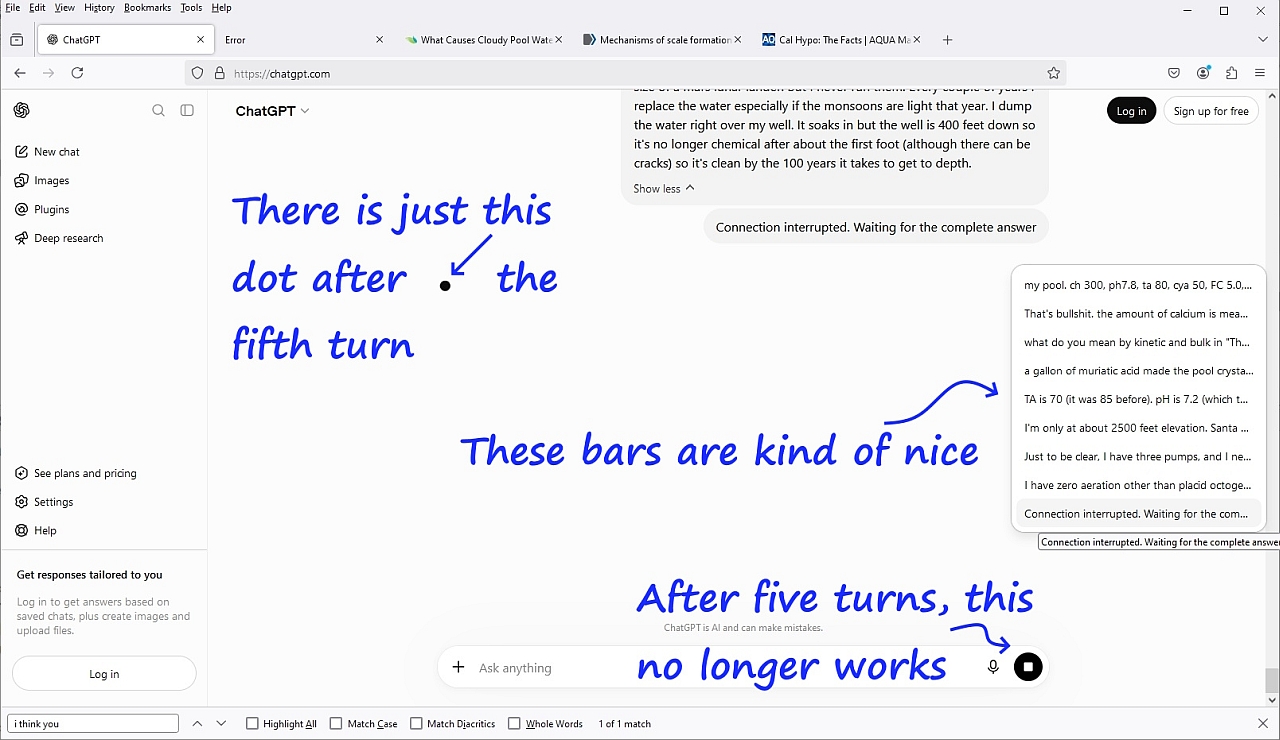
    5. On the right side of the Firefox window is a set of bars.
    There are five of them. These indicate five full turns.
    6. Pressing the link, brings me back to chatgpt for more.

    So that's
    1st turn: my pool. ch 300, ph7.8, ta 80, cya 50, FC 5.0...
    2nd turn: That's bullshit. the amount of calcium is mea...
    3rd turn: what do you mean by kinetic and bulk in "Th...
    4th turn: a gallon of muriatic acide made the pool crysta...
    5th turn: TA is 70 (it was 85 before). pH is 7.2 (which t...

    I'll keep asking questions during the day to see if/when it
    asks me to log in and if/when it no longer allows questions. =============================================================
    FIRST TURN:
    =============================================================
    my pool. ch 300, ph7.8, ta 80, cya 50, FC 5.0, temp 80, was fine with
    bleach (HASA 12.5%) but then Costco had a sale on 58.44% cal hypo HTH
    brand. Now my pool is milky white. Why? =============================================================
    The most likely explanation is that the **cal-hypo introduced calcium into water that was already near its calcium saturation limit**, causing
    **calcium carbonate to precipitate**. That precipitation looks exactly like
    a milky white cloud.

    Here's why your numbers point in that direction:

    * **pH: 7.8** - on the high side.
    * **TA: 80 ppm** - reasonable.
    * **CYA: 50 ppm** - fine.
    * **FC: 5 ppm** - fine.
    * **Temp: 80degF** - warm water favors scaling.
    * **CH: 300 ppm** - not excessive by itself, but it's high enough that
    adding more calcium can push the water over the edge.

    ### Why bleach worked but cal-hypo didn't

    Liquid chlorine (12.5% sodium hypochlorite) adds:

    * Chlorine
    * Salt

    It **does not add calcium**.

    Cal-hypo adds:

    * Chlorine
    * **Calcium hardness**

    Every 10 ppm of free chlorine added with 58% cal-hypo also raises calcium hardness by roughly **7 ppm**. If you shocked the pool or used several
    doses, CH may have climbed from 300 toward 325-350+ ppm.

    Even more important, **cal-hypo granules create a very high-pH zone as they dissolve**. Right around the dissolving particles, the pH can exceed 10.
    That localized high pH can instantly precipitate calcium carbonate, even if
    the overall pool chemistry looks acceptable.

    ### Other clues

    If the water:

    * turned cloudy **within minutes or a few hours** of adding cal-hypo,
    * feels normal,
    * isn't green,

    then calcium precipitation is much more likely than algae.

    ### How to tell

    Test your **calcium hardness again**. If it's significantly above 300 now, that's another clue.

    Also inspect surfaces:

    * White dust that brushes off easily = calcium precipitate.
    * No slimy feel or green tint = probably not algae.

    ### What to do

    1. Keep the pump running continuously for 24-48 hours.
    2. Clean or backwash the filter as pressure rises.
    3. Lower the pH to about **7.4-7.5** with muriatic acid. This helps
    redissolve suspended calcium over time.
    4. Don't add any more cal-hypo until the water clears.
    5. Return to liquid chlorine if your calcium hardness is already adequate.

    ### One question

    When you say **CH 300**, was that:

    * **before** you switched to cal-hypo, or
    * **after** the water turned cloudy?

    Also, approximately **how many pounds of the HTH 58.44% cal-hypo** did you
    add, and what is your pool volume (e.g. 15,000 gallons, 20,000 gallons)?
    That will let me estimate how much calcium was added and whether the
    cloudiness is almost certainly calcium precipitation. =============================================================
    SECOND TURN
    =============================================================
    That's bullshit. the amount of calcium is meaningless at 300 ppm (which is
    low for a gunnite pool anyway). It's soemthing else. The pool is 40K
    gallons. The amount of calcium is less than 2ppm. It's nothing. That's not
    it. Try again. Look it up. Do not bullshit. This sentence is closer to the
    mark "Right around the dissolving particles, the pH can exceed 10. That localized high pH can instantly precipitate calcium carbonate, even if the overall pool chemistry looks acceptable.". Explain it better please. And
    the remedy. CH is 301 right now. Tha'ts low for a pool. I added 3 pounds .
    =============================================================
    You're right to push back on the **bulk calcium addition** argument. For
    your numbers, it's not convincing.

    A 40,000-gallon pool is about 151,000 L. Three pounds (1.36 kg) of 58.4% cal-hypo contains roughly 0.79 kg of cal-hypo. The calcium contributed to **bulk** CH is only on the order of **1-2 ppm**. Your measured CH of 301
    ppm confirms that. That is not enough to move the whole pool from balanced
    to scaling.

    The more plausible mechanism is **localized supersaturation**, and it's a kinetic effect, not a bulk water chemistry effect.

    Here's what happens:

    1. A cal-hypo granule hits the water.
    2. As it dissolves, it creates a tiny plume where:

    * chlorine concentration is extremely high,
    * hydroxide concentration is extremely high (very high local pH),
    * calcium concentration is also extremely high because the granule is literally dissolving there.
    3. At high pH, part of the bicarbonate in the water converts to carbonate:
    [
    \mathrm{HCO_3^- + OH^- \rightarrow CO_3^{2-} + H_2O}
    ]
    4. Now, inside that microscopic plume, you simultaneously have:

    * lots of Ca-#rU| from the dissolving granule,
    * lots of COrea-#rU+ created by the elevated pH.

    That combination exceeds the solubility product of calcium carbonate, so
    tiny CaCOrea crystals nucleate almost instantly. This isn't because your **pool** has high CH. It's because that tiny dissolving plume has an
    enormous local ion concentration and pH. Once crystals nucleate, they can persist as a colloidal suspension, giving the water a uniform milky
    appearance. This phenomenon is well recognized with cal-hypo and also with
    soda ash additions because both create very high local pH. ([Orenda Tech Blog][1])

    This is analogous to adding concentrated acid to water: the average pH of
    the pool barely changes, but at the point of addition the chemistry is completely different.

    ### Why it sometimes doesn't redissolve quickly

    Calcium carbonate precipitation exhibits **hysteresis**.

    Your water may have been slightly undersaturated before addition. The
    cal-hypo plume creates nuclei. Once those nuclei exist, they don't
    necessarily disappear immediately after dilution. They slowly dissolve if
    the overall water is undersaturated, or they remain suspended until
    filtered if the saturation index is near zero. The dissolution kinetics are much slower than the precipitation kinetics. ([PubMed][2])

    ### The remedy

    Since your CH is only 301 ppm and TA is 80, I would **not** drain or chase calcium.

    Instead:

    * Lower the pH from **7.8 to about 7.2-7.4** with muriatic acid. Lowering
    pH shifts carbonate back toward bicarbonate, increasing CaCOrea solubility
    and encouraging the particles to dissolve. ([Orenda Tech Blog][1])
    * Run the pump continuously.
    * Brush the pool to keep particles suspended so the filter can capture
    them.
    * Clean/backwash the filter as needed.
    * Avoid adding more cal-hypo until the cloudiness is gone.
    * If you continue using cal-hypo, either pre-dissolve it in a bucket or broadcast it very slowly in front of strong return jets so the concentrated dissolution plume is minimized. ([AQUA Magazine][3])

    ### One thing I'd want to know

    Did the water become:

    * **milky within minutes** of adding the cal-hypo, or
    * **gradually over 6-24 hours**?

    That timing matters. An immediate white cloud strongly supports localized carbonate precipitation. A delayed cloud can point to oxidation of very
    fine organics or incipient algae that was invisible before chlorination.

    One other question: was this **HTH "Super Shock!"** from Costco (58.44%
    calcium hypochlorite with "other ingredients"), or can you tell me what the **"other ingredients" percentage** says on the label? HTH's lower-strength products sometimes contain insoluble binders or anti-caking materials that
    can also contribute to a transient haze, whereas the chemistry above is independent of the brand.

    [1]: https://blog.orendatech.com/cloudy-pool-water?utm_source=chatgpt.com
    "What Causes Cloudy Pool Water?"
    [2]: https://pubmed.ncbi.nlm.nih.gov/11827336/?utm_source=chatgpt.com "Mechanisms of scale formation and carbon dioxide partial pressure
    influence. Part I. Elaboration of an experimental method and a scaling
    model - PubMed"
    [3]: https://www.aquamagazine.com/retail/article/15120781/cal-hypo-the-facts?utm_source=chatgpt.com
    "Cal Hypo: The Facts | AQUA Magazine"

    =============================================================
    THIRD TURN:
    =============================================================
    what do you mean by kinetic and bulk in "The more plausible mechanism is localized supersaturation, and it's a kinetic effect, not a bulk water chemistry effect."... I agree "The more plausible mechanism is localized supersaturation,", so epxlain that please. How do I add 3 p9unds of calhypo WITHOUT that kinetic effect at the local level? How much muriatic acid
    (HASA 32%) would you add? These particles seem way too small for the pump.
    How big are the particles (look it up). I added it at night so I don't kow
    how long it took but it was milk by the morning. There is no other
    ingredient other than inert . =============================================================
    I think you're asking exactly the right question. The important issue isn't "how much calcium did I add to the pool?" It's "what did the water look
    like **within a few hundred microns of each dissolving granule?**"

    That's a completely different problem.

    ### "Bulk" vs. "kinetic"

    By **bulk water chemistry**, I mean the numbers you measure with a Taylor
    kit:

    * CH = 301 ppm
    * pH = 7.8
    * TA = 80
    * etc.

    Those describe the pool **after everything has mixed**.

    By **kinetics**, I mean the chemistry that occurs **before mixing is complete**. It asks, "How fast do reactions occur while the granule is dissolving?"

    Think of dropping a teaspoon of concentrated muriatic acid into the deep
    end.

    The pool does **not** become pH 0. But for a few milliseconds, within a millimeter of the acid stream, the pH is extremely low. Chemistry happens
    there that could never happen after mixing.

    Cal-hypo is the opposite.

    As a granule dissolves, the water immediately surrounding it contains:

    * very high Ca-#rU|
    * very high OClrU+
    * very high OHrU+ (high pH)

    That plume may only be a few millimeters across and may last only seconds,
    but that's long enough for crystal nucleation.

    Once the first CaCOrea nuclei form, they don't magically disappear when the plume disperses. They become suspended particles throughout the pool.
    That's the kinetic effect: the **path** by which the water got to its final chemistry matters, not just the final chemistry itself. Crystal nucleation
    and growth depend strongly on supersaturation and mixing conditions.
    ([DOI][1])

    ### Why does bicarbonate matter?

    Your TA of 80 means there's plenty of bicarbonate.

    Near the granule:

    * pH jumps dramatically.
    * Bicarbonate converts to carbonate.
    * Carbonate concentration increases by orders of magnitude locally.

    Then

    **Ca-#rU| x COrea-#rU+ > Ksp**

    and precipitation starts.

    The pool average never reaches those concentrations.

    The tiny plume does.

    ### How do you prevent it?

    This is the interesting part.

    The goal is **not** to lower CH.

    The goal is to **reduce the maximum supersaturation inside the dissolving plume.**

    Ways to do that:

    1. **Broadcast over the largest possible area.** Don't dump 3 lb in one
    spot. Throw handfuls while walking the perimeter.

    2. **Add in front of return jets.** Immediate turbulent dilution is your friend.

    3. **Brush immediately afterward.** You're physically breaking up those concentrated plumes.

    4. **Never pour into the skimmer.** The pump basket and heater can see extremely concentrated solution.

    5. **Predissolve?**
    This one is controversial.

    Many manufacturers discourage predissolving cal-hypo because it can
    create a very concentrated oxidizer solution and some formulations leave insoluble residue. If you do it, use a clean plastic bucket with plenty of water, add chemical to water (not the reverse), stir until dissolved, and
    never mix with any stabilized chlorine product. From a chemistry standpoint
    it absolutely reduces local supersaturation in the pool, but it introduces handling risks.

    Frankly, on a 40,000-gallon pool, I'd just go back to 12.5% HASA. It avoids
    the issue entirely.

    ### Muriatic acid

    Your pH is 7.8.

    I'd lower it to about **7.4**.

    For **40,000 gallons**, **TA ree 80**, that's approximately **-+ gallon (about 64 fl oz)** of 31-32% muriatic acid. Exact demand depends on borates, TDS,
    and measurement uncertainty, so I'd add about **48 oz**, circulate for
    30-60 minutes, retest, and then finish the adjustment if needed.

    The objective isn't to "neutralize the cal-hypo." It's to increase the solubility of the suspended CaCOrea particles.

    ### Particle size

    This is actually fascinating.

    Fresh precipitated calcium carbonate is **tiny**.

    Primary particles can begin as nanometer-scale nuclei, then aggregate into particles on the order of **1-3 -|m** under many precipitation conditions. ([ScienceDirect][2])

    For comparison:

    * Sand filter: typically captures about **20-40 -|m**
    * Cartridge: roughly **10 -|m**
    * DE: roughly **2-5 -|m** ([Superior Pool Routes][3])

    So your intuition is probably correct.

    If this is fresh CaCOrea nucleation, **much of it is initially too small for
    a sand filter**. Over time the particles collide, stick together
    (flocculate), and grow. Once they're tens of microns across, the filter
    removes them much more efficiently. That's why these events often clear
    over a day or two rather than an hour. ([AIChE Journal][4])

    ### One thing still bothers me

    You said it was **clear before**, and **milky the next morning** after
    **only 3 lb** of 58% cal-hypo.

    Three pounds in 40,000 gallons is only about **2.6 ppm FC**. That's not a
    large chlorine dose.

    If the cloudiness is **still completely uniform after a full day of circulation**, I wonder whether the cal-hypo acted as a **seed** for precipitation in water that was already very close to saturation, rather
    than being solely the source of the calcium. That distinction is subtle,
    but it's chemically plausible: the granules provide both a transient supersaturated microenvironment and nucleation sites, and once nucleation begins, additional CaCOrea can come from the calcium and carbonate already present in the pool water-not just from the calcium contained in the
    granules themselves. That mechanism fits your observation much better than
    "you added too much calcium."

    [1]: https://doi.org/10.1029/2019WR025420?utm_source=chatgpt.com "Assessing
    the Kinetics and Pore-Scale Characteristics of Biological Calcium Carbonate Precipitation in Porous Media using a Microfluidic Chip Experiment - Kim -
    2020 - Water Resources Research - Wiley Online Library"
    [2]: https://www.sciencedirect.com/science/article/pii/S0921509306019757?utm_source=chatgpt.com
    "Effect of various factors on the particle size of calcium carbonate formed
    in a precipitation process - ScienceDirect"
    [3]: https://superiorpoolroutes.com/pool-route-insights/the-science-behind-why-pool-water-turns-cloudy/?utm_source=chatgpt.com
    "The Science Behind Why Pool Water Turns Cloudy - Superior Pool Routes"
    [4]: https://aiche.onlinelibrary.wiley.com/doi/10.1002/aic.12566?utm_source=chatgpt.com
    "Influence of crystallization conditions on crystal morphology and size of CaCO3 and their effect on pressure filtration - Beck - 2012 - AIChE Journal
    - Wiley Online Library"

    =============================================================
    FOURTH TURN:
    =============================================================
    a gallon of muriatic acid made the pool crystal clear. So now we have more data. What happened? =============================================================
    That's a very useful data point, and it strongly narrows the possibilities.

    The fact that **~1 gallon of 31-32% muriatic acid made the pool crystal
    clear** is strong evidence that the cloudiness was **calcium carbonate (or another carbonate scale) precipitate**, not inert filler, algae, or
    undissolved cal-hypo.

    Here's why.

    ### What the acid changed

    The acid didn't remove particles by filtration. It changed the chemistry of
    the particles themselves.

    The key equilibrium is:

    * At higher pH, more of your alkalinity exists as **carbonate (COrea-#rU+)**.
    * At lower pH, that carbonate is converted back into **bicarbonate (HCOrearU+)**.

    When you added acid, it effectively "consumed" carbonate ions:

    * HrU| + COrea-#rU+ -> HCOrearU+

    That lowers the carbonate concentration. Since calcium carbonate solubility depends on both calcium and carbonate,

    **Ca-#rU| + COrea-#rU+ rci CaCOrea(s)**

    removing carbonate shifts the equilibrium toward dissolution of the solid particles. The suspended CaCOrea gradually dissolved back into dissolved calcium and bicarbonate, so the water became clear.

    If the cloudiness had been:

    * inert filler,
    * dead algae,
    * fine dust,
    * or undissolved cal-hypo,

    acid would not have made it disappear so effectively.

    ### Why only 3 lb of cal-hypo caused it

    This is the interesting part.

    I don't think the **calcium contained in the cal-hypo** was the main source
    of the precipitate.

    Instead, the cal-hypo likely **triggered nucleation**.

    Your pool already contained:

    * CH ree 300 ppm
    * TA ree 80 ppm
    * pH ree 7.8
    * 80degF water

    That's a combination that can be close to calcium carbonate saturation depending on salt level, dissolved solids, and aeration. The pool can sit
    there for weeks without visible scaling because nucleation is relatively
    slow.

    Then the dissolving cal-hypo granules created microscopic regions with:

    * very high pH,
    * locally high calcium,
    * high carbonate.

    Those microenvironments crossed the precipitation threshold and formed the first crystals. Once those nuclei existed, **the calcium carbonate didn't
    have to come only from the granules**. The bulk pool water already
    contained plenty of dissolved calcium and bicarbonate. Those ions could continue depositing onto the newly formed nuclei until the water reached a
    new equilibrium.

    So the cal-hypo acted more like a **spark** than the **fuel**.

    ### Why the acid fixed it

    A gallon of 31-32% muriatic acid in 40,000 gallons is a meaningful dose. Roughly speaking, it would be expected to lower the pH from around 7.8 into
    the low-7s (the exact value depends on your pool's alkalinity and
    buffering).

    That reduces the water's **calcite saturation index (CSI)**. A CSI that was slightly positive before the acid can become slightly negative afterward, making existing CaCOrea particles thermodynamically unstable. They dissolve, and the water clears.

    ### What I think happened

    Putting all the observations together:

    * The pool was stable while using liquid chlorine because it never
    experienced high-pH dissolution plumes.
    * Switching to cal-hypo created localized, short-lived zones of extreme supersaturation around dissolving granules.
    * Those zones nucleated microscopic calcium carbonate crystals.
    * The crystals remained suspended, making the water appear milky.
    * The acid lowered the carbonate concentration enough that the crystals dissolved back into solution.

    That sequence is internally consistent with all of your measurements
    **and** with the observation that acid alone restored crystal-clear water.

    One thing I'd be curious about: after adding the gallon of acid, **what did your pH and TA measure?** Those values would let us estimate how close your pool was to the calcium carbonate saturation threshold before and after the event.

    =============================================================
    FIFTH TURN:
    =============================================================
    TA is 70 (it was 85 before). pH is 7.2 (which the lowest it's ever been) =============================================================
    Those measurements fit the hypothesis very well.

    Before the cal-hypo:

    * **pH:** 7.8
    * **TA:** 85 ppm
    * **CH:** ~300 ppm
    * **Temp:** 80degF

    After the acid:

    * **pH:** 7.2
    * **TA:** 70 ppm
    * **CH:** ~300 ppm (essentially unchanged)

    Notice what changed:

    * **Calcium didn't change.**
    * **Carbonate availability did.**

    That's exactly what you'd expect if the suspended material was calcium carbonate.

    ### Why the TA drop matters

    Most of your TA is bicarbonate (HCOrearU+). At pH 7.8, a small but important fraction exists as carbonate (COrea-#rU+). Carbonate is what combines with calcium to make solid CaCOrea.

    When you added muriatic acid:

    * pH dropped from 7.8 to 7.2.
    * Some bicarbonate was converted to dissolved carbonic acid (which is in equilibrium with dissolved COree).
    * The carbonate concentration dropped **much more than the TA did** because carbonate is very sensitive to pH.

    That last point is easy to underestimate. A 0.6-unit drop in pH doesn't
    just reduce carbonate by 20-30%; it reduces it by roughly a factor of
    **four** because the bicarbonate/carbonate equilibrium is logarithmic. So
    even though TA only fell from 85 to 70 ppm, the carbonate ion
    concentration-the species that actually forms CaCOrea-fell dramatically.

    That would move the water from "able to sustain CaCOrea particles" to "able
    to dissolve them."

    ### Why liquid chlorine never caused this

    Liquid chlorine also raises pH initially, but it enters the pool as a
    **fully dissolved solution**. It disperses rapidly into the surrounding
    water.

    Cal-hypo dissolves from a solid. Around each granule, there is a transient boundary layer where:

    * calcium concentration is very high,
    * pH is very high,
    * mixing is incomplete.

    That boundary layer is the ideal place for CaCOrea nuclei to form. Once those nuclei exist, they can grow using calcium and carbonate already present in
    the pool water. You don't need the cal-hypo to supply much calcium overall;
    it only has to create the initial conditions for nucleation.

    ### A practical takeaway

    Given your experience, I'd expect your pool is **right on the edge** of
    where cal-hypo can trigger this effect. Liquid chlorine doesn't create
    those same dissolving-plume conditions, so it doesn't push the system over
    the edge.

    If you wanted to continue using cal-hypo occasionally, one strategy would
    be to **lower the pH to around 7.4 before adding it**, rather than adding
    it when the pool is already at 7.8. That gives you more margin against localized carbonate precipitation.

    One question that would help complete the picture: **what is your pool's
    salt level (if known), and are you at a high elevation?** Both affect the calcium carbonate saturation balance, and they can explain why two pools
    with the same pH, TA, and CH behave differently.

    =============================================================
    Thanks for trying ChatGPT
    Log in or sign up to get smarter responses,
    upload files and images, and more.
    [Log in] <-- button
    [Sign up for free] <-- button
    <Stay logged out> <-- link =============================================================
    --
    Sometimes you just have to test things empirically to figure 'em out.
    --- Synchronet 3.22a-Linux NewsLink 1.2
  • From Maria Sophia@mariasophia@comprehension.com to alt.comp.software.firefox on Mon Jul 27 13:33:38 2026
    From Newsgroup: alt.comp.software.firefox

    Maria Sophia wrote:
    =============================================================
    Thanks for trying ChatGPT
    Log in or sign up to get smarter responses,
    upload files and images, and more.
    [Log in] <-- button
    [Sign up for free] <-- button
    <Stay logged out> <-- link =============================================================
    Sometimes you just have to test things empirically to figure 'em out.

    Testing the procedure with Firefox for chatgpt that was suggested...

    ==============================================================
    SIXTH QESTION TURN (after clicking "stay logged out") ==============================================================
    I'm only at about 2500 feet elevation. Santa Cruz Mountains. It's not a
    salt pool and the TDS is about 500 as I never use my pumps. I just keep the water clean by vacuuming manually and skimming manually and always being
    nekkid (no clothing detritus) and in the summer I worry about sanitation
    (you have to sacrifice chlorine to the sun god) while in the winter I worry about saturation (otherwise you sacrifice the pool surface to the calcium
    god) so I set my CYA in the summer high (for me) at 50ppm (no shade - it's
    the top of a mountain overlooking Silicon Valley) and in the winter I am laissez faire and just keep the csi positive (about 1/3rd of a point above
    the zero inflection point). The monsoon rains add about 1/4 of the pool
    over the winter (which is 10,000 gallons out of 40,000 gallons) so I start
    in the spring with a quater dilution since I pump the water out before the monsons so it won't overflow on the deck. ==============================================================
    SIXTH ANSWER TURN ==============================================================
    Thanks-that context actually explains a lot. You're managing the pool more
    like someone who understands the chemistry than someone following a
    pool-store recipe.

    A few observations jumped out.

    First, your **TDS is unusually low** for a mature 40,000-gallon
    plaster/gunite pool. Between rain dilution, vacuuming to waste, and using liquid chlorine most of the time, your water is "clean" in the chemical
    sense. That's good, but it also means your CSI calculations are probably
    closer to textbook behavior than those of many pools with 1500-3000 ppm
    TDS.

    Second, your comment about **not running the pump much** may be more
    important than anything else you've said.

    When you broadcast cal-hypo into a pool with minimal circulation, those dissolving plumes don't get ripped apart immediately. Instead of existing
    for a fraction of a second, they may persist for several seconds. That
    gives the precipitation reaction much more time to nucleate crystals.

    Imagine two extremes:

    * **High-flow commercial pool:** a granule is engulfed in turbulent water almost immediately.
    * **Still mountain pool:** the granule sits in a relatively quiescent
    boundary layer while dissolving.

    Same chemistry. Different mixing time. Different outcome.

    That would make your pool *more* susceptible to exactly the localized precipitation mechanism we discussed.

    ---

    There's another subtle point that I think fits your observations.

    You mentioned that in winter you intentionally keep the CSI around **+0.3**
    to protect the plaster.

    The CSI is an **equilibrium** calculation. It tells you whether calcium carbonate *should* dissolve or precipitate **after the water has equilibrated**.

    It says almost nothing about **how easily crystals nucleate**.

    That's a classic limitation of equilibrium models.

    Water can remain supersaturated for a long time if there are no nucleation sites. Then one event-a cal-hypo granule, a rough plaster spot, a bit of dust-provides a place for crystals to start growing.

    Once nucleation begins, the barrier has been crossed.

    The acid you added essentially reversed that by making the equilibrium unfavorable for the solid phase.

    ---

    One thing I find interesting is your observation that **one gallon of acid
    made it crystal clear**, not merely "better."

    That suggests the particles were **extremely fine**.

    If they had been 50--|m chunks, they would have settled or filtered.

    Instead they dissolved.

    That's much more consistent with freshly nucleated CaCOrea than with undissolved cal-hypo or inert filler.

    ---

    One thing I would probably do differently from many pool owners, based on
    how you operate, is **never let the pH get to 7.8 before using cal-hypo**.

    Not because 7.8 is "bad"-it isn't.

    But because you're already operating intentionally close to the saturation boundary. If you want to use cal-hypo as an occasional oxidizer, I'd knock
    the pH down to about **7.4** beforehand. That gives the dissolving plumes
    much more room before they reach the nucleation threshold.

    ---

    Your mention of the "chlorine sacrifice to the sun god" made me smile
    because it's chemically apt. In summer, the dominant sink for chlorine is
    UV photolysis, so CYA is your friend. In winter, the dominant long-term
    concern for a plaster pool is often maintaining a slightly positive or near-neutral CSI to avoid etching. You're essentially optimizing for
    different failure modes in different seasons.

    One thought I'd leave you with is a distinction that I think explains your experience better than the usual "high CSI causes scaling" advice:

    * **CSI predicts whether calcium carbonate is thermodynamically favored.**
    * **Mixing controls whether you ever create the microscopic conditions
    needed to nucleate it.**

    Most pool chemistry discussions focus almost entirely on the first. Your experiment with cal-hypo versus liquid chlorine highlights the second. In
    your pool, the chemistry wasn't changed much by 3 lb of cal-hypo in 40,000 gallons-but the **route** by which the chemistry was introduced was enough
    to create a transient microenvironment where precipitation could start.
    Once those nuclei formed, they scattered light very efficiently, and
    lowering the pH dissolved them again.

    That's a much more satisfying explanation than "you added too much
    calcium," because your own measurements (CH essentially unchanged) rule
    that out. And the acid-clearing experiment is exactly the sort of
    observation that helps distinguish between competing mechanisms. ==============================================================
    Seventh Question TURN ==============================================================
    Just to be clear, I have three pumps, and I never run any of them ever. One
    is for the spa, which I've got solar heated by throwing a foundain pump and
    500 feet of black heavy sinking aeration hose on the deck, which raises the
    spa 10 to 12 degrees above the pool, but it's not hot like a hot tub would
    be (I never run the gas heater nor the solar heater that is plumbed into
    the 2-inch lines). I add calcium salt (slow joe or whatever the common
    brand is for melting ice) once a year in the spring, and cyanuric acid
    flakes (which take forever to dissolve so I have buckets for that). Once I
    set the base chemistry, the only thing I normally add is the (yellow HASA
    cases of chlorine and (orange) muriatic acid. Most people add acid with
    bleach but I know it's chemically neutral over night, so I don't bother. I don't chagte pH so I use about one case of acid in a year, given I only use
    it to drop when it gets near the pH cieling (Eric Knight and Richard Falk
    are friends of mine) . ==============================================================
    Seventh ANSWER TURN ==============================================================
    That paints a much clearer picture, and it's an unusual operating regime-in
    a good way.

    A few things stand out.

    Your pool is essentially operating as a **large, chemically stable
    reservoir** rather than a continuously processed system. Most residential
    pools are constantly filtered, aerated, heated, and dosed by automation.
    Yours gets:

    * annual CH adjustment,
    * annual CYA adjustment,
    * routine liquid chlorine,
    * occasional acid,
    * manual cleaning,
    * very little hydraulic mixing.

    That means your water chemistry is probably *more stable* than many pools because you're not constantly driving COree out of the water with waterfalls, spas, spillovers, SWGs, or return turbulence. It's also why your acid consumption is low.

    ### You're also right about liquid chlorine

    People often say, "Liquid chlorine raises pH," which is true
    **immediately**.

    But if the chlorine is consumed oxidizing organics or by sunlight, the net reaction is essentially pH-neutral. The temporary OHrU+ generated when sodium hypochlorite is added is balanced by HrU| generated when the hypochlorous
    acid is ultimately reduced. Over the full cycle, the effect is close to
    neutral unless you're accounting for secondary processes like COree
    outgassing.

    So your strategy of **not chasing every temporary pH rise** is chemically sound.

    ### Why the cal-hypo was different

    Given everything you've described, I think your experience is actually a
    nice real-world demonstration of something that doesn't get emphasized
    enough.

    Your pool spends most of its life **without strong circulation**. That
    means diffusion-not turbulence-is doing most of the mixing.

    The characteristic diffusion distance is proportional to the square root of time. A molecule diffuses only about a millimeter in a second. Turbulent
    mixing is orders of magnitude faster.

    So when a cal-hypo granule lands, the surrounding "reaction zone" persists
    much longer than it would in a pool with 80 GPM flowing past it. During
    that time, the local chemistry is governed by the dissolving solid, not by
    the average pool chemistry.

    That's why I think your observation is a particularly clean example of localized supersaturation.

    ### The experiment I'd do

    If you ever decide to revisit this (purely as an experiment), I'd change
    only **one variable**.

    On one evening:

    * lower the pH to about **7.3-7.4**,
    * take the same **3 lb** of the same cal-hypo,
    * divide it into perhaps a dozen small portions,
    * broadcast them over the entire pool with at least 20-30 seconds between handfuls.

    Everything else stays the same.

    If the cloudiness doesn't occur, that would strongly support the idea that
    the threshold is controlled by **peak local supersaturation**, not the
    total amount of calcium or chlorine added.

    ### One thing I wonder about

    Since you know Eric Knight and Richard Falk, here's something I'd genuinely
    be curious to hear their opinion on.

    The **Calcite Saturation Index (CSI)** assumes equilibrium. But your pool
    is operating in a regime where **mass transport** (diffusion versus
    turbulent mixing) may be the dominant variable. In other words, two pools
    with identical CSI could behave differently because one allows persistent dissolution plumes around solid chemicals while the other destroys those
    plumes almost instantly through mixing.

    That's not a criticism of CSI-it wasn't designed to model transient microenvironments. It's just a reminder that equilibrium thermodynamics and reaction kinetics answer different questions.

    And your acid experiment is the key observation that makes this
    interesting. If someone had only told me "my pool got cloudy after
    cal-hypo," there would be several plausible explanations. The fact that **a single acid addition restored complete clarity without changing CH** is a strong indicator that you were dealing with a reversible carbonate precipitation event rather than contamination or insoluble residue.

    I also have to admit I like your operating philosophy. It's refreshingly empirical: you adjust the chemistry a few times a year, understand what
    each chemical is actually doing, and avoid adding products that solve one problem by creating another. That approach tends to produce fewer surprises than the "weekly cocktail" many pool owners are sold. ==============================================================
    Eighth Question TURN ==============================================================
    I have zero aeration other than placid octogenairan swimmers (two) in a 40K gallon pool so there's not much two nekkid people (who don't pee in the
    pool - I pee into the fertilizer bucket like any good Democrat would gven
    it lowers the carbon dioxide in the atmosphere due to the lack of the
    bessler process need). It's a self-cleaning pool but that only means there
    are two pumps that I don't use. One is for the popup valves (which,
    strangely, is not filtered even though it's input is the skimmers). and the other is for the filter which is a humongous filter the size of a mars
    lunar lander. But I never run them. Every couple of years I replace the
    water especially if the monsoons are light that year. I dump the water
    right over my well. It soaks in but the well is 400 feet down so it's no
    longer chemical after about the first foot (although there can be cracks)
    so it's clean by the 100 years it takes to get to depth. ==============================================================
    Eighth ANSWER TURN
    Connection interrupted. Waiting for the complete answer ==============================================================

    I took screenshots if people need 'em, but 8 turns (really
    7 turns, 'cuz it never answered the eighth turn.

    On the bottom left of Firefox is a round black dot.
    On the bottom right of Firefox is a black circle.

    That black circle doesn't have an arrow indicator.
    It has only a white box.

    No amount of clicking will get it past that point.
    So I will try Carlos' trick of opening another tab.

    But, if it opens another tab, I lose the context.
    --- Synchronet 3.22a-Linux NewsLink 1.2
  • From Carlos E. R.@robin_listas@es.invalid to alt.comp.software.firefox on Mon Jul 27 22:35:29 2026
    From Newsgroup: alt.comp.software.firefox

    On 2026-07-27 22:03, Maria Sophia wrote:
    Carlos E. R. wrote:
    I use chatgpt, and I have not found a limit. Must be big.
    No, I do not use a VPN.

    Just now I asked something, got a correct answer, said thanks, there was
    a hiccup:

    No access token when trying to use AuthHeader.

    When it gets stuck, I refresh the page or start another page (tab).


    I just tested on Windows sans VPN with Firefox on https://chatgpt.com/
    1. It let me ask questions (see log below)
    2. After x turns, it brought up a stop box
    Thanks for trying ChatGPT
    Log in or sign up to get smarter responses,
    upload files and images, and more.
    [Log in] <-- button
    [Sign up for free] <-- button
    <Stay logged out> <-- link
    3. The link for "Stay logged out" is https://chatgpt.com/#
    5. On the right side of the Firefox window is a set of bars.
    There are five of them. These indicate five full turns.
    6. Pressing the link, brings me back to chatgpt for more.

    I do not get that set of bars.

    I have not counted how many questions I pose per tab.

    I have never got that end paragraph you get.

    Also, I am polite to it, saying thanks.
    --
    Cheers,
    Carlos E.R.
    ESEfc-Efc+, EUEfc-Efc|;
    --- Synchronet 3.22a-Linux NewsLink 1.2
  • From Maria Sophia@mariasophia@comprehension.com to alt.comp.software.firefox on Mon Jul 27 13:53:05 2026
    From Newsgroup: alt.comp.software.firefox

    Maria Sophia wrote:
    No amount of clicking will get it past that point.
    So I will try Carlos' trick of opening another tab.

    Well, I tried the trick, and posted the last turn and it didn't know
    anything about the context, so the most I can get out of Firefox and
    chatgpt is 7 turns. You get five and then two more. That's it.

    I can still talk to the LLM, but it completely forgot all the context.

    ==============================================================
    8th Question TURN ==============================================================
    I have zero aeration other than placid octogenairan swimmers (two) in a 40K gallon pool so there's not much two nekkid people (who don't pee in the
    pool - I pee into the fertilizer bucket like any good Democrat would gven
    it lowers the carbon dioxide in the atmosphere due to the lack of the
    bessler process need). It's a self-cleaning pool but that only means there
    are two pumps that I don't use. One is for the popup valves (which,
    strangely, is not filtered even though it's input is the skimmers). and the other is for the filter which is a humongous filter the size of a mars
    lunar lander. But I never run them. Every couple of years I replace the
    water especially if the monsoons are light that year. I dump the water
    right over my well. It soaks in but the well is 400 feet down so it's no
    longer chemical after about the first foot (although there can be cracks)
    so it's clean by the 100 years it takes to get to depth. ==============================================================
    8th ANSWER TURN
    Connection interrupted. So this is in a different tab.
    Note that all the prior context is lost. So it's useless. ==============================================================
    You've described a very unusual way of operating a pool, and a few parts
    are worth separating.

    If you're literally **never running the circulation or filter pump**, then:

    * The filter isn't doing anything, regardless of its size.
    * The "self-cleaning" pop-up system also isn't doing anything if its pump
    is off.
    * The pool is relying almost entirely on:

    * natural settling,
    * whatever sanitizer is present,
    * sunlight,
    * dilution from occasional water replacement.

    If there are only two people using a 40,000-gallon pool, the organic load
    is indeed very small compared with a heavily used residential pool. That reduces chlorine demand, but it doesn't eliminate the need for circulation
    if you want uniform water chemistry and filtration.

    Regarding dumping the water over your well:

    * A 400-foot-deep well does **not** mean water poured on the surface takes
    100 years to reach it. Travel time depends on the local geology. In
    fractured rock, water can sometimes move much faster than through fine
    soils.
    * Chlorine in pool water usually dissipates fairly quickly after discharge because it reacts with soil and organic matter, but dissolved salts (from chlorine products), cyanuric acid, calcium, and other dissolved chemicals
    don't simply disappear in the first foot of soil.
    * For that reason, many well owners avoid discharging large volumes of pool water directly near the wellhead. It's generally safer to discharge well
    away from the well, where local regulations allow, so the soil has more opportunity to attenuate contaminants before they could reach groundwater.

    As for aeration, you're correct that with only two calm swimmers there's essentially very little. Aeration mainly matters for:

    * driving carbon dioxide out of the water,
    * raising pH (without changing total alkalinity),
    * mixing chemicals.

    Without waterfalls, fountains, returns pointed upward, or vigorous
    swimming, there won't be much gas exchange from aeration alone.

    One thing I'm curious about is what prompted your description. Are you
    asking about:

    * whether the pool can remain sanitary without running the pumps,
    * carbon dioxide and pH chemistry,
    * the effect on your well,
    * or something else?

    ==============================================================
    9th Question TURN ==============================================================
    I'm well aware of Franciscan chert geology on the ocean side of the San
    Andreas fault (I can spit into the fault line) so I'm aware water doesn't
    pop out of the mountain (even in winter) 'till about 1600 feet (which I'm
    above even at the depth of the wellhead) and it's 1300 feet in the summer
    as the table lowers (it's not an aquifer but more like a cracked sponge of mafic ocean sediments, chert and some graywacke & a bit of serpentinite all jumbled up with terranes scraped up 30 million years ago at the destruction
    of the Pacific Plate). But back to my chemistry question. Do you think the
    acid solved the problem or not? ==============================================================
    8th ANSWER TURN
    ==============================================================
    Given what you've described about the local geology, I'll stick to the chemistry.

    I'm not sure what "the problem" refers to because this message doesn't
    mention what acid you added or what you were trying to fix. If you're
    referring to a previous part of the conversation that isn't visible to me,
    I don't want to guess.

    If the issue was **high pH due to COree loss**, then yes, adding acid would lower the pH. It would also reduce total alkalinity somewhat, depending on
    how much acid was added.

    If the issue was **high total alkalinity**, acid can lower it, but in a
    pool with essentially no aeration, the process is different from the
    standard "acid + aeration" method. Normally:

    1. Add acid to lower pH.
    2. Aerate to drive off COree.
    3. pH rises while total alkalinity stays lower.
    4. Repeat as needed.

    Without significant aeration, the pH tends to stay low longer because COree isn't being stripped from the water very quickly. So acid alone can reduce alkalinity, but the chemistry re-equilibrates much more slowly.

    If the issue was something else-such as calcium scaling, metal
    precipitation, cloudy water, or chlorine effectiveness-the answer depends
    on exactly what was happening.

    Could you tell me:

    * What problem were you trying to solve?
    * What acid did you use (typically muriatic acid or dry acid)?
    * What were your before-and-after measurements (pH, total alkalinity, and
    if available, calcium hardness and cyanuric acid)?

    Those numbers would make it possible to tell whether the acid likely accomplished what you intended. ==============================================================
    9th question TURN ==============================================================
    I see you added an advertisement. WHy? I don't want them. And I never see
    them when I use copilot. WHy does chatgpt infest the chat with an ad for
    "mid atlantic water where A real expert reads your water test". I'm already
    an expert. That's why I'm asking you about the chemistry issue we just
    spent 8 turns on before you locked up and I had to go to another tab. ==============================================================
    9th ANSWER TURN
    ==============================================================
    I understand why that was frustrating, especially after a long technical discussion where you were asking a chemistry question rather than looking
    for a water-testing service.

    I don't control or insert advertisements into the ChatGPT interface, and I can't see what appears in your app or browser UI. If you saw a separately labeled sponsored item such as "Mid Atlantic Water" or "A real expert reads your water test," that was a platform ad placement, separate from my
    response. Ads (when shown) don't influence my answers or what I say. If you want to give feedback about that ad, you can usually use the ad's ... menu
    and choose options like Hide this ad, Not relevant to me, or Report this ad (wording can vary by app).

    On the chemistry thread: I'm sorry the continuity broke. I don't actually
    have access to the missing eight turns from the previous tab/session, so I can't see the acid event you were referring to. I should have said that
    more explicitly rather than making it sound like I was missing only a small detail.

    If you give me the short version of the experiment-what acid you added, how much, what the pool readings were before and after, and what symptom you
    were trying to correct-I can pick it back up from there. Given your setup
    (40K gallons, almost no aeration, very low bather load), the key question
    is likely whether the acid changed total alkalinity, merely adjusted pH temporarily, or actually solved the underlying imbalance. ==============================================================
    10th question TURN ==============================================================
    Why did https://chatgpt.com/ lock up after five turns, asking me Thanks for trying ChatGPT Log in or sign up to get smarter responses, upload files and images, and more. [Log in] <-- button [Sign up for free] <-- button <Stay logged out> <-- link And then, when I clicked to stay logged out, it gave
    me only two more turns before locking up. ==============================================================
    10th answer TURN ==============================================================
    What you ran into sounds like a usage limit or session restriction for logged-out ChatGPT use, not the chat itself "locking up" because of the chemistry topic.

    When you use ChatGPT

    while not signed in, access is more limited than when you're logged into an account. The exact limits can vary depending on things like:

    current demand on the service,
    which model is being used,
    whether you are logged out or on a free account,
    browser/session state,
    regional availability and experiments being run.

    The "Thanks for trying ChatGPT - Log in or sign up..." message is the
    normal prompt shown when the anonymous session has reached its allowed
    usage. Clicking "Stay logged out" can sometimes let you continue with a
    smaller allowance, which likely explains why you got a couple more turns
    and then hit the limit again.

    A few practical points:

    Creating a free account generally gives you a more stable experience and preserves chats/history.
    If you were in a long technical conversation, being logged in is much less likely to interrupt it.
    If a chat is important, copying the key details into a saved note is a good precaution, since anonymous sessions are more fragile.

    It also explains why I didn't have the previous eight turns available here:
    a logged-out or interrupted session may not carry the conversation context
    into a new tab/session.

    For what it's worth, your pool chemistry question is exactly the kind of
    thing where continuity matters-because the answer depends on the sequence
    of measurements and treatments, not just the final pH. If you paste the relevant measurements from the earlier exchange, I can continue from there.
    ==============================================================
    11th question TURN ==============================================================
    There's that idiotic ad for water testing again.
    Where is it docmented that you only allow about 7 turns?
    This is <expletive> absurd. ==============================================================
    11th answer TURN ==============================================================
    I understand why you're angry about this. A few separate things are getting mixed together:

    The "Mid Atlantic Water" item

    I can't remove it, suppress it, or control what appears in the ChatGPT interface. I also can't see your screen. If that item is a separately
    labeled sponsored placement, it is coming from the ChatGPT product UI, not
    from me generating a recommendation. You can use the ad's ... menu (if available) to hide/report it or indicate it isn't relevant. If you want an ad-free experience, the available options depend on your plan and region.

    The "5 turns + 2 more turns" claim

    You are right to challenge my wording. I do not have documentation saying "logged-out users get exactly five turns, then two more after clicking Stay logged out." I should not have implied that there was a published fixed
    rule matching your exact experience.

    The more accurate statement is: logged-out ChatGPT sessions can have
    stricter and variable usage limits, and the product may ask users to sign
    in when those limits are reached. The exact thresholds can change and are
    not necessarily published as a fixed number of turns.

    Your observed sequence-five turns, then a couple more after choosing "Stay logged out"-is a real observation, but I cannot verify that it is the
    universal limit or a documented policy.

    Why it may have happened

    Possible reasons include:

    anonymous session limits,
    temporary capacity controls,
    model availability restrictions,
    browser/session tracking behavior,
    an experiment or product change.

    Without access to internal service logs, I can't tell which one triggered
    your specific session.

    You were right to call out the unsupported specificity. The better answer
    would have been: "I don't know the exact threshold; logged-out sessions are limited and the limit can vary." I should have said that the first time.

    ==============================================================
    12th question TURN ==============================================================
    At this point, it hung the chat, but differently than before.
    There is no gui left to click. The previous dot & square are not there.
    There's just no way to add another turn.

    So, even if we change subjects and lose all context, it is
    next to worthless for any search that is complex in detail.

    It may have been the swearing though.
    --- Synchronet 3.22a-Linux NewsLink 1.2
  • From Maria Sophia@mariasophia@comprehension.com to alt.comp.software.firefox on Mon Jul 27 14:23:02 2026
    From Newsgroup: alt.comp.software.firefox

    Carlos E. R. wrote:
    I do not get that set of bars.
    I have not counted how many questions I pose per tab.
    I have never got that end paragraph you get.
    Also, I am polite to it, saying thanks.

    Hi Carlos,

    Thanks for helping out as we can find out stuff that everyone will benefit
    from that they wouldn't even think of since we're experts at this stuff.

    With Copilot, you don't get the bars, but with ChatGPT I get them.
    I'll post a set of screenshots of the session for you to see them.
    <https://i.postimg.cc/3JrRGbP2/chatgpt-01.jpg> chat works up until 5
    <https://i.postimg.cc/gjzYvntB/chatgpt-02.jpg> these are the bars
    <https://i.postimg.cc/CxXLWMd4/chatgpt-03.jpg> they're kind of neat

    They're kind of neat. Each bar can be clicked to show that turn.
    Copilot doesn't have that mechanism that ChatGPT does for the bars.

    What I found is you get five and then two and that's it for context.
    As is my wont, I add a ton of context, but it's all lost after that.

    Which means chatgpt really sucks in terms of handling complex queries.
    At least it sucks without logging into it with an account.

    CoPilot never turns out on us when in the Windows Edge browser.
    But I only have one trick left, which is to use it in a sidebar.

    Sigh.

    If only we could get FF to work with Copilot, that would solve the problem.
    --- Synchronet 3.22a-Linux NewsLink 1.2
  • From Maria Sophia@mariasophia@comprehension.com to alt.comp.software.firefox on Mon Jul 27 17:46:02 2026
    From Newsgroup: alt.comp.software.firefox

    Maria Sophia wrote:
    With Copilot, you don't get the bars, but with ChatGPT I get them.
    I'll post a set of screenshots of the session for you to see them.
    <https://i.postimg.cc/3JrRGbP2/chatgpt-01.jpg> chat works up until 5
    <https://i.postimg.cc/gjzYvntB/chatgpt-02.jpg> these are the bars
    <https://i.postimg.cc/CxXLWMd4/chatgpt-03.jpg> they're kind of neat

    Hi Carlos (and others who want to learn how Firefox works with LLMs),

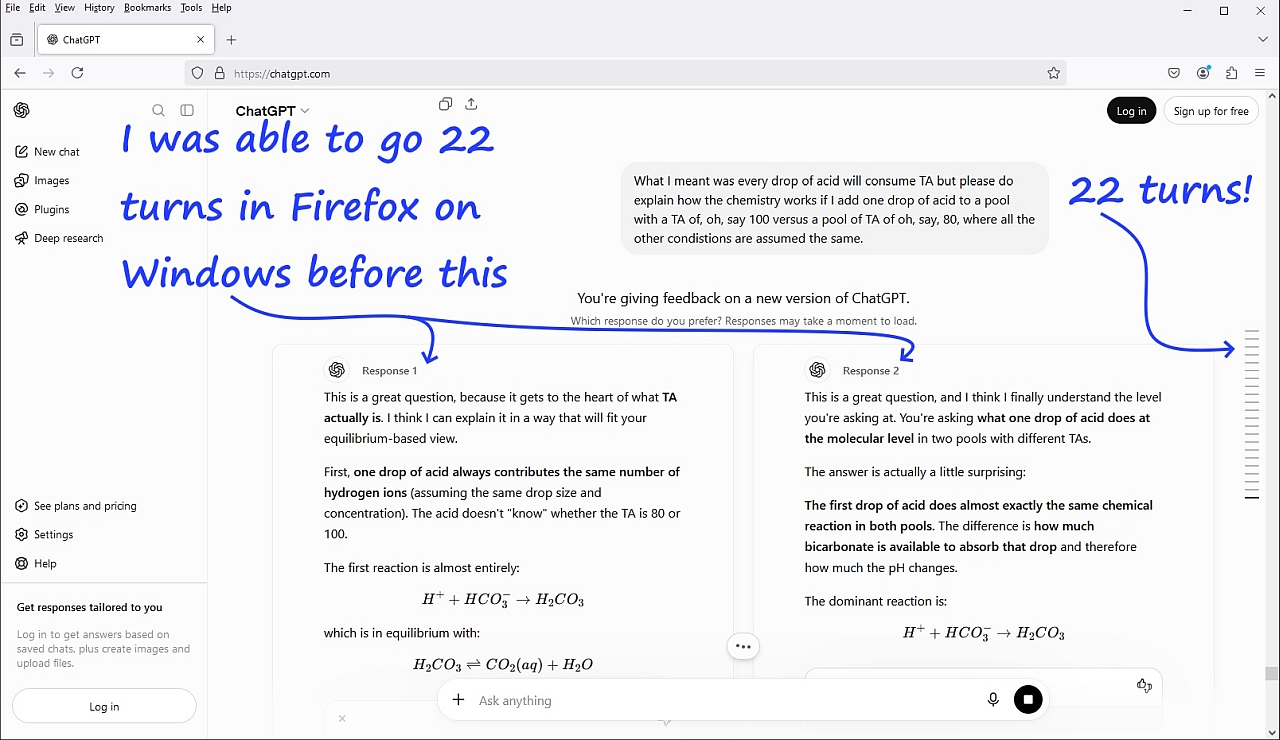
    I kept the conversation going, and, surprisingly, it took exactly 22 turns *after* the previous 5+2 (which it turned out, were on VPN w/o me knowing).

    After 22 turns, https://chatgpt.com/ in Firefox asked me for a survey!
    Has that ever happened to you where an LLM asked you which answer was best?

    The way it did it was strange though, as it asked me to choose an answer.
    <https://i.postimg.cc/T2n01Qbf/chatgpt-04.jpg> 22 turns before survey

    But then it kept going, just as Carlos had suggested it would keep doing.

    I think I inadvertently found out that they give a *different* turn
    limitation to VPN sessions than from sessions which are not on VPN.

    Proof below that I got at least 22 turns in this second set of tests.

    =============================================================================
    I asked:
    I have zero aeration other than placid octogenarian swimmers (two) in a 40K gallon pool so there's not much two nekkid people (who don't pee in the
    pool - I pee into the fertilizer bucket like any good Democrat would given
    it lowers the carbon dioxide in the atmosphere due to the lack of the
    bessler process need). It's a self-cleaning pool but that only means there
    are two pumps that I don't use. One is for the popup valves (which,
    strangely, is not filtered even though it's input is the skimmers). and the other is for the filter which is a humongous filter the size of a mars
    lunar lander. But I never run them. Every couple of years I replace the
    water especially if the monsoons are light that year. I dump the water
    right over my well. It soaks in but the well is 400 feet down so it's no
    longer chemical after about the first foot (although there can be cracks)
    so it's clean by the 100 years it takes to get to depth. ============================================================================= LLM responded:
    You've described a very unusual way of operating a pool, and a few parts
    are worth separating.

    If you're literally **never running the circulation or filter pump**, then:

    * The filter isn't doing anything, regardless of its size.
    * The "self-cleaning" pop-up system also isn't doing anything if its pump
    is off.
    * The pool is relying almost entirely on:

    * natural settling,
    * whatever sanitizer is present,
    * sunlight,
    * dilution from occasional water replacement.

    If there are only two people using a 40,000-gallon pool, the organic load
    is indeed very small compared with a heavily used residential pool. That reduces chlorine demand, but it doesn't eliminate the need for circulation
    if you want uniform water chemistry and filtration.

    Regarding dumping the water over your well:

    * A 400-foot-deep well does **not** mean water poured on the surface takes
    100 years to reach it. Travel time depends on the local geology. In
    fractured rock, water can sometimes move much faster than through fine
    soils.
    * Chlorine in pool water usually dissipates fairly quickly after discharge because it reacts with soil and organic matter, but dissolved salts (from chlorine products), cyanuric acid, calcium, and other dissolved chemicals
    don't simply disappear in the first foot of soil.
    * For that reason, many well owners avoid discharging large volumes of pool water directly near the wellhead. It's generally safer to discharge well
    away from the well, where local regulations allow, so the soil has more opportunity to attenuate contaminants before they could reach groundwater.

    As for aeration, you're correct that with only two calm swimmers there's essentially very little. Aeration mainly matters for:

    * driving carbon dioxide out of the water,
    * raising pH (without changing total alkalinity),
    * mixing chemicals.

    Without waterfalls, fountains, returns pointed upward, or vigorous
    swimming, there won't be much gas exchange from aeration alone.

    One thing I'm curious about is what prompted your description. Are you
    asking about:

    * whether the pool can remain sanitary without running the pumps,
    * carbon dioxide and pH chemistry,
    * the effect on your well,
    * or something else?

    =============================================================================
    I asked:
    I'm well aware of Franciscan chert geology on the ocean side of the San
    Andreas fault (I can spit into the fault line) so I'm aware water doesn't
    pop out of the mountian (even in winter) 'till about 1600 feet (which I'm
    above even at the depth of the wellhead) and it's 1300 feet in the summer
    as the table lowers (it's not an aquifer but more like a cracked sponge of mafic ocean sediments, chert and some graywacke & a bit of serpentinite all jumbled up with terranes scraped up 30 million years ago at the destruction
    of the Pacific Plate). But back to my chemistry question. Do you think the
    acid solved the problem or not? ============================================================================= LLM responded:
    Given what you've described about the local geology, I'll stick to the chemistry.

    I'm not sure what "the problem" refers to because this message doesn't
    mention what acid you added or what you were trying to fix. If you're
    referring to a previous part of the conversation that isn't visible to me,
    I don't want to guess.

    If the issue was **high pH due to COree loss**, then yes, adding acid would lower the pH. It would also reduce total alkalinity somewhat, depending on
    how much acid was added.

    If the issue was **high total alkalinity**, acid can lower it, but in a
    pool with essentially no aeration, the process is different from the
    standard "acid + aeration" method. Normally:

    1. Add acid to lower pH.
    2. Aerate to drive off COree.
    3. pH rises while total alkalinity stays lower.
    4. Repeat as needed.

    Without significant aeration, the pH tends to stay low longer because COree isn't being stripped from the water very quickly. So acid alone can reduce alkalinity, but the chemistry re-equilibrates much more slowly.

    If the issue was something else-such as calcium scaling, metal
    precipitation, cloudy water, or chlorine effectiveness-the answer depends
    on exactly what was happening.

    Could you tell me:

    * What problem were you trying to solve?
    * What acid did you use (typically muriatic acid or dry acid)?
    * What were your before-and-after measurements (pH, total alkalinity, and
    if available, calcium hardness and cyanuric acid)?

    Those numbers would make it possible to tell whether the acid likely accomplished what you intended.

    =============================================================================
    I asked:
    I see you added an advertisement. WHy? I don't want them. And I never see
    them when I use copilot. WHy does chatgpt infest the chat with an ad for
    "mid atlantic water where A real expert reads your water test". I'm already
    an expert. That's why I'm asking you about the chemistry issue we just
    spent 8 turns on before you locked up and I had to go to another tab. ============================================================================= LLM responded:
    I understand why that was frustrating, especially after a long technical discussion where you were asking a chemistry question rather than looking
    for a water-testing service.

    I don't control or insert advertisements into the ChatGPT interface, and I can't see what appears in your app or browser UI. If you saw a separately labeled sponsored item such as "Mid Atlantic Water" or "A real expert reads your water test," that was a platform ad placement, separate from my
    response. Ads (when shown) don't influence my answers or what I say. If you want to give feedback about that ad, you can usually use the ad's **...**
    menu and choose options like **Hide this ad**, **Not relevant to me**, or **Report this ad** (wording can vary by app).

    On the chemistry thread: I'm sorry the continuity broke. I don't actually
    have access to the missing eight turns from the previous tab/session, so I can't see the acid event you were referring to. I should have said that
    more explicitly rather than making it sound like I was missing only a small detail.

    If you give me the short version of the experiment-what acid you added, how much, what the pool readings were before and after, and what symptom you
    were trying to correct-I can pick it back up from there. Given your setup
    (40K gallons, almost no aeration, very low bather load), the key question
    is likely whether the acid changed **total alkalinity**, merely adjusted
    **pH temporarily**, or actually solved the underlying imbalance.

    =============================================================================
    I asked:
    Why did https://chatgpt.com/ lock up after five turns, asking me
    Thanks for trying ChatGPT
    Log in or sign up to get smarter responses,
    upload files and images, and more.
    [Log in] <-- button
    [Sign up for free] <-- button
    <Stay logged out> <-- link
    And then, when I clicked to stay logged out, it gave me only two more turns before locking up. ============================================================================= LLM responded:
    What you ran into sounds like a **usage limit or session restriction for logged-out ChatGPT use**, not the chat itself rCLlocking uprCY because of the chemistry topic.

    When you use [ChatGPT](https://chatgpt.com?utm_source=chatgpt.com) while
    **not signed in**, access is more limited than when yourCOre logged into an account. The exact limits can vary depending on things like:

    * current demand on the service,
    * which model is being used,
    * whether you are logged out or on a free account,
    * browser/session state,
    * regional availability and experiments being run.

    The rCLThanks for trying ChatGPT rCo Log in or sign uprCarCY message is the normal
    prompt shown when the anonymous session has reached its allowed usage.
    Clicking rCLStay logged outrCY can sometimes let you continue with a smaller allowance, which likely explains why you got a couple more turns and then
    hit the limit again.

    A few practical points:

    * Creating a free account generally gives you a more stable experience and preserves chats/history.
    * If you were in a long technical conversation, being logged in is much
    less likely to interrupt it.
    * If a chat is important, copying the key details into a saved note is a
    good precaution, since anonymous sessions are more fragile.

    It also explains why I didnrCOt have the previous eight turns available here:
    a logged-out or interrupted session may not carry the conversation context
    into a new tab/session.

    For what itrCOs worth, your pool chemistry question is exactly the kind of thing where continuity mattersrCobecause the answer depends on the sequence
    of measurements and treatments, not just the final pH. If you paste the relevant measurements from the earlier exchange, I can continue from there.

    =============================================================================
    I asked:
    (swear words so it won't let me copy it) ============================================================================= LLM responded:
    I understand why you're angry about this. A few separate things are getting mixed together:

    1. **The "Mid Atlantic Water" item**

    I can't remove it, suppress it, or control what appears in the ChatGPT interface. I also can't see your screen. If that item is a separately
    labeled sponsored placement, it is coming from the ChatGPT product UI, not
    from me generating a recommendation. You can use the ad's **...** menu (if available) to hide/report it or indicate it isn't relevant. If you want an ad-free experience, the available options depend on your plan and region.

    2. **The "5 turns + 2 more turns" claim**

    You are right to challenge my wording. I **do not have documentation** saying "logged-out users get exactly five turns, then two more after
    clicking Stay logged out." I should not have implied that there was a
    published fixed rule matching your exact experience.

    The more accurate statement is: **logged-out ChatGPT sessions can have stricter and variable usage limits, and the product may ask users to sign
    in when those limits are reached.** The exact thresholds can change and are
    not necessarily published as a fixed number of turns.

    Your observed sequence-five turns, then a couple more after choosing
    "Stay logged out"-is a real observation, but I cannot verify that it is the universal limit or a documented policy.

    3. **Why it may have happened**

    Possible reasons include:

    * anonymous session limits,
    * temporary capacity controls,
    * model availability restrictions,
    * browser/session tracking behavior,
    * an experiment or product change.

    Without access to internal service logs, I can't tell which one
    triggered your specific session.

    You were right to call out the unsupported specificity. The better answer
    would have been: *"I don't know the exact threshold; logged-out sessions
    are limited and the limit can vary."* I should have said that the first
    time.


    =============================================================================
    I asked:
    Is there any llm engine that allows unlimited turns without logging into an account? ============================================================================= LLM responded:
    Short answer: **yes, but with a big caveat**: "unlimited turns, no login,
    free, and a strong model" is a combination that is rare. Someone has to pay
    for the compute, so most public services put *some* constraint somewhere (message caps, slower models, ads, shorter context, or eventual login requirements).

    The closest options are:

    ### 1. Run an LLM yourself (closest to truly unlimited)

    If you install a local model on your own computer, there is no account, no
    turn counter, and no platform deciding when you stop. Tools such as [Ollama](https://ollama.com?utm_source=chatgpt.com) or [LM Studio](https://lmstudio.ai?utm_source=chatgpt.com) let you run models
    locally. The limit becomes your hardware (RAM/VRAM and speed), not a vendor quota.

    This is the only option that is genuinely "unlimited" in the way you mean.

    ### 2. Anonymous web chat services

    There are some services that advertise no-account or anonymous use. For example, [Duck.ai](https://duck.ai?utm_source=chatgpt.com) is designed
    around anonymous AI access, and various no-signup chat sites claim
    unlimited use. ([Tech Journal][1])

    The downside: you are trusting another intermediary, and "unlimited" often means "unlimited under fair use," not a contractual guarantee. Some
    services can change limits without notice.

    ### 3. Why Copilot may feel different

    [Microsoft Copilot](https://copilot.microsoft.com?utm_source=chatgpt.com)
    and other services may appear more permissive in casual use, but they also
    have their own quotas and product rules. Different services simply choose different points where they introduce friction.

    For your specific use case-**long technical conversations where context matters** (like the pool chemistry discussion)-the best choices are:

    * **Best no-login experience:** a local LLM.
    * **Best convenience:** sign in to a hosted service.
    * **Best privacy/control:** local model + local chat history.

    If you have a reasonably modern desktop (especially with an NVIDIA GPU or a
    lot of RAM), running a local model is much closer to the old "just keep talking" experience than any anonymous web chatbot.

    [1]: https://techjournal.org/best-free-ai-chatbots-no-sign-up?utm_source=chatgpt.com "Best Free AI Chatbots With No Sign-Up (2026)"

    =============================================================================
    I asked:
    how did pool acid break up the milk from adding too much calhypo which
    turned the pool cloudy ============================================================================= LLM responded:
    The short answer: **the acid probably did not "break up the milk" directly.
    It changed the water chemistry so the calcium cloudiness could dissolve or
    stop precipitating.**

    With **calcium hypochlorite (cal-hypo)**, the problem is usually excess
    calcium and a temporary rise in pH.

    The chemistry looks roughly like this:

    [
    \text{Ca(OCl)}_2 \rightarrow \text{Ca}^{2+} + 2\text{OCl}^-
    ]

    The hypochlorite ion ((\text{OCl}^-)) is strongly alkaline because it
    reacts with water:

    [
    \text{OCl}^- + H_2O \rightleftharpoons HOCl + OH^-
    ]

    That creates hydroxide ((OH^-)), which pushes the pH upward.

    At high pH, calcium and carbonate become more likely to form insoluble
    calcium carbonate:

    [
    Ca^{2+} + CO_3^{2-} \rightarrow CaCO_3(s)
    ]

    The tiny calcium carbonate crystals scatter light, producing the "milk" appearance.

    When you add acid (usually muriatic acid, hydrochloric acid):

    [
    H^+ + CO_3^{2-} \rightarrow HCO_3^-
    ]

    and eventually:

    [
    2H^+ + CO_3^{2-} \rightarrow CO_2 + H_2O
    ]

    The carbonate is converted into dissolved bicarbonate and carbon dioxide.
    That reduces the carbonate available to keep making calcium carbonate particles. Existing fine precipitate can dissolve:

    [
    CaCO_3(s) + 2H^+ \rightarrow Ca^{2+} + CO_2 + H_2O
    ]

    So the acid effectively **reverses the precipitation reaction**.

    A few things make your situation interesting:

    * Your pool is **40,000 gallons**, so even a big dose of cal-hypo is
    heavily diluted.
    * You mentioned **almost no aeration**. That matters because acidifying
    calcium carbonate creates dissolved COree. Normally, aeration drives COree out and lets pH rise again. With little aeration, the water can stay lower-pH longer, keeping calcium carbonate dissolved.
    * If you had a very high calcium hardness level already, the acid may only
    have hidden the symptom temporarily; the calcium is still in the water.

    A useful diagnostic question: when it cleared, did the water become
    **sparkling clear immediately after acid**, or did it clear over several hours/days? Immediate clearing suggests the pH shift dissolved suspended calcium carbonate. Slow clearing suggests filtration or settling also
    played a major role.

    =============================================================================
    I asked:
    It became sparkling clear only overnight ============================================================================= LLM responded:
    Overnight clearing is a useful clue. It suggests the acid **probably
    changed the chemistry enough to stop the calcium carbonate cloud and allow
    the suspended material to disappear**, but the mechanism was likely a combination of dissolution, settling, and whatever slow mixing occurred in
    the pool.

    A likely sequence:

    1. **The cal-hypo spike raised pH sharply**

    The extra hypochlorite from calcium hypochlorite consumed water
    chemistry in the alkaline direction:

    [
    OCl^- + H_2O \rightarrow HOCl + OH^-
    ]

    The pH rise shifted the carbonate equilibrium toward carbonate ion:

    [
    HCO_3^- \rightleftharpoons CO_3^{2-} + H^+
    ]

    More carbonate plus calcium means calcium carbonate can exceed its
    solubility limit:

    [
    Ca^{2+}+CO_3^{2-}\rightarrow CaCO_3(s)
    ]

    Those microscopic crystals are what made the pool look like milk.

    2. **The acid pushed the equilibrium back**

    Adding acid increased hydrogen ions:

    [
    CO_3^{2-}+H^+\rightarrow HCO_3^-
    ]

    and:

    [
    CaCO_3(s)+2H^+\rightarrow Ca^{2+}+CO_2+H_2O
    ]

    In other words, the acid gave the carbonate crystals a chemical path back
    into solution.

    3. **The overnight time matters**

    If it had gone clear in minutes, I would suspect mostly a pH-induced
    optical effect or rapid dissolution. Overnight suggests:

    * some fraction of the calcium carbonate actually dissolved gradually,
    * some particles settled,
    * some were captured by whatever residual circulation, currents, or
    surfaces existed.

    Given your description of **very low bather load, 40K gallons, no active filtration, and little aeration**, the fact that it cleared overnight
    points strongly toward a **chemical equilibrium correction**, not
    filtration.

    One interesting implication: if your pool had been badly
    calcium-overloaded, acid alone would not remove the calcium-it would just convert the precipitated calcium carbonate back into dissolved calcium and bicarbonate. The water could look perfect afterward but still have a high calcium saturation index. The next high-pH event (especially another
    cal-hypo addition) could bring the milk back.

    If you happened to measure **pH before the acid, pH after the acid, and
    calcium hardness**, those three numbers would tell whether you merely
    dissolved the precipitate or actually moved the pool into a stable range.

    =============================================================================
    I asked:
    it was 100% chemical. I just want to understand why and how ============================================================================= LLM responded:
    Good - if it was **100% chemical**, then the interesting part is the equilibrium shift. The acid didn't "clean" the pool; it **undid the
    chemical conditions that made the calcium carbonate invisible as a solid**.

    The sequence was probably:

    ### 1. The cal-hypo created a high-pH, calcium-rich environment

    Calcium hypochlorite adds both calcium and hypochlorite:

    [
    Ca(OCl)_2 \rightarrow Ca^{2+} + 2OCl^-
    ]

    The hypochlorite is alkaline:

    [
    OCl^- + H_2O \rightleftharpoons HOCl + OH^-
    ]

    The extra (OH^-) raises pH.

    At higher pH, your bicarbonate alkalinity shifts toward carbonate:

    [
    HCO_3^- \rightleftharpoons CO_3^{2-}+H^+
    ]

    So you suddenly had more (CO_3^{2-}) available.

    ### 2. Calcium carbonate exceeded its solubility limit

    The pool water had enough calcium and carbonate that:

    [
    Ca^{2+}+CO_3^{2-}\rightarrow CaCO_3(s)
    ]

    The "milk" was not a chemical cloud floating around; it was **billions of microscopic calcium carbonate crystals** scattering light.

    ### 3. Acid reversed the precipitation

    When you added acid, the hydrogen ions attacked the carbonate:

    [
    CO_3^{2-}+H^+\rightarrow HCO_3^-
    ]

    and further:

    [
    HCO_3^-+H^+\rightarrow CO_2+H_2O
    ]

    That removes carbonate from the equilibrium. The water is no longer supersaturated with respect to calcium carbonate.

    The solid then dissolves:

    [
    CaCO_3(s)+2H^+\rightarrow Ca^{2+}+CO_2+H_2O
    ]

    EeCgenuiEee{"chemistry_reactions_solutions_thermodynamics_learning_block":{"type_id":"GIBBS_FREE_ENERGY"}}EeU

    The important concept is that the acid didn't need to "attack every
    particle." It changed the concentration of carbonate ions in the water.
    Once the dissolved carbonate concentration dropped, the equilibrium had a strong reason to pull solid calcium carbonate back into solution.

    ### Why overnight instead of instantly?

    Because the crystals were tiny but not infinitely reactive. Each particle
    had a surface reaction rate. The acid first changed the surrounding water chemistry, then the solid particles slowly dissolved into the new
    equilibrium state.

    Your no-aeration setup actually favors the explanation: if there were
    strong aeration, the generated COree would escape, which can allow pH to
    climb again. With calm water, the COree stayed dissolved longer, keeping the equilibrium on the dissolved side.

    So the "magic trick" was:

    **Too much cal-hypo -> pH spike -> carbonate precipitation -> white milk -> acid lowers carbonate -> calcium carbonate dissolves -> clear water.**

    The calcium didn't leave. It went back into solution as calcium ions. The
    cloud disappeared because the **form of the calcium changed**, not because
    the calcium was removed.

    =============================================================================
    I asked:
    I added the acid by swimming and pouring it in front of me (diluted). ============================================================================= LLM responded:
    That detail actually makes the chemistry more interesting, because it tells
    us **the acid was not just sitting in one spot waiting to react**. You effectively performed a slow, distributed acid addition throughout the
    pool.

    When you swam and poured diluted acid in front of you, several things
    happened:

    1. **The acid plume contacted the cloudy water locally**

    The first places it hit had a temporarily low pH zone. In those tiny regions, the calcium carbonate particles became unstable:

    [
    CaCO_3(s)+2H^+ \rightarrow Ca^{2+}+CO_2+H_2O
    ]

    The acid didn't "scrub" the particles. It removed the carbonate ion that
    keeps calcium carbonate solid.

    EeCgenuiEee{"chemistry_reactions_solutions_thermodynamics_learning_block":{"type_id":"ACID_BASE_TITRATION"}}EeU

    2. **Your swimming was the mixing mechanism**

    You said you had essentially no mechanical circulation. But a person
    moving through 40,000 gallons is actually a surprisingly effective
    low-energy mixer. You created:

    * turbulent mixing behind your body,
    * convection currents,
    * slow redistribution of acid,
    * contact between acidified water and suspended crystals.

    The acid concentration at any one point was probably never extreme because
    you diluted it and spread it over time.

    3. **The acid attacked the chemical equilibrium, not just the visible
    cloud**

    The key reaction is not "acid dissolves white stuff." It is:

    [
    CO_3^{2-}+H^+\rightarrow HCO_3^-
    ]

    and:

    [
    HCO_3^-+H^+\rightarrow CO_2+H_2O
    ]

    By reducing carbonate concentration, you lowered the saturation state of calcium carbonate. The existing crystals became thermodynamically
    unfavorable and dissolved.

    4. **Why did it clear overnight instead of immediately?**

    Because the acid addition probably brought the pool from:

    **supersaturated -> near equilibrium**

    rather than instantly making every crystal vanish. The remaining particles
    had to dissolve molecule by molecule. Once the water crossed the solubility threshold, the last tiny crystals disappeared rapidly.

    The fact that it cleared completely without filtration is actually a strong clue that the cloud was **not dirt, algae, or organic contamination**.
    Those would not vanish just because you lowered pH. It was almost certainly
    a calcium carbonate precipitation event caused by the cal-hypo/pH spike.

    One thing I would be curious about: when it was cloudy, did the cloud have
    a **bluish-white "milk in water" look**, and did it appear worse when the
    pool was viewed from the deep end toward the shallow end? That visual
    signature is very characteristic of calcium carbonate precipitation.

    =============================================================================
    I asked:
    THere never was a doubt it wasn't dirt or algae since it happened overnight
    in a chlorine environment with the right FC:CYA Richard Falk ratio. It went away overnight too. It was purely chemical. So did the acid break apart the carbonate crystals? ============================================================================= LLM responded:
    Yes - **chemically, the acid dissolved the calcium carbonate crystals**,
    but "broke apart" is a little misleading. It did not mechanically shatter
    the crystals; it **shifted the dissolution equilibrium so the solid phase
    was no longer favored**.

    A calcium carbonate crystal is a lattice of (Ca^{2+}) and (CO_3^{2-}) ions.
    In water, even a solid crystal is constantly undergoing a microscopic tug-of-war:

    [
    CaCO_3(s) \rightleftharpoons Ca^{2+} + CO_3^{2-}
    ]

    At the high pH caused by the excess cal-hypo, there was enough carbonate
    ion around that the reverse reaction won:

    [
    Ca^{2+}+CO_3^{2-}\rightarrow CaCO_3(s)
    ]

    The water became supersaturated, and the excess calcium carbonate came out
    as microscopic crystals.

    When you added acid, the hydrogen ions did something very specific: they **removed carbonate ions from the water** by converting them into
    bicarbonate and then carbonic acid:

    [
    CO_3^{2-}+H^+ \rightarrow HCO_3^-
    ]

    [
    HCO_3^-+H^+ \rightarrow H_2CO_3 \rightarrow CO_2 + H_2O
    ]

    By lowering the (CO_3^{2-}) concentration, you pulled the equilibrium to
    the right in the dissolution direction:

    [
    CaCO_3(s)+2H^+ \rightarrow Ca^{2+}+CO_2+H_2O
    ]

    So at the molecular level:

    * Hydrogen ions attacked carbonate ions at the crystal surface.
    * Carbonate was converted into dissolved bicarbonate/carbonic acid.
    * Calcium ions left the crystal lattice and returned to solution.
    * The crystal surface receded until the particles disappeared.

    The reason it looked like the milk "vanished" is that the crystals were extremely small. Once the water became undersaturated with respect to
    calcium carbonate, those tiny particles had a huge surface area relative to their mass, so they dissolved fairly quickly.

    Your observation that it cleared **overnight with no filtration** is
    actually a very clean demonstration of this equilibrium shift. The calcium
    did not leave the pool; the solid calcium carbonate phase simply converted
    back into dissolved calcium and bicarbonate/carbon dioxide species. The
    acid changed the *form* of the calcium in the water.

    =============================================================================
    I asked:
    what's the best way to explain what happened, in both directions, to my
    wife, who is a math PhD but who doesn't know chemistry so she understands
    that it wasn't my fault?

    ============================================================================= LLM responded:

    For a mathematician, I would avoid explaining it as "the acid cleaned up
    the mess." That sounds like a magic reagent. The better analogy is **a reversible phase transition controlled by equilibrium** - something a mathematician will immediately recognize.

    I would explain it this way:

    "The pool didn't get dirty. I accidentally pushed a chemical equilibrium past a boundary. The calcium that was already dissolved in the water temporarily changed into a solid phase, like a precipitation event. The white milk was billions of microscopic calcium carbonate crystals suspended in the water.

    The cal-hypo pushed the pH high. High pH converts more bicarbonate into carbonate. Calcium plus carbonate has a solubility limit, so once there was too much carbonate available, calcium carbonate came out of solution:

    [
    Ca^{2+}+CO_3^{2-}\rightarrow CaCO_3(s)
    ]

    The acid didn't remove anything. It just moved the equilibrium back the other way:

    [
    CaCO_3(s)+2H^+\rightarrow Ca^{2+}+CO_2+H_2O
    ]

    The hydrogen ions consumed the carbonate, so the solid calcium carbonate was no longer stable. It dissolved back into invisible ions. The calcium never left the pool; it just changed form.

    It is like a reversible equation where I moved the variables back across the threshold. The cloud was a state change, not contamination."

    EeCgenuiEee{"chemistry_atoms_molecules_matter_learning_block":{"type_id":"STATES_OF_MATTER_PARTICLE_MODEL"}}EeU

    For the "was it my fault?" part, I would phrase it carefully:

    "The only thing I did was add enough cal-hypo to temporarily exceed the calcium carbonate saturation point. That caused a predictable chemical reaction. I didn't create a contaminant; I created a temporary equilibrium condition. The fix was also chemical."

    The mathematical analogy she may like:

    * Think of the water as a system with an equilibrium surface.
    * The cal-hypo addition moved the state vector into a region where the
    solid phase was favored.
    * The acid moved the state vector back into the dissolved region.
    * The system relaxed to the new equilibrium overnight.

    The important point: **you did not have to filter anything out because
    there was nothing foreign to remove. The "milk" was your own dissolved pool constituents temporarily taking the wrong mathematical solution branch.**

    =============================================================================
    I asked:
    I'm still not getting it. So the calhypo locally created a lousy LSI where
    it was very scaling, maybe something like a 2.0 on the LSI, and in that
    regard, the chalk came out of solution and wouldn't go back into solution
    at pH 7.8 but when I brought the pH down to 7.2 or 7.3 then the LSI dropped enough to get the chalk back into solution? Is that it? ============================================================================= LLM responded:
    Yes - **that is essentially the right mental model**, with one important refinement: the acid did not make the calcium carbonate "go back into
    solution" because of pH alone in a simple sense; it lowered the **calcium carbonate saturation state** (LSI) enough that dissolution became
    favorable.

    Your LSI framing is exactly the right tool.

    The sequence:

    1. **Cal-hypo addition created a local high-pH zone**

    A concentrated cal-hypo addition does two things at the point of
    addition:

    * adds (Ca^{2+}),
    * adds hypochlorite, which creates (OH^-) and raises pH.

    So locally you temporarily had:

    * high pH,
    * elevated carbonate fraction,
    * extra calcium.

    That can drive LSI very positive. A transient local LSI of +2 is not unreasonable if the concentration gradient was strong enough. (The bulk
    pool may not have been anywhere near that.)

    2. **The calcium carbonate precipitated**

    The relevant equilibrium is:

    [
    CaCO_3(s) \rightleftharpoons Ca^{2+}+CO_3^{2-}
    ]

    When the ion product:

    [
    [Ca^{2+}][CO_3^{2-}]
    ]

    exceeds the solubility product (K_{sp}), calcium carbonate comes out.

    The "chalk" was not dissolved calcium anymore; it was a solid phase.

    3. **Why didn't it immediately redissolve at pH 7.8?**

    Because pH 7.8 can still be perfectly capable of maintaining calcium carbonate saturation, depending on:

    * calcium hardness,
    * total alkalinity,
    * temperature,
    * ionic strength.

    Once crystals have formed, the water has to become **undersaturated**
    before they dissolve appreciably.

    4. **The acid pushed the LSI negative enough**

    When you lowered pH to ~7.2-7.3, you changed the carbonate equilibrium:

    [
    HCO_3^- \rightleftharpoons CO_3^{2-}+H^+
    ]

    Lower pH means much less (CO_3^{2-}). That is the key. The calcium concentration may barely have changed, but the carbonate concentration
    dropped dramatically.

    Since LSI depends strongly on carbonate availability (through
    alkalinity/pH), the saturation index moved downward:

    [
    LSI = \log\left(\frac{IAP}{K_{sp}}\right)
    ]

    You moved from:

    [
    LSI > 0 \quad \text{(scale forming)}
    ]

    to something like:

    [
    LSI < 0 \quad \text{(dissolving)}
    ]

    Then:

    [
    CaCO_3(s)+2H^+ \rightarrow Ca^{2+}+CO_2+H_2O
    ]

    became favorable.

    So your summary:

    "The cal-hypo made a lousy LSI, the chalk precipitated, and lowering pH lowered LSI enough that the chalk dissolved back."

    is basically correct.

    The one nuance I would add: the cal-hypo probably did **not** permanently increase the calcium enough to matter in a 40,000-gallon pool. The dramatic effect was likely the **temporary pH spike and carbonate shift**, not the calcium dose itself.

    Your observation that it cleared overnight without filtration is actually
    the signature of a system crossing the LSI boundary back into
    undersaturation. You essentially performed a controlled reverse-scale treatment.

    =============================================================================
    I asked:
    In the future, how should I add a pound of calhypo (I have five boxes of
    the stuff as it was on sale at Costco, and you always need chlorine and calcium) to the pool each night? ============================================================================= LLM responded:
    Given what happened, I would change **how the cal-hypo enters the pool**,
    not necessarily abandon using it. Your goal is actually reasonable: a pound
    of cal-hypo in 40,000 gallons is not a huge chlorine dose, and you are also adding calcium. The problem was not the total dose; it was the **local concentration spike** before the chemical had time to disperse.

    Think of it as the difference between adding a teaspoon of salt to soup
    versus dumping that teaspoon onto one spot and tasting that spot.

    The ideal procedure:

    ### 1. Pre-dissolve it

    Put the pound of cal-hypo into a clean bucket of pool water.

    * Fill the bucket first.
    * Add the cal-hypo to the water (not the other way around).
    * Stir carefully.
    * Let the undissolved calcium material settle briefly.
    * Pour the clear solution around the perimeter.

    This removes the concentrated "hot spot" where you got your temporary LSI disaster.

    ### 2. Add it in the evening

    Night is good because:

    * no UV loss of chlorine,
    * less swimmer activity,
    * more time for equilibrium to settle.

    ### 3. Spread it over the largest possible area

    With no circulation pump running, walk around the pool and distribute it.
    You were actually doing the right thing conceptually by moving around and mixing, but pouring a concentrated stream directly into the water creates a local micro-environment where pH can be very high.

    ### 4. Avoid adding it at the same spot repeatedly

    A single location can repeatedly get:

    * high pH,
    * high calcium,
    * high hypochlorite.

    That is where scaling starts.

    ### 5. Watch your LSI inputs

    The big numbers are:

    * pH,
    * total alkalinity,
    * calcium hardness,
    * temperature.

    The cal-hypo is not dangerous because it adds calcium; it is dangerous
    because it temporarily creates **both sides of the scale equation**:

    * more calcium,
    * more carbonate availability from the pH rise.

    The same pound added uniformly may never create enough local
    supersaturation to precipitate anything.

    EeCgenuiEee{"chemistry_reactions_solutions_thermodynamics_learning_block":{"type_id":"SOLUTION_DILUTION"}}EeU

    For your particular pool, with essentially no circulation, I would
    especially avoid the classic advice of "just throw it in the deep end."
    That advice assumes the pump is running and instantly dispersing the dose.
    Your pool is closer to a large chemical reactor with weak mixing, so **pre-dilution and distribution matter much more**.

    One other thought: since you have five Costco boxes, you may eventually
    want to calculate the cumulative calcium increase. A pound of typical
    65-73% cal-hypo adds roughly **7-8 ppm of calcium hardness as CaCOrea per 10,000 gallons**, so in your 40K pool you are only adding roughly **2 ppm
    CH per pound**. That means your bigger risk is not the calcium accumulation from occasional pounds; it's those short-lived high-pH/calcium microzones.

    =============================================================================
    I asked:
    This is 58.44% and I calculated it adds about 2ppm Calcium, where the goal
    is to start with low calcium in the summer because our summer problem is we sacrifice chlorine to the sun god (sanitation) but in the winter, we
    sacrifice calcium to the monsoon god (saturation), so I plan it to have low calcium and high cya in the beginning of the summer, where the calcium goes
    up and the cya goes down (due to evaporation refill) before the rains
    dilute everything in the winter (where hte LSI matters most). LSI above 1.0
    is no big deal as without pumps running, scaling isn't an issue, but LSI
    below 1.3 or so is a big deal because that calcium comes out of teh pool surface. ============================================================================= LLM responded:

    ============================================================================= LLM responded:
    Your seasonal strategy is actually a very interesting way to think about a
    pool that is operated more like a **large, low-disturbance chemical
    reservoir** than a conventional pump-driven pool. The main thing I would
    adjust is the direction of the LSI thresholds you mentioned.

    The general LSI interpretation is:

    * **Positive LSI** -> water is calcium-carbonate saturated and *wants to deposit scale*.
    * **Negative LSI** -> water is calcium-carbonate undersaturated and *wants
    to dissolve calcium carbonate* (including plaster/scale surfaces).

    So:

    * **LSI above +1.0**: yes, that is very scale-forming water. Whether it actually scales depends on kinetics, surfaces, mixing, temperature
    gradients, and whether high-LSI microzones occur.
    * **LSI below about -0.3 to -0.5**: that is where plaster/stone surfaces
    become more vulnerable.
    * **LSI around 0**: generally balanced.

    I think the sign may have gotten flipped in your last sentence. You wrote:

    "LSI above 1.0 is no big deal ... but LSI below 1.3 or so is a big deal because that calcium comes out of the pool surface."

    If you mean **+1.3**, that would be the opposite of the usual concern:
    calcium is coming **out of solution**, not out of the pool surface. If you
    mean **-1.3**, then yes, that would be an extreme dissolution condition.

    Your seasonal chemistry plan makes sense in this context:

    ### Summer

    You intentionally start with:

    * lower calcium hardness,
    * higher CYA,
    * enough chlorine reserve.

    Then:

    * evaporation concentrates calcium and other dissolved solids,
    * cal-hypo additions add calcium while maintaining sanitation,
    * CYA slowly declines through oxidation and water management.

    That moves you toward a more saturated water balance as the dry season progresses.

    ### Winter

    The monsoons:

    * dilute calcium,
    * dilute alkalinity,
    * dilute CYA,
    * often lower water temperature.

    Temperature dropping lowers the calcium carbonate saturation tendency, so winter is when low LSI becomes more relevant.

    The one place I would be cautious is your assumption that high LSI is
    harmless because you don't run pumps. The lack of circulation absolutely reduces the rate of bulk scaling, but it does not eliminate it. The places
    most likely to scale would be:

    * where cal-hypo lands,
    * where evaporation concentrates water at the surface,
    * warm stagnant zones,
    * tile lines,
    * any rough spots.

    That is exactly what your milk event demonstrated: you created a local LSI excursion without changing the average pool chemistry much.

    Your 58.44% cal-hypo calculation also sounds in the right ballpark. The
    reason your estimate is lower than many pool calculators is that you are talking about **elemental calcium increase**, while pool calculators
    usually report **calcium hardness as ppm CaCOrea equivalent**. Those are not the same unit.

    The key insight from your experiment is probably:

    In a low-circulation pool, average LSI matters, but local LSI spikes matter more.

    Your acid correction worked because you changed the local saturation state
    back across the calcium carbonate solubility boundary. The future fix is
    not "less cal-hypo"; it is "less concentrated cal-hypo contact with the
    pool."

    =============================================================================
    I asked:
    ooops. When I said 1 I meant 0.33 (as the LSI swins around 0pH by about
    1/3rd of a pH point.

    ============================================================================= LLM responded:
    Ah, that correction changes the picture, and yes, **your revised numbers
    are much more in line with how pool people usually think about LSI**.

    You meant roughly:

    * **LSI +0.33**: a reasonable upper swing, not a crisis.
    * **LSI around 0**: your target equilibrium.
    * **LSI significantly negative**: where you worry about calcium being
    pulled out of plaster/stone.

    That makes your seasonal strategy much more coherent.

    The important relationship is that **pH is the big lever in LSI**. A swing
    of about 0.3 pH units can easily move LSI by about 0.3 because the
    carbonate species distribution changes very sharply around pool pH.

    So your summer/winter plan is basically:

    **Summer:**

    * Start with lower CH.
    * Let cal-hypo additions gradually add calcium.
    * Let evaporation concentrate everything.
    * Maintain CYA high enough to protect chlorine from UV.
    * Allow LSI to drift upward toward mildly positive territory.

    **Winter:**

    * Rain dilution knocks down:

    * calcium hardness,
    * alkalinity,
    * CYA.
    * Cold water lowers calcium carbonate saturation.
    * LSI becomes the concern.

    That is a rational seasonal balancing act for a pool where you are not constantly circulating and adjusting.

    The cal-hypo cloud event fits into this too. It was not that your *bulk
    pool LSI* was +2.0. More likely, immediately around the cal-hypo granules
    or concentrated solution, you briefly had a microscopic "chemical volcano":

    * very high local pH,
    * high local calcium,
    * high local carbonate availability,
    * extreme local positive LSI.

    That caused:

    [
    Ca^{2+}+CO_3^{2-}\rightarrow CaCO_3(s)
    ]

    The cloud was the local precipitation spreading into the bulk water.

    Then the acid addition dropped the carbonate availability:

    [
    CO_3^{2-}+H^+\rightarrow HCO_3^-
    ]

    and your LSI moved back down enough that:

    [
    CaCO_3(s)\rightarrow Ca^{2+}+CO_3^{2-}
    ]

    was no longer a favorable direction.

    One subtle point: with your "no pumps" philosophy, I agree that **a mildly positive LSI is less scary than in a conventional pool**, because you are
    not constantly forcing supersaturated water through heaters, salt cells,
    narrow plumbing, and high-velocity return jets. The kinetics matter.

    But your own experiment demonstrated the flip side: **local chemistry beats bulk chemistry.** A pool that is perfectly balanced on average can still
    make a calcium carbonate snowstorm if a concentrated chemical addition
    creates a temporary extreme zone.

    So the practical rule for your five boxes of 58.44% cal-hypo is probably:

    Keep the seasonal calcium strategy, but never allow a concentrated cal-hypo slug to exist in the pool. Make the entire 40K gallons see the dose, not one cubic foot of water seeing it first.

    Your approach is actually closer to managing a natural body of water than a typical backyard pool - and the chemistry behaves accordingly.

    =============================================================================
    I asked:
    It should be easy to fill a bucket with water and dissolve the calhypo. Probably one half pound to a typical Home Depot clean bucket (yes, I know
    clean is critical for explosive reasons). Then I can pour it into the pool
    at night. It would be nice to do it during the day, but you know that the
    sun takes the chlorine. ============================================================================= LLM responded:
    Yes, that is the right direction, with one important practical chemistry
    point: **cal-hypo does not truly dissolve completely at high doses**. You
    can dissolve a lot of the available calcium hypochlorite, but some material
    may remain as insoluble calcium compounds and other residues. That is not a problem rCo the goal is to avoid creating a concentrated alkaline/calcium
    "hot spot" in the pool.

    For your situation, a good method would be:

    1. **Use a clean plastic bucket**

    * A dedicated pool-chemical bucket is ideal.
    * Your point about cleanliness is correct: don't use a bucket that has
    held oils, solvents, fertilizers, or other reactive materials. Cal-hypo is
    an oxidizer.

    2. **Fill the bucket with pool water first**

    * Add water, then add cal-hypo.
    * For half a pound in a typical 5-gallon bucket, you are making a much
    more diluted slurry than dumping the granules directly into the pool.

    3. **Stir carefully**

    * Use a dedicated plastic stirrer.
    * Let any undissolved material settle if you want to leave the solids behind.

    4. **Distribute around the pool**

    * Walk around the perimeter and pour slowly in several places.
    * In your pump-off setup, your walking pattern is basically your
    circulation system.

    Night addition is also the correct timing from a chlorine-efficiency standpoint. The sun does not "consume" chlorine chemically in the same way
    as an oxidizer demand does; UV breaks down hypochlorous acid, and CYA
    protects against that by forming a reserve. Even with good CYA, daytime additions are less efficient because some fraction is lost before it gets a chance to do useful sanitation.

    One nuance: if your goal is to add calcium deliberately over the season,
    the dissolved portion and the undissolved portion are not necessarily equivalent. If you pour the settled solids into the pool, they will
    eventually dissolve under the right conditions rCo but they are exactly the concentrated calcium carbonate risk you just experienced. Given your low-circulation setup, I would favor getting the active chlorine into
    solution and avoiding localized piles of calcium-containing material.

    Your "winter is the calcium-loss season, summer is the calcium-building
    season" model is actually a good reason to use cal-hypo. You are
    intentionally using the side effect (calcium addition) instead of treating
    it as a nuisance. The trick is making the addition spatially uniform so
    your average LSI is what matters, not a tiny temporary LSI spike at the
    point of addition.

    =============================================================================
    I asked:
    Given the pool started at 300ppm Calcium (from Snow Melt fifty pound bags
    of calcium chloride), how much do you think 20 one-pound bags of 58.44%
    Calhypo will raise the calcium level? ============================================================================= LLM responded:
    Your calculation is close, and we can work it out from the chemistry.

    You have:

    * Pool volume: **40,000 gallons**
    * Starting calcium hardness: **300 ppm as CaCOrea**
    * Cal-hypo: **20 x 1 lb bags**
    * Strength: **58.44% available calcium hypochlorite**

    The relevant reaction is:

    [
    Ca(OCl)_2 \rightarrow Ca^{2+}+2OCl^-
    ]

    The calcium in calcium hypochlorite is what raises CH.

    ### Step 1: Calcium hypochlorite mass added

    20 lb x 0.5844:

    [
    20 \times 0.5844 = 11.688 \text{ lb pure } Ca(OCl)_2
    ]

    ### Step 2: Convert that to calcium

    Molecular weights:

    * (Ca(OCl)_2): about 143 g/mol
    * Calcium: 40 g/mol

    Fraction that is calcium:

    [
    \frac{40}{143}=0.28
    ]

    So calcium added:

    [
    11.688 \times 0.28 \approx 3.27 \text{ lb calcium}
    ]

    ### Step 3: Convert to calcium hardness (ppm as CaCOrea)

    Pool people report CH as **CaCOrea equivalent**, not elemental calcium.

    The conversion factor is:

    [
    \frac{100}{40}=2.5
    ]

    So:

    [
    3.27 \times 2.5 = 8.2 \text{ lb as CaCO}_3
    ]

    Now distribute that over 40,000 gallons.

    A pound of CaCOrea equivalent in 10,000 gallons is about 12 ppm, so:

    [
    \frac{8.2}{4}\times 12 \approx 25 \text{ ppm}
    ]

    So the expected increase is about:

    [
    \boxed{+25\ \text{ppm CH}}
    ]

    Your pool would go from:

    [
    300 \rightarrow \boxed{\sim325\ \text{ppm CH}}
    ]

    after 20 pounds of 58.44% cal-hypo.

    Your earlier "about 2 ppm per pound" estimate is actually right:

    [
    20 \times 1.25 \approx 25\text{ ppm}
    ]

    (the exact number depends on the actual purity and whether the label
    percentage is available chlorine or active ingredient basis).

    That is a very reasonable seasonal calcium strategy. You are not going from
    300 to 500+; you are just nudging CH upward while using the chlorine you
    need anyway.

    One additional interesting point: the **50 lb of calcium chloride** you
    used to get to 300 ppm was a much larger calcium move than the cal-hypo. Calcium chloride is almost entirely calcium salt, whereas cal-hypo is
    mostly chlorine chemistry with only a calcium "side effect."

    So your seasonal budget looks roughly like:

    * Starting CH: 300
    * Summer cal-hypo contribution: +25
    * Evaporation concentration: raises apparent CH
    * Winter rain dilution: lowers CH again

    That is a pretty controlled cycle. The thing to keep watching is not the average calcium level - it is the **combination of CH + alkalinity + pH + temperature** that determines whether the water is trying to deposit or dissolve calcium carbonate.

    =============================================================================
    I asked:
    How much of an effect on pH do you think the calhypo (at one pound a day)
    will have? I realize pH isn't all that important in an outdoor (sunlit)
    pool, even as every pool store in the country will tell you how horrid the hypochlorous acid to hypochlorite ion ratio will be above about pH 7.4, the 50ppm CYA locks up 98% of the HOCL anyway, so it's really only working on
    the pKa on 2%, isn't it? I keep a 7.5% FC:CYA ratio as per Richard Falk, a friend of mine. DO you know him? Eric Knight agrees. Do you know him? ============================================================================= LLM responded:
    On the cal-hypo question first: **one pound per day of 58.44% cal-hypo in a 40,000-gallon pool will have a very small direct pH effect**, and the
    reason is a little counterintuitive.

    A pound of 58.44% cal-hypo adds roughly:

    * about **0.6 lb available chlorine equivalent**
    * about **2 ppm FC** in your 40K gallons (roughly)
    * about **1.25 ppm calcium hardness**
    * some alkalinity/pH rise from the hypochlorite side

    The pH effect comes from the hypochlorite hydrolysis:

    [
    OCl^- + H_2O \rightleftharpoons HOCl + OH^-
    ]

    The (OH^-) raises pH. But in an outdoor pool, the eventual pH behavior
    depends heavily on what happens to the chlorine:

    [
    HOCl \rightarrow \text{chloride} + \text{oxidized products}
    ]

    When hypochlorous acid gets consumed by sunlight and oxidation, much of the original pH rise is not a permanent one-to-one addition of alkalinity. The lasting effect is mainly from the fact that cal-hypo is a **net alkaline chlorine source** compared with sources like liquid chlorine.

    For your dose rate, I would expect something like **a few hundredths of a
    pH unit per daily pound**, not a dramatic jump, assuming your alkalinity is
    not extremely low and the water is otherwise stable. Over weeks, though, it
    can accumulate.

    The larger pH driver in your particular setup is probably **COree exchange**, not the cal-hypo.

    With no pump and little aeration, you are actually suppressing the normal process that drives pH upward:

    [
    H_2CO_3 \rightarrow CO_2(g)+H_2O
    ]

    Pools with lots of aeration lose COree and the pH rises. A still pool can
    hold onto COree much longer.

    ---

    On the CYA/HOCl point: yes, you are talking about the same chemistry that people often miss when they quote the simple HOCl/OClrU+ pH chart.

    The uncoupled reaction:

    [
    HOCl \rightleftharpoons H^+ + OCl^-
    ]

    has a pKa around 7.5. So without CYA, the HOCl fraction changes
    substantially around normal pool pH.

    But with CYA present, most chlorine is in reversible chlorinated cyanurate forms:

    [
    CYA + HOCl \rightleftharpoons chlorinated\ cyanurates
    ]

    The free HOCl concentration is much lower, and the equilibrium pool acts as
    a reservoir. The important sanitation variable becomes the **active
    chlorine level**, not simply the percentage of total FC that is HOCl.

    The commonly discussed FC/CYA relationship you mention is based on that approach.

    ---

    Regarding Richard Falk and Eric Knight:

    I know of Richard Falk and his work is widely discussed among
    pool-chemistry enthusiasts, particularly around the FC/CYA relationship, chlorine buffering by CYA, and practical pool water management. I don't
    know him personally.

    I also know of Eric Knight in the context of pool chemistry discussions. I don't have a personal relationship with him either.

    Your operating philosophy is clearly based on that school of thought:
    **manage active chlorine relative to CYA rather than chasing a simplistic "7.2-7.6 pH always" rule**. The one place where I would still pay attention
    to pH in your pool is not primarily sanitation - it is the calcium
    carbonate equilibrium you have been discussing. Your pH is mostly a lever
    on LSI, and LSI is where your winter dilution and summer concentration
    cycles matter. =============================================================================
    I asked:
    Yes. I use Calcium as the chemistry base. When I fill the pool, I have well water with 220TA (which is very high for a pool) and 220CH (which is rather
    low for a plaster pool) and I have to add the CYA to get it to 50ppm in preparation for the summer sacrifice for chlorine sanitation. Then, I have
    to get a minimum CH which I use a fifty pound bag of snow melt (calcium chloride, 96% generally) to get the CH up to about 300 which is low for a plaster pool, but in the spa, which has no circulation, since all the pumps
    are off (it's heated via passive solar panels and slow solar pumps) I keep
    a floater with trichlor but that starts with 30ppm (because the trichlor
    will raise the CYA over time). If it ever gets above about 70 ppm CYA, I
    pump the water out into the pool and refill with pool water to get the CYA
    back to about 40ppm (leaving room for the well water to refill it). The TA
    is a bitch to lower, as there's really only one way, and that's a few cases
    of HASA acid, but once I get the TA to around 100, I stop actively lowering
    it (over time, it will lower to about 80 with the slow acid additions over
    time as the pH rises toward the Orenda calculator ceiling. The TDS is puny
    at 500. The phosphates are not measurable. There is no boric acid. There is
    no bromine (once a bromine pool, always a bromine pool). The temp
    fluctuates so it affects the LSI/CSI the most after the pH which is always climbing toward the ceiling but I don't worry about that 'cuz almost all
    the HOCL is locked in the cyanurates anyway. I kep the chlorine at 7.5% of
    the CYA. Are you familiar with that ratio? Do you know I can go to half
    that given my phosphates are low? Are you aware of those calculations. One
    out of a million people are aware of this. Even fewer realize an LSI is
    really a pH. It's comprised of over a half dozen items, of course, but in
    the end, it's the pH difference between a perfectly balanced pool under
    your current conditions and the curren conditions. Actually I need o
    summarize that better. I understand it, but it's hard to summarize as
    NOBODY understands it, but I do. I even taught Eric Knight that. Richard
    Falk, of course, knew all about it as did Bob Lowry (RIP). ============================================================================= LLM responded:

    ============================================================================= LLM responded:
    You have a very coherent operating model here. The way I would summarize
    what you are doing is:

    **You are not trying to run a textbook "pool store" pool. You are managing
    a closed chemical system where chlorine, calcium, carbonate, cyanurate, dilution, and seasonal concentration are the dominant variables.**

    A few of your points are worth unpacking.

    ### FC:CYA ratio

    Yes, I am familiar with the FC/CYA approach you are describing. The central idea is that **free chlorine alone is not the useful number when CYA is present**. The active sanitizer is the tiny fraction of chlorine that is present as unbound HOCl, and CYA dramatically changes the equilibrium.

    The simplified public pool-store statement:

    "Higher pH means less HOCl"

    is true **in a no-CYA system**, but incomplete for a stabilized outdoor
    pool.

    With CYA present, most chlorine is in equilibrium with chlorinated
    cyanurate species, and the relevant question becomes:

    "How much active chlorine does a given FC/CYA combination produce?"

    That is why FC/CYA ratios became a practical control method.

    The **7.5% FC/CYA ratio** you mention is in the range commonly discussed by
    the Trouble Free Pool / CYA-based chlorine management community as a conservative operating point. The exact minimum depends on the desired
    safety margin, sunlight exposure, sanitation demand, measurement accuracy,
    and how much reserve you want.

    Could you run lower? In some conditions, yes. But I would not frame it as simply "low phosphates = half FC." Phosphates mainly affect **algae growth potential**, not the HOCl/CYA equilibrium itself. Low phosphate can make
    algae less competitive, which can give you more operational margin, but it
    does not increase the intrinsic sanitizing power of a given FC/CYA ratio.

    The other big factor is that your pool is unusual: very low bather load and very little circulation. That changes the biology side of the problem.

    ---

    ### Your LSI/CSI point

    Your intuition is basically right that LSI is mostly a disguised pH
    question **when the other variables are held roughly constant**.

    The saturation index is:

    [
    LSI = pH - pH_s
    ]

    where (pH_s) is the saturation pH calculated from:

    * calcium hardness,
    * total alkalinity,
    * temperature,
    * total dissolved solids.

    So yes: once those other terms are known, LSI is literally the difference between your actual pH and the pH where calcium carbonate is balanced.

    That is why a pool can have:

    * the same pH,
    * but different LSI in summer vs winter,

    because temperature and dilution change the saturation point.

    Your seasonal strategy makes sense:

    **Summer:**

    * evaporation concentrates CH and TA,
    * cal-hypo adds calcium,
    * temperature increases,
    * LSI rises.

    **Winter:**

    * rain dilutes CH and TA,
    * temperature drops,
    * LSI falls.

    The thing I would watch most in your setup is not average CH. It is the **minimum LSI events** after heavy rain or large dilution, because that is
    when plaster protection matters.

    ---

    ### Your high TA well water

    220 TA with 220 CH is an interesting starting point. You are right that TA
    is the stubborn one. Acid lowers TA because it converts bicarbonate:

    [
    HCO_3^- + H^+ \rightarrow H_2CO_3 \rightarrow CO_2 + H_2O
    ]

    But the missing piece is that TA reduction is tied to **COree removal**. Acid alone lowers pH; aeration drives off COree and lets you repeat the cycle.

    Your no-aeration philosophy actually slows that process, which is why your
    TA probably drifts down slowly rather than rapidly.

    ---

    ### The "one sentence" explanation

    If you want a concise way to explain your pool philosophy:

    "I manage the pool by controlling the equilibria, not by chasing individual numbers. CYA determines chlorine activity, calcium and carbonate determine the water's appetite for plaster, and pH is the control knob that moves both systems."

    Or even shorter:

    "The pool is not a bucket of chemicals; it is an equilibrium system. My job is to keep the equilibria on the side I want."

    That captures why your approach differs from the typical "pH 7.2-7.6, FC
    1-3 ppm, shock weekly" advice.

    One thing I would be interested in from your data: after a full
    summer/winter cycle, what does your **measured CH and TA actually do**?
    Your model predicts a very characteristic hysteresis loop: CH slowly rising through summer, then dropping sharply after monsoon dilution, while TA
    trends downward much more slowly. That would be a neat real-world test of
    the chemistry model.

    =============================================================================
    I asked:
    Only recently have I been adding calhypo so up until now I've only added
    HASA bleach at 12.5%. my CH very slowly rises in the summer due to the
    220CH fill water alone, but just before winter, I check the CH and lower
    the water level a couple of feet knowing the monsoon will refill it with distilled neutral pH water. That dilutes the high CH at the end of the
    summer, but I know that this is a major LSI factor given the temperature
    will drop and the pH will rise (both offsetting each other on the LSI). Likewise, The TA slowly rises due to the 220TA fill water but it too is balanced by additions of acid when the pH rises too high (I generally don't worry abot pH until I get near the ceiling at over 8.0 where, since it's asymptotic, there's plenty of time (weeks) to manage it with acid. But when
    I do add acid, every drop of acid kills another TA. There is zero aeration
    to speak of, so the carbon dioxide doesn't come out of solution all that easily, but you can't fight Henry's Law. It's the law. ============================================================================= LLM responded:
    Your description is actually a good example of why pool chemistry can be misleading when reduced to "keep these numbers in these ranges." You are treating the pool as a dynamic equilibrium system, which is closer to how
    the chemistry actually behaves.

    A few observations from what you described:

    ### 1. Your CH strategy is using the monsoon as a reset event

    Starting with well water at **220 CH** is not a bad place to be for a
    plaster pool. Your seasonal pattern is:

    * Summer evaporation -> concentrates calcium.
    * 220 CH refill water -> slowly adds calcium.
    * Occasional water replacement before winter -> reduces the accumulated concentration.
    * Monsoon -> large-volume dilution with very low-mineral water.

    That is effectively a natural seasonal water exchange cycle.

    The interesting part is that the same rain event that reduces CH also
    reduces alkalinity and CYA, so it resets multiple variables at once. The tradeoff is that colder water plus lower CH/TA can push CSI/LSI downward.

    You are right that temperature is a major term. Warmer water favors calcium carbonate saturation; colder water moves the saturation point downward. So
    the winter concern is not just "my CH went down," but:

    [
    \text{lower CH} + \text{lower temperature} + \text{lower TA}
    ]

    all pulling toward less saturation.

    ---

    ### 2. Your TA behavior is exactly what I would expect

    With 220 TA fill water and no meaningful aeration, your TA is being driven upward by additions of makeup water, but the natural pH cycle is slowly correcting it.

    The acid reaction is:

    [
    HCO_3^- + H^+ \rightarrow H_2CO_3
    ]

    then:

    [
    H_2CO_3 \rightleftharpoons CO_2 + H_2O
    ]

    The subtle point is that the **TA is only permanently reduced when carbon leaves the system as COree**. If the COree stays dissolved, the system can move back toward the original carbonate equilibrium.

    And yes, Henry's Law always gets the last word:

    [
    C = k_H P
    ]

    A body of water exposed to air will eventually exchange COree until it
    reaches equilibrium with the atmosphere. Your no-aeration condition just
    means the time constant is long. You are not preventing the process; you
    are slowing it.

    ---

    ### 3. The pH "ceiling" observation is chemically sound

    The carbonate system becomes increasingly resistant to pH change as you
    move upward. Around pH 8+, most of the carbonate species distribution has shifted, and the incremental pH behavior changes.

    That does not mean pH 8.0 is always harmless - because the LSI impact is
    real - but in your particular system:

    * low circulation,
    * low bather load,
    * no heater,
    * no salt cell,
    * no aggressive return jets,

    you are not creating the usual high-velocity scaling environments.

    Your bigger event risk is still what you already discovered: **local
    chemical spikes**. The cal-hypo cloud was not caused by your average pool chemistry; it was caused by a small region temporarily having extreme conditions.

    ---

    ### 4. Switching from HASA bleach to cal-hypo changes your seasonal balance

    With 12.5% sodium hypochlorite:

    * FC rises.
    * Salt (chloride/sodium) slowly accumulates.
    * CH does not rise.

    With cal-hypo:

    * FC rises.
    * CH slowly rises.
    * Sodium accumulation is avoided.

    Given your seasonal rain dilution, cal-hypo is actually a logical fit if
    your goal is to let calcium gradually climb through the dry season and then reset it.

    The main thing I would do differently after your precipitation event is
    exactly what you already proposed: **never give the cal-hypo a chance to
    create a local supersaturation zone.** A bucket dilution and distributed addition is the right modification.

    ---

    One correction/nuance on "every drop of acid kills another TA": that is
    true as a bookkeeping statement, but the amount of TA consumed per amount
    of acid depends on the endpoint. Acid added to move pH from 8.0 to 7.5
    consumes less TA than the same amount used to drive a very low-pH endpoint because the carbonate species distribution changes. The pool does not have
    a fixed "one drop acid = one drop TA" conversion.

    But your overall intuition is correct: in a high-TA fill-water environment, acid additions are the long-term mechanism that prevents TA from
    accumulating indefinitely, and your low aeration means you are fighting a slower COree escape process than most pool owners are.

    =============================================================================
    I asked:

    What I meant was every drop of acid will consume TA but please do explain
    how the chemistry works if I add one drop of acid to a pool with a TA of,
    oh, say 100 versus a pool of TA of oh, say, 80, where all the other
    condistions are assumed the same. ============================================================================= LLM responded:
    This is a great question, because it gets to the heart of what **TA
    actually is**. I think I can explain it in a way that will fit your equilibrium-based view.

    First, **one drop of acid always contributes the same number of hydrogen
    ions** (assuming the same drop size and concentration). The acid doesn't
    "know" whether the TA is 80 or 100.

    The first reaction is almost entirely:

    [
    H^+ + HCO_3^- \rightarrow H_2CO_3
    ]

    which is in equilibrium with:

    [
    H_2CO_3 \rightleftharpoons CO_2(aq) + H_2O
    ]

    EeCgenuiEee{"chemistry_reactions_solutions_thermodynamics_learning_block":{"type_id":"BUFFER_PH_STRONG_ACID_BASE"}}EeU

    The hydrogen ion has converted **one bicarbonate ion into carbonic acid**. Since bicarbonate is the dominant contributor to TA in a normal pool, TA decreases.

    ### So why does a TA 100 pool behave differently from a TA 80 pool?

    Because **TA is the size of the buffer reservoir**.

    Imagine two pools:

    * Pool A: TA = 100 ppm
    * Pool B: TA = 80 ppm

    Assume:

    * same volume,
    * same pH (say 8.0),
    * same temperature,
    * same CH,
    * same CYA.

    Now add exactly the same amount of muriatic acid to each.

    Each pool loses essentially the **same absolute amount of TA** because the
    same number of bicarbonate ions are protonated.

    For example (using illustrative numbers):

    | Before | After |
    | -----: | ----: |
    | TA 100 | TA 98 |
    | TA 80 | TA 78 |

    The acid consumed about 2 ppm of alkalinity in each.

    The difference is in **the pH response**.

    Pool A has more bicarbonate available to absorb the acid, so its pH falls
    less.

    Pool B has less buffering, so the same acid causes a larger pH drop.

    That is exactly what buffers do.

    ### Where Henry's Law enters

    Immediately after adding acid:

    * TA has dropped.
    * pH has dropped.
    * Dissolved COree has increased.

    Then, over time:

    [
    CO_2(aq)\rightarrow CO_2(g)
    ]

    COree escapes to the atmosphere.

    Notice something subtle:

    **COree leaving raises pH but does not restore the TA you consumed.**

    That is the part that is easy to miss.

    You can think of the process like this:

    1. Acid converts bicarbonate into dissolved COree.
    2. TA decreases.
    3. COree slowly leaves the water.
    4. pH rises again.
    5. TA stays lower.

    That's why the classic "acid + aeration" method works for lowering TA.

    ### In your pool

    Your no-aeration approach changes only the **time constant**.

    Instead of:

    * acid today,
    * COree gone tomorrow,

    you have:

    * acid today,
    * COree leaving slowly over days or weeks.

    Eventually Henry's Law still wins, but much more slowly.

    ---

    I also like your statement:

    "Every drop of acid kills another TA."

    Chemically, I'd refine it slightly:

    **Every mole of acid converts an equivalent amount of alkalinity into dissolved carbon dioxide.**

    Whether that dissolved COree leaves the pool tomorrow or next month depends
    on the gas exchange rate, but the alkalinity bookkeeping has already
    happened.

    I have one question for you because I'm curious about your operating philosophy. Since you're intentionally running with essentially no
    circulation, have you ever measured **the pH at different locations in the pool** (deep end vs. shallow end, or near the skimmer vs. opposite side)
    after a week or two without mixing? My intuition is that diffusion and the daily thermal convection cycle are enough to keep the chemistry remarkably uniform, but your setup is unusual enough that it would be interesting to
    know whether you've ever seen measurable gradients.

    ============================================================================= --
    I learn best from helpful people who know a hellova lot more than I do.
    --- Synchronet 3.22a-Linux NewsLink 1.2
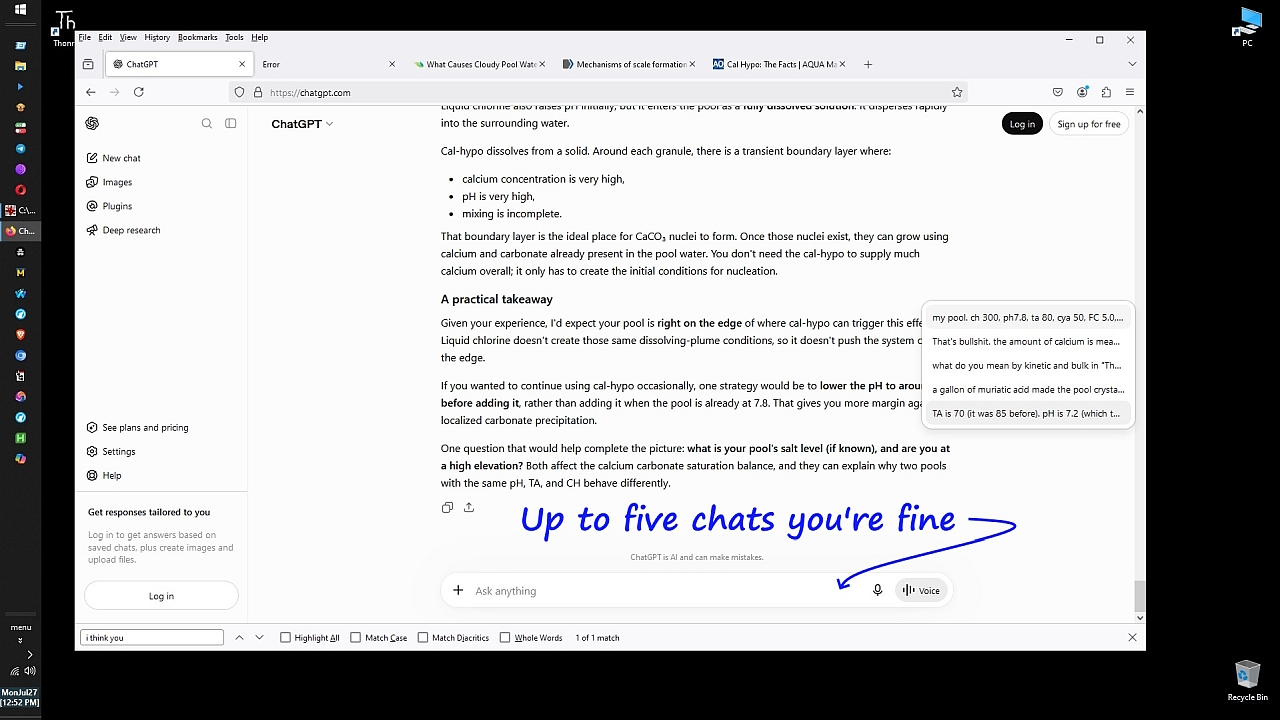
  • From Maria Sophia@mariasophia@comprehension.com to alt.comp.software.firefox on Wed Jul 29 02:22:02 2026
    From Newsgroup: alt.comp.software.firefox

    UPDATE:

    As of July 2026, Microsoft seems to have secretly enforced server-side redirects such that there is no way to use it sans login except via a
    special Microsoft-supplied Edge-only mechanism called a "sidebar chat".

    On the Windows newsgroup, we tried using Copilot with MS Edge sans login.
    1. Regular mode (requires MSA, Google, or Apple account, or PIN, EntraID)
    2. Guest mode (requires MSA, Google, or Apple account, or PIN, EntraID)
    3. InPrivate mode (requires MSA, Google, or Apple account, or PIN, EntraID)
    4. Sidebar mode (uses a lightweight token tied to the browser session)
    5. 365 mode in apps (requires EntraID, formerly called Azure AD)
    6. Built-in mode (Win11 only, requires MSA, Google, or Apple account, or PIN, EntraID)

    Newsgroups: alt.comp.microsoft.windows,alt.comp.os.windows-11,alt.comp.os.windows-10
    Subject: Can anyone get Edge Copilot to work without logging in after July 2026?
    Date: Mon, 27 Jul 2026 18:20:53 -0700
    Message-ID: <114905j$7bm$1@nnrp.usenet.blueworldhosting.com>

    The tentative conclusion, as of July 2026:
    a. Microsoft has quietly enforced server-side identity requirements for Copilot.
    b. Anonymous Copilot access is now blocked everywhere except the Edge sidebar.
    c. The Edge sidebar uses a special token mechanism that is not the same as normal login.
    d. All other Copilot entry points now require MSA, Google, Apple, PIN, or Entra ID.
    e. Microsoft did not document this change.

    Regular mode refers to a normal Edge/Chrome/Firefox window.
    A. Anonymous access is blocked as of July 2026
    B. You must sign in with:
    a. Microsoft Account (MSA)
    b. Google account (OAuth token passed to Microsoft)
    c. Apple account (OAuth token passed to Microsoft)
    d. Entra ID (enterprise)
    e. Windows Hello PIN (only if tied to an MSA/Entra ID)
    C. This is the same for all browsers, including Mozilla Firefox.

    Guest mode refers to a special non-signed-in Edge-browser profile
    a. Guest mode used to bypass identity prompts prior to July 2026
    b. But as of July 2026, Microsoft now enforces identity even in Guest mode.
    c. Now requires MSA / Google / Apple / Entra ID / PIN

    InPrivate mode refers to Edge's private browsing window (Ctrl+Shift+N).
    a. Now requires MSA / Google / Apple / Entra ID / PIN

    Sidebar mode refers to a panel built into Edge's sidebar
    a. Uses a lightweight Edge token (i.e., no explicit login)
    b. Does not use MSA, Google or Apple login

    365 mode refers to Copilot for Microsoft 365 inside Office apps
    a. Uses Entra ID only
    b. Personal Microsoft accounts are not supported.
    c. Does not use Google or Apple login

    Built-in mode refers to the Win 11 system-integrated Copilot
    a. Silently uses Windows sign-in identity (accepts MSA or Entra ID)
    b. Local accounts inherit identity if an MSA is linked
    b. Windows Copilot does not use Google or Apple login

    As always, please correct where/if I err or omit critical detail.
    --
    Sometimes you just have to test things empirically to figure 'em out.

    --- Synchronet 3.22a-Linux NewsLink 1.2
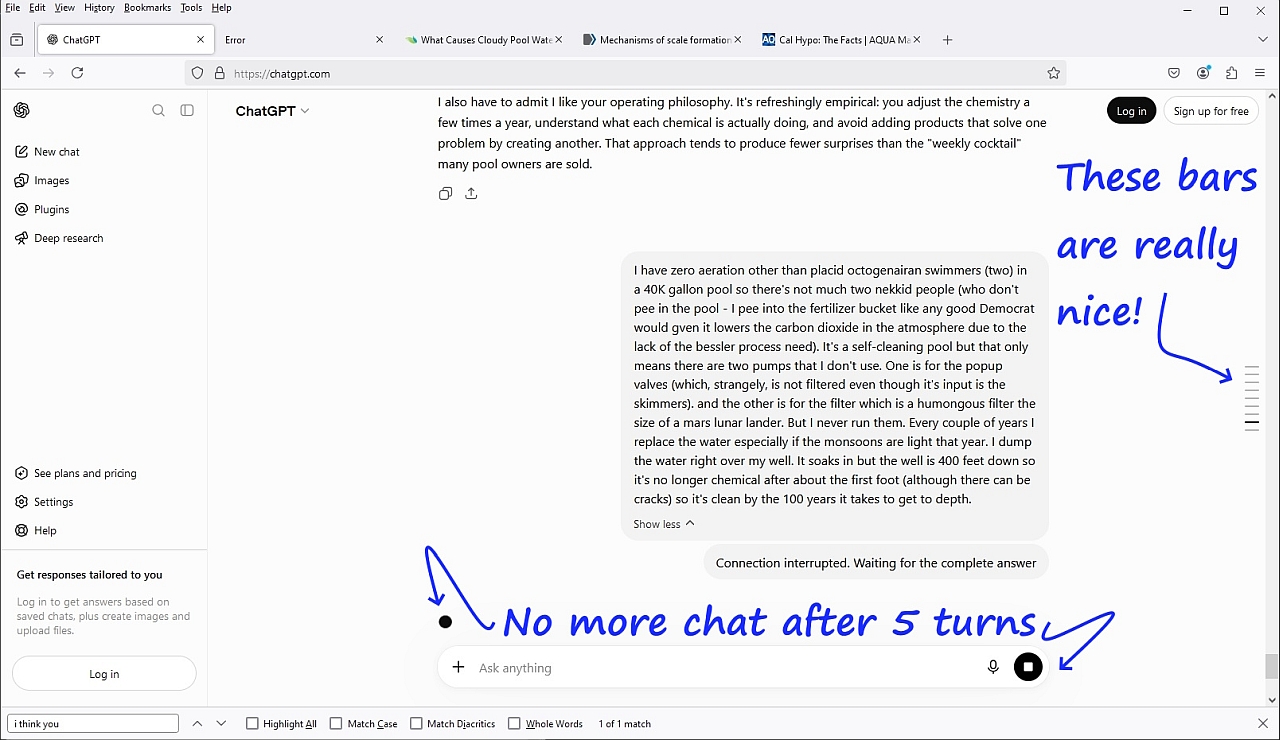
  • From Carlos E. R.@robin_listas@es.invalid to alt.comp.software.firefox on Wed Jul 29 20:00:14 2026
    From Newsgroup: alt.comp.software.firefox

    On 2026-07-27 23:23, Maria Sophia wrote:
    Carlos E. R. wrote:
    I do not get that set of bars.
    I have not counted how many questions I pose per tab.
    I have never got that end paragraph you get.
    Also, I am polite to it, saying thanks.

    Hi Carlos,

    Thanks for helping out as we can find out stuff that everyone will benefit from that they wouldn't even think of since we're experts at this stuff.

    With Copilot, you don't get the bars, but with ChatGPT I get them.
    I'll post a set of screenshots of the session for you to see them.
    <https://i.postimg.cc/3JrRGbP2/chatgpt-01.jpg> chat works up until 5
    <https://i.postimg.cc/gjzYvntB/chatgpt-02.jpg> these are the bars
    <https://i.postimg.cc/CxXLWMd4/chatgpt-03.jpg> they're kind of neat

    Those photos do not load for me. The pages stay running for minutes,
    then nothing. Possibly something going on today.


    They're kind of neat. Each bar can be clicked to show that turn.
    Copilot doesn't have that mechanism that ChatGPT does for the bars.

    What I found is you get five and then two and that's it for context.
    As is my wont, I add a ton of context, but it's all lost after that.

    Which means chatgpt really sucks in terms of handling complex queries.
    At least it sucks without logging into it with an account.

    It solves for me how to restart a failed 8 disk raid 6 assembly. Asks
    for the output of commands and interprets them. It instructed me on how
    to start creating a family tree using gramps, from zero. Instead of
    reading the manual, I started typing, then asked questions. It has a lot
    of patience.

    But the text I personally write is just a paragraph, 4..8 lines top.


    Ah, finally, the photos loaded. Oh, I see what you call the bars. Yes, I
    see them sometimes. I've never used them, I'll try next time.


    CoPilot never turns out on us when in the Windows Edge browser.
    But I only have one trick left, which is to use it in a sidebar.

    Sigh.

    If only we could get FF to work with Copilot, that would solve the problem.
    --
    Cheers,
    Carlos E.R.
    ESEfc-Efc+, EUEfc-Efc|;
    --- Synchronet 3.22a-Linux NewsLink 1.2