• FTTP installation - just sealant on outside wall entry? WAS Re: Sigh. Another powerline adapter fail

    From jkn@jkn+nin@nicorp.co.uk to uk.d-i-y on Thu Jan 8 15:12:08 2026
    From Newsgroup: uk.d-i-y

    Hi all
    This is a followup to some postings in the 'powerline' thread before Christmas. I've started a (brief, I hope) new thread will a bit of a
    followup Q:

    We finally got our FTTP installation done yesterday. This was from a
    telegraph pole. I was previously musing about where to get the ONT
    situation; I decided to put in the 'obvious place' on the ground floor
    (with a power socket nearby) and run a CAT6 cable to the router etc.
    upstairs.

    FWIW I was moderately happy with the way the installation went. I
    drilled the hole for the cable myself from the outside, to avoid the
    spalling I have seen nearby and after discussion with the contractor.
    They lent me a 6mm SDS drill bit to make the pilot hole ;-) (final hole
    was with a 10mm bit).

    I could have done without the bloke fastening an eye bolt (to take the overhead cable) about three feet to the right of the obvious place,
    which was right next to the downpipe where we had agreed the fibre cable
    would run down, but there you go. He moved it without complaint, but I
    don't like random holes being drilled for no good reason.

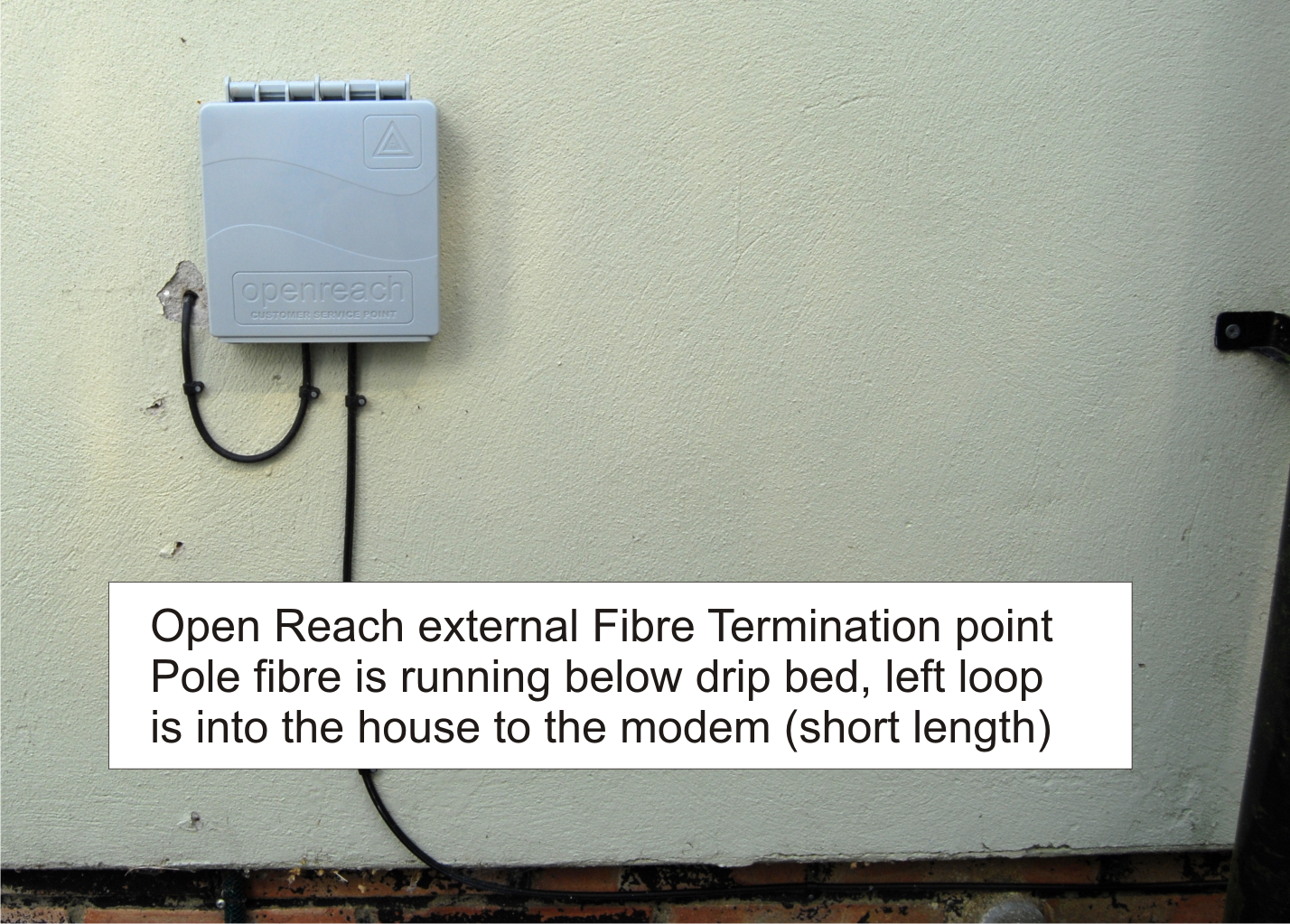
    Anyway ... my question is simply... is it usual for the fibre to enter
    the wall (after the drip loop) with only a sealant used, and no cover?

    I was expecting a small plastic cover piece, possibly called a CLI.
    There is something like that fitted on the *inside*, but not on the outside.

    From my reading of the installation guidelines I am not sure this is to
    spec. I would appreciate any comments.

    Thanks & Regards
    J^n

    --- Synchronet 3.21a-Linux NewsLink 1.2
  • From David Wade@dave@is.invalid to uk.d-i-y on Thu Jan 8 16:53:51 2026
    From Newsgroup: uk.d-i-y

    On 08/01/2026 16:12, jkn wrote:
    Hi all
    -a-a-a-aThis is a followup to some postings in the 'powerline' thread before Christmas. I've started a (brief, I hope) new thread will a bit
    of a followup Q:

    We finally got our FTTP installation done yesterday. This was from a telegraph pole. I was previously musing about where to get the ONT situation; I decided to put in the 'obvious place' on the ground floor
    (with a power socket nearby) and run a CAT6 cable to the router etc. upstairs.

    FWIW I was moderately happy with the way the installation went. I
    drilled the hole for the cable myself from the outside, to avoid the spalling I have seen nearby and after discussion with the contractor.
    They lent me a 6mm SDS drill bit to make the pilot hole ;-) (final hole
    was with a 10mm bit).

    I could have done without the bloke fastening an eye bolt (to take the overhead cable) about three feet to the right of the obvious place,
    which was right next to the downpipe where we had agreed the fibre cable would run down, but there you go. He moved it without complaint, but I
    don't like random holes being drilled for no good reason.

    Anyway ... my question is simply... is it usual for the fibre to enter
    the wall (after the drip loop) with only a sealant used, and no cover?


    Yes, they just use sealant..


    I was expecting a small plastic cover piece, possibly called a CLI.
    There is something like that fitted on the *inside*, but not on the
    outside.

    The box is I think a CSP or customer splice point. Its purpose is to
    protect the joint between the external grade fibre and the internal
    grade that feeds the ONT, not to cover the entry point. Its a grey box,
    I guess 3" or 4" square.

    It appears that they do sometimes fit these inside. It just means if
    your drop fibre from the pole is damaged they need access to your house
    to replace.


    From my reading of the installation guidelines I am not sure this is to spec. I would appreciate any comments.

    -a-a-a Thanks & Regards
    -a-a-a J^n


    Dave
    --- Synchronet 3.21a-Linux NewsLink 1.2
  • From The Natural Philosopher@tnp@invalid.invalid to uk.d-i-y on Thu Jan 8 17:54:51 2026
    From Newsgroup: uk.d-i-y

    On 08/01/2026 15:12, jkn wrote:
    Hi all
    -a-a-a-aThis is a followup to some postings in the 'powerline' thread before Christmas. I've started a (brief, I hope) new thread will a bit
    of a followup Q:

    We finally got our FTTP installation done yesterday. This was from a telegraph pole. I was previously musing about where to get the ONT situation; I decided to put in the 'obvious place' on the ground floor
    (with a power socket nearby) and run a CAT6 cable to the router etc. upstairs.

    FWIW I was moderately happy with the way the installation went. I
    drilled the hole for the cable myself from the outside, to avoid the spalling I have seen nearby and after discussion with the contractor.
    They lent me a 6mm SDS drill bit to make the pilot hole ;-) (final hole
    was with a 10mm bit).

    I could have done without the bloke fastening an eye bolt (to take the overhead cable) about three feet to the right of the obvious place,
    which was right next to the downpipe where we had agreed the fibre cable would run down, but there you go. He moved it without complaint, but I
    don't like random holes being drilled for no good reason.

    Anyway ... my question is simply... is it usual for the fibre to enter
    the wall (after the drip loop) with only a sealant used, and no cover?

    I was expecting a small plastic cover piece, possibly called a CLI.
    There is something like that fitted on the *inside*, but not on the
    outside.

    From my reading of the installation guidelines I am not sure this is to spec. I would appreciate any comments.

    -a-a-a Thanks & Regards
    -a-a-a J^n

    Moine was the same:-

    http://vps.templar.co.uk/FTTP%20installation/5%20OpenReach%20Fibre%20termination.png
    --
    "And if the blind lead the blind, both shall fall into the ditch".

    Gospel of St. Mathew 15:14


    --- Synchronet 3.21a-Linux NewsLink 1.2
  • From jkn@jkn+nin@nicorp.co.uk to uk.d-i-y on Thu Jan 8 18:01:00 2026
    From Newsgroup: uk.d-i-y

    On 08/01/2026 17:54, The Natural Philosopher wrote:
    On 08/01/2026 15:12, jkn wrote:
    Hi all
    -a-a-a-a-aThis is a followup to some postings in the 'powerline' thread
    before Christmas. I've started a (brief, I hope) new thread will a bit
    of a followup Q:

    We finally got our FTTP installation done yesterday. This was from a
    telegraph pole. I was previously musing about where to get the ONT
    situation; I decided to put in the 'obvious place' on the ground floor
    (with a power socket nearby) and run a CAT6 cable to the router etc.
    upstairs.

    FWIW I was moderately happy with the way the installation went. I
    drilled the hole for the cable myself from the outside, to avoid the
    spalling I have seen nearby and after discussion with the contractor.
    They lent me a 6mm SDS drill bit to make the pilot hole ;-) (final
    hole was with a 10mm bit).

    I could have done without the bloke fastening an eye bolt (to take the
    overhead cable) about three feet to the right of the obvious place,
    which was right next to the downpipe where we had agreed the fibre
    cable would run down, but there you go. He moved it without complaint,
    but I don't like random holes being drilled for no good reason.

    Anyway ... my question is simply... is it usual for the fibre to enter
    the wall (after the drip loop) with only a sealant used, and no cover?

    I was expecting a small plastic cover piece, possibly called a CLI.
    There is something like that fitted on the *inside*, but not on the
    outside.

    -aFrom my reading of the installation guidelines I am not sure this is
    to spec. I would appreciate any comments.

    -a-a-a-a Thanks & Regards
    -a-a-a-a J^n

    Moine was the same:-

    http://vps.templar.co.uk/ FTTP%20installation/5%20OpenReach%20Fibre%20termination.png


    OK, thanks to both you and David Wade. I appreciate the use of the CSP/Customer Splicing Point, it was the other bit I meant. I was thinking/hoping that they might use an 'External CLI' as shown on page 1
    of this:

    <https://www.ofsoptics.com/ip-ofs/EPT-COF-D888%20CSP%20Issue%202%2002%2006%2014.pdf>

    (In fact pages 2 and 3 of this PDF show such a part in use)

    I might buy a cap anyway, it looks a bit rough to me as it is.

    Thanks
    J^n

    --- Synchronet 3.21a-Linux NewsLink 1.2
  • From Jeff Layman@Jeff@invalid.invalid to uk.d-i-y on Thu Jan 8 18:05:48 2026
    From Newsgroup: uk.d-i-y

    On 08/01/2026 17:54, The Natural Philosopher wrote:


    Moine was the same:-

    http://vps.templar.co.uk/FTTP%20installation/5%20OpenReach%20Fibre%20termination.png

    I assume that the hole into the house sloped upwards from the outside.
    Does the cable have any silicone sealant on it where it goes through the
    wall?
    --
    Jeff
    --- Synchronet 3.21a-Linux NewsLink 1.2
  • From jkn@jkn+nin@nicorp.co.uk to uk.d-i-y on Thu Jan 8 18:16:45 2026
    From Newsgroup: uk.d-i-y

    On 08/01/2026 18:05, Jeff Layman wrote:
    On 08/01/2026 17:54, The Natural Philosopher wrote:


    Moine was the same:-

    http://vps.templar.co.uk/
    FTTP%20installation/5%20OpenReach%20Fibre%20termination.png

    I assume that the hole into the house sloped upwards from the outside.

    That is a good point - no, it doesn't. I mention in my posting that I
    drilled the hole. I drilled it horizontally to the best of my ability;
    you having reminded me I am a little annoyed that I didn't think to ask
    the engineers this. They saw me drilling the hole FWIW...

    Does the cable have any silicone sealant on it where it goes through the wall?

    Yes, as mentioned.

    I was assuming that one of the points of the 'CLI' (a sort of tube, with
    end cap) was to mechanically protect the cable as it goes through the wall/cavity, and also to prevent any 'mis-behaviour' (leaching/wear etc) between the brick/mortar and cable? Small beer perhaps, but still...

    J^n


    --- Synchronet 3.21a-Linux NewsLink 1.2
  • From John R Walliker@jrwalliker@gmail.com to uk.d-i-y on Thu Jan 8 18:50:30 2026
    From Newsgroup: uk.d-i-y

    On 08/01/2026 18:16, jkn wrote:
    On 08/01/2026 18:05, Jeff Layman wrote:
    On 08/01/2026 17:54, The Natural Philosopher wrote:


    Moine was the same:-

    http://vps.templar.co.uk/
    FTTP%20installation/5%20OpenReach%20Fibre%20termination.png

    I assume that the hole into the house sloped upwards from the outside.

    That is a good point - no, it doesn't. I mention in my posting that I drilled the hole. I drilled it horizontally to the best of my ability;
    you having reminded me I am a little annoyed that I didn't think to ask
    the engineers this. They saw me drilling the hole FWIW...

    Does the cable have any silicone sealant on it where it goes through
    the wall?

    Yes, as mentioned.

    I was assuming that one of the points of the 'CLI' (a sort of tube, with
    end cap) was to mechanically protect the cable as it goes through the wall/cavity, and also to prevent any 'mis-behaviour' (leaching/wear etc) between the brick/mortar and cable? Small beer perhaps, but still...

    The fibre cable is incredibly robust.
    John

    --- Synchronet 3.21a-Linux NewsLink 1.2
  • From The Natural Philosopher@tnp@invalid.invalid to uk.d-i-y on Thu Jan 8 18:57:21 2026
    From Newsgroup: uk.d-i-y

    On 08/01/2026 18:05, Jeff Layman wrote:
    On 08/01/2026 17:54, The Natural Philosopher wrote:


    Moine was the same:-

    http://vps.templar.co.uk/FTTP%20installation/5%20OpenReach%20Fibre%20termination.png

    I assume that the hole into the house sloped upwards from the outside.
    Does the cable have any silicone sealant on it where it goes through the wall?


    I patched it with mortar on the outside and filler on the inside.

    There has been no problem

    I think it was s,loped up,. but in my case it doesnt matter,.
    The cross section of the wall is paint-render-mesh-airgap-waterproof plywood-insulation-plasterboard.

    The airgap has a gap at the wall base to let any water out
    --
    rCLIdeas are inherently conservative. They yield not to the attack of
    other ideas but to the massive onslaught of circumstance"

    - John K Galbraith


    --- Synchronet 3.21a-Linux NewsLink 1.2
  • From alan_m@junk@admac.myzen.co.uk to uk.d-i-y on Thu Jan 8 19:15:22 2026
    From Newsgroup: uk.d-i-y

    On 08/01/2026 17:54, The Natural Philosopher wrote:


    Moine was the same:-

    http://vps.templar.co.uk/ FTTP%20installation/5%20OpenReach%20Fibre%20termination.png


    Snap (except my outside box is brown). Mine has no sealant on the
    outside and a plastic hole cover on the inside. When the wind is in the
    wrong direct I get a small amount of brick dust on the inside. This
    reminds me to apply a small amount of sealant on the outside.
    --
    mailto : news {at} admac {dot} myzen {dot} co {dot} uk
    --- Synchronet 3.21a-Linux NewsLink 1.2
  • From jkn@jkn+nin@nicorp.co.uk to uk.d-i-y on Thu Jan 8 21:15:12 2026
    From Newsgroup: uk.d-i-y

    On 08/01/2026 18:50, John R Walliker wrote:
    On 08/01/2026 18:16, jkn wrote:
    On 08/01/2026 18:05, Jeff Layman wrote:
    On 08/01/2026 17:54, The Natural Philosopher wrote:


    Moine was the same:-

    http://vps.templar.co.uk/
    FTTP%20installation/5%20OpenReach%20Fibre%20termination.png

    I assume that the hole into the house sloped upwards from the outside.

    That is a good point - no, it doesn't. I mention in my posting that I
    drilled the hole. I drilled it horizontally to the best of my ability;
    you having reminded me I am a little annoyed that I didn't think to
    ask the engineers this. They saw me drilling the hole FWIW...

    Does the cable have any silicone sealant on it where it goes through
    the wall?

    Yes, as mentioned.

    I was assuming that one of the points of the 'CLI' (a sort of tube,
    with end cap) was to mechanically protect the cable as it goes through
    the wall/cavity, and also to prevent any 'mis-behaviour'
    (leaching/wear etc) between the brick/mortar and cable? Small beer
    perhaps, but still...

    The fibre cable is incredibly robust.

    Understood - but in that case why make these CLI parts?

    Anyway, it seems that it is fairly common practice and has almost
    certainly been 'done to code', so I will just put some sort of cover on
    it to satisfy my own aesthetic. Thanks all

    J^n

    John


    --- Synchronet 3.21a-Linux NewsLink 1.2
  • From David Wade@dave@is.invalid to uk.d-i-y on Fri Jan 9 12:15:15 2026
    From Newsgroup: uk.d-i-y

    On 08/01/2026 22:15, jkn wrote:
    On 08/01/2026 18:50, John R Walliker wrote:
    On 08/01/2026 18:16, jkn wrote:
    On 08/01/2026 18:05, Jeff Layman wrote:
    On 08/01/2026 17:54, The Natural Philosopher wrote:


    Moine was the same:-

    http://vps.templar.co.uk/
    FTTP%20installation/5%20OpenReach%20Fibre%20termination.png

    I assume that the hole into the house sloped upwards from the outside.

    That is a good point - no, it doesn't. I mention in my posting that I
    drilled the hole. I drilled it horizontally to the best of my
    ability; you having reminded me I am a little annoyed that I didn't
    think to ask the engineers this. They saw me drilling the hole FWIW...

    Does the cable have any silicone sealant on it where it goes through
    the wall?

    Yes, as mentioned.

    I was assuming that one of the points of the 'CLI' (a sort of tube,
    with end cap) was to mechanically protect the cable as it goes
    through the wall/cavity, and also to prevent any 'mis-
    behaviour' (leaching/wear etc) between the brick/mortar and cable?
    Small beer perhaps, but still...

    The fibre cable is incredibly robust.

    Understood - but in that case why make these CLI parts?


    There are many different types of wall. If its brick/breeze block
    combination, fairly common on newer builds, with large cavities you may
    need the conduit to thread the fibre through. Also in rural older homes
    you might encounter rubble infill, which would be a real swine to sort.


    Anyway, it seems that it is fairly common practice and has almost
    certainly been 'done to code', so I will just put some sort of cover-a on
    it to satisfy my own aesthetic. Thanks all


    Wandering round my local area I don't think I have seen any
    installations with a CLI.


    -a-a-a J^n

    John


    Dave
    Dave
    --- Synchronet 3.21a-Linux NewsLink 1.2
  • From Peter Johnson@peter@parksidewood.nospam to uk.d-i-y on Fri Jan 9 17:20:05 2026
    From Newsgroup: uk.d-i-y

    On Thu, 8 Jan 2026 21:15:12 +0000, jkn <jkn+nin@nicorp.co.uk> wrote:


    Understood - but in that case why make these CLI parts?

    They are not exclusively for fibre
    --- Synchronet 3.21a-Linux NewsLink 1.2
  • From Nick Finnigan@nix@genie.co.uk to uk.d-i-y on Sat Jan 10 11:06:29 2026
    From Newsgroup: uk.d-i-y

    On 08/01/2026 15:12, jkn wrote:

    Anyway ... my question is simply... is it usual for the fibre to enter the wall (after the drip loop) with only a sealant used, and no cover?

    My FTTP was installed yesterday by 'MT Quinn openreach', with a grey box outside close to the hole through the wall. The hole has just sealant on
    the outside, just covered by the ONT on the inside.

    Initially a red LOS light, rebooting did not fix that, shining a light
    into the fibre from inside showed up outside. The installer said that sometimes climbing up the pole and shaking something fixes it.

    Somehow he managed to get rid of the red light, and move on to a flashing green PON light. He then needed to call someone to run diagnostics, so he
    had a long wait on hold outside where there is some mobile phone signal.

    Diagnostics can't see the ONT, script say to try another one. He did
    that, went outside to wait on hold again; still can't see the ONT, script still says to try another ONT.

    So I'm a failed install, still with FTTC, and an engineer with more tools will have to go up the pole sometime.

    --- Synchronet 3.21a-Linux NewsLink 1.2