• Re: Electric vehicles (seasonal rambling)

    From Indy Jess John@bathwatchdog@OMITTHISgooglemail.com to uk.d-i-y on Wed Dec 31 13:25:35 2025
    From Newsgroup: uk.d-i-y

    On 26/12/2025 19:28, The Natural Philosopher wrote:
    On 26/12/2025 18:28, Tim+ wrote:
    Have you considered why a gearbox is necessary with an IC engine?
    Electric
    motor simply donrCOt need one.

    They do, but they can start from rest so need no clutch to start.

    My first ever car was a Standard 10 (1957 model with "Standrive" 2-pedal control - just accelerator and brake) and it did have a clutch but it
    was normally disconnected by springs at tick-over and it engaged using centrifugal weights to force the clutch to engage as the engine speed increased. It had a electric switch on the gear lever so that it used
    engine vacuum to force the clutch to disengage as I held the knob to
    change gear. It was a clever fully manual automatic approach to
    driving. Luxury cars of a similar vintage had a pre-selector gearbox
    and fluid flywheel arrangement which was also a clutchless arrangement
    with manual gear selection. The answers to zero to above tick-over
    starting in a manual gearbox ICE without the driver using a clutch pedal
    are about 70 years old, though nobody uses them any more.

    Away from cars but continuing the assumption that the programmer knows
    better than the driver what is best, I remember a plane crash at a air
    show. The pilot in a latest model of an aircraft was demonstrating what
    it could do, and did a manoeuvre close to the ground then went for full
    power to get height to clear the trees he was heading towards. The
    plane's software reduced the engine power in the interests of fuel
    economy and the plane hit the trees. One scene of wrecked plane, dead
    pilot and spilled fuel all because the plane manufacturer had given the programmer's decision priority over the pilot's requirement.

    --- Synchronet 3.21a-Linux NewsLink 1.2
  • From Tim+@timdownieuk@yahoo.co.youkay to uk.d-i-y on Wed Dec 31 13:54:24 2025
    From Newsgroup: uk.d-i-y

    Indy Jess John <bathwatchdog@OMITTHISgooglemail.com> wrote:
    On 26/12/2025 19:28, The Natural Philosopher wrote:
    On 26/12/2025 18:28, Tim+ wrote:
    Have you considered why a gearbox is necessary with an IC engine?
    Electric
    motor simply donrCOt need one.

    They do, but they can start from rest so need no clutch to start.

    My first ever car was a Standard 10 (1957 model with "Standrive" 2-pedal control - just accelerator and brake) and it did have a clutch but it
    was normally disconnected by springs at tick-over and it engaged using centrifugal weights to force the clutch to engage as the engine speed increased. It had a electric switch on the gear lever so that it used engine vacuum to force the clutch to disengage as I held the knob to
    change gear. It was a clever fully manual automatic approach to
    driving. Luxury cars of a similar vintage had a pre-selector gearbox
    and fluid flywheel arrangement which was also a clutchless arrangement
    with manual gear selection. The answers to zero to above tick-over
    starting in a manual gearbox ICE without the driver using a clutch pedal
    are about 70 years old, though nobody uses them any more.

    Away from cars but continuing the assumption that the programmer knows better than the driver what is best, I remember a plane crash at a air
    show. The pilot in a latest model of an aircraft was demonstrating what
    it could do, and did a manoeuvre close to the ground then went for full power to get height to clear the trees he was heading towards. The
    plane's software reduced the engine power in the interests of fuel
    economy and the plane hit the trees. One scene of wrecked plane, dead
    pilot and spilled fuel all because the plane manufacturer had given the programmer's decision priority over the pilot's requirement.


    Hmmm, sounds like an urban legend. Can you recall when or where this is supposed to have occurred? It should be possible to find the original
    accident report online.

    Tim
    --
    Please don't feed the trolls
    --- Synchronet 3.21a-Linux NewsLink 1.2
  • From The Natural Philosopher@tnp@invalid.invalid to uk.d-i-y on Wed Dec 31 14:25:18 2025
    From Newsgroup: uk.d-i-y

    On 31/12/2025 13:54, Tim+ wrote:
    Hmmm, sounds like an urban legend. Can you recall when or where this is supposed to have occurred? It should be possible to find the original accident report online.

    IIRC it was an early Airbus of some sort. TOGA power was restricted in
    spoolup or something. I cant recall more than that.
    --
    Microsoft : the best reason to go to Linux that ever existed.

    --- Synchronet 3.21a-Linux NewsLink 1.2
  • From Theo@theom+news@chiark.greenend.org.uk to uk.d-i-y on Wed Dec 31 14:43:02 2025
    From Newsgroup: uk.d-i-y

    The Natural Philosopher <tnp@invalid.invalid> wrote:
    On 31/12/2025 13:54, Tim+ wrote:
    Hmmm, sounds like an urban legend. Can you recall when or where this is supposed to have occurred? It should be possible to find the original accident report online.

    IIRC it was an early Airbus of some sort. TOGA power was restricted in spoolup or something. I cant recall more than that.

    https://en.wikipedia.org/wiki/Air_France_Flight_296Q
    perhaps?

    Nothing to do with fuel economy though - they were intentionally operating
    the aircraft below its stall speed in order to demonstrate the computer protection. In this case the pilot pulled up which would have caused a
    stall - the computer prevented that, but there was not enough time for the engines to spool up to give climb thrust before they ran into the trees.
    Had the computer not been active they would have stalled and fallen onto
    the trees anyway.

    The Airbus stall protection has saved a great number of lives, including the 'Miracle on the Hudson'.

    Theo
    --- Synchronet 3.21a-Linux NewsLink 1.2
  • From Andy Burns@usenet@andyburns.uk to uk.d-i-y on Wed Dec 31 14:44:03 2025
    From Newsgroup: uk.d-i-y

    The Natural Philosopher wrote:

    Tim+ wrote:
    Hmmm, sounds like an urban legend.-a Can you recall when or where this is
    supposed to have occurred? It should be possible to find the original
    accident report online.

    IIRC it was an early Airbus of some sort. TOGA power was restricted in spoolup or something. I cant recall more than that.

    Possibly this one?

    <https://en.wikipedia.org/wiki/Air_France_Flight_296Q>
    --- Synchronet 3.21a-Linux NewsLink 1.2
  • From The Natural Philosopher@tnp@invalid.invalid to uk.d-i-y on Wed Dec 31 15:04:43 2025
    From Newsgroup: uk.d-i-y

    On 31/12/2025 14:43, Theo wrote:
    The Natural Philosopher <tnp@invalid.invalid> wrote:
    On 31/12/2025 13:54, Tim+ wrote:
    Hmmm, sounds like an urban legend. Can you recall when or where this is >>> supposed to have occurred? It should be possible to find the original
    accident report online.

    IIRC it was an early Airbus of some sort. TOGA power was restricted in
    spoolup or something. I cant recall more than that.

    https://en.wikipedia.org/wiki/Air_France_Flight_296Q
    perhaps?

    Nothing to do with fuel economy though - they were intentionally operating the aircraft below its stall speed in order to demonstrate the computer protection. In this case the pilot pulled up which would have caused a
    stall - the computer prevented that, but there was not enough time for the engines to spool up to give climb thrust before they ran into the trees.
    Had the computer not been active they would have stalled and fallen onto
    the trees anyway.

    The Airbus stall protection has saved a great number of lives, including the 'Miracle on the Hudson'.

    Theo
    That's what I recall, yes.
    No idea if it is that to which Tim+ refers...
    --
    The higher up the mountainside
    The greener grows the grass.
    The higher up the monkey climbs
    The more he shows his arse.

    Traditional

    --- Synchronet 3.21a-Linux NewsLink 1.2
  • From Indy Jess John@bathwatchdog@OMITTHISgooglemail.com to uk.d-i-y on Thu Jan 1 20:29:07 2026
    From Newsgroup: uk.d-i-y

    On 31/12/2025 13:54, Tim+ wrote:
    Indy Jess John <bathwatchdog@OMITTHISgooglemail.com> wrote:
    On 26/12/2025 19:28, The Natural Philosopher wrote:
    On 26/12/2025 18:28, Tim+ wrote:
    Have you considered why a gearbox is necessary with an IC engine?
    Electric
    motor simply donrCOt need one.

    They do, but they can start from rest so need no clutch to start.

    My first ever car was a Standard 10 (1957 model with "Standrive" 2-pedal
    control - just accelerator and brake) and it did have a clutch but it
    was normally disconnected by springs at tick-over and it engaged using
    centrifugal weights to force the clutch to engage as the engine speed
    increased. It had a electric switch on the gear lever so that it used
    engine vacuum to force the clutch to disengage as I held the knob to
    change gear. It was a clever fully manual automatic approach to
    driving. Luxury cars of a similar vintage had a pre-selector gearbox
    and fluid flywheel arrangement which was also a clutchless arrangement
    with manual gear selection. The answers to zero to above tick-over
    starting in a manual gearbox ICE without the driver using a clutch pedal
    are about 70 years old, though nobody uses them any more.

    Away from cars but continuing the assumption that the programmer knows
    better than the driver what is best, I remember a plane crash at a air
    show. The pilot in a latest model of an aircraft was demonstrating what
    it could do, and did a manoeuvre close to the ground then went for full
    power to get height to clear the trees he was heading towards. The
    plane's software reduced the engine power in the interests of fuel
    economy and the plane hit the trees. One scene of wrecked plane, dead
    pilot and spilled fuel all because the plane manufacturer had given the
    programmer's decision priority over the pilot's requirement.


    Hmmm, sounds like an urban legend. Can you recall when or where this is supposed to have occurred? It should be possible to find the original accident report online.

    Tim

    I am remembering a short news report broadcast many years ago so I know
    it was a real crash, I just don't remember when. I did a search for
    "air show crashes" and was offered an enormous list of them, each with a thumbnail description. After nearly 2 hours of ploughing through the
    list I found one that sort of meets the broadcast description of the
    crash. At least it is sufficient to lift it out of the Urban Legend
    category.
    1988, June 26 rCo (Mulhouse, Alsace, France) rCo While performing a gear
    down low speed pass, a chartered Air France Airbus A320 lost altitude
    and crashed into a treeline.

    Looking at the history of the A320, it was the first Fly-By-Wire
    passenger aircraft so it did rely on software interpreting the pilot's intentions as signalled by the controls. The first A320 was delivered
    to Air France on 28 March 1988 and began commercial service on 8 April
    1988, so it would have still been regarded as the latest model in June
    1988. 16 of the initial order of 25 had been delivered by the end of 1988.

    Jim

    --- Synchronet 3.21a-Linux NewsLink 1.2
  • From Theo@theom+news@chiark.greenend.org.uk to uk.d-i-y on Fri Jan 2 12:46:52 2026
    From Newsgroup: uk.d-i-y

    Indy Jess John <bathwatchdog@omitthisgooglemail.com> wrote:
    On 31/12/2025 13:54, Tim+ wrote:

    Hmmm, sounds like an urban legend. Can you recall when or where this is supposed to have occurred? It should be possible to find the original accident report online.

    I am remembering a short news report broadcast many years ago so I know
    it was a real crash, I just don't remember when. I did a search for
    "air show crashes" and was offered an enormous list of them, each with a thumbnail description. After nearly 2 hours of ploughing through the
    list I found one that sort of meets the broadcast description of the
    crash. At least it is sufficient to lift it out of the Urban Legend category.
    1988, June 26 rCo (Mulhouse, Alsace, France) rCo While performing a gear down low speed pass, a chartered Air France Airbus A320 lost altitude
    and crashed into a treeline.

    Looking at the history of the A320, it was the first Fly-By-Wire
    passenger aircraft so it did rely on software interpreting the pilot's intentions as signalled by the controls. The first A320 was delivered
    to Air France on 28 March 1988 and began commercial service on 8 April
    1988, so it would have still been regarded as the latest model in June
    1988. 16 of the initial order of 25 had been delivered by the end of 1988.

    So that's the Air France flight mentioned upthread: https://en.wikipedia.org/wiki/Air_France_Flight_296Q

    I think the 'fuel economy' part is Chinese whispers though. I'm not a pilot but AFAIK there is no situation in which the throttle controls are
    overridden by the computers. If you turn on autothrottle then the computer will move the thrust levers for you, but you can always move them
    manually to override it, in other words the pilot is always in command.

    Pilots regularly perform takeoffs are less than maximum thrust, for fuel consumption and noise reasons, but that is a calculated figure based on the conditions. The full thrust is always available to them if required.

    In this case the pilot had deliberately set the throttle *way too low* for demonstration purposes. If you watch the crash footage: https://www.youtube.com/watch?v=9zY2hz2K4UM

    you can see the aircraft is moving slowly with a quite high angle of attack. At 0:14 the aircraft is square on to the camera and you can measure it off
    the video - it's 15 degrees. In a low speed condition that's very close to stalling. It is likely that that was the maximum the stall protection
    computer would allow.

    The pilot noticed they were approaching the trees and commanded thrust. At about 0:17 you can hear the engines start to spool up, but that takes about
    5 seconds. At 0:20 the aircraft made contact with the trees, the engines ingested foliage and game over.

    The pilot said they commanded takeoff thrust and nothing happened. But jet engines are big heavy spinning things and changes take time to happen.
    There wasn't enough time here. Perhaps time seemed longer in a panic
    scenario?

    In other situations, if GPWS gives you a TERRAIN, TERRAIN, PULL UP! alert the 'terrain escape manouevre' is to apply maximum thrust and pull up, but you
    have to understand that pulling up is only going to be allowed within the flight envelope which depends on your current airspeed. If you don't have airspeed, pulling up too much would cause a stall and you'd fall out of the
    sky - the last thing you want when you are close to the ground.

    Theo
    --- Synchronet 3.21a-Linux NewsLink 1.2
  • From The Natural Philosopher@tnp@invalid.invalid to uk.d-i-y on Fri Jan 2 13:09:25 2026
    From Newsgroup: uk.d-i-y

    On 02/01/2026 12:46, Theo wrote:
    The pilot said they commanded takeoff thrust and nothing happened.
    But jet engines are big heavy spinning things and changes take time
    to happen. There wasn't enough time here. Perhaps time seemed longer
    in a panic scenario?

    At least one Bristol Blenheim was written off recently by ramming the
    throttles open to get full air but then starving the engines of fuel.

    I don't know what happens if you overfuel a big bypass jet at low RPM. I imagine the TOGA spool up parameters were set not to fuel efficiency,
    but to prevent compressor stall or explosions.

    Google's AI says:

    In modern aircraft,
    ============
    Full Authority Digital Engine Control (FADEC) system acts as an
    intermediary between the pilot and the engine.

    Computer-Managed Acceleration: Even if you "slam" the throttle
    forward, the FADEC ignores the instantaneous command and instead
    calculates the maximum safe rate of fuel increase.

    Protection Systems: The computer monitors dozens of parameters (like
    air density, engine temperatures, and RPM) to ensure the engine
    accelerates without overheating or stalling.

    Spool-Up Delay: You will experience a "lag" or spool-up time
    (typically a few seconds) because the physical mass of the engine's
    internal rotors must gain inertia before producing full thrust.

    Older Jet Engines (Hydromechanical)
    =======================
    Older engines relied on mechanical linkages and simple fuel control
    units (FCU). Suddenly calling for full throttle on these systems could
    be dangerous:

    Compressor Stall and Surge: If fuel is added faster than the
    compressor can provide air, the combustion chamber pressure can exceed
    the compressor's output pressure. This causes airflow to reverse, often accompanied by loud bangs, flames from the intake or exhaust, and severe vibration.

    Overheating (High EGT): Excessive fuel without immediate airflow
    causes a rapid spike in Exhaust Gas Temperature (EGT). This can melt
    turbine blades or cause catastrophic engine failure within seconds.

    Flameout: Paradoxically, a "rich blow-out" can occur where the sheer volume of fuel displaces oxygen and extinguishes the flame entirely. " --------------------------------------------------------------------------------------------------------------------

    It is possible that this was the first time the pilot used a FADEC under emergency conditions.
    --
    The theory of Communism may be summed up in one sentence: Abolish all
    private property.

    Karl Marx


    --- Synchronet 3.21a-Linux NewsLink 1.2
  • From Theo@theom+news@chiark.greenend.org.uk to uk.d-i-y on Fri Jan 2 20:29:51 2026
    From Newsgroup: uk.d-i-y

    The Natural Philosopher <tnp@invalid.invalid> wrote:
    On 02/01/2026 12:46, Theo wrote:
    The pilot said they commanded takeoff thrust and nothing happened.
    But jet engines are big heavy spinning things and changes take time
    to happen. There wasn't enough time here. Perhaps time seemed longer
    in a panic scenario?

    At least one Bristol Blenheim was written off recently by ramming the throttles open to get full air but then starving the engines of fuel.

    I don't know what happens if you overfuel a big bypass jet at low RPM. I imagine the TOGA spool up parameters were set not to fuel efficiency,
    but to prevent compressor stall or explosions.

    Nothing happens. Or rather, nothing bad happens. Anything with a high
    bypass turbofan (post-1960s) will have electronic control, and that will
    make sure the engine is operating within safe parameters. If you ask for maximum thrust it'll give what it can, but not what it can't.

    Just like flooring it in a modern car won't cause the engine to die through
    an over-rich mixture - the accelerator pedal is just an input to the ECU and the ECU won't let you command unsafe mixtures.

    Theo
    --- Synchronet 3.21a-Linux NewsLink 1.2
  • From Abandoned Trolley@that.bloke@microsoft.com to uk.d-i-y on Fri Jan 2 23:32:52 2026
    From Newsgroup: uk.d-i-y


    Just like flooring it in a modern car won't cause the engine to die through an over-rich mixture - the accelerator pedal is just an input to the ECU and the ECU won't let you command unsafe mixtures.

    Theo


    And in older cars it might not cause the engine to die.

    If the throttle plate is jammed open then theres no chance of an
    over-rich mixture
    --- Synchronet 3.21a-Linux NewsLink 1.2
  • From Chris J Dixon@chris@cdixon.me.uk to uk.d-i-y on Sat Jan 3 09:47:27 2026
    From Newsgroup: uk.d-i-y

    Theo wrote:

    Andrew <Andrew97d@btinternet.com> wrote:

    Some people here will have travelled on the Tube in LOndon
    in the 60's and 70's and remember the way that power was
    applied in steps, whereas the modern tube cars make that
    funny noise which I guess is the from the inverters and
    associated gubbins.

    The Piccadilly and Bakerloo lines still have 1970s stock with DC motors >powered via thyristors with camshaft control, where you go through the >'gears' by changing position on the camshaft.

    Unless there have been changes since build, the camshaft
    progressively switches out sections of a series resistor bank,
    coupled with also switching the 4 motors on a vehicle from "four
    in series" to "two in series, two in parallel". No solid state
    equipment is involved.

    Somewhere in the loft I have some of the calculations I did when
    designing the similar equipment for the now retired BR Class 313.
    That, although able to operate from AC or DC supplies, still used
    a camshaft and resistor for the actual control.

    Chris
    --
    Chris J Dixon Nottingham UK
    chris@cdixon.me.uk @ChrisJDixon1

    Plant amazing Acers.
    --- Synchronet 3.21a-Linux NewsLink 1.2
  • From Chris J Dixon@chris@cdixon.me.uk to uk.d-i-y on Sat Jan 3 09:50:42 2026
    From Newsgroup: uk.d-i-y

    Paul wrote:

    One speed cars, the max-rpm of the motor prevents achieving
    really high road speed. If I need to hit 160km/hr to make a pass on a long >straight stretch before the next hill arrives, I expect my car
    to be able to do that speed. If the car will barely do 120km/hr,
    that is a marketing deal-breaker for "people who hate BEV".
    It's just one more thing to point to. I can pull out in my BEV,
    but never pass.

    There is the electric motor curve in Fig.13 here at the bottom.
    Constant torque at low speed, constant power at higher speed
    (with the torque dropping the faster you go). Maybe it's more
    likely that an econobox can benefit from a 2 speed (for eff&range).

    https://www.geartechnology.com/how-many-speed-ratios-for-electric-cars-one-example

    Summary: The message here, is to always check the top speed of the
    BEV you have your eye on, then review the driving habits of
    the local populace, to see where you'll end up on the road
    by driving with any "limitations".

    For example, your econobox-BEV has 0-60 of 14 seconds.
    Can you safely merge into traffic using a short merge lane
    with your shiny new BEV ? The roads were designed with some
    "theoretical car" as a model. Maybe 8 seconds was the target value.

    There are "city cars" that aren't real candidates for usage here,
    because some of the roads will have speeds where the vehicle
    can't keep up. Your "city" becomes a relatively small island.

    Paul

    Horses for courses. My partner's Nissan Leaf has all the
    performance I will ever need or desire.

    Chris
    --
    Chris J Dixon Nottingham UK
    chris@cdixon.me.uk @ChrisJDixon1

    Plant amazing Acers.
    --- Synchronet 3.21a-Linux NewsLink 1.2
  • From The Other John@nomail@here.org to uk.d-i-y on Sat Jan 3 10:56:13 2026
    From Newsgroup: uk.d-i-y

    On 03/01/2026 09:50, Chris J Dixon wrote:
    Horses for courses. My partner's Nissan Leaf has all the
    performance I will ever need or desire.

    I love my Leaf too!
    --
    TOJ
    --- Synchronet 3.21a-Linux NewsLink 1.2
  • From The Natural Philosopher@tnp@invalid.invalid to uk.d-i-y on Sat Jan 3 10:58:36 2026
    From Newsgroup: uk.d-i-y

    On 03/01/2026 09:50, Chris J Dixon wrote:
    Paul wrote:

    One speed cars, the max-rpm of the motor prevents achieving
    really high road speed. If I need to hit 160km/hr to make a pass on a long >> straight stretch before the next hill arrives, I expect my car
    to be able to do that speed. If the car will barely do 120km/hr,
    that is a marketing deal-breaker for "people who hate BEV".
    It's just one more thing to point to. I can pull out in my BEV,
    but never pass.

    There is the electric motor curve in Fig.13 here at the bottom.
    Constant torque at low speed, constant power at higher speed
    (with the torque dropping the faster you go). Maybe it's more
    likely that an econobox can benefit from a 2 speed (for eff&range).

    https://www.geartechnology.com/how-many-speed-ratios-for-electric-cars-one-example

    Summary: The message here, is to always check the top speed of the
    BEV you have your eye on, then review the driving habits of
    the local populace, to see where you'll end up on the road
    by driving with any "limitations".

    For example, your econobox-BEV has 0-60 of 14 seconds.
    Can you safely merge into traffic using a short merge lane
    with your shiny new BEV ? The roads were designed with some
    "theoretical car" as a model. Maybe 8 seconds was the target value. >>
    There are "city cars" that aren't real candidates for usage here, >> because some of the roads will have speeds where the vehicle
    can't keep up. Your "city" becomes a relatively small island.

    Paul

    Horses for courses. My partner's Nissan Leaf has all the
    performance I will ever need or desire.

    And in the end that is the key takeway. You trade a bit of efficiency
    and top speed for lower cost.

    An electric motor does not deliver full power at low speed. If that is acceptable, fair enough


    Chris
    --
    When plunder becomes a way of life for a group of men in a society, over
    the course of time they create for themselves a legal system that
    authorizes it and a moral code that glorifies it.

    Fr|-d|-ric Bastiat

    --- Synchronet 3.21a-Linux NewsLink 1.2
  • From Jeff Layman@Jeff@invalid.invalid to uk.d-i-y on Sat Jan 3 15:16:38 2026
    From Newsgroup: uk.d-i-y

    On 02/01/2026 23:32, Abandoned Trolley wrote:


    Just like flooring it in a modern car won't cause the engine to die through >> an over-rich mixture - the accelerator pedal is just an input to the ECU and >> the ECU won't let you command unsafe mixtures.

    Theo


    And in older cars it might not cause the engine to die.

    If the throttle plate is jammed open then theres no chance of an
    over-rich mixture

    Right. It's constant pumping of the accelerator pedal which causes
    flooding. I seem to remember that the easiest way to deal with a flooded engine is to push the pedal right down and hold it there while turning
    the engine over with the starter motor. This eventually clears the
    cylinders of petrol and dries the spark plugs, allowing the engine to fire.

    I'd have thought that with the exhaust system full of a petrol/air
    mixture there could be a fair chance of a "backfire" when the hot
    exhaust meets the mixture. I've never experienced it, though. Has anyone?
    --
    Jeff
    --- Synchronet 3.21a-Linux NewsLink 1.2
  • From Chris Green@cl@isbd.net to uk.d-i-y on Sat Jan 3 15:32:00 2026
    From Newsgroup: uk.d-i-y

    Jeff Layman <Jeff@invalid.invalid> wrote:
    On 02/01/2026 23:32, Abandoned Trolley wrote:


    Just like flooring it in a modern car won't cause the engine to die through
    an over-rich mixture - the accelerator pedal is just an input to the ECU and
    the ECU won't let you command unsafe mixtures.

    Theo


    And in older cars it might not cause the engine to die.

    If the throttle plate is jammed open then theres no chance of an
    over-rich mixture

    Right. It's constant pumping of the accelerator pedal which causes
    flooding.

    It's only on some types of carburretor that pumping the accelerator
    pedal causes flooding.
    --
    Chris Green
    -+
    --- Synchronet 3.21a-Linux NewsLink 1.2
  • From Indy Jess John@bathwatchdog@OMITTHISgooglemail.com to uk.d-i-y on Sat Jan 3 15:42:45 2026
    From Newsgroup: uk.d-i-y

    On 02/01/2026 12:46, Theo wrote:
    Indy Jess John <bathwatchdog@omitthisgooglemail.com> wrote:
    On 31/12/2025 13:54, Tim+ wrote:

    Hmmm, sounds like an urban legend. Can you recall when or where this is >>> supposed to have occurred? It should be possible to find the original
    accident report online.

    I am remembering a short news report broadcast many years ago so I know
    it was a real crash, I just don't remember when. I did a search for
    "air show crashes" and was offered an enormous list of them, each with a
    thumbnail description. After nearly 2 hours of ploughing through the
    list I found one that sort of meets the broadcast description of the
    crash. At least it is sufficient to lift it out of the Urban Legend
    category.
    1988, June 26 rCo (Mulhouse, Alsace, France) rCo While performing a gear
    down low speed pass, a chartered Air France Airbus A320 lost altitude
    and crashed into a treeline.

    Looking at the history of the A320, it was the first Fly-By-Wire
    passenger aircraft so it did rely on software interpreting the pilot's
    intentions as signalled by the controls. The first A320 was delivered
    to Air France on 28 March 1988 and began commercial service on 8 April
    1988, so it would have still been regarded as the latest model in June
    1988. 16 of the initial order of 25 had been delivered by the end of 1988.

    So that's the Air France flight mentioned upthread: https://en.wikipedia.org/wiki/Air_France_Flight_296Q

    I think the 'fuel economy' part is Chinese whispers though. I'm not a pilot but AFAIK there is no situation in which the throttle controls are
    overridden by the computers. If you turn on autothrottle then the computer will move the thrust levers for you, but you can always move them
    manually to override it, in other words the pilot is always in command.

    Pilots regularly perform takeoffs are less than maximum thrust, for fuel consumption and noise reasons, but that is a calculated figure based on the conditions. The full thrust is always available to them if required.

    In this case the pilot had deliberately set the throttle *way too low* for demonstration purposes. If you watch the crash footage: https://www.youtube.com/watch?v=9zY2hz2K4UM

    you can see the aircraft is moving slowly with a quite high angle of attack. At 0:14 the aircraft is square on to the camera and you can measure it off the video - it's 15 degrees. In a low speed condition that's very close to stalling. It is likely that that was the maximum the stall protection computer would allow.

    The pilot noticed they were approaching the trees and commanded thrust. At about 0:17 you can hear the engines start to spool up, but that takes about
    5 seconds. At 0:20 the aircraft made contact with the trees, the engines ingested foliage and game over.

    The pilot said they commanded takeoff thrust and nothing happened. But jet engines are big heavy spinning things and changes take time to happen.
    There wasn't enough time here. Perhaps time seemed longer in a panic scenario?

    In other situations, if GPWS gives you a TERRAIN, TERRAIN, PULL UP! alert the 'terrain escape manouevre' is to apply maximum thrust and pull up, but you have to understand that pulling up is only going to be allowed within the flight envelope which depends on your current airspeed. If you don't have airspeed, pulling up too much would cause a stall and you'd fall out of the sky - the last thing you want when you are close to the ground.

    Theo

    Thanks for the information and for finding the video. I didn't know it existed.

    I was remembering the news as described on the radio and I had no way of deciding what was fact and what was opinion. I was also aware that the crashed plane was one of the very first deliveries of that first ever fly-by-wire arrangement, and as a former programmer I know that it is virtually impossible to prove the absence of any remaining bugs. Sod's
    Law guarantees that at some time a real life experience will be
    something the test data didn't check for. So it is possible that the
    crash caused an urgent review of the software before the next delivery
    was made. In a business where customer confidence controls the level of orders, any software update because of the crash would have been a
    closely guarded secret. Pilot error of reacting too late is much more forgivable as a reason for the crash than a software bug would be.

    --- Synchronet 3.21a-Linux NewsLink 1.2
  • From Joe@joe@jretrading.com to uk.d-i-y on Sat Jan 3 15:55:10 2026
    From Newsgroup: uk.d-i-y

    On Sat, 3 Jan 2026 15:32:00 +0000
    Chris Green <cl@isbd.net> wrote:

    Jeff Layman <Jeff@invalid.invalid> wrote:
    On 02/01/2026 23:32, Abandoned Trolley wrote:


    Just like flooring it in a modern car won't cause the engine to
    die through an over-rich mixture - the accelerator pedal is just
    an input to the ECU and the ECU won't let you command unsafe
    mixtures.

    Theo


    And in older cars it might not cause the engine to die.

    If the throttle plate is jammed open then theres no chance of an over-rich mixture

    Right. It's constant pumping of the accelerator pedal which causes flooding.

    It's only on some types of carburretor that pumping the accelerator
    pedal causes flooding.


    SU carburettors don't have an accelerator pump, I don't know about
    Stromberg CD types. Pretty much all downdraught types do.

    Another way: I had a Rover 400 series for a while (rebadged Honda
    Concerto type, not the genuine BL one) and very short journeys such as
    kerb to driveway with a cold engine tended to flood the cylinders.
    In the old days, leaving a choke too far out for too long (remember the
    handbag storage hook?) would also do it.
    --
    Joe

    --- Synchronet 3.21a-Linux NewsLink 1.2
  • From Scott@newsgroups@gefion.myzen.co.uk to uk.d-i-y on Sat Jan 3 16:22:36 2026
    From Newsgroup: uk.d-i-y

    On Sat, 3 Jan 2026 10:56:13 +0000, The Other John <nomail@here.org>
    wrote:

    On 03/01/2026 09:50, Chris J Dixon wrote:
    Horses for courses. My partner's Nissan Leaf has all the
    performance I will ever need or desire.

    I love my Leaf too!

    My sister-in-law has a Leaf, which she is very happy with.

    I have been looking at an electric Micra (to replace my existing ICE
    Micra) but I have concerns about visibility. Has anyone looked at one
    as yet?
    --- Synchronet 3.21a-Linux NewsLink 1.2
  • From Chris Green@cl@isbd.net to uk.d-i-y on Sat Jan 3 16:33:06 2026
    From Newsgroup: uk.d-i-y

    Joe <joe@jretrading.com> wrote:
    On Sat, 3 Jan 2026 15:32:00 +0000
    Chris Green <cl@isbd.net> wrote:

    Jeff Layman <Jeff@invalid.invalid> wrote:
    On 02/01/2026 23:32, Abandoned Trolley wrote:


    Just like flooring it in a modern car won't cause the engine to
    die through an over-rich mixture - the accelerator pedal is just
    an input to the ECU and the ECU won't let you command unsafe
    mixtures.

    Theo


    And in older cars it might not cause the engine to die.

    If the throttle plate is jammed open then theres no chance of an over-rich mixture

    Right. It's constant pumping of the accelerator pedal which causes flooding.

    It's only on some types of carburretor that pumping the accelerator
    pedal causes flooding.


    SU carburettors don't have an accelerator pump, I don't know about
    Stromberg CD types. Pretty much all downdraught types do.

    Yes, I was thinking of SUs, it's the only type I have much experience
    with.
    --
    Chris Green
    -+
    --- Synchronet 3.21a-Linux NewsLink 1.2
  • From The Natural Philosopher@tnp@invalid.invalid to uk.d-i-y on Sat Jan 3 18:33:47 2026
    From Newsgroup: uk.d-i-y

    On 03/01/2026 15:42, Indy Jess John wrote:
    I was remembering the news as described on the radio and I had no way of deciding what was fact and what was opinion.-a I was also aware that the crashed plane was one of the very first deliveries of that first ever fly-by-wire arrangement, and as a former programmer I know that it is virtually impossible to prove the absence of any remaining bugs.-a Sod's
    Law guarantees that at some time a real life experience will be
    something the test data didn't check for.-a So it is possible that the
    crash caused an urgent review of the software before the next delivery
    was made.-a In a business where customer confidence controls the level of orders, any software update because of the crash would have been a
    closely guarded secret.-a Pilot error of reacting too late is much more forgivable as a reason for the crash than a software bug would be.

    IIRC this is extensively covered in a mentour pilot briefing on you
    tube. It may well be the first time the pilots had encountered FADEC in
    an emergency situation.

    https://www.youtube.com/watch?v=wQlEoGB-d40

    Anyway, too low, too slow, too late.

    The pliots were convicted of manslaughetr

    The pilot excused himself by saying the aircraft didnt respond to TOGA
    thrust demand. , The data showed it did at the correct rate. It jut was iunreessonable to go from idle to full power in the time allowed.


    -- rCLThe fundamental cause of the trouble in the modern world today is
    that the stupid are cocksure while the intelligent are full of doubt."

    - Bertrand Russell


    --- Synchronet 3.21a-Linux NewsLink 1.2
  • From The Natural Philosopher@tnp@invalid.invalid to uk.d-i-y on Sat Jan 3 18:36:12 2026
    From Newsgroup: uk.d-i-y

    On 03/01/2026 15:55, Joe wrote:
    On Sat, 3 Jan 2026 15:32:00 +0000
    Chris Green <cl@isbd.net> wrote:

    Jeff Layman <Jeff@invalid.invalid> wrote:
    On 02/01/2026 23:32, Abandoned Trolley wrote:


    Just like flooring it in a modern car won't cause the engine to
    die through an over-rich mixture - the accelerator pedal is just
    an input to the ECU and the ECU won't let you command unsafe
    mixtures.

    Theo


    And in older cars it might not cause the engine to die.

    If the throttle plate is jammed open then theres no chance of an
    over-rich mixture

    Right. It's constant pumping of the accelerator pedal which causes
    flooding.

    It's only on some types of carburretor that pumping the accelerator
    pedal causes flooding.


    SU carburettors don't have an accelerator pump, I don't know about
    Stromberg CD types. Pretty much all downdraught types do.

    Strombergs didnt either. they were very similar to SUs with a damper
    pot, but a diaphragm rather than a piston


    Another way: I had a Rover 400 series for a while (rebadged Honda
    Concerto type, not the genuine BL one) and very short journeys such as
    kerb to driveway with a cold engine tended to flood the cylinders.
    In the old days, leaving a choke too far out for too long (remember the handbag storage hook?) would also do it.

    As will fuel injection with a broken temp sensor
    --
    In a Time of Universal Deceit, Telling the Truth Is a Revolutionary Act.

    - George Orwell

    --- Synchronet 3.21a-Linux NewsLink 1.2
  • From Joe@joe@jretrading.com to uk.d-i-y on Sat Jan 3 21:28:48 2026
    From Newsgroup: uk.d-i-y

    On Sat, 3 Jan 2026 18:36:12 +0000
    The Natural Philosopher <tnp@invalid.invalid> wrote:

    On 03/01/2026 15:55, Joe wrote:


    SU carburettors don't have an accelerator pump, I don't know about Stromberg CD types. Pretty much all downdraught types do.

    Strombergs didnt either. they were very similar to SUs with a damper
    pot, but a diaphragm rather than a piston


    Why I mentioned 'CD' specifically, Stromberg also made conventional
    downdraught carburettors, I don't think SU ever did.
    --
    Joe

    --- Synchronet 3.21a-Linux NewsLink 1.2
  • From The Natural Philosopher@tnp@invalid.invalid to uk.d-i-y on Sat Jan 3 23:11:10 2026
    From Newsgroup: uk.d-i-y

    On 03/01/2026 21:28, Joe wrote:
    On Sat, 3 Jan 2026 18:36:12 +0000
    The Natural Philosopher <tnp@invalid.invalid> wrote:

    On 03/01/2026 15:55, Joe wrote:


    SU carburettors don't have an accelerator pump, I don't know about
    Stromberg CD types. Pretty much all downdraught types do.

    Strombergs didnt either. they were very similar to SUs with a damper
    pot, but a diaphragm rather than a piston


    Why I mentioned 'CD' specifically, Stromberg also made conventional downdraught carburettors, I don't think SU ever did.


    Ah... Ok only ever saw the 'dashpot' type in both
    --
    rCLBut what a weak barrier is truth when it stands in the way of an hypothesis!rCY

    Mary Wollstonecraft

    --- Synchronet 3.21a-Linux NewsLink 1.2
  • From Sam Plusnet@not@home.com to uk.d-i-y on Sun Jan 4 01:02:50 2026
    From Newsgroup: uk.d-i-y

    On 03/01/2026 21:28, Joe wrote:
    On Sat, 3 Jan 2026 18:36:12 +0000
    The Natural Philosopher <tnp@invalid.invalid> wrote:

    On 03/01/2026 15:55, Joe wrote:


    SU carburettors don't have an accelerator pump, I don't know about
    Stromberg CD types. Pretty much all downdraught types do.

    Strombergs didnt either. they were very similar to SUs with a damper
    pot, but a diaphragm rather than a piston


    Why I mentioned 'CD' specifically, Stromberg also made conventional downdraught carburettors, I don't think SU ever did.

    What happened to firms which made carburettors? Their use in cars
    declined, and were entirely phased out by the mid '90s.
    --
    Sam Plusnet
    --- Synchronet 3.21a-Linux NewsLink 1.2
  • From Abandoned Trolley@that.bloke@microsoft.com to uk.d-i-y on Sun Jan 4 08:52:27 2026
    From Newsgroup: uk.d-i-y


    What happened to firms which made carburettors?-a Their use in cars declined, and were entirely phased out by the mid '90s.


    I believe that Weber still have a factory producing spare parts and bits
    for the enthusiast market.

    At one time the firm was owned by Fiat, and it turned in to
    Marelli-Weber for a while - Marelli made various ignition bits like
    coils and distributors. They must have been rubbish though as Fiat
    stopped using them and went over to Bosch
    --- Synchronet 3.21a-Linux NewsLink 1.2
  • From Abandoned Trolley@that.bloke@microsoft.com to uk.d-i-y on Sun Jan 4 09:15:07 2026
    From Newsgroup: uk.d-i-y

    On 03/01/2026 21:28, Joe wrote:
    On Sat, 3 Jan 2026 18:36:12 +0000
    The Natural Philosopher <tnp@invalid.invalid> wrote:

    On 03/01/2026 15:55, Joe wrote:


    SU carburettors don't have an accelerator pump, I don't know about
    Stromberg CD types. Pretty much all downdraught types do.

    Strombergs didnt either. they were very similar to SUs with a damper
    pot, but a diaphragm rather than a piston


    Why I mentioned 'CD' specifically, Stromberg also made conventional downdraught carburettors, I don't think SU ever did.


    Maybe not SU, but I know that some Ford Escorts and Fiestas in the 80s
    were fitted with a Ford designed vertical draught carb - a bit like a SU turned on its side

    It occurs to me that the implementation of an accelerator pump does not require any particular design of carb

    I imagine that "conventional downdraught carburettors" means fixed choke "Weber" style, in which case a lot of them were horizontal.

    You may be interested to note that the "O" in the Weber model number,
    for example "40 CDOE" actually stands for the Italian word "Orizontale"

    Also, I imagine that in some cases where an engine dies when the pedal
    is floored it might be on account of the manifold vacuum disappearing,
    causing the distributor to cancel the ignition advance.

    I think theres too many variables in this equation to make any
    definitive conclusion, and in any case to test the theory you would need
    a car with carbs and an accelerator pump and some sort of ignition
    system that doesnrCOt use a distributor. When you find one you will
    probably discover that the ECU / black box has a vacuum sensor connected
    to it.

    Anyone got a spare magneto ?

    --- Synchronet 3.21a-Linux NewsLink 1.2
  • From The Natural Philosopher@tnp@invalid.invalid to uk.d-i-y on Sun Jan 4 10:49:21 2026
    From Newsgroup: uk.d-i-y

    On 04/01/2026 01:02, Sam Plusnet wrote:
    On 03/01/2026 21:28, Joe wrote:
    On Sat, 3 Jan 2026 18:36:12 +0000
    The Natural Philosopher <tnp@invalid.invalid> wrote:

    On 03/01/2026 15:55, Joe wrote:


    SU carburettors don't have an accelerator pump, I don't know about
    Stromberg CD types. Pretty much all downdraught types do.
    Strombergs didnt either. they were very similar to-a SUs with a damper
    pot, but a diaphragm rather than a piston


    Why I mentioned 'CD' specifically, Stromberg also made conventional
    downdraught carburettors, I don't think SU ever did.

    What happened to firms which made carburettors?-a Their use in cars declined, and were entirely phased out by the mid '90s.

    They all exist in china where they make carbs for chainsaws or in the
    USA where they yearn for V8s cart springs, solid rear axles and
    carburettors, because they *almost* understand them...
    --
    rCLBut what a weak barrier is truth when it stands in the way of an hypothesis!rCY

    Mary Wollstonecraft

    --- Synchronet 3.21a-Linux NewsLink 1.2
  • From Joe@joe@jretrading.com to uk.d-i-y on Sun Jan 4 11:39:01 2026
    From Newsgroup: uk.d-i-y

    On Sun, 4 Jan 2026 09:15:07 +0000
    Abandoned Trolley <that.bloke@microsoft.com> wrote:

    On 03/01/2026 21:28, Joe wrote:
    On Sat, 3 Jan 2026 18:36:12 +0000
    The Natural Philosopher <tnp@invalid.invalid> wrote:

    On 03/01/2026 15:55, Joe wrote:


    SU carburettors don't have an accelerator pump, I don't know about
    Stromberg CD types. Pretty much all downdraught types do.

    Strombergs didnt either. they were very similar to SUs with a
    damper pot, but a diaphragm rather than a piston


    Why I mentioned 'CD' specifically, Stromberg also made conventional downdraught carburettors, I don't think SU ever did.


    Maybe not SU, but I know that some Ford Escorts and Fiestas in the
    80s were fitted with a Ford designed vertical draught carb - a bit
    like a SU turned on its side

    It occurs to me that the implementation of an accelerator pump does
    not require any particular design of carb

    No, but adding a damper to the piston of a constant-depression type
    does pretty much the same thing, temporarily increasing the suction
    around the needle.

    I imagine that "conventional downdraught carburettors" means fixed
    choke "Weber" style, in which case a lot of them were horizontal.

    You may be interested to note that the "O" in the Weber model number,
    for example "40 CDOE" actually stands for the Italian word
    "Orizontale"

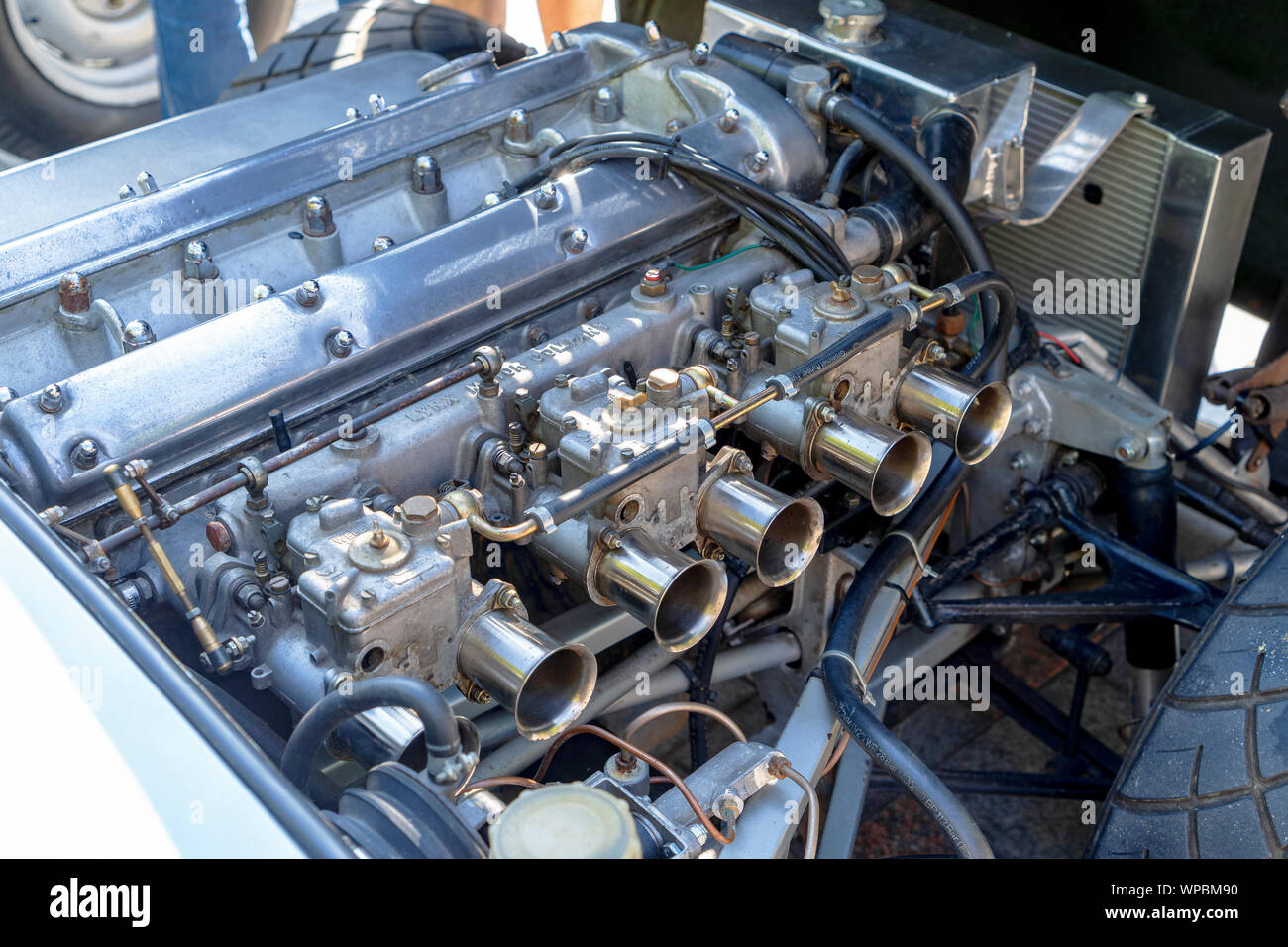
    DCOE, I think. Normally one choke per cylinder. I don't think any
    normal production car came with these fitted.

    https://c8.alamy.com/comp/WPBM90/classic-high-performance-car-engine-with-three-weber-twin-choke-carburettors-fitted-WPBM90.jpg

    Who needs air filters?

    There was also a compromise design, the twin-choke progressive, where
    the carb had two venturis of different size, the larger one only opening
    after the small one was full open. The Weber DCD was of this kind, I
    had one on a Sceptre, which I think was not original equipment.

    https://www.ebay.co.uk/itm/205923149182

    --
    Joe

    --- Synchronet 3.21a-Linux NewsLink 1.2
  • From Scott@newsgroups@gefion.myzen.co.uk to uk.d-i-y on Sun Jan 4 13:40:29 2026
    From Newsgroup: uk.d-i-y

    On Tue, 23 Dec 2025 20:39:42 +0000, Scott
    <newsgroups@gefion.myzen.co.uk> wrote:
    [snip]

    Another thought - is it true that all electric cars are rear wheel
    drive? Does this cause problems for a generation (excuse the pun!)
    that has only experienced front wheel drive? I seem to remember being
    taught that rear wheel drive vehicles are more likely to skid,
    especially in snow.
    --- Synchronet 3.21a-Linux NewsLink 1.2
  • From nib@news@ingram-bromley.co.uk to uk.d-i-y on Sun Jan 4 14:21:33 2026
    From Newsgroup: uk.d-i-y

    On 2026-01-04 13:40, Scott wrote:
    On Tue, 23 Dec 2025 20:39:42 +0000, Scott
    <newsgroups@gefion.myzen.co.uk> wrote:
    [snip]

    Another thought - is it true that all electric cars are rear wheel
    drive? Does this cause problems for a generation (excuse the pun!)
    that has only experienced front wheel drive? I seem to remember being
    taught that rear wheel drive vehicles are more likely to skid,
    especially in snow.

    Certainly not universally true, though with most Teslas being rear-wheel
    drive (if not all 4) probably the big majority are.

    My Renault 5 is front drive as are some other small cars that are based
    on the same platform. VWs however seem to be mostly rear drive even on
    the small ones. The new Ford Puma electric is front drive.

    (believing Wikipedia)

    nib
    --- Synchronet 3.21a-Linux NewsLink 1.2
  • From Chris Green@cl@isbd.net to uk.d-i-y on Sun Jan 4 14:26:14 2026
    From Newsgroup: uk.d-i-y

    The Natural Philosopher <tnp@invalid.invalid> wrote:
    On 04/01/2026 01:02, Sam Plusnet wrote:
    On 03/01/2026 21:28, Joe wrote:
    On Sat, 3 Jan 2026 18:36:12 +0000
    The Natural Philosopher <tnp@invalid.invalid> wrote:

    On 03/01/2026 15:55, Joe wrote:


    SU carburettors don't have an accelerator pump, I don't know about
    Stromberg CD types. Pretty much all downdraught types do.
    Strombergs didnt either. they were very similar to-a SUs with a damper >>> pot, but a diaphragm rather than a piston


    Why I mentioned 'CD' specifically, Stromberg also made conventional
    downdraught carburettors, I don't think SU ever did.

    What happened to firms which made carburettors?-a Their use in cars declined, and were entirely phased out by the mid '90s.

    They all exist in china where they make carbs for chainsaws or in the
    USA where they yearn for V8s cart springs, solid rear axles and carburettors, because they *almost* understand them...

    Well they are easier to fix if your on a dirt track in the middle of
    the Sahara.

    I have a bit of experience of this, we owned a GMC Jimmy (same as a
    Chevrolet Blazer) in Oman from 1980 to 1987. It was definitely "cart
    springs, solid rear axles and carburettors", ours wasn't a V8 though,
    it had the smallest engine option, a 4 litre straight 6.

    It was a tough off-road vehicle and reasonably comfortable at the same
    time, we had loads of fun and it **was** easy to mend when I broke it,
    which was quite often! :-)
    --
    Chris Green
    -+
    --- Synchronet 3.21a-Linux NewsLink 1.2
  • From Andy Burns@usenet@andyburns.uk to uk.d-i-y on Sun Jan 4 14:37:53 2026
    From Newsgroup: uk.d-i-y

    nib wrote:

    VWs however seem to be mostly rear drive even on the small ones.

    The newly unveiled ID.Polo is FWD.
    --- Synchronet 3.21a-Linux NewsLink 1.2
  • From Scott@newsgroups@gefion.myzen.co.uk to uk.d-i-y on Sun Jan 4 15:08:35 2026
    From Newsgroup: uk.d-i-y

    On Sun, 4 Jan 2026 14:37:53 +0000, Andy Burns <usenet@andyburns.uk>
    wrote:

    nib wrote:

    VWs however seem to be mostly rear drive even on the small ones.

    The newly unveiled ID.Polo is FWD.

    Good to know, having been taught to drive in an Austin 1300 when my
    dad had an Austin 1800 (we thought this was the worst car ever until
    he purchased an Allegro).
    --- Synchronet 3.21a-Linux NewsLink 1.2
  • From Tim+@timdownieuk@yahoo.co.youkay to uk.d-i-y on Sun Jan 4 15:14:29 2026
    From Newsgroup: uk.d-i-y

    Scott <newsgroups@gefion.myzen.co.uk> wrote:
    On Tue, 23 Dec 2025 20:39:42 +0000, Scott
    <newsgroups@gefion.myzen.co.uk> wrote:
    [snip]

    Another thought - is it true that all electric cars are rear wheel
    drive?

    No. In fact most are FWD but there are a significant number of RWD ones out there.

    Does this cause problems for a generation (excuse the pun!)
    that has only experienced front wheel drive? I seem to remember being
    taught that rear wheel drive vehicles are more likely to skid,
    especially in snow.

    I think the RWD ones are more fun possibly. IrCOm sure there is a learning curve to adapting to RWD if one has never driven a car with it before and I believe that some folk have been caught out by it.

    Tim
    --
    Please don't feed the trolls
    --- Synchronet 3.21a-Linux NewsLink 1.2
  • From Theo@theom+news@chiark.greenend.org.uk to uk.d-i-y on Sun Jan 4 15:46:06 2026
    From Newsgroup: uk.d-i-y

    Tim+ <timdownieuk@yahoo.co.youkay> wrote:
    Scott <newsgroups@gefion.myzen.co.uk> wrote:
    On Tue, 23 Dec 2025 20:39:42 +0000, Scott
    <newsgroups@gefion.myzen.co.uk> wrote:
    [snip]

    Another thought - is it true that all electric cars are rear wheel
    drive?

    No. In fact most are FWD but there are a significant number of RWD ones out there.

    Especially in cars which are also offered with a combustion version, the inverter / motor / reduction gearbox stack can directly replace the engine / clutch / gearbox stack, with both driving the front wheels.

    AWD is also not uncommon - it's cheap and easy to fit a second motor to the rear axle. AWD is more likely to be offered as an option on upmarket cars, unlike combustion where you need a propshaft and differential so it's more likely only offered on off-road (4WD) versions. Tri/quad motor versions of some models are available for better power/traction.

    Some hybrids also offer electric AWD - engine and motor drives the front wheels, and a second motor driving the rear wheels electrically, with no propshaft.

    Does this cause problems for a generation (excuse the pun!)
    that has only experienced front wheel drive? I seem to remember being taught that rear wheel drive vehicles are more likely to skid,
    especially in snow.

    I think the RWD ones are more fun possibly. IrCOm sure there is a learning curve to adapting to RWD if one has never driven a car with it before and I believe that some folk have been caught out by it.

    I suspect the ABS is better nowadays, so the car will cut power in order to avoid a skid. With independent drive to each axle you can do controlled
    power delivery via the motors, not just with individual wheel braking.

    Theo
    --- Synchronet 3.21a-Linux NewsLink 1.2
  • From The Natural Philosopher@tnp@invalid.invalid to uk.d-i-y on Sun Jan 4 20:36:24 2026
    From Newsgroup: uk.d-i-y

    On 04/01/2026 14:37, Andy Burns wrote:
    nib wrote:

    VWs however seem to be mostly rear drive even on the small ones.

    The newly unveiled ID.Polo is FWD.

    All Post Beetle V dubs are FWD.
    --
    Karl Marx said religion is the opium of the people.
    But Marxism is the crack cocaine.

    --- Synchronet 3.21a-Linux NewsLink 1.2
  • From The Natural Philosopher@tnp@invalid.invalid to uk.d-i-y on Sun Jan 4 20:37:12 2026
    From Newsgroup: uk.d-i-y

    On 04/01/2026 15:14, Tim+ wrote:
    Scott <newsgroups@gefion.myzen.co.uk> wrote:
    On Tue, 23 Dec 2025 20:39:42 +0000, Scott
    <newsgroups@gefion.myzen.co.uk> wrote:
    [snip]

    Another thought - is it true that all electric cars are rear wheel
    drive?

    No. In fact most are FWD but there are a significant number of RWD ones out there.

    Does this cause problems for a generation (excuse the pun!)
    that has only experienced front wheel drive? I seem to remember being
    taught that rear wheel drive vehicles are more likely to skid,
    especially in snow.

    I think the RWD ones are more fun possibly. IrCOm sure there is a learning curve to adapting to RWD if one has never driven a car with it before and I believe that some folk have been caught out by it.

    Tim


    RWD has better traction in the snow but is harder to keep in a straight line
    --
    The lifetime of any political organisation is about three years before
    its been subverted by the people it tried to warn you about.

    Anon.

    --- Synchronet 3.21a-Linux NewsLink 1.2
  • From Sam Plusnet@not@home.com to uk.d-i-y on Sun Jan 4 21:09:29 2026
    From Newsgroup: uk.d-i-y

    On 04/01/2026 15:08, Scott wrote:
    On Sun, 4 Jan 2026 14:37:53 +0000, Andy Burns <usenet@andyburns.uk>
    wrote:

    nib wrote:

    VWs however seem to be mostly rear drive even on the small ones.

    The newly unveiled ID.Polo is FWD.

    Good to know, having been taught to drive in an Austin 1300 when my
    dad had an Austin 1800 (we thought this was the worst car ever until
    he purchased an Allegro).

    I was quite fond of my Allegro. It was a 'learning' experience and, as
    my first car, I had nothing to compare it with.
    --
    Sam Plusnet
    --- Synchronet 3.21a-Linux NewsLink 1.2
  • From Paul@nospam@needed.invalid to uk.d-i-y on Sun Jan 4 17:01:07 2026
    From Newsgroup: uk.d-i-y

    On Sat, 1/3/2026 4:50 AM, Chris J Dixon wrote:
    Paul wrote:

    One speed cars, the max-rpm of the motor prevents achieving
    really high road speed. If I need to hit 160km/hr to make a pass on a long >> straight stretch before the next hill arrives, I expect my car
    to be able to do that speed. If the car will barely do 120km/hr,
    that is a marketing deal-breaker for "people who hate BEV".
    It's just one more thing to point to. I can pull out in my BEV,
    but never pass.

    There is the electric motor curve in Fig.13 here at the bottom.
    Constant torque at low speed, constant power at higher speed
    (with the torque dropping the faster you go). Maybe it's more
    likely that an econobox can benefit from a 2 speed (for eff&range).

    https://www.geartechnology.com/how-many-speed-ratios-for-electric-cars-one-example

    Summary: The message here, is to always check the top speed of the
    BEV you have your eye on, then review the driving habits of
    the local populace, to see where you'll end up on the road
    by driving with any "limitations".

    For example, your econobox-BEV has 0-60 of 14 seconds.
    Can you safely merge into traffic using a short merge lane
    with your shiny new BEV ? The roads were designed with some
    "theoretical car" as a model. Maybe 8 seconds was the target value. >>
    There are "city cars" that aren't real candidates for usage here,
    because some of the roads will have speeds where the vehicle
    can't keep up. Your "city" becomes a relatively small island.

    Paul

    Horses for courses. My partner's Nissan Leaf has all the
    performance I will ever need or desire.

    Chris


    My point is, no matter what kind of vehicle you shop for, it
    has to be capable of handling local (dangerous) driving situations
    that you know of.

    I had to rule out some of the cars I took for test drives, because of
    that. They would not have been safe on merges.

    You can take a fully-laden transport up our ramps, no problem at all. It's because drivers in the lane you are entering, see your vehicle type, and
    they all move over to make room. But for smaller vehicles that cannot
    clearly be seen or judged, there is some amount of extra risk.

    I know, anecdotally, the drivers where you drive, drive with much
    smaller clearances. We usually use larger spacings.

    To give an example of conditions on a roadway, imagine a divided highway
    with four lanes going in each direction. The posted limit is 80km/hr.
    The traffic is all moving at 120km/hr. All four lanes are plugged with
    traffic. The police speed traps ? Useless. They pull over the odd car,
    for their own entertainment. You can't stop a fire hose.

    An overhead sign says "circulation: fluide", which means there are
    no accidents ahead requiring radical moves.

    In the rear view, you spot a car in the fastest lane. You're not in the
    fastest lane. Not a problem, right ? The driver of the vehicle has
    been practicing on GTA5 on his computer. He does a four wheel slide across
    four lanes of traffic, because a "diagonal gap" opened in the fluide
    traffic. This was in preparation for using the off-ramp, coming up next.

    That could be your daily drive coming home from work. One of the reasons
    that road is as thick with traffic as it is, is that is the major
    road for people going home. And your car has to be capable of moving
    in a "fluide" manner. No hay wagons allowed on there. Sure, it's
    not the autobahn, but when you test drive vehicles at the dealership,
    you're thinking of that road and the challenges. Absolutely nobody is
    moving out of your way when you merge in and enter the 120km/hr
    four lane firehose. There is no where for people to move, to accommodate
    you. And you buy a vehicle suited to the local conditions. In fact,
    I've never seen a transport even attempt to enter that particular section. Transport can take parallel secondary roads and enter where it thins out.

    The road here isn't like that. But there are still too-short ramps to
    contend with. There was a crash at one of those too-short ramps in
    the last six months (someone rear ended on entering the highway). Normally, there is room to move over, if there was, say, a transport merging there.
    but you never know how people will be driving there, and how unreasonable
    they can be. People even speed in the fire lane at the mall here.
    There is no accounting for taste.

    A car that takes 14 seconds to reach 60 MPH (the speed of that road),
    is not really a candidate. You need something slightly better. And
    a test drive will tell you whether it will fit with local practice or not.

    Some of the BEVs don't have very high top-speeds. As a selection limit
    for me, anything less than 120km/hr would be out of the question, as
    that's what you need on any major highway here to be "fluide". Some
    roads have 110km/hr posted limits and we drive 120km/hr. If the car had
    a limit of, say, 108km/hr, then it would be a city car, and I wouldn't
    take it out on a major highway. That would be comfortable on an 80km/hr secondary road (one lane each way, not a divided highway). Any time those
    roads have black ice on them, they're a bastard (waiting for the car to
    recover and come back over the line). What you're trading there, by
    agreeing to drive on a secondary road, is your safety in deep cold
    winter days.

    *******

    One of the cars I took for a test drive. the sales-person was a lady.
    We went out in the parking lot. She said "I'll drive". I didn't particularly like this (as I'm test driving these heaps for a reason), but I let
    her go ahead. The reason she wanted to drive, is she is a race car driver
    at weekend. Needless to say, we entered the ramp with *plenty* of
    merge speed to spare :-) At the traction limit on the grippy factory
    tyres. Most impressive. She should have brought her helmet and driving
    gloves, just for the theatre aspect of it :-) So that was my test drive.
    On my sheet of paper, I could tick "merging performance: Yes".

    Paul
    --- Synchronet 3.21a-Linux NewsLink 1.2
  • From Chris J Dixon@chris@cdixon.me.uk to uk.d-i-y on Mon Jan 5 09:11:59 2026
    From Newsgroup: uk.d-i-y

    Paul wrote:

    On Sat, 1/3/2026 4:50 AM, Chris J Dixon wrote:

    Horses for courses. My partner's Nissan Leaf has all the
    performance I will ever need or desire.

    Chris


    My point is, no matter what kind of vehicle you shop for, it
    has to be capable of handling local (dangerous) driving situations
    that you know of.

    I had to rule out some of the cars I took for test drives, because of
    that. They would not have been safe on merges.

    You can take a fully-laden transport up our ramps, no problem at all. It's >because drivers in the lane you are entering, see your vehicle type, and
    they all move over to make room. But for smaller vehicles that cannot
    clearly be seen or judged, there is some amount of extra risk.

    I know, anecdotally, the drivers where you drive, drive with much
    smaller clearances. We usually use larger spacings.
    [snip]

    You may have noticed that this is a UK group. Perhaps our
    perspective is rather different.

    In my experience the Nissan Leaf will accelerate and reach legal
    speed limits faster than my 2 litre Mondeo Mk 5.

    Chris
    --
    Chris J Dixon Nottingham UK
    chris@cdixon.me.uk @ChrisJDixon1

    Plant amazing Acers.
    --- Synchronet 3.21a-Linux NewsLink 1.2
  • From The Natural Philosopher@tnp@invalid.invalid to uk.d-i-y on Mon Jan 5 11:24:14 2026
    From Newsgroup: uk.d-i-y

    On 05/01/2026 09:11, Chris J Dixon wrote:
    In my experience the Nissan Leaf will accelerate and reach legal
    speed limits faster than my 2 litre Mondeo Mk 5.

    short term power delivery from electric motors and lithium cells has
    never been a huge problem

    Sustained high power levels however will overheat the motor and flatten
    the battery fast.
    --
    "Socialist governments traditionally do make a financial mess. They
    always run out of other people's money. It's quite a characteristic of them"

    Margaret Thatcher

    --- Synchronet 3.21a-Linux NewsLink 1.2
  • From Abandoned Trolley@that.bloke@microsoft.com to uk.d-i-y on Mon Jan 5 11:49:48 2026
    From Newsgroup: uk.d-i-y

    On 04/01/2026 11:39, Joe wrote:
    On Sun, 4 Jan 2026 09:15:07 +0000
    Abandoned Trolley <that.bloke@microsoft.com> wrote:

    On 03/01/2026 21:28, Joe wrote:
    On Sat, 3 Jan 2026 18:36:12 +0000
    The Natural Philosopher <tnp@invalid.invalid> wrote:

    On 03/01/2026 15:55, Joe wrote:


    SU carburettors don't have an accelerator pump, I don't know about
    Stromberg CD types. Pretty much all downdraught types do.

    Strombergs didnt either. they were very similar to SUs with a
    damper pot, but a diaphragm rather than a piston


    Why I mentioned 'CD' specifically, Stromberg also made conventional
    downdraught carburettors, I don't think SU ever did.


    Maybe not SU, but I know that some Ford Escorts and Fiestas in the
    80s were fitted with a Ford designed vertical draught carb - a bit
    like a SU turned on its side

    It occurs to me that the implementation of an accelerator pump does
    not require any particular design of carb

    No, but adding a damper to the piston of a constant-depression type
    does pretty much the same thing, temporarily increasing the suction
    around the needle.

    I imagine that "conventional downdraught carburettors" means fixed
    choke "Weber" style, in which case a lot of them were horizontal.

    You may be interested to note that the "O" in the Weber model number,
    for example "40 CDOE" actually stands for the Italian word
    "Orizontale"

    DCOE, I think. Normally one choke per cylinder. I don't think any
    normal production car came with these fitted.

    https://c8.alamy.com/comp/WPBM90/classic-high-performance-car-engine-with-three-weber-twin-choke-carburettors-fitted-WPBM90.jpg

    Who needs air filters?

    I guess thats either a D type or E type Jag ? - from that picture I cant
    see if the engine block is mounted at an angle


    There was also a compromise design, the twin-choke progressive, where
    the carb had two venturis of different size, the larger one only opening after the small one was full open. The Weber DCD was of this kind, I
    had one on a Sceptre, which I think was not original equipment.


    Might have been OE - I know that certain models of Hillman Hunter GLS
    were factory fitted with Holbay heads and dual Webers


    https://www.ebay.co.uk/itm/205923149182


    --- Synchronet 3.21a-Linux NewsLink 1.2
  • From Chris J Dixon@chris@cdixon.me.uk to uk.d-i-y on Mon Jan 5 21:26:39 2026
    From Newsgroup: uk.d-i-y

    The Natural Philosopher wrote:

    On 05/01/2026 09:11, Chris J Dixon wrote:
    In my experience the Nissan Leaf will accelerate and reach legal
    speed limits faster than my 2 litre Mondeo Mk 5.

    short term power delivery from electric motors and lithium cells has
    never been a huge problem

    Sustained high power levels however will overheat the motor and flatten
    the battery fast.

    Indeed it will. Acceleration is, in the real world, a short term
    condition.

    I did spend my working life designing propulsion equipment for
    electric trains.

    Chris
    --
    Chris J Dixon Nottingham UK
    chris@cdixon.me.uk @ChrisJDixon1

    Plant amazing Acers.
    --- Synchronet 3.21a-Linux NewsLink 1.2
  • From Simon Simple@nothanks@nottoday.co.uk to uk.d-i-y on Mon Jan 5 22:52:20 2026
    From Newsgroup: uk.d-i-y

    On 04/01/2026 21:09, Sam Plusnet wrote:
    On 04/01/2026 15:08, Scott wrote:
    On Sun, 4 Jan 2026 14:37:53 +0000, Andy Burns <usenet@andyburns.uk>
    wrote:

    nib wrote:

    VWs however seem to be mostly rear drive even on the small ones.

    The newly unveiled ID.Polo is FWD.

    Good to know, having been taught to drive in an Austin 1300 when my
    dad had an Austin 1800 (we thought this was the worst car ever until
    he purchased an Allegro).

    I was quite fond of my Allegro.-a It was a 'learning' experience and, as
    my first car, I had nothing to compare it with.


    I had a mate who had an all-aggro. Had a puncture, jacked it up in the
    wrong place and the windscreen fell out. Seem it was a structural
    member, and far stronger than the tinfoil body.
    --
    SS

    --- Synchronet 3.21a-Linux NewsLink 1.2
  • From Indy Jess John@bathwatchdog@OMITTHISgooglemail.com to uk.d-i-y on Tue Jan 6 13:46:45 2026
    From Newsgroup: uk.d-i-y

    On 03/01/2026 15:55, Joe wrote:
    SU carburettors don't have an accelerator pump, I don't know about
    Stromberg CD types. Pretty much all downdraught types do.

    As someone who has owned a few old cars (my current one will be 62 years
    old in March) I can confirm that neither SUs nor Strombergs have an accelerator pump.

    Not all downdraft ones do. The Consul Classic had an accelerator pump,
    the Triumph Mayflower didn't.

    --- Synchronet 3.21a-Linux NewsLink 1.2
  • From Indy Jess John@bathwatchdog@OMITTHISgooglemail.com to uk.d-i-y on Tue Jan 6 14:01:41 2026
    From Newsgroup: uk.d-i-y

    On 05/01/2026 11:49, Abandoned Trolley wrote:


    I guess thats either a D type or E type Jag ? - from that picture I cant
    see if the engine block is mounted at an angle

    From the factory the E-type came with three SUs, bigger ones for
    cylinders 1&2 and 5&6, because the slightly smaller one for 3&4
    scavenged some additional fuel from the ones either side of it.


    Might have been OE - I know that certain models of Hillman Hunter GLS
    were factory fitted with Holbay heads and dual Webers

    There were some interesting aftermarket conversions. My brother bought
    a mini (the original Issigonis design) and discovered that there was no
    inlet manifold; each cylinder had its own Amal Monobloc carburettor
    (normally only seen on motorbikes of that era). It took quite a while
    to get them all singing exactly the same song, but having got them
    perfectly tuned the car went like stink - flat out in top saw the
    speedometer needle against the other side of the stop below 0mph.


    --- Synchronet 3.21a-Linux NewsLink 1.2
  • From Scott@newsgroups@gefion.myzen.co.uk to uk.d-i-y on Tue Jan 6 15:44:52 2026
    From Newsgroup: uk.d-i-y

    On Tue, 23 Dec 2025 20:39:42 +0000, Scott
    <newsgroups@gefion.myzen.co.uk> wrote:
    [snip]

    In another random thought, I wondered why electric cars seem to have
    two batteries - the lithium ion traction battery and a traditional
    lead acid battery. Would it not be a better use of space to have just
    one battery? Also, how does the lead acid battery get charged?
    --- Synchronet 3.21a-Linux NewsLink 1.2
  • From Tim+@timdownieuk@yahoo.co.youkay to uk.d-i-y on Tue Jan 6 16:52:16 2026
    From Newsgroup: uk.d-i-y

    Scott <newsgroups@gefion.myzen.co.uk> wrote:
    On Tue, 23 Dec 2025 20:39:42 +0000, Scott
    <newsgroups@gefion.myzen.co.uk> wrote:
    [snip]

    In another random thought, I wondered why electric cars seem to have
    two batteries - the lithium ion traction battery and a traditional
    lead acid battery. Would it not be a better use of space to have just
    one battery? Also, how does the lead acid battery get charged?


    A lot of the accessories still run off 12V and this is supplied by a DC/DC converter (which charges the 12V battery) from the HV traction battery.
    You need a secondary battery to close the HV contactors that allow power through to all the other systems.

    It doesnrCOt have to be a 12V lead acid battery though. They are the most common but manufacturers are beginning to use smaller lithium batteries in their place to supply 12/24 or more volts for the accessories.

    Tim
    --
    Please don't feed the trolls
    --- Synchronet 3.21a-Linux NewsLink 1.2
  • From The Other John@nomail@here.org to uk.d-i-y on Tue Jan 6 16:54:51 2026
    From Newsgroup: uk.d-i-y

    On 06/01/2026 15:44, Scott wrote:
    In another random thought, I wondered why electric cars seem to have
    two batteries - the lithium ion traction battery and a traditional
    lead acid battery. Would it not be a better use of space to have just
    one battery? Also, how does the lead acid battery get charged?

    In my Nissan Leaf the 12V lead acid battery is charged by the solar
    panel built into the roof but while locked in my garage it's charged
    from the traction battery.
    --
    TOJ
    --- Synchronet 3.21a-Linux NewsLink 1.2
  • From Theo@theom+news@chiark.greenend.org.uk to uk.d-i-y on Tue Jan 6 17:41:47 2026
    From Newsgroup: uk.d-i-y

    Tim+ <timdownieuk@yahoo.co.youkay> wrote:
    Scott <newsgroups@gefion.myzen.co.uk> wrote:
    On Tue, 23 Dec 2025 20:39:42 +0000, Scott
    <newsgroups@gefion.myzen.co.uk> wrote:
    [snip]

    In another random thought, I wondered why electric cars seem to have
    two batteries - the lithium ion traction battery and a traditional
    lead acid battery. Would it not be a better use of space to have just
    one battery? Also, how does the lead acid battery get charged?


    A lot of the accessories still run off 12V and this is supplied by a DC/DC converter (which charges the 12V battery) from the HV traction battery.
    You need a secondary battery to close the HV contactors that allow power through to all the other systems.

    It doesnrCOt have to be a 12V lead acid battery though. They are the most common but manufacturers are beginning to use smaller lithium batteries in their place to supply 12/24 or more volts for the accessories.

    It also means all the usual things you do with 12v still work. eg if it
    goes flat you can jump start it in the normal way (not actually to turn over the starter motor, but to provide enough power to turn on the high voltage system). The computers need to check everything is happy before they enable
    HV power and they run off 12V.

    12V is safe to run in regular wiring harnesses to sensors, lighting, etc -
    high voltage isn't.

    The Cybertruck uses 48V instead and had to do lots of hacks to interface
    with the 12V world, such as the ability to jump from a 12V lead acid in an emergency.

    Theo
    --- Synchronet 3.21a-Linux NewsLink 1.2
  • From Scott@newsgroups@gefion.myzen.co.uk to uk.d-i-y on Tue Jan 6 18:15:09 2026
    From Newsgroup: uk.d-i-y

    Kessington Medical Centre
    85 Milngavie Road, Bearsden, Glasgow, G61 2DNOn 06 Jan 2026 17:41:47 +0000 (GMT), Theo <theom+news@chiark.greenend.org.uk> wrote:

    Tim+ <timdownieuk@yahoo.co.youkay> wrote:
    Scott <newsgroups@gefion.myzen.co.uk> wrote:
    On Tue, 23 Dec 2025 20:39:42 +0000, Scott
    <newsgroups@gefion.myzen.co.uk> wrote:
    [snip]

    In another random thought, I wondered why electric cars seem to have
    two batteries - the lithium ion traction battery and a traditional
    lead acid battery. Would it not be a better use of space to have just
    one battery? Also, how does the lead acid battery get charged?


    A lot of the accessories still run off 12V and this is supplied by a DC/DC >> converter (which charges the 12V battery) from the HV traction battery.
    You need a secondary battery to close the HV contactors that allow power
    through to all the other systems.

    It doesnAt have to be a 12V lead acid battery though. They are the most
    common but manufacturers are beginning to use smaller lithium batteries in >> their place to supply 12/24 or more volts for the accessories.

    It also means all the usual things you do with 12v still work. eg if it
    goes flat you can jump start it in the normal way (not actually to turn over >the starter motor, but to provide enough power to turn on the high voltage >system). The computers need to check everything is happy before they enable >HV power and they run off 12V.

    Could you explain this a bit more. I believe the supply voltage is
    typically 400V (Nissan Leaf), so surely a 12V battery will not cut the
    go very far?

    12V is safe to run in regular wiring harnesses to sensors, lighting, etc - >high voltage isn't.

    Why is that? 230V seems fine in the home.

    The Cybertruck uses 48V instead and had to do lots of hacks to interface
    with the 12V world, such as the ability to jump from a 12V lead acid in an >emergency.

    Theo
    --- Synchronet 3.21a-Linux NewsLink 1.2
  • From Tim+@timdownieuk@yahoo.co.youkay to uk.d-i-y on Tue Jan 6 18:32:04 2026
    From Newsgroup: uk.d-i-y

    Scott <newsgroups@gefion.myzen.co.uk> wrote:
    Kessington Medical Centre
    85 Milngavie Road, Bearsden, Glasgow, G61 2DNOn 06 Jan 2026 17:41:47
    +0000 (GMT), Theo <theom+news@chiark.greenend.org.uk> wrote:

    Tim+ <timdownieuk@yahoo.co.youkay> wrote:
    Scott <newsgroups@gefion.myzen.co.uk> wrote:
    On Tue, 23 Dec 2025 20:39:42 +0000, Scott
    <newsgroups@gefion.myzen.co.uk> wrote:
    [snip]

    In another random thought, I wondered why electric cars seem to have
    two batteries - the lithium ion traction battery and a traditional
    lead acid battery. Would it not be a better use of space to have just
    one battery? Also, how does the lead acid battery get charged?


    A lot of the accessories still run off 12V and this is supplied by a DC/DC >>> converter (which charges the 12V battery) from the HV traction battery. >>> You need a secondary battery to close the HV contactors that allow power >>> through to all the other systems.

    It doesn-At have to be a 12V lead acid battery though. They are the most >>> common but manufacturers are beginning to use smaller lithium batteries in >>> their place to supply 12/24 or more volts for the accessories.

    It also means all the usual things you do with 12v still work. eg if it
    goes flat you can jump start it in the normal way (not actually to turn over >> the starter motor, but to provide enough power to turn on the high voltage >> system). The computers need to check everything is happy before they enable >> HV power and they run off 12V.

    Could you explain this a bit more. I believe the supply voltage is
    typically 400V (Nissan Leaf), so surely a 12V battery will not cut the
    go very far?

    As previously explained, it powers the computer and other accessories that enable the HV battery to be rCLturned onrCY. It doesnrCOt drive the car.

    Your 12V battery wonrCOt drive an ICE car far if the engine doesnrCOt start. ;-)


    12V is safe to run in regular wiring harnesses to sensors, lighting, etc - >> high voltage isn't.

    Why is that? 230V seems fine in the home.

    Houses rarely crash. Also, every single accessory in the car would need to
    be re-engineered to operate off of the higher voltage. Far easier and
    cheaper to use motors, fans, bulbs, radios etc that have been designed for
    12V operation.

    Tim
    --
    Please don't feed the trolls
    --- Synchronet 3.21a-Linux NewsLink 1.2
  • From nib@news@ingram-bromley.co.uk to uk.d-i-y on Tue Jan 6 18:51:00 2026
    From Newsgroup: uk.d-i-y

    On 2026-01-06 18:32, Tim+ wrote:
    Scott <newsgroups@gefion.myzen.co.uk> wrote:
    Kessington Medical Centre
    85 Milngavie Road, Bearsden, Glasgow, G61 2DNOn 06 Jan 2026 17:41:47
    +0000 (GMT), Theo <theom+news@chiark.greenend.org.uk> wrote:

    Tim+ <timdownieuk@yahoo.co.youkay> wrote:
    Scott <newsgroups@gefion.myzen.co.uk> wrote:
    On Tue, 23 Dec 2025 20:39:42 +0000, Scott
    <newsgroups@gefion.myzen.co.uk> wrote:
    [snip]

    In another random thought, I wondered why electric cars seem to have >>>>> two batteries - the lithium ion traction battery and a traditional
    lead acid battery. Would it not be a better use of space to have just >>>>> one battery? Also, how does the lead acid battery get charged?


    A lot of the accessories still run off 12V and this is supplied by a DC/DC >>>> converter (which charges the 12V battery) from the HV traction battery. >>>> You need a secondary battery to close the HV contactors that allow power >>>> through to all the other systems.

    It doesn-At have to be a 12V lead acid battery though. They are the most >>>> common but manufacturers are beginning to use smaller lithium batteries in >>>> their place to supply 12/24 or more volts for the accessories.

    It also means all the usual things you do with 12v still work. eg if it >>> goes flat you can jump start it in the normal way (not actually to turn over
    the starter motor, but to provide enough power to turn on the high voltage >>> system). The computers need to check everything is happy before they enable
    HV power and they run off 12V.

    Could you explain this a bit more. I believe the supply voltage is
    typically 400V (Nissan Leaf), so surely a 12V battery will not cut the
    go very far?

    As previously explained, it powers the computer and other accessories that enable the HV battery to be rCLturned onrCY. It doesnrCOt drive the car.

    Your 12V battery wonrCOt drive an ICE car far if the engine doesnrCOt start. ;-)


    12V is safe to run in regular wiring harnesses to sensors, lighting, etc - >>> high voltage isn't.

    Why is that? 230V seems fine in the home.

    Houses rarely crash. Also, every single accessory in the car would need to be re-engineered to operate off of the higher voltage. Far easier and cheaper to use motors, fans, bulbs, radios etc that have been designed for 12V operation.

    Tim


    Cars like my Renault as you would expect use almost all the same
    components as the same company's ICE cars, the battery, motor and its
    control system just drop in instead of the engine. In the same way as
    you start/stop the engine you switch on/off the electric drive (my last
    EV even had the same "Motor Start/Stop" control as its ICE stable-mates).

    The only things in mine powered from the 400V are the traction drive,
    the motor for the heat pump and the charger for the 12V battery. All of
    these are disabled when the drive is switched off (= ignition off).

    nib
    --- Synchronet 3.21a-Linux NewsLink 1.2
  • From Scott@newsgroups@gefion.myzen.co.uk to uk.d-i-y on Tue Jan 6 18:51:27 2026
    From Newsgroup: uk.d-i-y

    On 6 Jan 2026 18:32:04 GMT, Tim+ <timdownieuk@yahoo.co.youkay> wrote:

    Scott <newsgroups@gefion.myzen.co.uk> wrote:
    On 06 Jan 2026 17:41:47
    +0000 (GMT), Theo <theom+news@chiark.greenend.org.uk> wrote:

    Tim+ <timdownieuk@yahoo.co.youkay> wrote:
    Scott <newsgroups@gefion.myzen.co.uk> wrote:
    On Tue, 23 Dec 2025 20:39:42 +0000, Scott
    <newsgroups@gefion.myzen.co.uk> wrote:
    [snip]

    In another random thought, I wondered why electric cars seem to have >>>>> two batteries - the lithium ion traction battery and a traditional
    lead acid battery. Would it not be a better use of space to have just >>>>> one battery? Also, how does the lead acid battery get charged?


    A lot of the accessories still run off 12V and this is supplied by a DC/DC >>>> converter (which charges the 12V battery) from the HV traction battery. >>>> You need a secondary battery to close the HV contactors that allow power >>>> through to all the other systems.

    It doesn?t have to be a 12V lead acid battery though. They are the most >>>> common but manufacturers are beginning to use smaller lithium batteries in >>>> their place to supply 12/24 or more volts for the accessories.

    It also means all the usual things you do with 12v still work. eg if it >>> goes flat you can jump start it in the normal way (not actually to turn over
    the starter motor, but to provide enough power to turn on the high voltage >>> system). The computers need to check everything is happy before they enable
    HV power and they run off 12V.

    Could you explain this a bit more. I believe the supply voltage is
    typically 400V (Nissan Leaf), so surely a 12V battery will not cut the
    go very far?

    As previously explained, it powers the computer and other accessories that >enable the HV battery to be oturned ono. It doesnAt drive the car.

    I must be missing something. I thought you were discussing the
    proposition: "eg if it goes flat you can jump start it in the normal
    way (not actually to turn over the starter motor, but to provide
    enough power to turn on the high voltage system)".

    Did you mean a flat traction battery or a flat 12V battery? If the
    traction battery is flat, how can it 'turned on' and how can it drive
    a car? If you mean the 12V battery is flat, my understanding is that
    it cannot drive the car anyway.

    Your 12V battery wonAt drive an ICE car far if the engine doesnAt start.
    ;-)
    I don't disagree with that but once an ICE engine starts, it can
    usually keep going. If an electric car starts and the battery if flat,
    it won't be going anywhere.

    12V is safe to run in regular wiring harnesses to sensors, lighting, etc - >>> high voltage isn't.

    Why is that? 230V seems fine in the home.

    Houses rarely crash. Also, every single accessory in the car would need to >be re-engineered to operate off of the higher voltage. Far easier and >cheaper to use motors, fans, bulbs, radios etc that have been designed for >12V operation.

    Okay.
    --- Synchronet 3.21a-Linux NewsLink 1.2
  • From Scott@newsgroups@gefion.myzen.co.uk to uk.d-i-y on Tue Jan 6 18:55:00 2026
    From Newsgroup: uk.d-i-y

    On Tue, 6 Jan 2026 18:51:00 +0000, nib <news@ingram-bromley.co.uk>
    wrote:

    On 2026-01-06 18:32, Tim+ wrote:
    Scott <newsgroups@gefion.myzen.co.uk> wrote:
    Kessington Medical Centre
    85 Milngavie Road, Bearsden, Glasgow, G61 2DNOn 06 Jan 2026 17:41:47
    +0000 (GMT), Theo <theom+news@chiark.greenend.org.uk> wrote:

    Tim+ <timdownieuk@yahoo.co.youkay> wrote:
    Scott <newsgroups@gefion.myzen.co.uk> wrote:
    On Tue, 23 Dec 2025 20:39:42 +0000, Scott
    <newsgroups@gefion.myzen.co.uk> wrote:
    [snip]

    In another random thought, I wondered why electric cars seem to have >>>>>> two batteries - the lithium ion traction battery and a traditional >>>>>> lead acid battery. Would it not be a better use of space to have just >>>>>> one battery? Also, how does the lead acid battery get charged?


    A lot of the accessories still run off 12V and this is supplied by a DC/DC
    converter (which charges the 12V battery) from the HV traction battery. >>>>> You need a secondary battery to close the HV contactors that allow power >>>>> through to all the other systems.

    It doesn?t have to be a 12V lead acid battery though. They are the most >>>>> common but manufacturers are beginning to use smaller lithium batteries in
    their place to supply 12/24 or more volts for the accessories.

    It also means all the usual things you do with 12v still work. eg if it >>>> goes flat you can jump start it in the normal way (not actually to turn over
    the starter motor, but to provide enough power to turn on the high voltage >>>> system). The computers need to check everything is happy before they enable
    HV power and they run off 12V.

    Could you explain this a bit more. I believe the supply voltage is
    typically 400V (Nissan Leaf), so surely a 12V battery will not cut the
    go very far?

    As previously explained, it powers the computer and other accessories that >> enable the HV battery to be oturned ono. It doesnAt drive the car.

    Your 12V battery wonAt drive an ICE car far if the engine doesnAt start.
    ;-)


    12V is safe to run in regular wiring harnesses to sensors, lighting, etc - >>>> high voltage isn't.

    Why is that? 230V seems fine in the home.

    Houses rarely crash. Also, every single accessory in the car would need to >> be re-engineered to operate off of the higher voltage. Far easier and
    cheaper to use motors, fans, bulbs, radios etc that have been designed for >> 12V operation.

    Tim


    Cars like my Renault as you would expect use almost all the same
    components as the same company's ICE cars, the battery, motor and its >control system just drop in instead of the engine. In the same way as
    you start/stop the engine you switch on/off the electric drive (my last
    EV even had the same "Motor Start/Stop" control as its ICE stable-mates).

    The only things in mine powered from the 400V are the traction drive,
    the motor for the heat pump and the charger for the 12V battery. All of >these are disabled when the drive is switched off (= ignition off).

    I hadn't thought about that aspect. Is this the Renault 5? What do you
    think of it? I'm looking at its stablemate, the Nissan Micra, but I
    think the all-round vision is very restricted.
    --- Synchronet 3.21a-Linux NewsLink 1.2
  • From nib@news@ingram-bromley.co.uk to uk.d-i-y on Tue Jan 6 19:27:39 2026
    From Newsgroup: uk.d-i-y

    On 2026-01-06 18:55, Scott wrote:
    On Tue, 6 Jan 2026 18:51:00 +0000, nib <news@ingram-bromley.co.uk>
    wrote:

    On 2026-01-06 18:32, Tim+ wrote:
    Scott <newsgroups@gefion.myzen.co.uk> wrote:
    Kessington Medical Centre
    85 Milngavie Road, Bearsden, Glasgow, G61 2DNOn 06 Jan 2026 17:41:47 >>>>> +0000 (GMT), Theo <theom+news@chiark.greenend.org.uk> wrote:

    Tim+ <timdownieuk@yahoo.co.youkay> wrote:
    Scott <newsgroups@gefion.myzen.co.uk> wrote:
    On Tue, 23 Dec 2025 20:39:42 +0000, Scott
    <newsgroups@gefion.myzen.co.uk> wrote:
    [snip]

    In another random thought, I wondered why electric cars seem to have >>>>>>> two batteries - the lithium ion traction battery and a traditional >>>>>>> lead acid battery. Would it not be a better use of space to have just >>>>>>> one battery? Also, how does the lead acid battery get charged?


    A lot of the accessories still run off 12V and this is supplied by a DC/DC
    converter (which charges the 12V battery) from the HV traction battery. >>>>>> You need a secondary battery to close the HV contactors that allow power >>>>>> through to all the other systems.

    It doesn?t have to be a 12V lead acid battery though. They are the most >>>>>> common but manufacturers are beginning to use smaller lithium batteries in
    their place to supply 12/24 or more volts for the accessories.

    It also means all the usual things you do with 12v still work. eg if it >>>>> goes flat you can jump start it in the normal way (not actually to turn over
    the starter motor, but to provide enough power to turn on the high voltage
    system). The computers need to check everything is happy before they enable
    HV power and they run off 12V.

    Could you explain this a bit more. I believe the supply voltage is
    typically 400V (Nissan Leaf), so surely a 12V battery will not cut the >>>> go very far?

    As previously explained, it powers the computer and other accessories that >>> enable the HV battery to be rCLturned onrCY. It doesnrCOt drive the car. >>>
    Your 12V battery wonrCOt drive an ICE car far if the engine doesnrCOt start.
    ;-)


    12V is safe to run in regular wiring harnesses to sensors, lighting, etc -
    high voltage isn't.

    Why is that? 230V seems fine in the home.

    Houses rarely crash. Also, every single accessory in the car would need to >>> be re-engineered to operate off of the higher voltage. Far easier and
    cheaper to use motors, fans, bulbs, radios etc that have been designed for >>> 12V operation.

    Tim


    Cars like my Renault as you would expect use almost all the same
    components as the same company's ICE cars, the battery, motor and its
    control system just drop in instead of the engine. In the same way as
    you start/stop the engine you switch on/off the electric drive (my last
    EV even had the same "Motor Start/Stop" control as its ICE stable-mates).

    The only things in mine powered from the 400V are the traction drive,
    the motor for the heat pump and the charger for the 12V battery. All of
    these are disabled when the drive is switched off (= ignition off).

    I hadn't thought about that aspect. Is this the Renault 5? What do you
    think of it? I'm looking at its stablemate, the Nissan Micra, but I
    think the all-round vision is very restricted.

    'Tis the Renault 5. Very pleased with it so far. Took a little while to
    get used to the "gear lever" being just above the wiper stalk!

    One feature might put some people off: Renault are very much in bed with Google. It uses Google maps, Google voice recognition and lots of other
    stuff and can link to your Google account. Sometimes its a bit spooky to
    do a search on Google Maps at home then have the car suggest that place
    as a destination the next time you go out!

    nib
    --- Synchronet 3.21a-Linux NewsLink 1.2
  • From Tim+@timdownieuk@yahoo.co.youkay to uk.d-i-y on Tue Jan 6 19:45:24 2026
    From Newsgroup: uk.d-i-y

    Scott <newsgroups@gefion.myzen.co.uk> wrote:
    On 6 Jan 2026 18:32:04 GMT, Tim+ <timdownieuk@yahoo.co.youkay> wrote:

    Scott <newsgroups@gefion.myzen.co.uk> wrote:
    On 06 Jan 2026 17:41:47
    +0000 (GMT), Theo <theom+news@chiark.greenend.org.uk> wrote:

    Tim+ <timdownieuk@yahoo.co.youkay> wrote:
    Scott <newsgroups@gefion.myzen.co.uk> wrote:
    On Tue, 23 Dec 2025 20:39:42 +0000, Scott
    <newsgroups@gefion.myzen.co.uk> wrote:
    [snip]

    In another random thought, I wondered why electric cars seem to have >>>>>> two batteries - the lithium ion traction battery and a traditional >>>>>> lead acid battery. Would it not be a better use of space to have just >>>>>> one battery? Also, how does the lead acid battery get charged?


    A lot of the accessories still run off 12V and this is supplied by a DC/DC
    converter (which charges the 12V battery) from the HV traction battery. >>>>> You need a secondary battery to close the HV contactors that allow power >>>>> through to all the other systems.

    It doesn?t have to be a 12V lead acid battery though. They are the most >>>>> common but manufacturers are beginning to use smaller lithium batteries in
    their place to supply 12/24 or more volts for the accessories.

    It also means all the usual things you do with 12v still work. eg if it >>>> goes flat you can jump start it in the normal way (not actually to turn over
    the starter motor, but to provide enough power to turn on the high voltage >>>> system). The computers need to check everything is happy before they enable
    HV power and they run off 12V.

    Could you explain this a bit more. I believe the supply voltage is
    typically 400V (Nissan Leaf), so surely a 12V battery will not cut the
    go very far?

    As previously explained, it powers the computer and other accessories that >> enable the HV battery to be -oturned on-o. It doesn-At drive the car.

    I must be missing something. I thought you were discussing the
    proposition: "eg if it goes flat you can jump start it in the normal
    way (not actually to turn over the starter motor, but to provide
    enough power to turn on the high voltage system)".

    Did you mean a flat traction battery or a flat 12V battery?

    12V battery. The traction battery is your energy source for driving. You canrCOt rCLjump startrCY an EV with a 12V battery anymore than you can jumpstart
    an ICE if the tank is empty.

    If the
    traction battery is flat, how can it 'turned on' and how can it drive
    a car?

    You canrCOt.

    If you mean the 12V battery is flat, my understanding is that
    it cannot drive the car anyway.

    rCLItrCY doesnrCOt drive the car. If you mean that with a charged traction battery but a flat 12V battery once yourCOve rCLjump startedrCY it the HV/LV DC/DC converter can continue to power the 12V systems so generally, if it boots, you can then drive it.


    Your 12V battery won-At drive an ICE car far if the engine doesn-At start. >> ;-)
    I don't disagree with that but once an ICE engine starts, it can
    usually keep going. If an electric car starts and the battery if flat,
    it won't be going anywhere.

    See above about the DC/DC charger. ItrCOs the EV equivalent of an alternator.


    Tim
    --
    Please don't feed the trolls
    --- Synchronet 3.21a-Linux NewsLink 1.2
  • From Tim+@timdownieuk@yahoo.co.youkay to uk.d-i-y on Tue Jan 6 19:52:11 2026
    From Newsgroup: uk.d-i-y

    Tim+ <timdownieuk@yahoo.co.youkay> wrote:


    12V battery. The traction battery is your energy source for driving. You canrCOt rCLjump startrCY an EV with a 12V battery anymore than you can jumpstart
    an ICE if the tank is empty.


    rCawith a 12V battery AND a flat traction batteryrCa

    (Not sure where that bit of the sentence wentrCa)

    Tim
    --
    Please don't feed the trolls
    --- Synchronet 3.21a-Linux NewsLink 1.2
  • From Paul@nospam@needed.invalid to uk.d-i-y on Tue Jan 6 15:06:52 2026
    From Newsgroup: uk.d-i-y

    On Tue, 1/6/2026 1:15 PM, Scott wrote:
    Kessington Medical Centre
    85 Milngavie Road, Bearsden, Glasgow, G61 2DNOn 06 Jan 2026 17:41:47 +0000 (GMT), Theo <theom+news@chiark.greenend.org.uk> wrote:

    Tim+ <timdownieuk@yahoo.co.youkay> wrote:
    Scott <newsgroups@gefion.myzen.co.uk> wrote:
    On Tue, 23 Dec 2025 20:39:42 +0000, Scott
    <newsgroups@gefion.myzen.co.uk> wrote:
    [snip]

    In another random thought, I wondered why electric cars seem to have
    two batteries - the lithium ion traction battery and a traditional
    lead acid battery. Would it not be a better use of space to have just
    one battery? Also, how does the lead acid battery get charged?


    A lot of the accessories still run off 12V and this is supplied by a DC/DC >>> converter (which charges the 12V battery) from the HV traction battery. >>> You need a secondary battery to close the HV contactors that allow power >>> through to all the other systems.

    It doesnrCOt have to be a 12V lead acid battery though. They are the most >>> common but manufacturers are beginning to use smaller lithium batteries in >>> their place to supply 12/24 or more volts for the accessories.

    It also means all the usual things you do with 12v still work. eg if it
    goes flat you can jump start it in the normal way (not actually to turn over >> the starter motor, but to provide enough power to turn on the high voltage >> system). The computers need to check everything is happy before they enable >> HV power and they run off 12V.

    Could you explain this a bit more. I believe the supply voltage is
    typically 400V (Nissan Leaf), so surely a 12V battery will not cut the
    go very far?

    12V is safe to run in regular wiring harnesses to sensors, lighting, etc - >> high voltage isn't.

    Why is that? 230V seems fine in the home.

    The Cybertruck uses 48V instead and had to do lots of hacks to interface
    with the 12V world, such as the ability to jump from a 12V lead acid in an >> emergency.

    Theo

    When you design something, you draw boxes around bits of it. There
    is a philosophy and an architecture behind it.

    The idea is, you don't EVER want 400V on the left, to show up
    on a failure, on any component (in the cabin or even under the hood)
    on the right.

    +-------------------------+ +-------------------------------+
    | 400V battery | | 12V Battery |
    | |---- OptoIsolators? ---| |
    | Inverter/Charger/Regen | | Lighter for your smoke |
    | | | Car radio |
    | Electric Motor(s) | | ContactorToEnable400VSystem |
    +-------------------------+ | |
    This box waterproof!!! | Computers + Sensors |
    Orange colored big wires +-------------------------------+
    to impress Fire Department!

    You don't want a fault from the HV system, to show up inside the car.
    If the 400VDC to 12VDC buck converter you designed to drive the
    lighter socket develops a short from primary to secondary,
    a person sticking their finger in the lighter socket could
    be electrocuted.

    The "box" on the left has to be water-tight, so first responders
    jumping into a river to rescue your electric ass, are not
    the recipients of a 400VDC shock. DC is a bastard for your muscles.
    If a technician was working on a BEV and shows signs of electrocution,
    I would kick him with my safety boot -- never reach out and rescue
    someone with your two bare hands if you expect to be able to escape
    or let go. The DC through your muscles can keep muscles clenched.

    This is how the other day, there was some video from a city that just
    had a flash flood. One car driver had water all the way up to the door
    glass on the car, and right up past the front grill and at bonnet level,
    and he drove (still under power) from the flooded street into a
    less flooded parking lot. That is only possible with an electric car.

    While you can fit a "snorkel kit" to ICE vehicles,
    usually the intake on a snorkle kit is a pipe rising
    up the side of the vehicle, demonstrating to you as the driver, what
    your limit on snorkel operation is. The car driving with the water up to
    the glass, that would be too high for a snorkel terminating under
    the bonnet metalwork. A snorkle kit has a valve on it, such that
    if the vehicle rolls or tips, the potential for water to enter
    the pipe can be stopped, before the engine ingests it. But the car in
    the video, had no such pipe up the side. There were no bubbles
    for exhaust coming from the back, either :-) That wasn't an ICE.

    When you drive a BEV, that's a modern marvel. And it's a marvel
    for all the things you cannot see and did not think about.

    I don't know a thing about designing cars, but I can certainly
    think of some boxes to add to such a *dangerous* piece of kit.
    Think how much effort it takes, to prevent 400V from ever
    contacting anything in the environment... If you smash the
    vehicle into a brick wall, I expect the contactor fails open,
    but I don't know if the water tight integrity of the battery
    box modules can be guaranteed. There will still be some situations
    where the Fire Department are in mortal danger on a river rescue.

    *******

    You have to learn all about this stuff, to keep customers safe.

    https://en.wikipedia.org/wiki/Extra-low_voltage#Separated_or_safety_extra-low_voltage_%28SELV%29

    https://www.electricalsafetyfirst.org.uk/guidance/your-questions-answered/questions/what-is-the-difference-between-selv-pelv-and-felv/

    When you design PCBs for the computers in cars and the like,
    part of the review of your design, includes checking
    creepage and clearance around interfaces that deal with
    nasty voltages. More of your time can be spent in a review,
    impressing your peers with the care you've taken, than
    with the computer parts that really needed review. So when as
    an engineer, you work on shit like this, that consumes big
    bites of your time. You have to read up on the topic, and
    be good enough at it, to defend yourself in an audience of
    experts.

    It's like when you make an idle comment about "Time" in a
    USENET group (maybe you were making a joke about Time),
    and a Time Lord shows up :-) Same thing.

    Paul
    --- Synchronet 3.21a-Linux NewsLink 1.2
  • From Indy Jess John@bathwatchdog@OMITTHISgooglemail.com to uk.d-i-y on Wed Jan 7 00:32:32 2026
    From Newsgroup: uk.d-i-y

    On 03/01/2026 18:33, The Natural Philosopher wrote:
    On 03/01/2026 15:42, Indy Jess John wrote:
    I was remembering the news as described on the radio and I had no way
    of deciding what was fact and what was opinion.-a I was also aware that
    the crashed plane was one of the very first deliveries of that first
    ever fly-by-wire arrangement, and as a former programmer I know that
    it is virtually impossible to prove the absence of any remaining
    bugs.-a Sod's Law guarantees that at some time a real life experience
    will be something the test data didn't check for.-a So it is possible
    that the crash caused an urgent review of the software before the next
    delivery was made.-a In a business where customer confidence controls
    the level of orders, any software update because of the crash would
    have been a closely guarded secret.-a Pilot error of reacting too late
    is much more forgivable as a reason for the crash than a software bug
    would be.

    IIRC this is extensively covered in a mentour pilot briefing on you
    tube. It may well be the first time the pilots had encountered-a FADEC in
    an emergency situation.

    -ahttps://www.youtube.com/watch?v=wQlEoGB-d40

    Anyway, too low, too slow, too late.

    The pliots were convicted of manslaughetr

    The pilot excused himself by saying the aircraft didnt respond to TOGA thrust demand. , The data showed it did at the correct rate. It jut was iunreessonable to go from idle to full power in the time allowed.


    -- rCLThe fundamental cause of the trouble in the modern world today is
    that the stupid are cocksure while the intelligent are full of doubt."

    -a-a - Bertrand Russell


    Thanks for the link. I watched it right through and learned a lot.

    --- Synchronet 3.21a-Linux NewsLink 1.2
  • From Roland Perry@roland@perry.co.uk to uk.d-i-y on Wed Jan 7 06:19:54 2026
    From Newsgroup: uk.d-i-y

    In message <a3kqlkps6lsr9qronl0vtsmifh77t8ih8v@4ax.com>, at 18:15:09 on
    Tue, 6 Jan 2026, Scott <newsgroups@gefion.myzen.co.uk> remarked:

    I believe the supply voltage is typically 400V (Nissan Leaf), so surely
    a 12V battery will not cut the go very far?

    12V is safe to run in regular wiring harnesses to sensors, lighting, etc - >>high voltage isn't.

    Why is that? 230V seems fine in the home.

    400v not so much.
    --
    Roland Perry
    --- Synchronet 3.21a-Linux NewsLink 1.2
  • From Theo@theom+news@chiark.greenend.org.uk to uk.d-i-y on Wed Jan 7 12:14:22 2026
    From Newsgroup: uk.d-i-y

    The Natural Philosopher <tnp@invalid.invalid> wrote:
    On 03/01/2026 15:42, Indy Jess John wrote:
    I was remembering the news as described on the radio and I had no way of deciding what was fact and what was opinion.-a I was also aware that the crashed plane was one of the very first deliveries of that first ever fly-by-wire arrangement, and as a former programmer I know that it is virtually impossible to prove the absence of any remaining bugs.-a Sod's Law guarantees that at some time a real life experience will be
    something the test data didn't check for.-a So it is possible that the crash caused an urgent review of the software before the next delivery
    was made.-a In a business where customer confidence controls the level of orders, any software update because of the crash would have been a
    closely guarded secret.-a Pilot error of reacting too late is much more forgivable as a reason for the crash than a software bug would be.

    IIRC this is extensively covered in a mentour pilot briefing on you
    tube. It may well be the first time the pilots had encountered FADEC in
    an emergency situation.

    FWIW 'FADEC' and 'fly by wire' are different things. The pilots had time on the 737 (presumably 737-300 at that point) and A310, which have FADEC, ie
    there was a 'ECU' between the controls and the engines (instead of a flight engineer who was previously a human ECU). By 1989 I think FADEC was common, and crew would have been trained on emergency situations on it in the simulator.

    But the A320 was the first airliner with fly by wire, meaning in addition to FADEC there was also an ECU between the control input (sidestick) and the control surfaces. Older FADEC aircraft like the A310 had a yoke with mechanical pulleys connecting to the rudder, elevator, ailerons, etc (with hydraulic assist, like a car with power steering).

    Those two computers would communicate, allowing the flight control ECU to
    tell the engine ECU what to do in certain circumstances. That's something
    that was new in the A320 family.

    Theo
    --- Synchronet 3.21a-Linux NewsLink 1.2
  • From Scott@newsgroups@gefion.myzen.co.uk to uk.d-i-y on Wed Jan 7 12:39:41 2026
    From Newsgroup: uk.d-i-y

    On 6 Jan 2026 19:52:11 GMT, Tim+ <timdownieuk@yahoo.co.youkay> wrote:

    Tim+ <timdownieuk@yahoo.co.youkay> wrote:

    12V battery. The traction battery is your energy source for driving. You >> canAt ojump starto an EV with a 12V battery anymore than you can jumpstart >> an ICE if the tank is empty.

    awith a 12V battery AND a flat traction batterya

    (Not sure where that bit of the sentence wenta)

    Good, thanks - this explains it.
    --- Synchronet 3.21a-Linux NewsLink 1.2
  • From Andrew@Andrew97d@btinternet.com to uk.d-i-y on Thu Jan 8 21:52:43 2026
    From Newsgroup: uk.d-i-y

    On 04/01/2026 20:36, The Natural Philosopher wrote:
    On 04/01/2026 14:37, Andy Burns wrote:
    nib wrote:

    VWs however seem to be mostly rear drive even on the small ones.

    The newly unveiled ID.Polo is FWD.

    All Post Beetle V dubs are FWD.


    ROFL. Thats because it is just a standard golf floorpan
    and drivetrain with a different body.
    --- Synchronet 3.21a-Linux NewsLink 1.2
  • From nib@news@ingram-bromley.co.uk to uk.d-i-y on Fri Jan 9 10:14:50 2026
    From Newsgroup: uk.d-i-y

    On 2026-01-08 21:52, Andrew wrote:
    On 04/01/2026 20:36, The Natural Philosopher wrote:
    On 04/01/2026 14:37, Andy Burns wrote:
    nib wrote:

    VWs however seem to be mostly rear drive even on the small ones.

    The newly unveiled ID.Polo is FWD.

    All Post Beetle V dubs are FWD.


    ROFL. Thats because it is just a standard golf floorpan
    and drivetrain with a different body.

    We were talking EVs! VW ID.3, ID.4, ID.5, ID.6 and ID.Buzz are all rear
    drive.

    nib
    --- Synchronet 3.21a-Linux NewsLink 1.2
  • From Indy Jess John@bathwatchdog@OMITTHISgooglemail.com to uk.d-i-y on Mon Jan 12 23:13:02 2026
    From Newsgroup: uk.d-i-y

    On 04/01/2026 14:21, nib wrote:
    On 2026-01-04 13:40, Scott wrote:
    On Tue, 23 Dec 2025 20:39:42 +0000, Scott
    <newsgroups@gefion.myzen.co.uk> wrote:
    [snip]

    Another thought - is it true that all electric cars are rear wheel
    drive? Does this cause problems for a generation (excuse the pun!)
    that has only experienced front wheel drive? I seem to remember being
    taught that rear wheel drive vehicles are more likely to skid,
    especially in snow.

    Certainly not universally true, though with most Teslas being rear-wheel drive (if not all 4) probably the big majority are.

    My Renault 5 is front drive as are some other small cars that are based
    on the same platform. VWs however seem to be mostly rear drive even on
    the small ones. The new Ford Puma electric is front drive.

    (believing Wikipedia)

    nib

    I think it is more to do with the weight distribution. Many years ago I
    was commuting in a Hillman Imp, and that had the engine in the back
    driving the rear wheels. One snowy morning I set off to work and the
    steering felt rather light though still usable and the rear wheels dug
    right through the snow and it just went. Where I was working at that
    time was at the top of a 1 in 9 hill, and I was one of only 11 cars that
    got there that morning.

    I imagine the VW Beetle would have been similarly OK in snow, but I have
    never driven one of those.

    --- Synchronet 3.21a-Linux NewsLink 1.2