The True Melissa <thetruemelissa@gmail.com> wrote:
The interplanetary settings let writers get crazier, though. For
instance, Barsoom no longer had a stable atmosphere, and a single air >>factory pumped out enough breathable air for the whole planet. The far- >>flung areas don't seem to be aware of this, and nobody ever got around
to creating a backup system -- when the air-maker and his apprentice >>happened to die at once, the whole planet started smothering.
You can't set *that* level of nonsense in darkest Africa or the exotic >>Orient.
Maybe. But where is the source of the Nile? It's actually a giant spring turned into a river by a giant pumping plant built by the ancient Egyptians.
When the Nile started to dry up in the 1850s, destroying the crocodile
purse and shoe industry, Speke and Burton were sent up the dry riverbed to find out what had happened.
Warning: contains obscene digressions in Burton's footnotes.
--scott
On 2/24/2026 5:42 AM, Steve Hayes wrote:
There is a river on the border of Namibia and Angola now labelled on
maps as Kunene, and got to be so labelled because early foreign
tourists waved vaguely at the river and asked what it was called, and
the locals replied "Kunene", meaning the left bank, as opposed to the
far side of the river in what is now called Angola, which was the
right bank.
I guess this kind of misinterpretation (or over-) is common: The island Krakatoa which exploded about one and a half century ago was apparently
named thus when westerners asking the locals what the name was, and got
the answer "I don't know". In the local tongue something like "kaga tau"
Anders D. Nygaard <news2012adn@google.com> wrote:always implicate the next tribe over, never the one making the claim. >According to Dutch sources (1676) based on earlier Indonesian sources
On 2/24/2026 5:42 AM, Steve Hayes wrote:
There is a river on the border of Namibia and Angola now labelled on
maps as Kunene, and got to be so labelled because early foreign
tourists waved vaguely at the river and asked what it was called, and
the locals replied "Kunene", meaning the left bank, as opposed to the
far side of the river in what is now called Angola, which was the
right bank.
I guess this kind of misinterpretation (or over-) is common: The island
Krakatoa which exploded about one and a half century ago was apparently
named thus when westerners asking the locals what the name was, and got
the answer "I don't know". In the local tongue something like "kaga tau"
A myth, probably. A general one even, valid for many other place names. Similar, perhaps, to many of the reports of cannibalism -- which
the name Krakatau derives from Sanskrit 'Karkata' meaning 'crab'. [1] >Speculation: the island and surrounding atols--
may have been crab-shaped, or something like it.
The Portugese spelling of the name 'Krakatao'
is the source of the pidgin-Portugese, (aka English) Krakatoa,
Jan
(fide wikip)
[1] The group of islands in Sunda Strait may be the remains
of a much larger volcanic explosion of the Proto-Krakatau
that destroyed the land connection between Sumatra and Java,
ca 500 CE.
On 24/02/2026 16:43, Cryptoengineer wrote:
On 2/23/2026 9:05 PM, Lawrence D'Oliveiro wrote:
On Sun, 22 Feb 2026 11:05:28 -0500 (EST), Scott Dorsey wrote:
But where is the source of the Nile?
I remember a doco where Joanna Lumley started a journey from the Nile
delta, and went all the way up to what was supposed to be the
"source", which was an nondescript trickle of a little brook somewhere
in Sudan, I think it was.
Obviously what they meant by "source" was "highest upstream point
where at least *some* of the water comes from". Because if they mean
to ask "where does the water come from?", then the correct answer is
"all the tributaries and streams that feed into it along its length".
'Source' is pretty ambiguous for most rivers.
1. Highest altitude stream that feeds into it? Permanent? Seasonal?
2. Furthest from the mouth? Missouri River needs to be renamed then.
3. Some are obvious, such as where a river runs from a large lake.
pt
yes, but where does that lake get its water from?
Anders D. Nygaard <news2012adn@google.com> wrote:
On 2/24/2026 5:42 AM, Steve Hayes wrote:
There is a river on the border of Namibia and Angola now labelled on
maps as Kunene, and got to be so labelled because early foreign
tourists waved vaguely at the river and asked what it was called, and
the locals replied "Kunene", meaning the left bank, as opposed to the
far side of the river in what is now called Angola, which was the
right bank.
I guess this kind of misinterpretation (or over-) is common: The island
Krakatoa which exploded about one and a half century ago was apparently
named thus when westerners asking the locals what the name was, and got
the answer "I don't know". In the local tongue something like "kaga tau"
A myth, probably. A general one even, valid for many other place names.
According to Dutch sources (1676) based on earlier Indonesian sources
the name Krakatau derives from Sanskrit 'Karkata' meaning 'crab'. [1] Speculation: the island and surrounding atols
may have been crab-shaped, or something like it.
The Portugese spelling of the name 'Krakatao'
is the source of the pidgin-Portugese, (aka English) Krakatoa,
Jan
(fide wikip)
[1] The group of islands in Sunda Strait may be the remains
of a much larger volcanic explosion of the Proto-Krakatau
that destroyed the land connection between Sumatra and Java,
ca 500 CE.
On 2/23/2026 9:05 PM, Lawrence DrCOOliveiro wrote:
On Sun, 22 Feb 2026 11:05:28 -0500 (EST), Scott Dorsey wrote:
But where is the source of the Nile?
I remember a doco where Joanna Lumley started a journey from the Nile delta, and went all the way up to what was supposed to be the
rCLsourcerCY, which was an nondescript trickle of a little brook somewhere in Sudan, I think it was.
Obviously what they meant by rCLsourcerCY was rCLhighest upstream point where at least *some* of the water comes fromrCY. Because if they mean
to ask rCLwhere does the water come from?rCY, then the correct answer is rCLall the tributaries and streams that feed into it along its lengthrCY.
'Source' is pretty ambiguous for most rivers.
1. Highest altitude stream that feeds into it? Permanent? Seasonal?
2. Furthest from the mouth? Missouri River needs to be renamed then.
3. Some are obvious, such as where a river runs from a large lake.
On 25/02/2026 12:40 a.m., J. J. Lodder wrote:
Anders D. Nygaard <news2012adn@google.com> wrote:
On 2/24/2026 5:42 AM, Steve Hayes wrote:
There is a river on the border of Namibia and Angola now labelled on
maps as Kunene, and got to be so labelled because early foreign
tourists waved vaguely at the river and asked what it was called, and
the locals replied "Kunene", meaning the left bank, as opposed to the
far side of the river in what is now called Angola, which was the
right bank.
I guess this kind of misinterpretation (or over-) is common: The island
Krakatoa which exploded about one and a half century ago was apparently
named thus when westerners asking the locals what the name was, and got
the answer "I don't know". In the local tongue something like "kaga tau"
A myth, probably. A general one even, valid for many other place names.
According to Dutch sources (1676) based on earlier Indonesian sources
the name Krakatau derives from Sanskrit 'Karkata' meaning 'crab'. [1] Speculation: the island and surrounding atols
may have been crab-shaped, or something like it.
Just as I always want to double-check those "I don't know" etymology stories, I always look a little harder at Sanskrit etymologies,
particularly of things quite a long way from northern India. There is a
lot of "Sanskrit explains everything" ideology out there.
Anyhow, for what it's worth, Andro Cherpillod (Dictionnaire Etymologique
des Noms Goographiques) derives it from Malay/Javanese ke-rekatak
meaning "split".
On Tue, 24 Feb 2026 08:57:11 +0100, Anders D. Nygaard wrote:
I guess this kind of misinterpretation (or over-) is common: The
island Krakatoa which exploded about one and a half century ago was apparently named thus when westerners asking the locals what the
name was, and got the answer "I don't know". In the local tongue
something like "kaga tau"
That kind of explanation is only plausible in areas taken over by
colonists unfamiliar with the language and culture of prior
inhabitants.
Since those inhabitants from before colonial times are still very much
in charge on that island, as in the rest of Indonesia, they would know
what name to use.
Cryptoengineer <petertrei@gmail.com> wrote:
On 2/23/2026 9:05 PM, Lawrence D|o-C-OOliveiro wrote:
On Sun, 22 Feb 2026 11:05:28 -0500 (EST), Scott Dorsey wrote:
But where is the source of the Nile?
I remember a doco where Joanna Lumley started a journey from the Nile
delta, and went all the way up to what was supposed to be the
|o-C-Lsource|o-C-Y, which was an nondescript trickle of a little brook somewhere
in Sudan, I think it was.
Obviously what they meant by |o-C-Lsource|o-C-Y was |o-C-Lhighest upstream point
where at least *some* of the water comes from|o-C-Y. Because if they mean >> > to ask |o-C-Lwhere does the water come from?|o-C-Y, then the correct answer is
|o-C-Lall the tributaries and streams that feed into it along its length|o-C-Y.
'Source' is pretty ambiguous for most rivers.
1. Highest altitude stream that feeds into it? Permanent? Seasonal?
2. Furthest from the mouth? Missouri River needs to be renamed then.
3. Some are obvious, such as where a river runs from a large lake.
Many years ago, a friend and I went for a walk near Cirencester, looking
for the source of the River Thames. We discovered that it was coming
from a very embarassed woman squatting in some bushes.
Lawrence D'Oliveiro <ldo@nz.invalid> wrote:
On Tue, 24 Feb 2026 08:57:11 +0100, Anders D. Nygaard wrote:
I guess this kind of misinterpretation (or over-) is common: The
island Krakatoa which exploded about one and a half century ago was
apparently named thus when westerners asking the locals what the
name was, and got the answer "I don't know". In the local tongue
something like "kaga tau"
That kind of explanation is only plausible in areas taken over by
colonists unfamiliar with the language and culture of prior
inhabitants.
Since those inhabitants from before colonial times are still very much
in charge on that island, as in the rest of Indonesia, they would know
what name to use.
Indeed. When the Portugese and the Dutch arrived in those parts
they found well-organised local states.
They did not try to colonise or conquer, they just traded.
That involved learning some of the local languages,
Ross Clark <benlizro@ihug.co.nz> wrote:
On 25/02/2026 12:40 a.m., J. J. Lodder wrote:
Anders D. Nygaard <news2012adn@google.com> wrote:
On 2/24/2026 5:42 AM, Steve Hayes wrote:A myth, probably. A general one even, valid for many other place names.
There is a river on the border of Namibia and Angola now labelled on >>>>> maps as Kunene, and got to be so labelled because early foreign
tourists waved vaguely at the river and asked what it was called, and >>>>> the locals replied "Kunene", meaning the left bank, as opposed to the >>>>> far side of the river in what is now called Angola, which was the
right bank.
I guess this kind of misinterpretation (or over-) is common: The island >>>> Krakatoa which exploded about one and a half century ago was apparently >>>> named thus when westerners asking the locals what the name was, and got >>>> the answer "I don't know". In the local tongue something like "kaga tau" >>>
According to Dutch sources (1676) based on earlier Indonesian sources
the name Krakatau derives from Sanskrit 'Karkata' meaning 'crab'. [1]
Speculation: the island and surrounding atols
may have been crab-shaped, or something like it.
Just as I always want to double-check those "I don't know" etymology
stories, I always look a little harder at Sanskrit etymologies,
particularly of things quite a long way from northern India. There is a
lot of "Sanskrit explains everything" ideology out there.
Anyhow, for what it's worth, Andr|- Cherpillod (Dictionnaire Etymologique
des Noms G|-ographiques) derives it from Malay/Javanese ke-rekatak
meaning "split".
Whatever, it is clear that the name was current in local
Sundanese/Javanese long before the Dutch arrived in those parts,
and wrote it down in its present form. [1]
The connection of those early Indonesian languages with India
is indeed something you can freely speculate and argue about,
because there are not many sources,
nospam@de-ster.demon.nl (J. J. Lodder) writes:
Lawrence D'Oliveiro <ldo@nz.invalid> wrote:
On Tue, 24 Feb 2026 08:57:11 +0100, Anders D. Nygaard wrote:
I guess this kind of misinterpretation (or over-) is common: The
island Krakatoa which exploded about one and a half century ago was
apparently named thus when westerners asking the locals what the
name was, and got the answer "I don't know". In the local tongue
something like "kaga tau"
That kind of explanation is only plausible in areas taken over by
colonists unfamiliar with the language and culture of prior
inhabitants.
Since those inhabitants from before colonial times are still very much
in charge on that island, as in the rest of Indonesia, they would know
what name to use.
Indeed. When the Portugese and the Dutch arrived in those parts
they found well-organised local states.
They did not try to colonise or conquer, they just traded.
That involved learning some of the local languages,
An ozzie once told me that Canberra (which is generally thought
to mean "meeting place") meant 'meeting place for orgy'.
On 25/02/2026 10:17 p.m., J. J. Lodder wrote:
Ross Clark <benlizro@ihug.co.nz> wrote:
On 25/02/2026 12:40 a.m., J. J. Lodder wrote:
Anders D. Nygaard <news2012adn@google.com> wrote:
On 2/24/2026 5:42 AM, Steve Hayes wrote:A myth, probably. A general one even, valid for many other place names. >>>
There is a river on the border of Namibia and Angola now labelled on >>>>> maps as Kunene, and got to be so labelled because early foreign
tourists waved vaguely at the river and asked what it was called, and >>>>> the locals replied "Kunene", meaning the left bank, as opposed to the >>>>> far side of the river in what is now called Angola, which was the
right bank.
I guess this kind of misinterpretation (or over-) is common: The island >>>> Krakatoa which exploded about one and a half century ago was apparently >>>> named thus when westerners asking the locals what the name was, and got >>>> the answer "I don't know". In the local tongue something like "kaga tau" >>>
According to Dutch sources (1676) based on earlier Indonesian sources
the name Krakatau derives from Sanskrit 'Karkata' meaning 'crab'. [1]
Speculation: the island and surrounding atols
may have been crab-shaped, or something like it.
Just as I always want to double-check those "I don't know" etymology
stories, I always look a little harder at Sanskrit etymologies,
particularly of things quite a long way from northern India. There is a
lot of "Sanskrit explains everything" ideology out there.
Anyhow, for what it's worth, Andro Cherpillod (Dictionnaire Etymologique >> des Noms Goographiques) derives it from Malay/Javanese ke-rekatak
meaning "split".
Whatever, it is clear that the name was current in local
Sundanese/Javanese long before the Dutch arrived in those parts,
and wrote it down in its present form. [1]
The connection of those early Indonesian languages with India
is indeed something you can freely speculate and argue about,
because there are not many sources,
The languages in the area are all Austronesian, and quite well
documented and studied. Indian cultural and linguistic influence in the
early centuries AD is also well known -- Old Javanese (documented from
9th century) is heavily laden with Sanskrit vocabulary.
For place names, however, there is always room to "freely speculate and argue". Wikipedia has more than I expected on the etymology:
https://en.wikipedia.org/wiki/Krakatoa
- Apparently the earliest recorded name for the island is in an Old Sundanese manuscript of the 15th century,as "Rakata". This looks like
the proposed Sanskrit-derived word for crab.
- The first European record has "Carcata" (1611, map by L.J.Waghenaer),
which is different enough to make me think the Sanskrit case is not
entirely proven, particularly in the light of numerous suggestive words
such as Malay kerak-keruk 'to crack".
When the Portugese and the Dutch arrived in those parts they found well-organised local states. They did not try to colonise or
conquer, they just traded.
The languages in the area are all Austronesian, and quite well
documented and studied. Indian cultural and linguistic influence in
the early centuries AD is also well known -- Old Javanese
(documented from 9th century) is heavily laden with Sanskrit
vocabulary.
On Thu, 26 Feb 2026 09:28:30 +1300, Ross Clark wrote:
The languages in the area are all Austronesian, and quite well
documented and studied. Indian cultural and linguistic influence in
the early centuries AD is also well known -- Old Javanese
(documented from 9th century) is heavily laden with Sanskrit
vocabulary.
Oddly, they never took on any Indic writing systems -- that I can
recall, anyway. The earliest form of writing (on the Malay Peninsula,
anyway) was based on Arabic script. You can still see it in use today.
On Wed, 25 Feb 2026 11:46:44 +0100, J. J. Lodder wrote:
When the Portugese and the Dutch arrived in those parts they found well-organised local states. They did not try to colonise or
conquer, they just traded.
They did indeed both colonize and conquer.
nospam@de-ster.demon.nl (J. J. Lodder) writes:
Lawrence D'Oliveiro <ldo@nz.invalid> wrote:
On Tue, 24 Feb 2026 08:57:11 +0100, Anders D. Nygaard wrote:
I guess this kind of misinterpretation (or over-) is common: The
island Krakatoa which exploded about one and a half century ago was
apparently named thus when westerners asking the locals what the
name was, and got the answer "I don't know". In the local tongue
something like "kaga tau"
That kind of explanation is only plausible in areas taken over by
colonists unfamiliar with the language and culture of prior
inhabitants.
Since those inhabitants from before colonial times are still very much
in charge on that island, as in the rest of Indonesia, they would know
what name to use.
Indeed. When the Portugese and the Dutch arrived in those parts
they found well-organised local states.
They did not try to colonise or conquer, they just traded.
That involved learning some of the local languages,
An ozzie once told me that Canberra (which is generally thought
to mean "meeting place") meant 'meeting place for orgy'.
On 26/02/2026 04:31, Scott Lurndal wrote:
nospam@de-ster.demon.nl (J. J. Lodder) writes:
Lawrence D'Oliveiro <ldo@nz.invalid> wrote:
On Tue, 24 Feb 2026 08:57:11 +0100, Anders D. Nygaard wrote:
I guess this kind of misinterpretation (or over-) is common: The
island Krakatoa which exploded about one and a half century ago was
apparently named thus when westerners asking the locals what the
name was, and got the answer "I don't know". In the local tongue
something like "kaga tau"
That kind of explanation is only plausible in areas taken over by
colonists unfamiliar with the language and culture of prior
inhabitants.
Since those inhabitants from before colonial times are still very much >>>> in charge on that island, as in the rest of Indonesia, they would know >>>> what name to use.
Indeed. When the Portugese and the Dutch arrived in those parts
they found well-organised local states.
They did not try to colonise or conquer, they just traded.
That involved learning some of the local languages,
An ozzie once told me that Canberra (which is generally thought
to mean "meeting place") meant 'meeting place for orgy'.
Try "Aussie." We use Oz for the land but we use don't use it for the >inhabitants. :-)
And it can't be explained, it's like knowing why the nickname for
someone with red hair is "Blue" (or Bluey).
Lynn McGuire wrote:
On 2/25/2026 7:22 PM, Bobbie Sellers wrote:
On 2/25/26 14:32, Lynn McGuire wrote:
On 2/25/2026 12:55 PM, John Ames wrote:
On Mon, 23 Feb 2026 00:05:46 -0000 (UTC)
Lawrence D'Oliveiro <ldo@nz.invalid> wrote:
But then, this just shows how Burroughs was a cut above a lot of his >>>>> contemporaries ...
Funnily enough that's how Burroughs got into the game to begin with; he >>>> read some of the slop that the pulps were printing and figured "hell, >>>> if *this* can get printed, I can do better..." A classic example of how >>>> much difference just *giving a damn* can make.
In the 1970s, you could buy most of Burrough's Tarzan, Pellucidar,
and Mars books in B. Daltons. I bought and read them all. Pure pulp
and I loved them all.
Lynn
I read those much earlier from public libraries.
Are your sure that we are not talking about the Burroughs of
"Naked Lunch",
"Nova", "Junkie" and other prefigurations of modern horror.
bliss
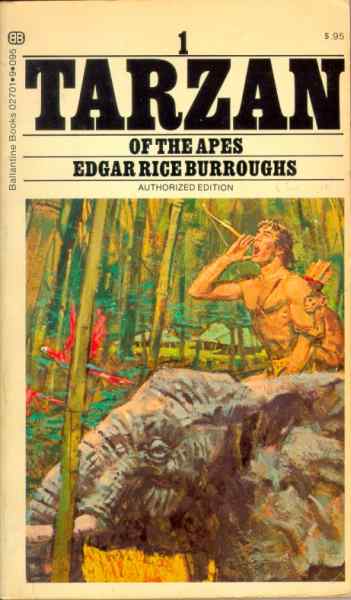
I bought "Tarzan of the Apes" by Edgar Rice Burroughs published by Ballantine Books in 1972 for 95 cents:
https://www.isfdb.org/cgi-bin/pl.cgi?342428
Here is the cover:
https://www.isfdb.org/wiki/images/4/46/TRZNFTHPSQ1972.jpg
I lost all of my 50 ? 60 ? 70 ? ERB books in The Great Flood of 1989.
I bought the Tarzan books when I was nine or ten years old, read them
over and over, along with a book or two from his other series.
Regrettably, I decided at age 12 that these were too "childish" and gave
them away. The only ERB I have left is his "Beyond the Farthest Star", mentioned in an earlier thread.
William Hyde <wthyde1953@gmail.com> wrote:
Lynn McGuire wrote:
On 2/25/2026 7:22 PM, Bobbie Sellers wrote:
On 2/25/26 14:32, Lynn McGuire wrote:
On 2/25/2026 12:55 PM, John Ames wrote:
On Mon, 23 Feb 2026 00:05:46 -0000 (UTC)
Lawrence D'Oliveiro <ldo@nz.invalid> wrote:
But then, this just shows how Burroughs was a cut above a lot of his >>>>>>> contemporaries ...
Funnily enough that's how Burroughs got into the game to begin with; he >>>>>> read some of the slop that the pulps were printing and figured "hell, >>>>>> if *this* can get printed, I can do better..." A classic example of how >>>>>> much difference just *giving a damn* can make.
In the 1970s, you could buy most of Burrough's Tarzan, Pellucidar,
and Mars books in B. Daltons. I bought and read them all. Pure pulp >>>>> and I loved them all.
Lynn
I read those much earlier from public libraries.
Are your sure that we are not talking about the Burroughs of
"Naked Lunch",
"Nova", "Junkie" and other prefigurations of modern horror.
bliss
I bought "Tarzan of the Apes" by Edgar Rice Burroughs published by
Ballantine Books in 1972 for 95 cents:
https://www.isfdb.org/cgi-bin/pl.cgi?342428
Here is the cover:
https://www.isfdb.org/wiki/images/4/46/TRZNFTHPSQ1972.jpg
I lost all of my 50 ? 60 ? 70 ? ERB books in The Great Flood of 1989.
I bought the Tarzan books when I was nine or ten years old, read them
over and over, along with a book or two from his other series.
Regrettably, I decided at age 12 that these were too "childish" and gave
them away. The only ERB I have left is his "Beyond the Farthest Star",
mentioned in an earlier thread.
Much ERB may be found on-line, if you would really want to,
Lawrence D'Oliveiro <ldo@nz.invalid> wrote:
They did indeed both colonize and conquer.
Later, much later.
J. J. Lodder wrote:
William Hyde <wthyde1953@gmail.com> wrote:
Lynn McGuire wrote:
On 2/25/2026 7:22 PM, Bobbie Sellers wrote:
On 2/25/26 14:32, Lynn McGuire wrote:
On 2/25/2026 12:55 PM, John Ames wrote:
On Mon, 23 Feb 2026 00:05:46 -0000 (UTC)
Lawrence D'Oliveiro <ldo@nz.invalid> wrote:
But then, this just shows how Burroughs was a cut above a lot of his >>>>>>>> contemporaries ...
Funnily enough that's how Burroughs got into the game to begin with; >>>>>>> he
read some of the slop that the pulps were printing and figured "hell, >>>>>>> if *this* can get printed, I can do better..." A classic example of >>>>>>> how
much difference just *giving a damn* can make.
In the 1970s, you could buy most of Burrough's Tarzan, Pellucidar, >>>>>> and Mars books in B. Daltons. I bought and read them all. Pure pulp >>>>>> and I loved them all.
Lynn
I read those much earlier from public libraries.
Are your sure that we are not talking about the Burroughs of
"Naked Lunch",
"Nova", "Junkie" and other prefigurations of modern horror.
bliss
I bought "Tarzan of the Apes" by Edgar Rice Burroughs published by
Ballantine Books in 1972 for 95 cents:
https://www.isfdb.org/cgi-bin/pl.cgi?342428
Here is the cover:
https://www.isfdb.org/wiki/images/4/46/TRZNFTHPSQ1972.jpg
I lost all of my 50 ? 60 ? 70 ? ERB books in The Great Flood of 1989.
I bought the Tarzan books when I was nine or ten years old, read them
over and over, along with a book or two from his other series.
Regrettably, I decided at age 12 that these were too "childish" and gave >>> them away. The only ERB I have left is his "Beyond the Farthest Star",
mentioned in an earlier thread.
Much ERB may be found on-line, if you would really want to,
I'm still trying to catch up on "new" SF, by which I mean anything written since 1990.
But a nostalgia read or two may not be such a bad idea.
William Hyde
On Thu, 26 Feb 2026 11:21:45 +0100, J. J. Lodder wrote:
Lawrence D'Oliveiro <ldo@nz.invalid> wrote:
They did indeed both colonize and conquer.
Later, much later.
The Portuguese deposed the Malacca Sultanate and conquered Malacca in
1511.
On Wed, 25 Feb 2026 11:46:44 +0100, J. J. Lodder wrote:
When the Portugese and the Dutch arrived in those parts they found
well-organised local states. They did not try to colonise or
conquer, they just traded.
They did indeed both colonize and conquer.
Your eyes is like pools -- pools of muddy water
Your lips is like petals -- bicycle pedals
Your teeth is like the stars -- they come out at night.
On Wed, 25 Feb 2026 22:35:36 -0000 (UTC), Lawrence DrCOOliveiro wrote:
On Wed, 25 Feb 2026 11:46:44 +0100, J. J. Lodder wrote:
When the Portugese and the Dutch arrived in those parts they found
well-organised local states. They did not try to colonise or
conquer, they just traded.
They did indeed both colonize and conquer.
Yes, but much, much later.
On Wed, 25 Feb 2026 22:11:55 -0600, lar3ryca <larry@invalid.ca> wrote:
On 2026-02-25 16:03, Paul S Person wrote:
On Tue, 24 Feb 2026 16:57:52 -0500, Cryptoengineer
<petertrei@gmail.com> wrote:
On 2/24/2026 4:45 PM, Anders D. Nygaard wrote:
On 2/24/2026 9:24 PM, lar3ryca wrote:
I went into a book store and asked the girl,
"Do you have the Prince Harry book, the one you can put on your phone?" >>>>> She said, "Do you mean the PDF file?"
"No" I said, "that's his uncle."
Usually, your .sig gives rise to a chuckle or two; sometimes after
I've turned it around in my mind for a while.
But this one ... I just don't get it.
A hint for the humour-challenged, please?
/Anders, Denmark
In English, 'PDF File' sounds fairly close
to 'Pedophile'
Apparently, "PDF" has some pronounciation other than the three
letters. One that sounds a lot like "pedo".
But not here.
It's a joke, son. It only has to be close enough.
My point is that, for me, it is nowhere near close enough.
Maybe if it involved a bicycle and its pedals ...
Remember Thursday, when William Hyde asked plaintively:
J. J. Lodder wrote:
William Hyde <wthyde1953@gmail.com> wrote:
Lynn McGuire wrote:
On 2/25/2026 7:22 PM, Bobbie Sellers wrote:I bought the Tarzan books when I was nine or ten years old, read them
On 2/25/26 14:32, Lynn McGuire wrote:
On 2/25/2026 12:55 PM, John Ames wrote:
On Mon, 23 Feb 2026 00:05:46 -0000 (UTC)
Lawrence D'Oliveiro <ldo@nz.invalid> wrote:
But then, this just shows how Burroughs was a cut above a lot of his >>>>>>>> contemporaries ...
Funnily enough that's how Burroughs got into the game to begin with; >>>>>>> he
read some of the slop that the pulps were printing and figured "hell, >>>>>>> if *this* can get printed, I can do better..." A classic example of >>>>>>> how
much difference just *giving a damn* can make.
In the 1970s, you could buy most of Burrough's Tarzan, Pellucidar, >>>>>> and Mars books in B. Daltons. I bought and read them all. Pure pulp >>>>>> and I loved them all.
Lynn
I read those much earlier from public libraries.
Are your sure that we are not talking about the Burroughs of >>>>> "Naked Lunch",
"Nova", "Junkie" and other prefigurations of modern horror.
bliss
I bought "Tarzan of the Apes" by Edgar Rice Burroughs published by
Ballantine Books in 1972 for 95 cents:
https://www.isfdb.org/cgi-bin/pl.cgi?342428
Here is the cover:
https://www.isfdb.org/wiki/images/4/46/TRZNFTHPSQ1972.jpg
I lost all of my 50 ? 60 ? 70 ? ERB books in The Great Flood of 1989. >>>
over and over, along with a book or two from his other series.
Regrettably, I decided at age 12 that these were too "childish" and gave >>> them away. The only ERB I have left is his "Beyond the Farthest Star", >>> mentioned in an earlier thread.
Much ERB may be found on-line, if you would really want to,
I'm still trying to catch up on "new" SF, by which I mean anything written since 1990.
I'm fond of the books by Anne Leckie. I even managed to read the
Ancillary series in correct order.
But a nostalgia read or two may not be such a bad idea.
I've got a copy of _The Man Who Sold The Moon_ on hand.
On Thu, 26 Feb 2026 08:02:22 -0800, Paul S Person <psperson@old.netcom.invalid> wrote:
On Wed, 25 Feb 2026 22:11:55 -0600, lar3ryca <larry@invalid.ca> wrote:
On 2026-02-25 16:03, Paul S Person wrote:
On Tue, 24 Feb 2026 16:57:52 -0500, Cryptoengineer
<petertrei@gmail.com> wrote:
On 2/24/2026 4:45 PM, Anders D. Nygaard wrote:
On 2/24/2026 9:24 PM, lar3ryca wrote:
I went into a book store and asked the girl,
"Do you have the Prince Harry book, the one you can put on your phone?"
She said, "Do you mean the PDF file?"
"No" I said, "that's his uncle."
Usually, your .sig gives rise to a chuckle or two; sometimes after >>>>> I've turned it around in my mind for a while.
But this one ... I just don't get it.
A hint for the humour-challenged, please?
/Anders, Denmark
In English, 'PDF File' sounds fairly close
to 'Pedophile'
Apparently, "PDF" has some pronounciation other than the three
letters. One that sounds a lot like "pedo".
But not here.
It's a joke, son. It only has to be close enough.
My point is that, for me, it is nowhere near close enough.
Maybe if it involved a bicycle and its pedals ...
Your eyes is like pools -- pools of muddy water
Your lips is like petals -- bicycle pedals
Your teeth is like the stars -- they come out at night.
Lawrence =?iso-8859-13?q?D=FFOliveiro?= <ldo@nz.invalid> wrote:IIRC, "open" in this context meant "allow trade with the USA". The
On Wed, 25 Feb 2026 11:46:44 +0100, J. J. Lodder wrote:
When the Portugese and the Dutch arrived in those parts they found
well-organised local states. They did not try to colonise or
conquer, they just traded.
They did indeed both colonize and conquer.
Yes, but much, much later. They talk about Matthew Perry opening up
Japan in school, but they don't mention that he met Portuguese priests
who had been there for a long time. It wasn't until Perry's era when
the Dutch and Portuguese had enough resources to actually start colonizing >Southeast Asia.
On Thu, 26 Feb 2026 20:26:20 -0500 (EST), kludge@panix.com (Scott
Dorsey) wrote:
Lawrence =?iso-8859-13?q?D=FFOliveiro?= <ldo@nz.invalid> wrote:
On Wed, 25 Feb 2026 11:46:44 +0100, J. J. Lodder wrote:
When the Portugese and the Dutch arrived in those parts they found
well-organised local states. They did not try to colonise or
conquer, they just traded.
They did indeed both colonize and conquer.
Yes, but much, much later. They talk about Matthew Perry opening up
Japan in school, but they don't mention that he met Portuguese priests
who had been there for a long time. It wasn't until Perry's era when
the Dutch and Portuguese had enough resources to actually start colonizing >> Southeast Asia.
IIRC, "open" in this context meant "allow trade with the USA". The
priests weren't traders.
On 2/27/26 08:39, Paul S Person wrote:
On Thu, 26 Feb 2026 20:26:20 -0500 (EST), kludge@panix.com (Scott
Dorsey) wrote:
Lawrence =?iso-8859-13?q?D=FFOliveiro?= <ldo@nz.invalid> wrote:
On Wed, 25 Feb 2026 11:46:44 +0100, J. J. Lodder wrote:
When the Portugese and the Dutch arrived in those parts they found
well-organised local states. They did not try to colonise or
conquer, they just traded.
They did indeed both colonize and conquer.
Yes, but much, much later. They talk about Matthew Perry opening up
Japan in school, but they don't mention that he met Portuguese priests
who had been there for a long time. It wasn't until Perry's era when
the Dutch and Portuguese had enough resources to actually start colonizing >>> Southeast Asia.
IIRC, "open" in this context meant "allow trade with the USA". The
priests weren't traders.
Any Christian priests were either attached to the trading with the
Netherlands
or lurking illegally in Japan where they had been banned for over 200
years on pain
of painful death. The Christians in Japan hid from the authorities.
On Wed, 25 Feb 2026 11:46:44 +0100, J. J. Lodder wrote:
When the Portugese and the Dutch arrived in those parts they found
well-organised local states. They did not try to colonise or
conquer, they just traded.
Snidely <snidely.too@gmail.com> wrote:
Remember Thursday, when William Hyde asked plaintively:
J. J. Lodder wrote:
William Hyde <wthyde1953@gmail.com> wrote:
Lynn McGuire wrote:
On 2/25/2026 7:22 PM, Bobbie Sellers wrote:I bought the Tarzan books when I was nine or ten years old, read them >>>>> over and over, along with a book or two from his other series.
On 2/25/26 14:32, Lynn McGuire wrote:
On 2/25/2026 12:55 PM, John Ames wrote:
On Mon, 23 Feb 2026 00:05:46 -0000 (UTC)
Lawrence D'Oliveiro <ldo@nz.invalid> wrote:
But then, this just shows how Burroughs was a cut above a lot of his >>>>>>>>>> contemporaries ...
Funnily enough that's how Burroughs got into the game to begin with; >>>>>>>>> he
read some of the slop that the pulps were printing and figured "hell, >>>>>>>>> if *this* can get printed, I can do better..." A classic example of >>>>>>>>> how
much difference just *giving a damn* can make.
In the 1970s, you could buy most of Burrough's Tarzan, Pellucidar, >>>>>>>> and Mars books in B. Daltons. I bought and read them all. Pure pulp >>>>>>>> and I loved them all.
Lynn
I read those much earlier from public libraries.
Are your sure that we are not talking about the Burroughs of >>>>>>> "Naked Lunch",
"Nova", "Junkie" and other prefigurations of modern horror.
bliss
I bought "Tarzan of the Apes" by Edgar Rice Burroughs published by >>>>>> Ballantine Books in 1972 for 95 cents:
https://www.isfdb.org/cgi-bin/pl.cgi?342428
Here is the cover:
https://www.isfdb.org/wiki/images/4/46/TRZNFTHPSQ1972.jpg
I lost all of my 50 ? 60 ? 70 ? ERB books in The Great Flood of 1989. >>>>>
Regrettably, I decided at age 12 that these were too "childish" and gave >>>>> them away. The only ERB I have left is his "Beyond the Farthest Star", >>>>> mentioned in an earlier thread.
Much ERB may be found on-line, if you would really want to,
I'm still trying to catch up on "new" SF, by which I mean anything written >>> since 1990.
I'm fond of the books by Anne Leckie. I even managed to read the
Ancillary series in correct order.
I'll have a look, on your say so.
I had taken it, without having a look,
to be yet more galactic empire junk,
like Star Wars.
But a nostalgia read or two may not be such a bad idea.
I've got a copy of _The Man Who Sold The Moon_ on hand.
'At hand' is the best place to keep it, I think,
provided you have an edition with a decorative cover.
(or a first edition)
For safety it is best to shrink-wrap those books,
and to keep them as collectibles,
Jan
(not tempted)
With a quizzical look, J. J. Lodder observed:
Snidely <snidely.too@gmail.com> wrote:
Remember Thursday, when William Hyde asked plaintively:
J. J. Lodder wrote:
William Hyde <wthyde1953@gmail.com> wrote:
Lynn McGuire wrote:
On 2/25/2026 7:22 PM, Bobbie Sellers wrote:I bought the Tarzan books when I was nine or ten years old, read them >>>>> over and over, along with a book or two from his other series.
On 2/25/26 14:32, Lynn McGuire wrote:
On 2/25/2026 12:55 PM, John Ames wrote:
On Mon, 23 Feb 2026 00:05:46 -0000 (UTC)In the 1970s, you could buy most of Burrough's Tarzan, Pellucidar, >>>>>>>> and Mars books in B. Daltons. I bought and read them all. Pure pulp
Lawrence D'Oliveiro <ldo@nz.invalid> wrote:
But then, this just shows how Burroughs was a cut above a lot >>>>>>>>>> of his contemporaries ...
Funnily enough that's how Burroughs got into the game to begin with;
he
read some of the slop that the pulps were printing and figured >>>>>>>>> "hell, if *this* can get printed, I can do better..." A classic >>>>>>>>> example of how much difference just *giving a damn* can make. >>>>>>>>
and I loved them all.
Lynn
I read those much earlier from public libraries.
Are your sure that we are not talking about the Burroughs of >>>>>>> "Naked Lunch",
"Nova", "Junkie" and other prefigurations of modern horror.
bliss
I bought "Tarzan of the Apes" by Edgar Rice Burroughs published by >>>>>> Ballantine Books in 1972 for 95 cents:
https://www.isfdb.org/cgi-bin/pl.cgi?342428
Here is the cover:
https://www.isfdb.org/wiki/images/4/46/TRZNFTHPSQ1972.jpg
I lost all of my 50 ? 60 ? 70 ? ERB books in The Great Flood of 1989. >>>>>
Regrettably, I decided at age 12 that these were too "childish" and gave
them away. The only ERB I have left is his "Beyond the Farthest Star", >>>>> mentioned in an earlier thread.
Much ERB may be found on-line, if you would really want to,
I'm still trying to catch up on "new" SF, by which I mean anything written
since 1990.
I'm fond of the books by Anne Leckie. I even managed to read the
Ancillary series in correct order.
I'll have a look, on your say so.
I had taken it, without having a look,
to be yet more galactic empire junk,
like Star Wars.
There is an empire, but it isn't just space cowboys or Horatio
Hornblower. And the non-Ancillary books use the same universe, but
explore different cultures that humans might have.
But a nostalgia read or two may not be such a bad idea.
I've got a copy of _The Man Who Sold The Moon_ on hand.
'At hand' is the best place to keep it, I think,
provided you have an edition with a decorative cover.
(or a first edition)
For safety it is best to shrink-wrap those books,
and to keep them as collectibles,
Jan
(not tempted)
It was a used paperback book when I bought it 50ish years ago, and
probably not a first edition, although it predates the ink-blot SF
covers.
Lawrence =?iso-8859-13?q?D=FFOliveiro?= <ldo@nz.invalid> wrote:
On Wed, 25 Feb 2026 11:46:44 +0100, J. J. Lodder wrote:
When the Portugese and the Dutch arrived in those parts they found
well-organised local states. They did not try to colonise or
conquer, they just traded.
They did indeed both colonize and conquer.
Yes, but much, much later. They talk about Matthew Perry opening up
Japan in school, but they don't mention that he met Portuguese priests
who had been there for a long time.
It wasn't until Perry's era when
the Dutch and Portuguese had enough resources to actually start colonizing Southeast Asia.
On Wed, 25 Feb 2026 11:46:44 +0100, J. J. Lodder wrote:
When the Portugese and the Dutch arrived in those parts they found
well-organised local states. They did not try to colonise or
conquer, they just traded.
Good joke! The islands of what is now Indonesia did not come peacefully
under Dutch rule.
On 2/27/26 08:39, Paul S Person wrote:
On Thu, 26 Feb 2026 20:26:20 -0500 (EST), kludge@panix.com (Scott
Dorsey) wrote:
Lawrence =?iso-8859-13?q?D=FFOliveiro?= <ldo@nz.invalid> wrote:
On Wed, 25 Feb 2026 11:46:44 +0100, J. J. Lodder wrote:
When the Portugese and the Dutch arrived in those parts they found
well-organised local states. They did not try to colonise or
conquer, they just traded.
They did indeed both colonize and conquer.
Yes, but much, much later. They talk about Matthew Perry opening up
Japan in school, but they don't mention that he met Portuguese priests
who had been there for a long time. It wasn't until Perry's era when
the Dutch and Portuguese had enough resources to actually start colonizing >> Southeast Asia.
IIRC, "open" in this context meant "allow trade with the USA". The
priests weren't traders.
Any Christian priests were either attached to the trading with the Netherlands
or lurking illegally in Japan where they had been banned for over 200
years on pain
of painful death.
The Christians in Japan hid from the authorities. The Dutch were
subjected to severe restrictions on a single island connected by a foot bridge to mainland. They had a small community on that island and
permission to teach some few Japanese people foreign languages so that they could study Western Learning.
The original opening of Japan by Perry was in order to get coaling startions
for American ships trading with China. China also maintained trading relationships
with Japan by the way.
The Jesuit priests had been in Japan during the Unification of Japan in the late 1500 under the three great leaders Nobunaga, Hideyoshi, and finally Ieyasu Tokugawa whose successor drove out the Christian priests and
crushed the Christian Rebellion in Southern Japan. Participating in the crushing was Miyamoto Musashi, the great swordsman. He is the hero
of a series of films and TV shows as well as manga and anime and
at least one great novel.
Ah, but Jesus actually visited Japan.
Steve Hayes <hayesstw@telkomsa.net> wrote:
On Thu, 26 Feb 2026 08:02:22 -0800, Paul S Person
<psperson@old.netcom.invalid> wrote:
Maybe if it involved a bicycle and its pedals ...
Your eyes is like pools -- pools of muddy water
Your lips is like petals -- bicycle pedals
Your teeth is like the stars -- they come out at night.
"Let me gaze into your beautiful orbs - stitched with red cotton."
Participating in the crushing was Miyamoto Musashi, the great
swordsman. He is the hero of a series of films and TV shows as well
as manga and anime and at least one great novel.
Ah, but Jesus actually visited Japan.
https://en.wikipedia.org/wiki/Kirisuto_no_Haka
In article <klloR.5$1%Hc.3@fx18.iad>, Scott Lurndal <slp53@pacbell.net> wrote: >>
Ah, but Jesus actually visited Japan.
https://en.wikipedia.org/wiki/Kirisuto_no_Haka
And did those feet
In ancient times
Nihon o aruku?
Bobbie Sellers <bliss-sf4ever@dslextreme.com> wrote:
On 2/27/26 08:39, Paul S Person wrote:
On Thu, 26 Feb 2026 20:26:20 -0500 (EST), kludge@panix.com (Scott
Dorsey) wrote:
Lawrence =?iso-8859-13?q?D=FFOliveiro?= <ldo@nz.invalid> wrote:
On Wed, 25 Feb 2026 11:46:44 +0100, J. J. Lodder wrote:
When the Portugese and the Dutch arrived in those parts they found >>>>>> well-organised local states. They did not try to colonise or
conquer, they just traded.
They did indeed both colonize and conquer.
Yes, but much, much later. They talk about Matthew Perry opening up
Japan in school, but they don't mention that he met Portuguese priests >>>> who had been there for a long time. It wasn't until Perry's era when
the Dutch and Portuguese had enough resources to actually start colonizing >>>> Southeast Asia.
IIRC, "open" in this context meant "allow trade with the USA". The
priests weren't traders.
Any Christian priests were either attached to the trading with the
Netherlands
or lurking illegally in Japan where they had been banned for over 200
years on pain
of painful death.
Certainly not by way of the Dutch.
(who were thoroughly Protestant,
and not at all inclined to help catholicism in any way)
The Japanese felt that crucifying christians was doing them a favour,
by their own christian doctrines.
In short, there probably weren't catholic missionaries before Perry.
The Christians in Japan hid from the authorities. The Dutch were
subjected to severe restrictions on a single island connected by a foot
bridge to mainland. They had a small community on that island and
permission to teach some few Japanese people foreign languages so that they >> could study Western Learning.
Not foreign languages, just Dutch.
The Shogunate provided translators,
because they did not want the Dutch to learn Japanese.
The Dutch sciences (Oranda Rangaku) were the window on the west
for Japanese scholars. <https://www.the-low-countries.com/article/when-japans-elite-spoke-dutch/> Many scientific Japanese terms still have obviously Dutch roots.
The original opening of Japan by Perry was in order to get coaling
startions
for American ships trading with China. China also maintained trading
relationships
with Japan by the way.
The Jesuit priests had been in Japan during the Unification of Japan in
the late 1500 under the three great leaders Nobunaga, Hideyoshi, and finally >> Ieyasu Tokugawa whose successor drove out the Christian priests and
crushed the Christian Rebellion in Southern Japan. Participating in the
crushing was Miyamoto Musashi, the great swordsman. He is the hero
of a series of films and TV shows as well as manga and anime and
at least one great novel.
They had gambled on the wrong side in the civil wars, and lost all,
Jan
On 2/27/2026 3:48 PM, J. J. Lodder wrote:
Bobbie Sellers <bliss-sf4ever@dslextreme.com> wrote:
On 2/27/26 08:39, Paul S Person wrote:
On Thu, 26 Feb 2026 20:26:20 -0500 (EST), kludge@panix.com (Scott
Dorsey) wrote:
Lawrence =?iso-8859-13?q?D=FFOliveiro?=-a <ldo@nz.invalid> wrote:
On Wed, 25 Feb 2026 11:46:44 +0100, J. J. Lodder wrote:
When the Portugese and the Dutch arrived in those parts they found >>>>>>> well-organised local states. They did not try to colonise or
conquer, they just traded.
They did indeed both colonize and conquer.
Yes, but much, much later.-a They talk about Matthew Perry opening up >>>>> Japan in school, but they don't mention that he met Portuguese priests >>>>> who had been there for a long time.-a It wasn't until Perry's era when >>>>> the Dutch and Portuguese had enough resources to actually start
colonizing
Southeast Asia.
IIRC, "open" in this context meant "allow trade with the USA". The
priests weren't traders.
-a-a-a-a-a-a Any Christian priests were either attached to the trading with
the
Netherlands
or lurking illegally in Japan where they had been banned for over 200
years on pain
of painful death.
Certainly not by way of the Dutch.
(who were thoroughly Protestant,
-a and not at all inclined to help catholicism in any way)
The Japanese felt that crucifying christians was doing them a favour,
by their own christian doctrines.
In short, there probably weren't catholic missionaries before Perry.
-a The Christians in Japan hid from the authorities. The Dutch were
subjected to severe restrictions on a single island connected by a foot
bridge to mainland.-a They had a small community on that island and
permission to teach some few Japanese people foreign languages so
that they
could study Western Learning.
Not foreign languages, just Dutch.
The Shogunate provided translators,
because they did not want the Dutch to learn Japanese.
The Dutch sciences (Oranda Rangaku) were the window on the west
for Japanese scholars.
<https://www.the-low-countries.com/article/when-japans-elite-spoke-
dutch/>
Many scientific Japanese terms still have obviously Dutch roots.
Just to clarify the timeline:
-a-a-a-a-a-a The original opening of Japan by Perry was in order to get >>> coaling
startions
for American ships trading with China.-a China also maintained trading
relationships
with Japan by the way.
-a-a-a-a-a-a The Jesuit priests had been in Japan during the Unification of
Japan in
the late 1500 under the three great leaders Nobunaga, Hideyoshi, and
finally
Ieyasu Tokugawa whose successor drove out the Christian priests and
crushed the Christian Rebellion in Southern Japan.-a Participating in the >>> crushing was Miyamoto Musashi,-a the great swordsman. He is the hero
of a series of films and TV shows as well as manga and anime and
at least one great novel.
They had gambled on the wrong side in the civil wars, and lost all,
Jan
1549: First Portuguese Missionaries arrive. Many converts made.
~1597: Christianity brutally suppressed. A few crypto-Christians remain underground until after the opening.
From roughly 1600 to 1853, Japan is 'closed'. The only foreign mission
was a small Dutch group on an island in Hiroshima harbor.
1871: Freedom of religion restored, many Christian missions arrive.
pt
~1597: Christianity brutally suppressed.
On 2/27/2026 3:48 PM, J. J. Lodder wrote:
Bobbie Sellers <bliss-sf4ever@dslextreme.com> wrote:
On 2/27/26 08:39, Paul S Person wrote:
On Thu, 26 Feb 2026 20:26:20 -0500 (EST), kludge@panix.com (Scott
Dorsey) wrote:
Lawrence =?iso-8859-13?q?D=FFOliveiro?= <ldo@nz.invalid> wrote:
On Wed, 25 Feb 2026 11:46:44 +0100, J. J. Lodder wrote:
When the Portugese and the Dutch arrived in those parts they found >>>>>> well-organised local states. They did not try to colonise or
conquer, they just traded.
They did indeed both colonize and conquer.
Yes, but much, much later. They talk about Matthew Perry opening up >>>> Japan in school, but they don't mention that he met Portuguese priests >>>> who had been there for a long time. It wasn't until Perry's era when >>>> the Dutch and Portuguese had enough resources to actually start
colonizing Southeast Asia.
IIRC, "open" in this context meant "allow trade with the USA". The
priests weren't traders.
Any Christian priests were either attached to the trading with the >> Netherlands
or lurking illegally in Japan where they had been banned for over 200
years on pain
of painful death.
Certainly not by way of the Dutch.
(who were thoroughly Protestant,
and not at all inclined to help catholicism in any way)
The Japanese felt that crucifying christians was doing them a favour,
by their own christian doctrines.
In short, there probably weren't catholic missionaries before Perry.
The Christians in Japan hid from the authorities. The Dutch were
subjected to severe restrictions on a single island connected by a foot
bridge to mainland. They had a small community on that island and
permission to teach some few Japanese people foreign languages so that
they could study Western Learning.
Not foreign languages, just Dutch.
The Shogunate provided translators,
because they did not want the Dutch to learn Japanese.
The Dutch sciences (Oranda Rangaku) were the window on the west
for Japanese scholars. <https://www.the-low-countries.com/article/when-japans-elite-spoke-dutch/> Many scientific Japanese terms still have obviously Dutch roots.
The original opening of Japan by Perry was in order to get coaling >> startions
for American ships trading with China. China also maintained trading
relationships
with Japan by the way.
The Jesuit priests had been in Japan during the Unification of
Japan in the late 1500 under the three great leaders Nobunaga,
Hideyoshi, and finally Ieyasu Tokugawa whose successor drove out the
Christian priests and crushed the Christian Rebellion in Southern
Japan. Participating in the crushing was Miyamoto Musashi, the great
swordsman. He is the hero of a series of films and TV shows as well as
manga and anime and at least one great novel.
They had gambled on the wrong side in the civil wars, and lost all,
Jan
Just to clarify the timeline:
1549: First Portuguese Missionaries arrive. Many converts made.
~1597: Christianity brutally suppressed. A few crypto-Christians remain underground until after the opening.
From roughly 1600 to 1853, Japan is 'closed'. The only foreign mission
was a small Dutch group on an island in Hiroshima harbor.
On Fri, 27 Feb 2026 23:23:17 -0500, Cryptoengineer wrote:
~1597: Christianity brutally suppressed.
Maybe somebody accidentally told them about the Crusades ...
Just to clarify the timeline:
1549: First Portuguese Missionaries arrive. Many converts made.
~1597: Christianity brutally suppressed. A few crypto-Christians remain underground until after the opening.
From roughly 1600 to 1853, Japan is 'closed'. The only foreign mission
was a small Dutch group on an island in Hiroshima harbor.
"Gary R. Schmidt" <grschmidt@acm.org> writes:
And it can't be explained, it's like knowing why the nickname for
someone with red hair is "Blue" (or Bluey).
Hmm. I have a red heeler mix (named Bernadette). My grand-niece
watches a cartoon called Bluey (which appears to be about a blue
heeler).
On 27/02/26 03:24, Scott Lurndal wrote:
"Gary R. Schmidt" <grschmidt@acm.org> writes:
And it can't be explained, it's like knowing why the nickname for
someone with red hair is "Blue" (or Bluey).
When I were a lad the newspapers carried a comic strip called "Bluey and >Curly". Curly had straight hair, of course. The comics were in black and >white in those days, but everyone knew that Bluey must have had red hair.
Hmm. I have a red heeler mix (named Bernadette). My grand-niece
watches a cartoon called Bluey (which appears to be about a blue
heeler).
The ABC cartoon series Bluey is enormously popular with children, and I >believe it has received multiple awards for quality.
On 2/28/2026 2:20 PM, Lawrence DrCOOliveiro wrote:
Which in turn reminds me of rCLThe StarlostrCY TV series, which started
out so promisingly ... and left Harlan Ellison permanently
embittered ...
As someone who recently watched that show, the "Started out" period
ended before the production had finished hiring. Ellison pulled his
name and replaced it with his "I hate this production" pen name
before they had even finished re-writing his premiere episode.
I donrCOt recall if Malaysian TV showed all the episodes -- I know
there werenrCOt that many made. So it either ended (unexpectedly), or
they pulled it prematurely, without any announcement -- and replaced
it with that (to me) festering pile of trash called rCLThe InvadersrCY,
yet another formulaic rehash of the tired old hostile-aliens-secretly-trying-to-take-over-Earth trope.
On Sat, 28 Feb 2026 20:28:53 -0800, Dimensional Traveler wrote:
On 2/28/2026 2:20 PM, Lawrence DrCOOliveiro wrote:
Which in turn reminds me of rCLThe StarlostrCY TV series, which started
out so promisingly ... and left Harlan Ellison permanently
embittered ...
As someone who recently watched that show, the "Started out" period
ended before the production had finished hiring. Ellison pulled his
name and replaced it with his "I hate this production" pen name
before they had even finished re-writing his premiere episode.
As a teenage SF fan, the premise seemed to me to hold so much
potential. I must have been less critical about things back then,
because I faithfully sat down and watched it every week. Certainly my >imagination was triggered in a major way -- I think that must have
been my first exposure to the generation-ship idea. I had never, to
that point, thought of a spaceship vast enough to hold the equivalent
of entire citiesrCO (multiple cities!) worth of inhabitants.
And a generation ship whose navigation system had broken down and was
heading for disaster? And the inhabitants totally unaware of this, any >members of the crew who might have been qualified to know what was
going on -- and do something about it -- being (seemingly) long since
dead? To me, that sounded amazing.
I donrCOt recall if Malaysian TV showed all the episodes -- I know there >werenrCOt that many made. So it either ended (unexpectedly), or they
pulled it prematurely, without any announcement -- and replaced it
with that (to me) festering pile of trash called rCLThe InvadersrCY, yet >another formulaic rehash of the tired old >hostile-aliens-secretly-trying-to-take-over-Earth trope.--
I remember being just about physically sick.
We all know that 90% of everything is crap, but there's a
little-known extension to that law. When choosing what to show, TV programmers will almost always make their pick from that 90%.
IMDb says "18 episodes" but in the episode list, #17 and #18 sayWhich seems prudent, as the program /may/ have gotten better.
that they were written but never filmed.
The IMDb rating is 6.2, fromr 656 raters. That would be a bit
higher than the average rating for a movie (I think), but TV
series generally have higher scores than movies. (I assume that
some other people are like me -- we will quit watching a TV series
we don't like, but won't rate it since we did not see much of it.)
Just to clarify the timeline:
1549: First Portuguese Missionaries arrive. Many converts made.
~1597: Christianity brutally suppressed. A few crypto-Christians
remain underground until after the opening.
From roughly 1600 to 1853, Japan is 'closed'. The only foreign
mission was a small Dutch group on an island in Hiroshima harbor.
1871: Freedom of religion restored, many Christian missions arrive.
On Fri, 27 Feb 2026 23:23:17 -0500, Cryptoengineer wrote:
Just to clarify the timeline:
1549: First Portuguese Missionaries arrive. Many converts made.
~1597: Christianity brutally suppressed. A few crypto-Christians
remain underground until after the opening.
From roughly 1600 to 1853, Japan is 'closed'. The only foreign
mission was a small Dutch group on an island in Hiroshima harbor.
1871: Freedom of religion restored, many Christian missions
arrive.
DoesnrCOt it make you wonder, in a country where Buddhism and
Shintoism, and I think even animism and Confucianism, could coexist peacefully for centuries, the moment Christianity appears on the
scene, the trouble starts?
Could it be because this was the first time the Japanese were
exposed to a religion with intolerance built deeply into its core
doctrines? Namely: rCLour god is the true god, all other gods are
falserCY?
On Fri, 27 Feb 2026 23:23:17 -0500, Cryptoengineer wrote:
Just to clarify the timeline:
1549: First Portuguese Missionaries arrive. Many converts made.
~1597: Christianity brutally suppressed. A few crypto-Christians
remain underground until after the opening.
From roughly 1600 to 1853, Japan is 'closed'. The only foreign
mission was a small Dutch group on an island in Hiroshima harbor.
1871: Freedom of religion restored, many Christian missions arrive.
DoesnrCOt it make you wonder, in a country where Buddhism and Shintoism,
and I think even animism and Confucianism, could coexist peacefully
for centuries, the moment Christianity appears on the scene, the
trouble starts?
Could it be because this was the first time the Japanese were exposed
to a religion with intolerance built deeply into its core doctrines?
Namely: rCLour god is the true god, all other gods are falserCY?
Short version: TV ads can carry ultrasonic tags,
On 3/1/2026 5:30 PM, Lawrence D'Oliveiro wrote:
On Fri, 27 Feb 2026 23:23:17 -0500, Cryptoengineer wrote:
Just to clarify the timeline:
1549: First Portuguese Missionaries arrive. Many converts made.
~1597: Christianity brutally suppressed. A few crypto-Christians
remain underground until after the opening.
From roughly 1600 to 1853, Japan is 'closed'. The only foreign
mission was a small Dutch group on an island in Hiroshima harbor.
1871: Freedom of religion restored, many Christian missions arrive.
Doesn't it make you wonder, in a country where Buddhism and Shintoism,
and I think even animism and Confucianism, could coexist peacefully
for centuries, the moment Christianity appears on the scene, the
trouble starts?
Could it be because this was the first time the Japanese were exposed
to a religion with intolerance built deeply into its core doctrines? Namely: "our god is the true god, all other gods are false"?
My quick perusal of Wikipedia finds:
"Under Oda Nobunaga, the Jesuits enjoyed the favor of his regency. The successor of Oda, Toyotomi Hideyoshi at first protected Christianity,
however later changed his policy with the publishing of the Bateren
Edict, banning missionary activities. After conquering Kyushu, Hideyoshi visited Hakozaki and came to believe that Jesuits were selling Japanese people as slaves overseas, Christians were destroying shrines and
temples, and people were being forced to convert to Christianity,
resulting in the aforementioned edict. Alessandro Valignano, on 14
December 1582 wrote a letter to Governor-General of the Philippines Francisco de Sande Pic<n stating that it would be impossible to conquer
Japan by military power and converting Japan to Christianity was the
most important task of church.[18][19] Scholars also theorise that
Hideyoshi believed the true mission of the Christian missionaries was to convert the Japanese population to Christianity, overthrow the
government, and turn it into a colony".
I've also heard that around 1600 a British{?} diplomat gave the
Shogun a copy of the Treaty of Zaragoza in Latin, which the
Shogun ordered a Jesuit priest to translate. This specified
Spanish and Portuguese colonial spheres of the far east, ceding
Japan to Portugal.
The Shogun was not happy.
Cryptoengineer <petertrei@gmail.com> wrote:
On 3/1/2026 5:30 PM, Lawrence D'Oliveiro wrote:
On Fri, 27 Feb 2026 23:23:17 -0500, Cryptoengineer wrote:
Just to clarify the timeline:
1549: First Portuguese Missionaries arrive. Many converts made.
~1597: Christianity brutally suppressed. A few crypto-Christians
remain underground until after the opening.
From roughly 1600 to 1853, Japan is 'closed'. The only foreign
mission was a small Dutch group on an island in Hiroshima harbor.
1871: Freedom of religion restored, many Christian missions arrive.
Doesn't it make you wonder, in a country where Buddhism and Shintoism,
and I think even animism and Confucianism, could coexist peacefully
for centuries, the moment Christianity appears on the scene, the
trouble starts?
Could it be because this was the first time the Japanese were exposed
to a religion with intolerance built deeply into its core doctrines?
Namely: "our god is the true god, all other gods are false"?
My quick perusal of Wikipedia finds:
"Under Oda Nobunaga, the Jesuits enjoyed the favor of his regency. The
successor of Oda, Toyotomi Hideyoshi at first protected Christianity,
however later changed his policy with the publishing of the Bateren
Edict, banning missionary activities. After conquering Kyushu, Hideyoshi
visited Hakozaki and came to believe that Jesuits were selling Japanese
people as slaves overseas, Christians were destroying shrines and
temples, and people were being forced to convert to Christianity,
resulting in the aforementioned edict. Alessandro Valignano, on 14
December 1582 wrote a letter to Governor-General of the Philippines
Francisco de Sande Pic||n stating that it would be impossible to conquer
Japan by military power and converting Japan to Christianity was the
most important task of church.[18][19] Scholars also theorise that
Hideyoshi believed the true mission of the Christian missionaries was to
convert the Japanese population to Christianity, overthrow the
government, and turn it into a colony".
I've also heard that around 1600 a British{?} diplomat gave the
Shogun a copy of the Treaty of Zaragoza in Latin, which the
Shogun ordered a Jesuit priest to translate. This specified
Spanish and Portuguese colonial spheres of the far east, ceding
Japan to Portugal.
In 1600 the Dutch ship 'De Liefde' (The Love) stranded in Japan.
The Captain, Jacob Quaeckernaeck, the ships officer, Jan Joosten van Lodensteyn, and the ship's pilot, William Adams
were ordered to present themselves at the Shogun's court.
William Adams was an Englishman by birth.
(the Dutch were equal opportunity employers)
They could do little but obey, because they were effectively prisoners.
But of course they were happy with it,
for making contacts was just what the journey was about.
And yes, the treaty of Zaragossa was a refinement of
the earlier treaty of Tordesillas.
The Shogun was not happy.
Of course not, it stipulated effectively
that he was to consider himself a subject of the king of Portugal.
He had good reason to see the attempts at conversion of the missionaries
as an attempt to take control of Japan, ultimately.
He was happy with the Dutch and the English. [1]
Adams got Japanese titles, an estate, and a Japanese wife,
and he became the first non-Japanese samurai.
The Dutch got trade licences, and became rich.
The most useful knowledge that the Dutch brought with them
was that there are several kinds of christianity,
and that they were at war with each other in Europe.
Good christians, like the Dutch and the English,
versus bad christians like those horrible Jesuits.
Jan
[1] There is much popularised history of it in the 'Shogun' series
by James Clavell.
On Fri, 27 Feb 2026 23:23:17 -0500, Cryptoengineer wrote:Why would it make us wonder when the same thing happened 1500 years
Just to clarify the timeline:
1549: First Portuguese Missionaries arrive. Many converts made.
~1597: Christianity brutally suppressed. A few crypto-Christians
remain underground until after the opening.
From roughly 1600 to 1853, Japan is 'closed'. The only foreign
mission was a small Dutch group on an island in Hiroshima harbor.
1871: Freedom of religion restored, many Christian missions arrive.
DoesnAt it make you wonder, in a country where Buddhism and Shintoism,
and I think even animism and Confucianism, could coexist peacefully
for centuries, the moment Christianity appears on the scene, the
trouble starts?
Could it be because this was the first time the Japanese were exposedNo Jews or Muslims present, then.
to a religion with intolerance built deeply into its core doctrines?
Namely: oour god is the true god, all other gods are falseo?
On Sun, 1 Mar 2026 22:30:15 -0000 (UTC), Lawrence D|Oliveiro
<ldo@nz.invalid> wrote:
On Fri, 27 Feb 2026 23:23:17 -0500, Cryptoengineer wrote:
Just to clarify the timeline:
1549: First Portuguese Missionaries arrive. Many converts made.
~1597: Christianity brutally suppressed. A few crypto-Christians
remain underground until after the opening.
From roughly 1600 to 1853, Japan is 'closed'. The only foreign
mission was a small Dutch group on an island in Hiroshima harbor.
1871: Freedom of religion restored, many Christian missions arrive.
DoesnAt it make you wonder, in a country where Buddhism and Shintoism,
and I think even animism and Confucianism, could coexist peacefully
for centuries, the moment Christianity appears on the scene, the
trouble starts?
Why would it make us wonder when the same thing happened 1500 years
earlier in the Roman Empire?
Could it be because this was the first time the Japanese were exposed
to a religion with intolerance built deeply into its core doctrines?
Namely: oour god is the true god, all other gods are falseo?
No Jews or Muslims present, then.
Cryptoengineer <petertrei@gmail.com> wrote:
[...]
Short version: TV ads can carry ultrasonic tags,
Utter nonsense. The audio bandwidth of TV isn't sufficient to carry ultrasonic signals.
| Sysop: | Amessyroom |
|---|---|
| Location: | Fayetteville, NC |
| Users: | 59 |
| Nodes: | 6 (0 / 6) |
| Uptime: | 18:23:30 |
| Calls: | 810 |
| Calls today: | 1 |
| Files: | 1,287 |
| D/L today: |
10 files (21,017K bytes) |
| Messages: | 193,781 |