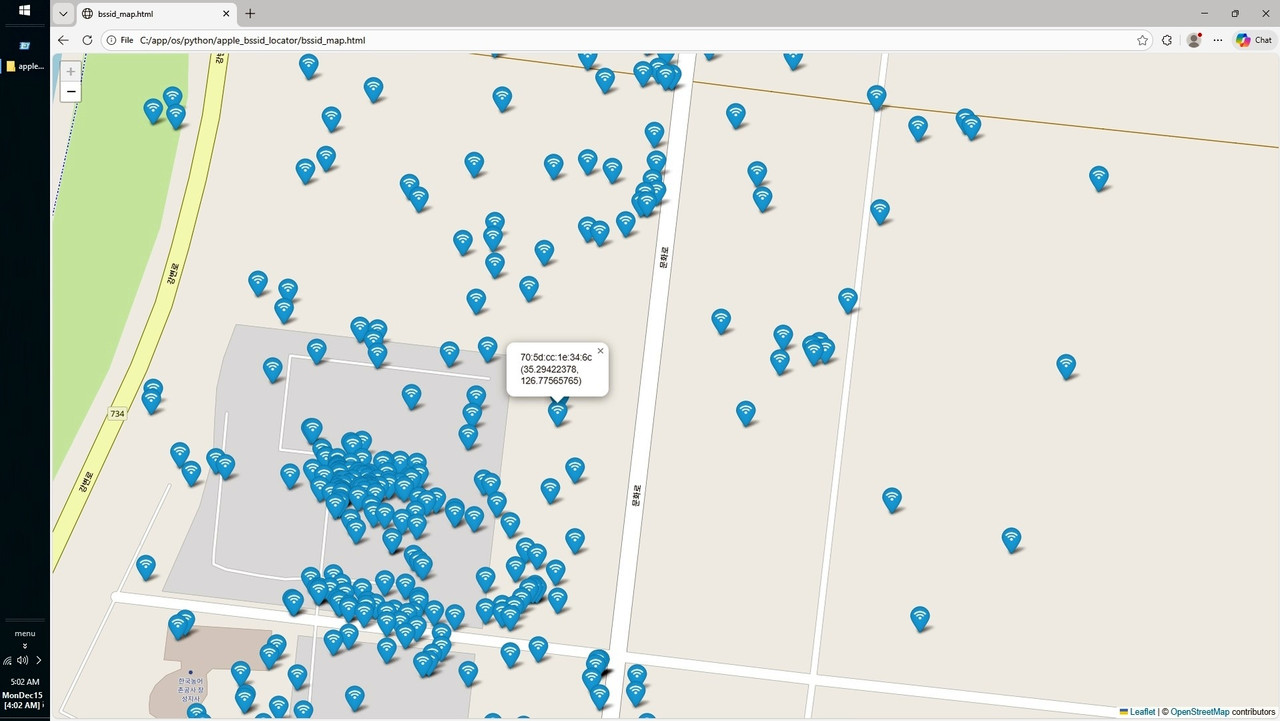
Here is code I hacked out this morning which tracks those 400 BSSID:GPS pairs, where I set the distance to 100KM but it could be any distance.
bssidgenerate.bat
Here is code I hacked out this morning which tracks those 400 BSSID:GPS
pairs, where I set the distance to 100KM but it could be any distance.
Here is code that generates random (or sequential) BSSIDs to place into a file which can later be checked against Apple's highly insecure WPS DB.
My claim is that it's trivial to gather valid access points to check
against Apple's highly insecure WPS database, where below is that check.
BSSID: 8c:85:80:d1:be:37
Latitude: 32.45985031
Longitude: -93.81759643000001
BSSID: 8e:76:3f:f8:5d:cd
Latitude: 32.4594841
Longitude: -93.8175888
BSSID: 92:76:3f:f8:5d:cd
Latitude: 32.4594841
Longitude: -93.81756591
BSSID: 92:95:51:b5:b6:ae
Latitude: 32.45910644
Longitude: -93.81759643000001
Does anyone have any idea why the highly insecure Apple WPS database
contains GPS entries to this illogically numerous set of decimal places?
Marian wrote:
-a BSSID: 8c:85:80:d1:be:37
-a Latitude: 32.45985031
-a Longitude: -93.81759643000001
-a -a BSSID: 8e:76:3f:f8:5d:cd
-a Latitude: 32.4594841
-a Longitude: -93.8175888
-a -a BSSID: 92:76:3f:f8:5d:cd
-a Latitude: 32.4594841
-a Longitude: -93.81756591
-a -a BSSID: 92:95:51:b5:b6:ae
-a Latitude: 32.45910644
-a Longitude: -93.81759643000001
Does anyone have any idea why the highly insecure Apple WPS database
contains GPS entries to this illogically numerous set of decimal places?
BSSID: 8c:85:80:d1:be:37 <https://wavedigger.networksurvey.app/?tab=bssid&bssid=8c-85-80-d1-be-37>
BSSID: 8e:76:3f:f8:5d:cd <https://wavedigger.networksurvey.app/?tab=bssid&bssid=8e-76-3f-f8-5d-cd>
BSSID: 92:76:3f:f8:5d:cd <https://wavedigger.networksurvey.app/?tab=bssid&bssid=92-76-3f-f8-5d-cd>
BSSID: 92:95:51:b5:b6:ae <https://wavedigger.networksurvey.app/?tab=bssid&bssid=92-95-51-b5-b6-ae>
this tutorial is only useful if you want to control the query
of Apple's highly insecure WPS database, which has no privacy controls.
How could anyone discover that AA:BB:CC:11:22:33 belongs to Arlen?
Marian wrote:
this tutorial is only useful if you want to control the query
of Apple's highly insecure WPS database, which has no privacy controls.
I've not followed this thread in detail, I could understand the outrage
*if* apple were storing SSID/GPS pairs, such as ssid:Arlens_house_nomap=latitude:40.12345678,longitude:-120.12345678
But how is it compromising to store BSSID/GPS pairs such as bssid:AA:BB:CC:11:22:33=latitude:40.12345678,longitude:-120.12345678
How could anyone discover that AA:BB:CC:11:22:33 belongs to Arlen?
How could anyone discover that AA:BB:CC:11:22:33 belongs to Arlen?
Easy : Someone drives up to his house and than checks their phone which SSIDs it detects. :-)
Since I reproduced almost exactly what the researchers said could be done, did you read the research papers which were cited about this subject?
See references in the sig...
How could anyone discover that AA:BB:CC:11:22:33 belongs to Arlen?
Easy : Someone drives up to his house and than checks their phone which
SSIDs it detects. :-)
Here's the key thing we need to do to gain an appreciation for privacy.
I suggest anyone else who thinks a BSSID is "just a number" begin to
separate the object being tracked from the person being inferred.
Marian wrote:
See references in the sig...
I hide .sigs to avoid the politics/religion that some people use.
If someone could come up with a single sentence that describes how
someone could find one or more BSSIDs for a person or family, without already knowing their location, that would spark my curiosity ...
$GPGGA,210230,3855.4487,N,09446.0071,W,1,07,1.1,370.5,M,-29.5,M,,*7A # degrees minutes fractions-of-a-minute
Latitude (in DDMM.MMM format) 38.554487 as 38. 55.4487
Latitude compass direction
Longitude (in DDDMM.MMM format) 094.460071 as 094. 46.0071
Longitude compass direction
We don't want to go into the minutiae to dismiss the crap on the end of -93.81759643000001
Marian wrote:
Since I reproduced almost exactly what the researchers said could be done, >> did you read the research papers which were cited about this subject?
No, I didn't ...
Andy Burns <usenet@andyburns.uk> wrote:
Marian wrote:
See references in the sig...
I hide .sigs to avoid the politics/religion that some people use.
If someone could come up with a single sentence that describes how
someone could find one or more BSSIDs for a person or family, without
already knowing their location, that would spark my curiosity ...
The key question.
You think you can be anonymous / untrackable ? Think again.
I (can) have every access point location
in the world (over 2 billion) if I felt like getting it (and storing it).
You think you can be anonymous / untrackable ? Think again.
The fundamental issue is Apple is not respecting their legally binding
policy to allow people like me (who care about privacy) to opt out of WPS.
Marian wrote:
I (can) have every access point location
in the world (over 2 billion) if I felt like getting it (and storing it).
But which of those 2 billion belong to me?
On Mon, 22 Dec 2025 18:00:14 +0000, Andy Burns <usenet@andyburns.uk>
wrote:
Marian wrote:
I (can) have every access point locationBut which of those 2 billion belong to me?
in the world (over 2 billion) if I felt like getting it (and storing it). >>
Well, *you* know which it is, and ve haf vays of making you talk, so...
https://en.wiktionary.org/wiki/ve_haf_vays_of_making_you_talk
On Mon, 22 Dec 2025 18:00:14 +0000, Andy Burns <usenet@andyburns.uk>
wrote:
Marian wrote:
I (can) have every access point locationBut which of those 2 billion belong to me?
in the world (over 2 billion) if I felt like getting it (and storing it). >>
Well, *you* know which it is, and ve haf vays of making you talk, so...
https://en.wiktionary.org/wiki/ve_haf_vays_of_making_you_talk
Char Jackson <none@none.invalid> wrote:
On Mon, 22 Dec 2025 18:00:14 +0000, Andy Burns <usenet@andyburns.uk>
wrote:
Marian wrote:
I (can) have every access point locationBut which of those 2 billion belong to me?
in the world (over 2 billion) if I felt like getting it (and storing it). >>>
Well, *you* know which it is, and ve haf vays of making you talk, so...
Do *you* know your MAC address if presented with a list? I certainly don't.
On Tue, 23 Dec 2025 10:00:36 -0000 (UTC), Chris <ithinkiam@gmail.com>
wrote:
Char Jackson <none@none.invalid> wrote:
On Mon, 22 Dec 2025 18:00:14 +0000, Andy Burns <usenet@andyburns.uk>
wrote:
Marian wrote:
I (can) have every access point locationBut which of those 2 billion belong to me?
in the world (over 2 billion) if I felt like getting it (and storing it). >>>>
Well, *you* know which it is, and ve haf vays of making you talk, so...
Do *you* know your MAC address if presented with a list? I certainly don't.
I actually don't know my WAN MAC, but I know where to find it and could
do so in a few seconds if I needed it. I was just joking with Andy,
though.
The fundamental issue is Apple is not respecting their legally binding
policy to allow people like me (who care about privacy) to opt out of WPS.
As long as that BSSID is not openly linked to you, the person, than there is no privacy issue present.
Also, I take it you have disabled the "A" part of your device(s) A-GPS* ?
* If not, your smartphone asking Apple for the coordinates of nearby BSSIDs gives your own location away.
As for your "legally binding policy" claim ?: You have claimed facts *way* to often to believe you without having hard evidence for it.
And you misssed the whole point (but whats new).
you are throwing so much
data around that you can't control and even *need* to throw around (smartphone) that removing that BSSID and its coordinates from a database doesn't really help.
As long as that BSSID is not openly linked to you, the person, than there
is no privacy issue present.
Since I have already posted a half dozen security research papers and articles that expressly claim otherwise
you're entitled to your own opinion which isn't backed up by a single security
researcher on earth
The research shows that BSSID + geolocation enables inference attacks, movement tracking,
and household identification even without explicit personal identifiers.
For those lurking and learning, this isn't what people like Rudy think it is, since A-GPS has absolutely nothing directly to do with any of this.
A-GPS is simply a method for a phone to speed up its own location fix
using network assistance.
Yep. Which is rather useless as long as you have no clue who you are targetting/tracking.
Yes. And than you have identified a random household. Thats as meaningless as the above.
Kiddo, come back when you figure out how you can identify a *specific* person / household from whats in that database. *Than* you have something to complain about.
:-) And what does that "network assistance" look like ? Riddle me dat
batman.
Kiddo, have you *ever* stopped to think about why Apple would have spend money to create that database you have been free to access and now complaining about ? What's is purpose ? Can you answer me that ?
Kiddo, come back when you figure out how you can identify a *specific*
person / household from whats in that database. *Than* you have something >> to complain about.
One use case I can think about is when the government wants to track
you down, they know where you live. They then look up (baed on the geolocation what your MAC address is. But if the WiFi AP never moves,
it still does not help them track you when you are not home.
So yes, it does not seem very useful. But then my imagination is
quite limited.
:-) And what does that "network assistance" look like ? Riddle me dat
batman.
Kiddo, have you *ever* stopped to think about why Apple would have spend
money to create that database you have been free to access and now
complaining about ? What's is purpose ? Can you answer me that ?
A database of BSSID with location means that your phone can look up its location without using GPS. At least approximately, which is probably
quite close in a city or in a suburb...
The kind of *assisted* GPS that I am familiar with is RTK.
The research papers I listed which most have likely read by now explain the variety of ways that access points can easily be tracked by use of the
Apple WPS implementation
The research papers I listed which most have likely read by now explain the >> variety of ways that access points can easily be tracked by use of the
Apple WPS implementation
But people don't care if APs can be tracked, unless *they* can be
associated with specific APs.
I'm simply informing you and others on this newsgroup of this problem set.
And I'm asking for solutions (in another thread) for resolving the
problem.
but my point is that being able to easily track it from anywhere in the world means anyone can essentially atrack you.
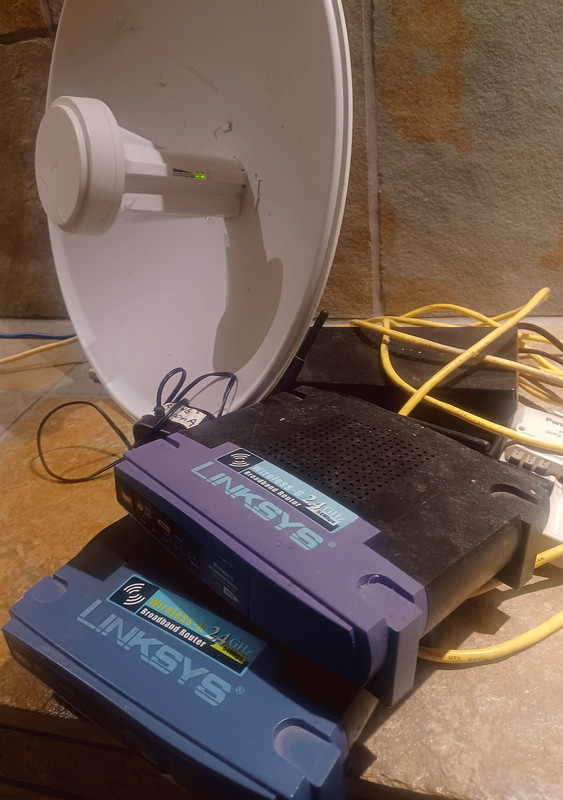
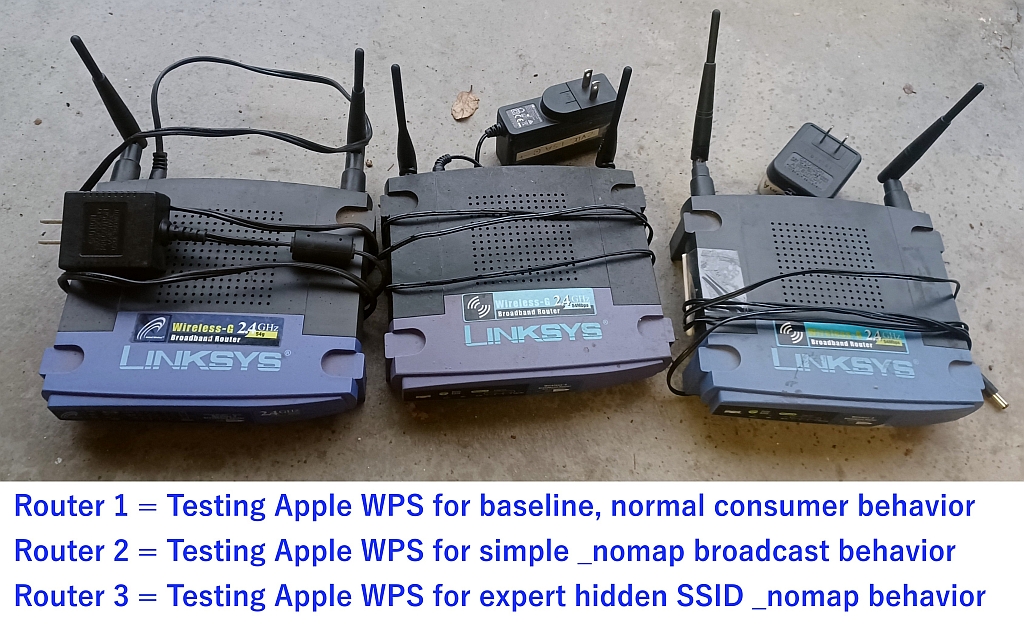
To prove how easy it is to track anyone's movements from place to place,
I'm setting up these three routers to prove that I can easily be tracked:
I'm simply informing you and others on this newsgroup of this problem set.
And I'm informing you that you have dreamed up a problem where none exists.
And I'm asking for solutions (in another thread) for resolving the
problem.
Maybe you should start with clarifying the problem, instead of having us guess what you think it might be.
but my point is that being able to easily track it from anywhere in the
world means anyone can essentially atrack you.
Ehhh.... If someone can do "x" that someone can essentially do "x" ? Yeah duh!
But as I already explained to you and you refused to respond to, from whats in that database you can only track a *random* person. Which, as I mentioned earlier, is useless.
To prove how easy it is to track anyone's movements from place to place,
I'm setting up these three routers to prove that I can easily be tracked:
You still don't get it, do you. You are still working your way backwards from the answer (you know what your BSSID is) to the question (find your BSSID and read your own location next to it). Anyone can do that.
Doing it the other way around however ...
The key point is that Apple's WPS endpoint returns hundreds of nearby GPS:BSSIDs pairs for any submitted BSSID, not just the one requested.
Lest you claim "I don't get it", it's important to reiterate that the insecurity of Apple's Wi-Fi Positioning System (WPS) isn't speculative.
I'm all about helping everyone -
The key point is that Apple's WPS endpoint returns hundreds of nearbyKiddo, you have changed your story. From a privacy issue to a "I can get the whole database".
GPS:BSSIDs pairs for any submitted BSSID, not just the one requested.
You have not given me/us any explanation to why knowing *a random BSSID* and its location would be a privacy issue, and now not why you think that being able to get all the Apple databases contents would be one.
Lest you claim "I don't get it", it's important to reiterate that the
insecurity of Apple's Wi-Fi Positioning System (WPS) isn't speculative.
And as I've told you a number of times before, I'm not going on a wild goose hunt for something you *could* be meaning. You have it as a fact in your head, *you* explain it. I'm not going to play a ten guesses game with you.
I'm all about helping everyone -
No, you're not.
If you would be than you would take the time to make sure that your intended audience gets the facts instead of some guesswork as well as getting something thats easy to read and follow and thus understand.
I've told you that many times, but you have disregarded that for years now. Thats not something an /actual/ helpfull person would do.
Though I must say I was pleasantly surprised that your last "tutorial" was about a single subject and not multiple together, poored out after having gone to a food-blender. Yes, I remember those. :-(
Rudolph, let's keep this focused on the technical issue rather than tone.
For you to tell me "I don't get it" a hundreds times, doesn't mean that I don't get it when I simply reproduced what researchers said could be done.
Worse, I, myself, could easily track any BSSID in the world.
That's not random.
These flaws effectively exposes large portions of Apple's WPS database
to anyone who knows how to query it, which is what the researchers said.
I have no intention of tracking people, but I proved it's trivial to do. Just like the security researchers said it was.
That's not random.
Yes, it is. Tell me, what is *the name of the person* behind the BSSID's you have been tracking ?
Ofcourse, you have no idea.
Unit #2-A
Anyone can do this for any home in the United States.
Which is why this is so dangerous to privacy.
Marian wrote:
Anyone can do this for any home in the United States.
Which is why this is so dangerous to privacy.
Apologies for the unit 2-a on every name and address in the previous list. Only the first line was that unit.
I used gVIM to munge the record, slightly, for privacy, since the exact
unit didn't matter for our purposes, but I made an editing redaction error.
The point is anyone in the world can track these people by their GPS:BSSID. Jeffrey Devin ......................... 4306 Josey Circle
Ronda and Alfred Beel ................ 4310 Josey Circle
James and Dollie Henson Smythe ....... 4314 Josey Circle
Rosemary Ellerbee Jones .............. 4317 Josey Circle
Benjamin and Eric Choyica ............ 4318 Josey Circle
Lonzie D. Groniger .................... 4321 Josey Circle
Terrince Steedman ..................... 4326 Josey Circle
Lutrisher Walton Hill ................ 4329 Josey Circle
Shane Jameson Sr. ..................... 4330 Josey Circle
Flora Ann Jackson Gellion ............ 4338 Josey Circle
Mary E. Gebbs Hendy ................... 4816 Josey Circle
Sherryn Marie Smythe .................. 4820 Josey Circle
Melvin Hawthorn, Jr. ................. 4823 Josey Circle
Charles Nesh .......................... 4824 Josey Circle
Trivia Yashica Watken ................ 4827 Josey Circle
Pamela Tomas .......................... 4828 Josey Circle
etc.
The papers explained how anyone in the world could track every owner of
every home in the United States by their GPS:BSSID using the highly
insecure Apple WPS database like could for the above people (which I have
no plans on doing but which is why I understand how badly designed Apple's WPS implementation is - which Google's WPS & Mozilla's WPS isn't).
That's not random.
Yes, it is. Tell me, what is *the name of the person* behind the BSSID's >> you have been tracking ?
Ofcourse, you have no idea.
Ah, but I do.
Apologies for the unit 2-a on every name and address in the previous list. Only the first line was that unit....
The point is anyone in the world can track these people by their[snip rest of list]
GPS:BSSID.
Jeffrey Devin ......................... 4306 Josey Circle
Ronda and Alfred Beel ................ 4310 Josey Circle
James and Dollie Henson Smythe ....... 4314 Josey Circle
So, you have a list of person names and, I assume, street adresses - but no (GPS.)BSSIDs. iow, nothing to track any of those persons with.
Kiddo, you *really need to* explain how you convert BSSIDs into a persons name, or a persons name into a BSSID.
And lets not forget, I asked you a simple Yes/No question about it which you still have not answered :
[quote=me]
So, if I pick a name than you can, assiming he's got a BSSID with him, tell me where that person is traveling ? Yes or no ? And ofcourse, explain your answer. :-)
[/quote]
Ofcourse, when I pick a name of someone/place I know the BSSID of it would be *very* evident when you would give me a random BSSID for it ...
The same would happen when I give you a known-to-me BSSID and you come back with some random persons name.
Yeah, your best shot at not falling into that "trap" is by simply refusing to answer the question.
The only problem with that is that *not* giving an answer is an answer in itself : YOU HAVE NO CLUE.
Another claim without anything to support it.
I (can) have every access point location
in the world (over 2 billion) if I felt like getting it (and storing it).
But which of those 2 billion belong to me?
...And lets not forget, I asked you a simple Yes/No question about it which
you still have not answered :
f. This derived linkage is not present in Apple's data itself.
2. How the location association works
a. Apples WPS database stores BSSID-to-location pairs.
b. In practice, these coordinates almost always correspond to a specific building.
c. That building is associated with an owner through public
property records (in the USA anyway)
And yet I proved it's trivial to obtain the named owner of every building
in the United States
In short, you need to access *other* publicly available databases to *try to* link a BSSID to a specific person.
And yet I proved it's trivial to obtain the named owner of every building >> in the United States
I've got a name for you :John Smith. Now tell me, where does he live and whats his BSSID ?
Do I have to explain the above to you or are you smart enough to figure it out for yourself ?
Essentially... 1. Every home in the USA is tied to an owner in a public database
2. Every BSSID in every home in the USA is in the Apple public database
BSSID <-> GPS <-> Address <-> Owner
Only an extremely unimaginative person wouldn't be able to connect the
dots
I've got a name for you :John Smith. Now tell me, where does he live and >> whats his BSSID ?
Do I have to explain the above to you or are you smart enough to figure
it out for yourself ?
BSSID <-> GPS <=> Address <-> Owner
Every person who knows anything understands that every owner of every
home in the United States is in a public database
Arlen,
Apologies for the unit 2-a on every name and address in the previous...
list.
Only the first line was that unit.
The point is anyone in the world can track these people by their[snip rest of list]
GPS:BSSID.
Jeffrey Devin ......................... 4306 Josey Circle
Ronda and Alfred Beel ................ 4310 Josey Circle
James and Dollie Henson Smythe ....... 4314 Josey Circle
So, you have a list of person names and, I assume, street adresses - but
no (GPS.)BSSIDs. iow, nothing to track any of those persons with.
I respect your knowledge, so I'm aware you understand what a BSSID is.
You also understand that most people own the home they live in.
And, you understand that if they move, they take their router with them.
I know the owner of every home on Josey Circle in Shreveport, LA, right?
And, in another post, I showed the BSSID nearest to each of those
buildings, right? (I'm not going to put it together here for reasons that
I'm not trying to dox people.)
So what are you asking me to answer?
a. Are you disputing I have the named owner of every home in the USA?
b. Or are you disputing I have the BSSID of every home in the USA?
If your name was, oh, let's say Jeffrey Devin, and if you put that router
in the home that you own at 4306 Josey Circle, then I can track that AP anywhere in the world if you then moved to another home, and took your
router with you. c. Are you disputing I can track the location of that
AP BSSID, Andy?
Note that by tracking the BSSID and knowing the owner of every home in the USA (since that's a public record), I could tie it to you "if" you're the owner. If you only rented the home, then I'd need more data to tie it to
you.
But in the USA, overwhelmingly, people own the home they live in.
So it's tied to the owner. Who, in this case, would be you.
Would it not?
And, you understand that if they move, they take their router with them.
Are you disputing any of that?
I know the owner of every home on Josey Circle in Shreveport, LA, right?
And, in another post, I showed the BSSID nearest to each of those
buildings, right? (I'm not going to put it together here for reasons that I'm not trying to dox people.)
a. Are you disputing I have the named owner of every home in the USA?
b. Or are you disputing I have the BSSID of every home in the USA?
Note that by tracking the BSSID and knowing the owner of every home in the USA (since that's a public record), I could tie it to you "if" you're the owner.
But in the USA, overwhelmingly, people own the home they live in.
So it's tied to the owner.
Who, in this case, would be you.
Would it not?
Arlen,
And, you understand that if they move, they take their router with them.
Are you disputing any of that?
Wishfull thinking much ? If he doesn't I will.
I know the owner of every home on Josey Circle in Shreveport, LA, right?
Which is pretty useless.
And, in another post, I showed the BSSID nearest to each of those
buildings, right? (I'm not going to put it together here for reasons that >> I'm not trying to dox people.)
:-) You're just telling us exactly what you've done, so we can repeat it >ourselves. In my country thats called "aiding and abedding" - which can >easily land you into jail.
a. Are you disputing I have the named owner of every home in the USA?
You already asked that.
b. Or are you disputing I have the BSSID of every home in the USA?
If he doesn't I will. Also, *the* BSSID ? Just a single one ? What are >you ? Poor ?
Note that by tracking the BSSID and knowing the owner of every home in the >> USA (since that's a public record), I could tie it to you "if" you're the >> owner.
Thats a rather big "if", don't you think ? It certainly trashes your
initial claim that you could track *everyone* (all over the world).
But in the USA, overwhelmingly, people own the home they live in.
Tell that to all the poor city-dwellers who predominanty rent they places.
Who are, by the way, in close proximity and often stacked several layers >ontop of each other. Which ofcourse makes a mockery of any claim that a >certain location will al;ways point to a single home.
So it's tied to the owner.
:-) You're "cooking the books" there.
Who, in this case, would be you.
Would it not?
Chances are - for multiple reasons as indicated in the above - he's not.
You're playing the "no true Scotsman" falacy there* : when you do not like a >certain result you just discard it - leaving you with a meaningless, small >subset, but all confirming what you wish to claim. Duh. Also, blergh.
* https://en.wikipedia.org/wiki/No_true_Scotsman
Bottom line : you *might* be able to track someone when you are given a >persons name. - if the stars align just right.
It helps greatly if a MAC address is unique within its local
network segment,
but a duplicate MAC appearing somewhere else shouldn't cause
any problems.
*Many years ago,...
it didn't cause any problems. It simply moved certain
tasks farther up the network stack
Tell that to all the poor city-dwellers who predominanty rent they places.
Who are, by the way, in close proximity and often stacked several
layers ontop of each other.
A BSSID is typically based on the interface's MAC address. Each MAC
address is assumed, by many people, to be globally unique, but they
don't have to be.* It helps greatly if a MAC address is unique within
its local network segment, but a duplicate MAC appearing somewhere else shouldn't cause any problems. By extension, a duplicate BSSID appearing somewhere else shouldn't cause any problems that I can think of.
So my question is, would it help Arlen's quest for privacy if he were to choose a MAC, and thus a BSSID, that already exists somewhere else and
is already present in the database? When someone does a query on that
BSSID, would they get the first result, or all results? I wonder if
Arlen has checked for duplicate BSSID entries in his favorite database.
*Many years ago, where I worked we trialed a piece of software that intentionally used the same IP address and MAC address on every server
in the pool. That violates everything we're taught about network
addressing, but it didn't cause any problems. It simply moved certain
tasks farther up the network stack. We ended up buying and deploying
that software into our production network.
*Many years ago, where I worked we trialed a piece of software that intentionally used the same IP address and MAC address on every server
in the pool. That violates everything we're taught about network
addressing, but it didn't cause any problems. It simply moved certain
tasks farther up the network stack. We ended up buying and deploying
that software into our production network.
Certainly that
ability to change the BSSID of the access point exists in pro routers.
But what matters is not the router but the Wi-Fi chipset and the driver.
So what are you asking me to answer?
For a named person, if you already know where they live, you know their location, if you don't know where the live, Apple's database doesn't
help you find out. Even if you find their router's BSSID, why do you
ant to wait years until they move home, just so you can track where they move to?
a. Are you disputing I have the named owner of every home in the USA?
Situation is a bit different here, there's the electoral roll which will list everyone's address, but many people opt to tick the "privacy" box
so that isn't public information, there's also the land registry but
homes which have not recently changed hands are not required to be registered, and you have to pay to see each record.
b. Or are you disputing I have the BSSID of every home in the USA?
I don't think you have it in such a cut-and-dried format, you've tied
things together by implication.
If your name was, oh, let's say Jeffrey Devin, and if you put that router
in the home that you own at 4306 Josey Circle, then I can track that AP
anywhere in the world if you then moved to another home, and took your
router with you. c. Are you disputing I can track the location of that
AP BSSID, Andy?
But the BSSIDs are unique, people's names are not, how easy would it be
for you to link to SSNs?
Note that by tracking the BSSID and knowing the owner of every home in the >> USA (since that's a public record), I could tie it to you "if" you're the
owner. If you only rented the home, then I'd need more data to tie it to
you.
But in the USA, overwhelmingly, people own the home they live in.
So it's tied to the owner. Who, in this case, would be you.
For anyone who runs their own business, the companies house data is
another source of addresses,
Would it not?
It would be easier for you to find my address by *not* using Apple's database ...
Char,
It helps greatly if a MAC address is unique within its local
network segment,
I would say that!
Examples of 'puters who could not communicate over the LAN because either >their ethernet-cards MAC was already present, or they had a hard-set IP that >clashed are aplenty.
but a duplicate MAC appearing somewhere else shouldn't cause
any problems.
As long as it would not be a duplicate there, you would be correct. :-)
There are a few problems with your suggestion though : it only works for >devices that do not move around, which would make Arlens statement that he >can track anyone a bit of a joke.
If they hoever *do* move around (hello smartphones!) there is a rather good >chance that they will, sometimes, enter a network segment where their BSSID >is alread present - which could lead to a denial of service for one, or even >all of the devices being copies of each other.
*Many years ago,...
it didn't cause any problems. It simply moved certain
tasks farther up the network stack
I think it did a bit more. Like negotiating which server would handle the >request, and how to mark it that a certain ethernet packet was part of an >ongoing conversation with a specific server.
iow, all those servers would need to /activily work together/ so they would >not yell over each other and try to hijack each others conversations.
You know, it does sound odd : that sofware (that was bought) would need to >add markers to make sure ongoing conversations would go to the server which >first serviced it, in effect duplicating what the ethernet MAC and the >puters IP are for ...
thanks for the discussion. Happy New Year!
but I remember the servers having dual NICs, with one dedicated
as sort of a mesh, where they disambiguated and de-duped everything,
Arlen says the whole idea that I tossed out above is a non-starter,
Happy New Year!
but a duplicate MAC appearing somewhere else shouldn't
cause any problems.
As long as it would not be a duplicate there, you would be
correct. :-)
I was thinking that the chance of that kind of collision would
be exceedingly low, but statistics were never my strength.
Arlen,
[quote=me]
Tell that to all the poor city-dwellers who predominanty rent they places. >>
Who are, by the way, in close proximity and often stacked several
layers ontop of each other.
As my thoughts went over to the "well off" city-dwellers who own the >appartments they live in, I realized that they too often live stacked that >way, sometimes in high-rises of 20 stories or more, with penthouses ontop.
Your Apple-database location data in such cases ? Useless.
Regards,
Rudy Wieser
Adding location information to DNS, DHCP, SNMP etc have been proposed....
An early scheme is RFC 1712
proposed in 1994. Its now more than 36 years later
Char Jackson <none@none.invalid> wrote:
On Mon, 22 Dec 2025 18:00:14 +0000, Andy Burns <usenet@andyburns.uk>
wrote:
Marian wrote:
I (can) have every access point location
in the world (over 2 billion) if I felt like getting it (and storing it).
But which of those 2 billion belong to me?
Well, *you* know which it is, and ve haf vays of making you talk, so...
Do *you* know your MAC address if presented with a list? I certainly don't.
It would be easier just to ask me for my physical address.
https://en.wiktionary.org/wiki/ve_haf_vays_of_making_you_talk
Am surprised there isn't a reference to the 80's comedy show 'Allo 'Allo!
Jeff,
Adding location information to DNS, DHCP, SNMP etc have been proposed....
An early scheme is RFC 1712
proposed in 1994. Its now more than 36 years later (which is, for >technology, a loooong time), and nothing like it has been implemented.
Maybe that is because there is no automated way to determine the "floor >number". Especially for devices which task it is to do DNS, DHCP and so
on - those do not even contain hardware to determine their own X/Y location.
I must say that that RFC does have a joke smell to it. You know, like the >"I'm a teapot" HTTP status, the "evil bit" for ethernet packets and lets not >forget "IP over avian carriers" (which, by the way /does/ work).
And although most/all smartphones do have a GPS, those are notoriously bad >at determing elevation (which is not really a surprise, if you look at where >the GPS satelites are located in relation to the GPS receiver).
Regards,--
Rudy Wieser
And happy year to you - and everyone else here. :-)
Maybe that is because there is no automated way to determine the
"floor number". Especially for devices which task it is to do
DNS, DHCP and so on - those do not even contain hardware to
determine their own X/Y location.
Quoting myself: "Note that the data does not need to be derived
from GPS data. Since it doesn't change (often), it could be
entered into the database when the DNS record was created."
I suggest you not pass judgment on technology that you
might consider old and instead concentrate on whether
they might actually work.
That's true which is why sports GPS receivers often include a
barometric altimeter:
| Sysop: | Amessyroom |
|---|---|
| Location: | Fayetteville, NC |
| Users: | 54 |
| Nodes: | 6 (0 / 6) |
| Uptime: | 17:44:27 |
| Calls: | 742 |
| Files: | 1,218 |
| D/L today: |
4 files (8,203K bytes) |
| Messages: | 184,414 |
| Posted today: | 1 |